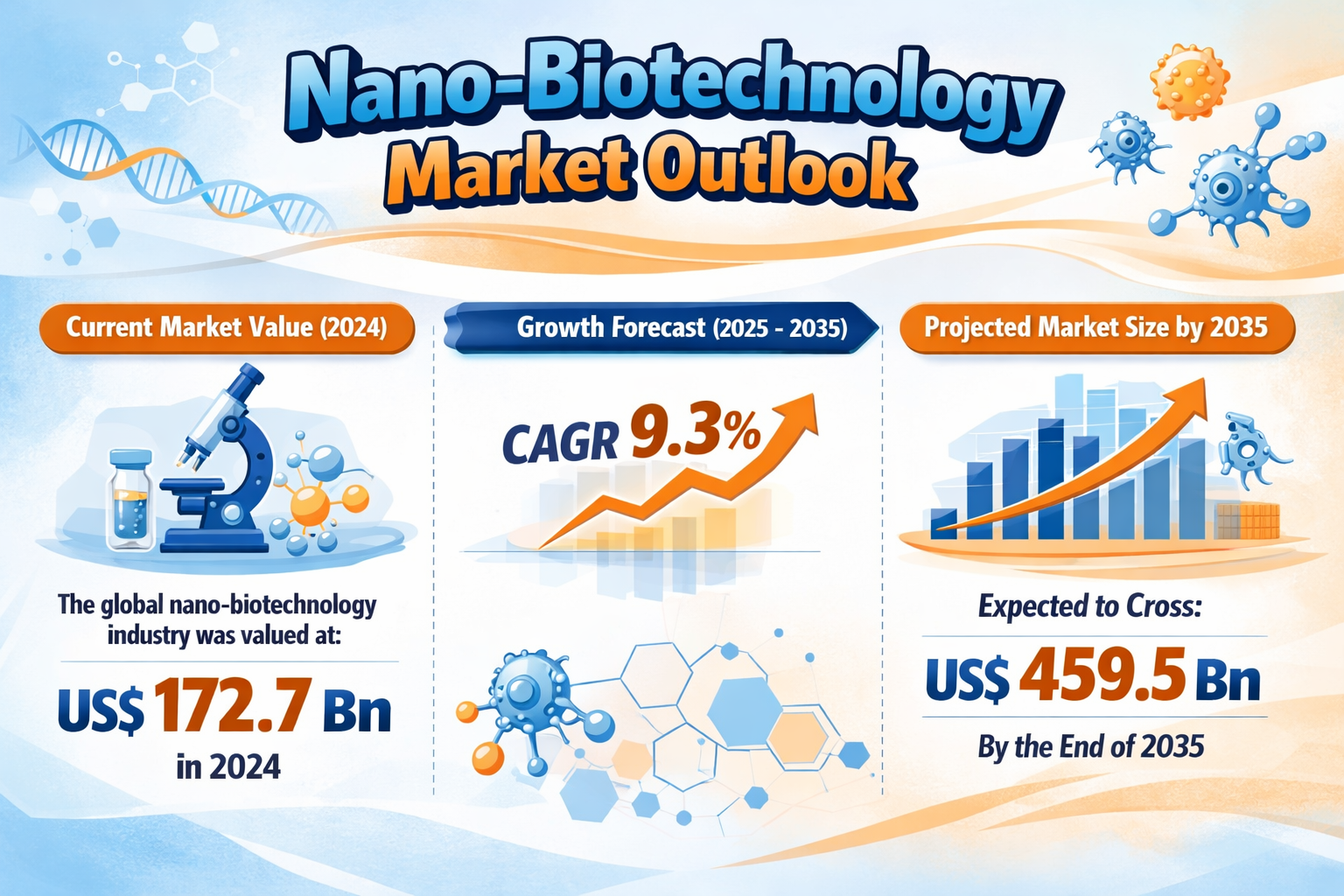
The global nano-biotechnology market is experiencing significant expansion as nanotechnology continues to transform healthcare, biotechnology, and pharmaceutical industries. According to recent industry analysis, the market was valued at US$ 172.7 Bn in 2024 and is projected to reach US$ 459.5 Bn by 2035, expanding at a compound annual growth rate (CAGR) of 9.3% during the forecast period from 2025 to 2035.
This remarkable growth trajectory is largely attributed to increasing investments in nanotechnology research, rising demand for targeted therapies, and advancements in diagnostic technologies. The integration of nanotechnology with biotechnology is enabling the development of innovative medical solutions, particularly in drug delivery systems, diagnostic imaging, and tissue engineering.
Growing prevalence of chronic diseases such as cancer, cardiovascular disorders, and neurological conditions is further fueling the demand for nano-biotechnology-based medical solutions. In addition, governments and private organizations worldwide are increasing funding for nanotechnology research, accelerating commercialization and market adoption.
Explore the highlights and essential data from our Report in this sample –
https://www.transparencymarketresearch.com/sample/sample.php?flag=S&rep_id=788
Market Overview
Nano-biotechnology is an interdisciplinary field that merges nanotechnology and biotechnology to study and manipulate biological systems at the nanoscale, typically between 1 and 100 nanometers. By leveraging the unique properties of nanomaterials, researchers can develop advanced biomedical devices, diagnostic tools, and therapeutic agents with improved performance and efficiency.
One of the most impactful applications of nano-biotechnology is in drug delivery systems. Nanoparticles can be engineered to deliver therapeutic agents directly to diseased cells, significantly improving treatment efficacy while minimizing side effects. This capability is particularly important in oncology, where targeted drug delivery helps reduce damage to healthy tissues.
In addition to therapeutics, nano-biotechnology is revolutionizing diagnostics and medical imaging. Nanoparticles such as quantum dots and superparamagnetic nanoparticles are used as contrast agents in imaging techniques like MRI, PET, and CT scans. These nanoparticles enhance image resolution and sensitivity, enabling early detection of diseases.
The industry is also witnessing growing interest in sustainable and biodegradable nanomaterials. Researchers are exploring naturally derived materials such as lipids, proteins, and polysaccharides to create biocompatible nanostructures that improve therapeutic outcomes while reducing environmental impact.
Furthermore, nano-biotechnology is playing a crucial role in tissue engineering, where nanomaterial-based scaffolds mimic the extracellular matrix to support cell growth and tissue regeneration. These advancements are expected to transform regenerative medicine in the coming years.
Key Market Growth Drivers
Rising Demand for Targeted Therapies
The growing demand for targeted therapies is one of the most significant drivers of the nano-biotechnology market. Traditional treatment methods such as chemotherapy often affect both healthy and diseased cells, resulting in severe side effects. Targeted therapies aim to address this limitation by delivering drugs specifically to diseased tissues.
Nanoparticles are capable of transporting therapeutic agents directly to target cells, enhancing treatment precision and effectiveness. These nanocarriers can be designed to recognize specific molecular markers associated with diseases, making them highly suitable for cancer therapy and precision medicine.
Additionally, nanomaterials enable the co-delivery of multiple therapeutic agents within a single system. This multifunctional capability allows researchers to overcome drug resistance and improve treatment outcomes.
Advancements in Diagnostic Technologies
Another major growth driver is the advancement of nano-enabled diagnostic technologies. Nanosensors can detect extremely small quantities of disease biomarkers, enabling early and accurate disease diagnosis.
For example, gold nanoparticles are widely used in diagnostic assays to detect pathogens and tumor markers. Their large surface area allows multiple binding interactions, increasing detection sensitivity and providing faster results in clinical settings.
Moreover, integration of nanotechnology with imaging technologies has significantly improved diagnostic accuracy. Nanoscale contrast agents enhance the clarity and resolution of imaging results, enabling real-time visualization of pathological changes.
Increasing Prevalence of Chronic Diseases
The rising global burden of chronic diseases is also accelerating demand for nano-biotechnology solutions. Conditions such as cancer, diabetes, and cardiovascular diseases require advanced treatment and monitoring approaches, which nanotechnology can provide.
Nano-biotechnology facilitates personalized medicine by enabling patient-specific treatment strategies. As healthcare systems worldwide shift toward precision medicine, adoption of nano-based therapeutics and diagnostics is expected to increase.
Growing Research and Development Investments
Significant investments in research and development are further boosting market growth. Pharmaceutical companies, biotechnology firms, and academic institutions are actively collaborating to develop innovative nano-based products.
Governments across various countries are also supporting nanotechnology research through funding programs and favorable regulatory frameworks, encouraging innovation and commercialization.
Analysis of Key Players – Key Player Strategies
The nano-biotechnology market is characterized by intense competition and continuous technological innovation. Leading companies are focusing on research collaborations, strategic partnerships, product innovation, and acquisitions to strengthen their market presence.
Major players operating in the global nano-biotechnology market include:
- Johnson & Johnson Services, Inc.
- Abbott
- Novartis AG
- Merck and Co. Inc.
- Bristol-Myers Squibb Company
- Danaher Corporation
- Thermo Fisher Scientific, Inc.
- Pfizer, Inc.
- Sanofi
- Nanobiotix
- Arcturus Therapeutics, Inc.
- Cello Therapeutics
- Merck KGaA
- Ascendia Pharmaceutical Solutions
- OZ Biosciences
Key Strategies Adopted by Leading Companies
Product Innovation:
Companies are investing heavily in developing novel nanomaterials and nano-enabled medical devices to enhance treatment efficiency and diagnostic accuracy.
Strategic Partnerships:
Collaborations between pharmaceutical firms and research institutions are accelerating the development of next-generation nano-based therapeutics.
Expansion of Research Capabilities:
Many companies are expanding their R&D infrastructure to support the development of advanced nano-biotechnology solutions.
Focus on Precision Medicine:
Key players are focusing on personalized treatment approaches using nanotechnology to address complex diseases more effectively.
Market Challenges & Opportunities
Market Challenges
Despite its promising potential, the nano-biotechnology market faces several challenges.
One of the primary challenges is the complex regulatory environment associated with nanotechnology-based products. Regulatory agencies require extensive safety assessments for nanomaterials, which can delay product approvals.
Another challenge is the high cost of research and development. Developing nano-based therapeutics and diagnostic technologies requires sophisticated equipment and extensive testing, which can increase overall costs.
Additionally, concerns regarding the long-term safety and toxicity of nanomaterials remain a critical issue. Continuous research is required to ensure the safety and biocompatibility of nano-based medical products.
Market Opportunities
Despite these challenges, the nano-biotechnology market presents numerous growth opportunities.
The emergence of biodegradable nanomaterials is opening new avenues for environmentally sustainable medical solutions. These materials reduce toxicity risks and improve patient safety.
Another major opportunity lies in the development of advanced tissue engineering technologies. Nanomaterial-based scaffolds are expected to revolutionize regenerative medicine by enabling more efficient tissue regeneration.
Furthermore, increasing adoption of point-of-care diagnostic devices powered by nanotechnology is creating new growth prospects for the market.
Key Player Strategies
Leading market players are adopting several strategies to strengthen their competitive positions:
- Investment in Nanotechnology Research to develop advanced therapeutics and diagnostics.
- Strategic Collaborations and Partnerships with academic institutions and biotechnology companies.
- Expansion into Emerging Markets where healthcare infrastructure is rapidly developing.
- Development of Sustainable Nanomaterials to address environmental concerns.
- Focus on Personalized Medicine through targeted nano-based therapies.
These strategies are expected to drive innovation and market expansion over the coming decade.
Recent Developments
In March 2025, Arbor Biotechnologies announced that the company had raised a sum of US$ 73.9 Mn in series C venture capital financing, led by QIA, Partners Investment, Revelation Partners, and Kerna Ventures and their existing investors. The company aims to utilize the proceeds from the round to support clinical development of the company’s lead therapeutic candidate, ABO-101, in primary hyperoxaluria type 1 (PH1) and progression to IND/CTA filing of its first-in-class programs. ABO-101 consists of a lipid nanoparticle (LNP), licensed from Acuitas Therapeutics, encapsulating messenger RNA expressing a novel Type V CRISPR Cas12i2 nuclease and an optimized guide RNA which specifically targets the human HAO1 gene, and is currently under evaluation in RedePHine, a Phase 1/2, multi-center, open-label, dose-escalation clinical trial.
In May 2024, Acuitas Therapeutics, Inc. entered into a strategic partnership with Aldevron for development of delivery systems for nucleic acid therapeutics based on lipid nanoparticles. Under the terms of the agreement, Aldevron gained capabilities to expand its mRNA LNP encapsulation through incorporation of Acuitas’ proprietary LNP encapsulation platform.
Investment Landscape and ROI Outlook
The nano-biotechnology market is attracting substantial investments from venture capital firms, pharmaceutical companies, and government institutions. Rising demand for innovative medical technologies is encouraging investors to support companies developing nano-enabled therapeutics and diagnostics.
Investment opportunities are particularly strong in areas such as drug delivery systems, nanosensors, regenerative medicine, and precision medicine.
As clinical adoption increases and commercialization accelerates, the market is expected to deliver strong returns on investment. Companies that successfully develop scalable nano-based medical technologies are likely to achieve significant market share and long-term profitability.
Market Segmentations
By Product Type
- Nanomaterials
- Devices
- Reagents
By Application
- Drug Delivery
- Diagnostics
- Imaging
- Gene Delivery
- Tissue Engineering
- Others (Vaccine Development, etc.)
By End User
- Pharmaceutical and Biopharmaceutical Companies
- Academic and Research Laboratories
- Others
By Region
- North America
- Europe
- Asia Pacific
- Latin America
- Middle East & Africa
North America currently leads the global market due to advanced healthcare infrastructure, strong research funding, and the presence of major nano-biotechnology companies. Meanwhile, Asia Pacific is expected to witness rapid growth due to expanding healthcare systems and increasing investments in biotechnology.
Why Buy This Report?
- Comprehensive analysis of global nano-biotechnology market trends and growth drivers
- Detailed insights into key market segments and regional dynamics
- Competitive landscape with profiles of leading companies
- Strategic insights into emerging technologies and investment opportunities
- Reliable market forecasts and data-driven industry analysis
FAQs
- What is the projected size of the nano-biotechnology market by 2035?
The market is expected to reach US$ 459.5 Bn by 2035. - What is the CAGR of the nano-biotechnology market during the forecast period?
The market is projected to grow at a CAGR of 9.3% from 2025 to 2035. - Which region dominates the nano-biotechnology market?
North America currently holds the largest market share. - What are the major applications of nano-biotechnology?
Key applications include drug delivery, diagnostics, imaging, gene delivery, and tissue engineering. - Who are the leading companies in the nano-biotechnology market?
Major players include Johnson & Johnson, Abbott, Novartis, Merck, Pfizer, Sanofi, Thermo Fisher Scientific, and Danaher Corporation.





Leave a Reply