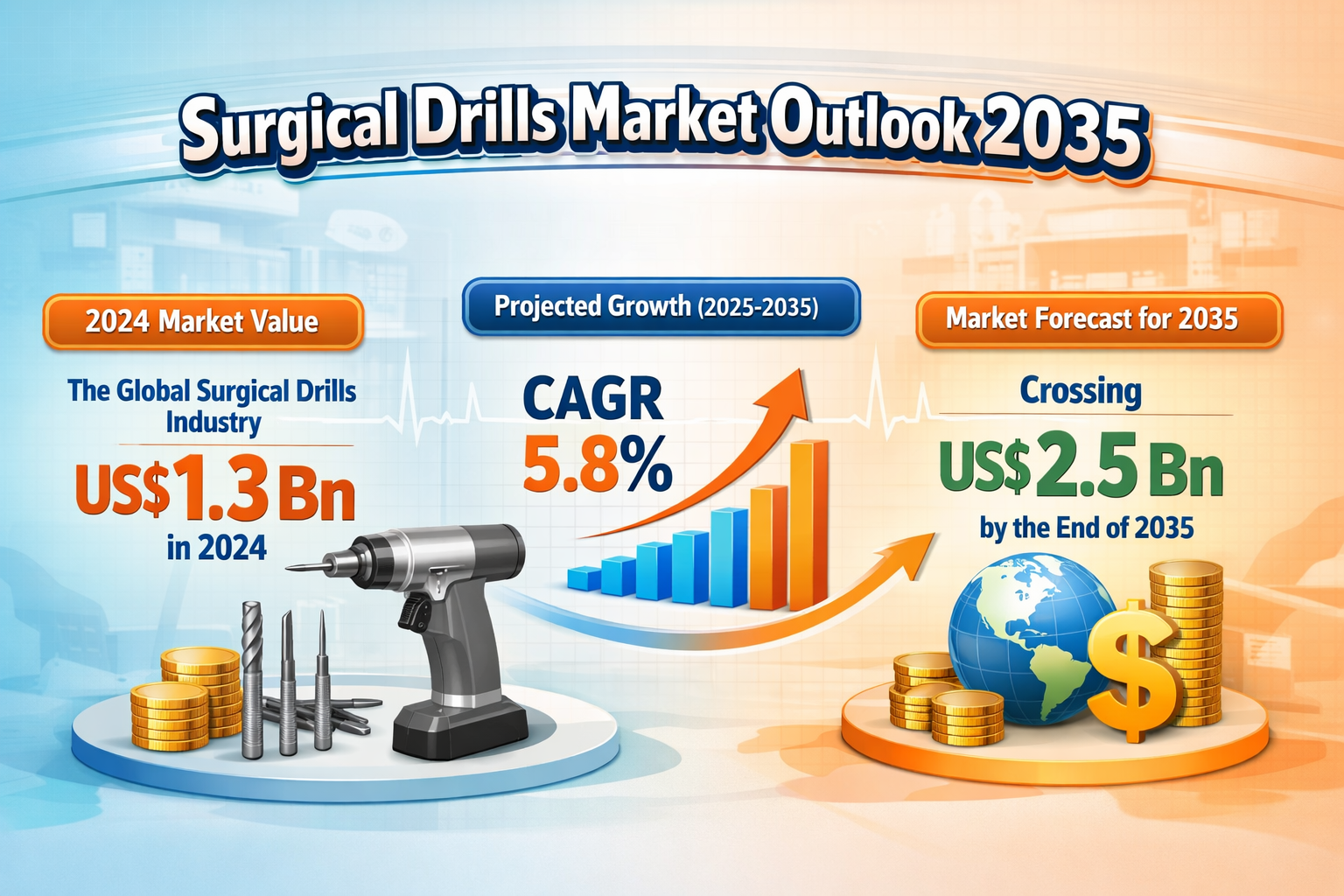
The global surgical drills market, valued at US$ 1.3 billion in 2024, is projected to grow at a CAGR of 5.8% from 2025 to 2035, surpassing US$ 2.5 billion by 2035. The steady growth of this market is largely fueled by technological innovations in surgical methods, the increasing prevalence of chronic diseases, and the rising demand for minimally invasive procedures across orthopedics, neurosurgery, dentistry, and trauma surgery
Market Overview
Surgical drills are precision instruments designed to create accurate holes in bones and hard tissues during surgical procedures. They are essential across multiple medical specialties, including orthopedic, dental, neurological, and ENT surgeries. Modern surgical drills are engineered to reduce tissue damage, minimize heat generation, and provide smooth cutting for improved patient safety and operational efficiency.
Available in various forms, surgical drills include pneumatic, electric, and battery-powered devices, with additional accessories such as drill bits and attachments that enhance accuracy, torque control, and ergonomic performance. With the ongoing shift toward minimally invasive surgeries, surgeons increasingly rely on these drills for precision, efficiency, and reduced patient recovery times.
The market is also witnessing innovations such as image-guided navigation systems, robotic-assisted surgery, and augmented reality (AR) integration, reshaping surgical practices to improve precision and reduce procedural risks.
Access an overview of significant conclusions from our Report in this sample –
https://www.transparencymarketresearch.com/sample/sample.php?flag=S&rep_id=20744
Key Market Growth Drivers
1. Rising Demand for Minimally Invasive Procedures
Minimally invasive surgeries require smaller incisions, less tissue disruption, and faster patient recovery. Surgical drills play a central role in these procedures by offering high precision and dexterity for bone and tissue interventions. Electric and battery-powered drills are particularly preferred for their portability, stable performance, and ease of handling in confined surgical environments.
Technological enhancements, including improved ergonomics, torque management, and noise reduction, further support the adoption of next-generation surgical drills. Robotics and navigation systems are increasingly integrated to provide higher accuracy and repeatability, fueling global market demand.
2. Rising Prevalence of Chronic Diseases
The growing incidence of chronic diseases such as cardiovascular disorders, diabetes, obesity, and osteoporosis is driving the demand for surgical interventions. In orthopedic care, chronic conditions often lead to joint damage, fractures, and bone deformities, requiring reconstructive surgeries. Surgical drills facilitate these procedures with precision, reducing risks for patients and medical teams alike.
Dental applications also benefit, as surgical drills are essential for accurate dental implant placement, improving durability and patient outcomes. Manufacturers have responded by prioritizing safety, ergonomic design, and precision, meeting the needs of surgeons treating chronic disease-related complications.
Analysis of Key Players
The global surgical drills market is highly competitive, with players focusing on technological innovation and strategic collaborations. Key market participants include Stryker, Medtronic, Johnson & Johnson, B. Braun SE, CONMED Corporation, Arthrex, Inc., De Soutter Medical, adeor Medical AG, Brasseler USA, NSK / Nakanishi Inc., Zimmer Biomet, GMI Dental Implantology, Shanghai Bojin Medical Instrument Co., Ltd., Joimax GmbH, and 3M.
These companies emphasize ergonomic design, torque control, digital integration, and safety features, while also focusing on environmentally conscious products, including disposable or reusable components. Strategic collaborations, global distribution networks, and strong after-sales services are common strategies to maintain competitive advantage.
Market Challenges & Opportunities
Challenges
-
High Cost of Advanced Surgical Drills: Cutting-edge electric and battery-powered systems often require significant investment, which can limit adoption in smaller healthcare facilities.
-
Regulatory Compliance: Strict sterilization standards and regulatory approvals can delay product launches.
-
Competition from Low-Cost Alternatives: Emerging manufacturers from developing economies introduce lower-cost options, impacting market share of premium products.
Opportunities
-
Integration with Digital Surgery: Robotics, AR, and navigation systems offer opportunities for premium product development and precision-based solutions.
-
Disposable Drills: Rising adoption of disposable components to reduce infection risks and ensure compliance with sterilization protocols.
-
Emerging Markets: Developing regions with improving healthcare infrastructure and increased surgical volume represent untapped growth potential.
Key Player Strategies
Market leaders employ a combination of research & development, strategic collaborations, and geographic expansion to strengthen their market positions:
-
Stryker emphasizes digital precision and ergonomic tools for orthopedic procedures.
-
Arthrex focuses on battery-powered systems such as the Synergy Power system for versatile orthopedic applications.
-
Medtronic and Johnson & Johnson invest in integrating navigation systems and robotics into surgical tools for precision-driven procedures.
Additionally, companies are focusing on after-sales service, training programs, and customer support to maintain loyalty and adoption among surgical centers.
Recent Developments
-
June 2025: Arthrex launched the Synergy Power, a dependable battery-powered system for orthopedic procedures, featuring two ergonomic handpieces: a dual-trigger rotary drill and sagittal saw, enhancing comfort and precision.
-
March 2023: Stryker introduced its CD NXT System, providing live digital depth measurement during drilling, enabling fast, precise, and repeatable procedures while reducing errors inherent in manual depth gauges.
Investment Landscape and ROI Outlook
The surgical drills market presents significant investment opportunities for manufacturers, healthcare providers, and technology investors. Key factors include:
-
Growing demand for minimally invasive procedures globally.
-
Rapid adoption of next-generation surgical technologies.
-
High value of advanced instruments with strong ROI potential due to recurrent usage, maintenance, and replacement cycles.
Emerging regions such as Asia Pacific, Latin America, and the Middle East provide high ROI prospects due to rising healthcare expenditure, increasing surgical volume, and expanding access to modern medical technologies.
Market Segmentations
By Product Type
-
Instruments (leading segment due to essential role in surgeries)
-
Pneumatic Drills
-
Electric Drills
-
Battery-Powered Drills
-
Accessories
By Drill Bit Type
-
Lance-shaped Drills
-
Pilot Drills
-
Twist Drills
-
Others (Guide Drills, etc.)
By Usability
-
Reusable Drills
-
Disposable Drills
By Application
-
Orthopedic Surgeries
-
Neurological Surgeries
-
Dental Surgeries
-
ENT Surgeries
-
Others (Cardiothoracic Surgeries, etc.)
By End-User
-
Hospitals & Clinics
-
Ambulatory Surgical Centers
-
Others (Specialty Clinics, etc.)
By Region
-
North America: Dominates market due to advanced healthcare infrastructure, high surgical volume, and adoption of cutting-edge technologies.
-
Europe: Strong adoption in orthopedic and dental procedures, with emphasis on safety and precision.
-
Asia Pacific: Rapid growth due to improving healthcare access, rising chronic disease prevalence, and expanding surgical capacity.
-
Latin America & Middle East & Africa: Emerging opportunities driven by healthcare modernization and increasing investment in surgical infrastructure.
Key Countries Covered: U.S., Canada, Germany, U.K., France, Italy, Spain, Netherlands, China, Australia, India, Japan, South Korea, ASEAN, Brazil, Mexico, Argentina, GCC countries, South Africa.
Why Buy This Report?
This report offers a comprehensive view of the surgical drills market, providing actionable insights for investors, manufacturers, and healthcare providers. Key benefits include:
-
Detailed market size, forecasts, and CAGR analysis.
-
Segmentation by product type, drill bit type, usability, application, end-user, and region.
-
Profiles and strategies of leading market players.
-
Insights into recent technological advancements and innovations.
-
Analysis of key growth drivers, challenges, and opportunities.
-
Investment landscape and ROI outlook.
By leveraging this report, stakeholders can identify market gaps, assess competition, and make informed strategic decisions to capitalize on the expanding global surgical drills market.
FAQs
1. What is the projected growth of the global surgical drills market?
The market is expected to grow at a CAGR of 5.8% from 2025 to 2035, reaching US$ 2.5 billion by 2035.
2. Which regions dominate the surgical drills market?
North America leads due to advanced healthcare infrastructure, high surgical volumes, and adoption of digital technologies, followed by Europe and Asia Pacific.
3. What are the main growth drivers for the market?
Key drivers include the rising demand for minimally invasive surgeries, increasing prevalence of chronic diseases, and adoption of battery-powered and electric surgical drills.
4. Who are the leading players in the surgical drills market?
Major players include Stryker, Medtronic, Johnson & Johnson, B. Braun SE, CONMED Corporation, Arthrex, Inc., and Zimmer Biomet.
5. What are the emerging trends in surgical drills?
Trends include digital integration, robotics, AR-assisted surgery, ergonomic design, and increased adoption of disposable drills to reduce infection risks.





Leave a Reply