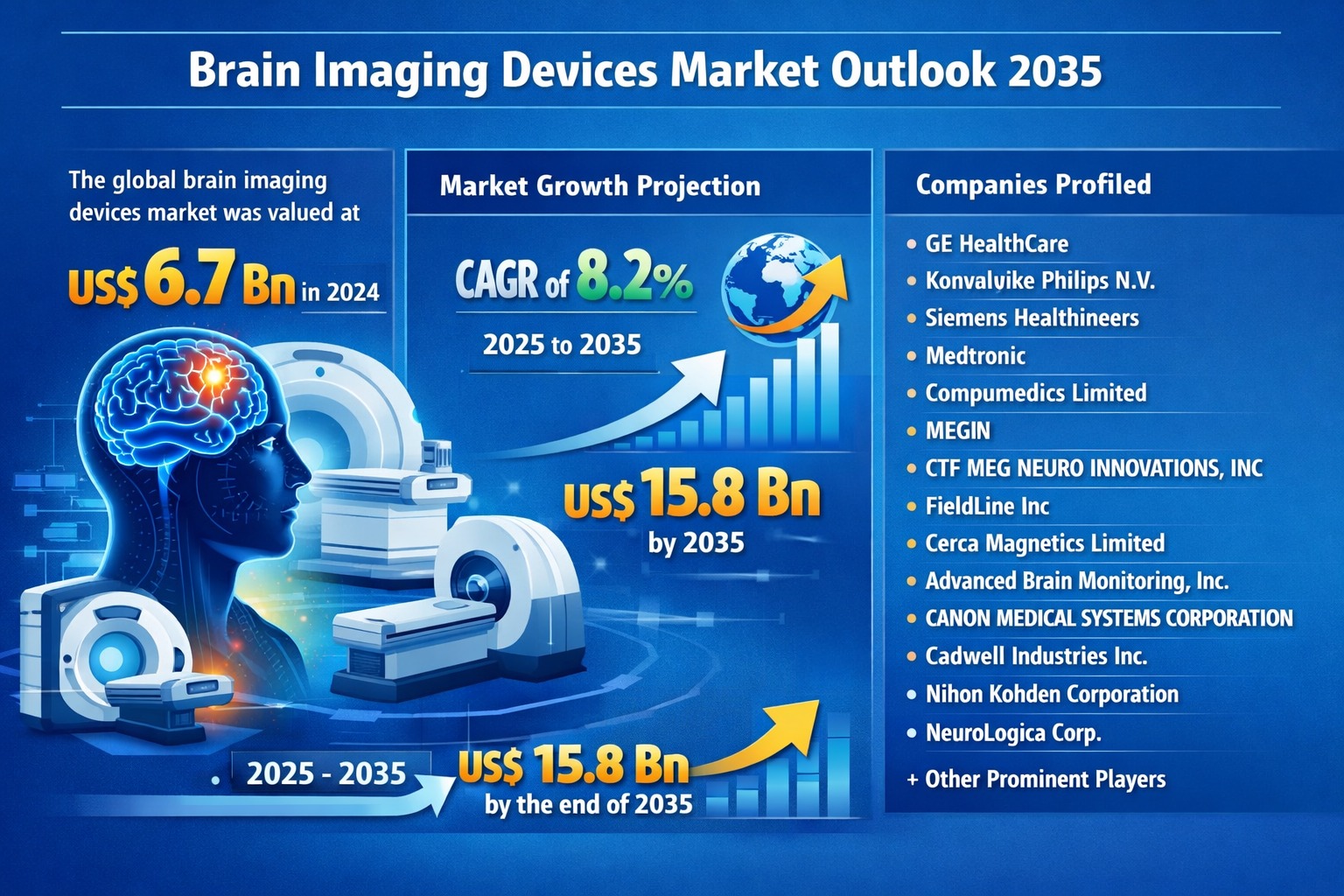
The global brain imaging devices market was valued at US$ 6.7 billion in 2024 and is projected to reach US$ 15.8 billion by 2035, expanding at a compound annual growth rate (CAGR) of 8.2% from 2025 to 2035. This steady growth trajectory reflects the increasing reliance on advanced neuroimaging technologies for early diagnosis, treatment planning, and monitoring of neurological conditions.
The market’s expansion is underpinned by rising healthcare investments, increasing neurological disease prevalence, and the integration of artificial intelligence (AI) into imaging systems. With more than 78 million people expected to suffer from dementia by 2030, demand for accurate and scalable imaging solutions is expected to surge significantly.
→Discover Market Opportunities – Request Your Sample Copy Now: https://www.transparencymarketresearch.com/sample/sample.php?flag=S&rep_id=86781
Market Overview
Brain imaging devices are critical tools for visualizing brain structure and function, enabling clinicians to diagnose and manage disorders such as Alzheimer’s disease, Parkinson’s disease, epilepsy, tumors, and psychiatric conditions. Key modalities include:
- Magnetic Resonance Imaging (MRI)
- Positron Emission Tomography (PET)
- Electroencephalography (EEG)
- Computed Tomography (CT)
- Magnetoencephalography (MEG)
Recent technological advancements, including functional MRI (fMRI) and AI-powered imaging analytics, have dramatically enhanced image resolution and diagnostic accuracy. These innovations allow clinicians to observe real-time brain activity, improving understanding of cognitive and emotional processes.
The market is also benefiting from the global shift toward personalized medicine, where imaging data plays a crucial role in tailoring treatment strategies.
Key Market Growth Drivers
- Rising Incidence of Neurological Disorders
The increasing prevalence of neurological diseases is a primary driver of market growth. Aging populations worldwide are more susceptible to conditions such as Alzheimer’s, Parkinson’s, and multiple sclerosis. This has created a strong demand for advanced diagnostic tools capable of early detection and continuous monitoring.
- Integration of Artificial Intelligence in Imaging Solutions
AI and machine learning are transforming brain imaging by enabling faster and more accurate analysis of complex datasets. AI algorithms can detect subtle abnormalities, reduce noise in imaging data, and assist radiologists in diagnosis. This not only improves efficiency but also enhances patient outcomes.
- Growing Demand for Early Diagnosis
Healthcare systems are increasingly prioritizing early detection to reduce long-term treatment costs and improve survival rates. Brain imaging devices play a pivotal role in identifying diseases at early stages.
- Expansion of Healthcare Infrastructure
Emerging economies, particularly in Asia-Pacific and Latin America, are investing heavily in healthcare infrastructure, increasing access to advanced imaging technologies.
Analysis of Key Players – Key Player Strategies
The brain imaging devices market is highly competitive, with major players focusing on innovation, partnerships, and geographic expansion. Leading companies include:
- GE HealthCare
- Koninklijke Philips N.V.
- Siemens Healthineers
- Medtronic
- CANON MEDICAL SYSTEMS CORPORATION
- Nihon Kohden Corporation
- Compumedics Limited
Key Strategies Adopted:
- Technological Innovation: Continuous investment in AI-enabled imaging systems and high-resolution devices
- Product Portfolio Expansion: Launch of portable and mobile imaging solutions
- Strategic Collaborations: Partnerships with research institutions and healthcare providers
- Regional Expansion: Strengthening presence in high-growth markets like Asia-Pacific
These strategies are helping companies maintain competitive advantages and capture larger market shares.
Market Challenges & Opportunities
Challenges
- High Cost of Equipment: Advanced imaging systems such as MRI and PET scanners are expensive, limiting adoption in low-income regions
- Shortage of Skilled Professionals: Operating sophisticated imaging devices requires specialized training
- Regulatory Hurdles: Stringent approval processes can delay product launches
- Data Privacy Concerns: Increased use of AI raises concerns about patient data security
Opportunities
- AI-Powered Diagnostics: Enhancing accuracy and efficiency in disease detection
- Portable Imaging Devices: Expanding access in remote and underserved areas
- Telemedicine Integration: Enabling remote diagnosis and consultation
- Emerging Markets Growth: Rising healthcare spending in Asia-Pacific and Latin America
→Explore Strategies & Trends – Request Full Report Access – https://www.transparencymarketresearch.com/sample/sample.php?flag=S&rep_id=86781
Key Player Strategies
Key players are increasingly focusing on:
- AI Integration: Embedding machine learning algorithms into imaging platforms
- R&D Investments: Developing next-generation imaging technologies such as high-field MRI and MEG systems
- Mergers & Acquisitions: Strengthening market position and expanding capabilities
- Customization: Offering tailored solutions for specific clinical applications
These strategies are shaping the competitive landscape and driving innovation across the industry.
Recent Developments
- In September 2025, Hyperfine, Inc., a pioneering health technology company that revolutionized brain imaging with the launch of the Swoop system (the first FDA-cleared AI-powered portable MRI for the brain), announced that its Optive AI software received both – CE Marking and UK Conformity Assessment (UKCA) approval.
- In March 2024, Neurophet participated in the AD/PD 2024, an international event focusing on Alzheimer’s, Parkinson’s, and related neurological diseases.
Investment Landscape and ROI Outlook
The brain imaging devices market presents a highly attractive investment landscape due to its strong growth fundamentals and technological evolution. Key investment trends include:
- Increased Funding in AI-Based Imaging Startups
- Government Support for Healthcare Innovation
- Private Sector Investments in R&D
ROI Outlook
With a projected CAGR of 8.2%, investors can expect steady returns over the forecast period. High-growth segments such as AI-enabled imaging and portable devices are likely to deliver above-average returns.
By 2035, the market is expected to generate an additional US$ 9.1 billion in revenue, making it a lucrative opportunity for stakeholders across the value chain.
Market Segmentations
By Type
- Magnetic Resonance Imaging (MRI)
- Computed Tomography (CT)
- Positron Emission Tomography (PET)
- Single-Photon Emission Computed Tomography (SPECT)
- Electroencephalography (EEG)
- Magnetoencephalography (MEG)
- Near Infrared Spectroscopy (NIRS)
- Others
By Modality
- Fixed
- Mobile
Fixed modality devices dominate the market due to superior image quality and widespread adoption in hospitals and diagnostic centers.
By Application
- Clinical Diagnosis
- Emergency Medicine
- Brain Mapping
- Brain Oxygenation Monitoring
- Others
By End-user
- Hospitals
- Diagnostic and Imaging Centers
- Others
By Region
- North America (Leading market due to advanced infrastructure and high R&D investment)
- Europe
- Asia Pacific (Fastest-growing region with rising healthcare spending)
- Latin America
- Middle East & Africa
Forecast Analysis
Looking ahead to 2035, the brain imaging devices market is expected to undergo significant transformation driven by AI, digital health integration, and personalized medicine.
Key Forecast Insights:
- AI-driven imaging systems will account for a substantial share of new installations
- Asia-Pacific will witness the highest growth rate due to expanding healthcare infrastructure
- Portable and point-of-care imaging devices will gain traction
- Demand for early diagnostic tools will continue to rise
The convergence of AI and imaging technologies is expected to redefine diagnostic workflows, enabling faster, more accurate, and cost-effective healthcare solutions.
Why Buy This Report?
- Comprehensive analysis of market size, trends, and forecasts up to 2035
- Detailed insights into key growth drivers and challenges
- In-depth profiling of leading market players
- Strategic recommendations for investors and stakeholders
- Regional and segment-wise market breakdown
- Coverage of recent developments and emerging opportunities
This report is essential for decision-makers looking to capitalize on the growing brain imaging devices market.
FAQs: Analysts’ Viewpoint Regarding Brain Imaging Devices Market
- How big was the global brain imaging devices market in 2024?
The market was valued at US$ 6.7 billion in 2024, reflecting strong demand for advanced diagnostic technologies.
- What is the projected size of the market by 2035?
It is expected to reach US$ 15.8 billion by 2035, driven by technological advancements and increasing disease prevalence.
- What are the key factors driving market growth?
The primary drivers include rising incidence of neurological disorders and integration of artificial intelligence in imaging solutions.
- What is the expected growth rate during the forecast period?
The market is anticipated to grow at a CAGR of 8.2% from 2025 to 2035.
- Which region will dominate the market?
North America is expected to maintain its dominance due to advanced healthcare infrastructure, high R&D investment, and favorable reimbursement policies.
Buy Full Report Now: https://www.transparencymarketresearch.com/checkout.php?rep_id=86781<ype=S
→Explore Latest Research Reports by Transparency Market Research:
Herbal Essentials Market: https://www.transparencymarketresearch.com/herbal-essentials-market.html
Sinus Dilation Devices Market: https://www.transparencymarketresearch.com/sinus-dilation-devices-market.html
Spinal Implants Market: https://www.transparencymarketresearch.com/spinal-implants-market.html
About Transparency Market Research
Transparency Market Research, a global market research company registered at Wilmington, Delaware, United States, provides custom research and consulting services. Our exclusive blend of quantitative forecasting and trends analysis provides forward-looking insights for thousands of decision makers. Our experienced team of Analysts, Researchers, and Consultants use proprietary data sources and various tools & techniques to gather and analyses information.
Our data repository is continuously updated and revised by a team of research experts, so that it always reflects the latest trends and information. With a broad research and analysis capability, Transparency Market Research employs rigorous primary and secondary research techniques in developing distinctive data sets and research material for business reports.





Leave a Reply