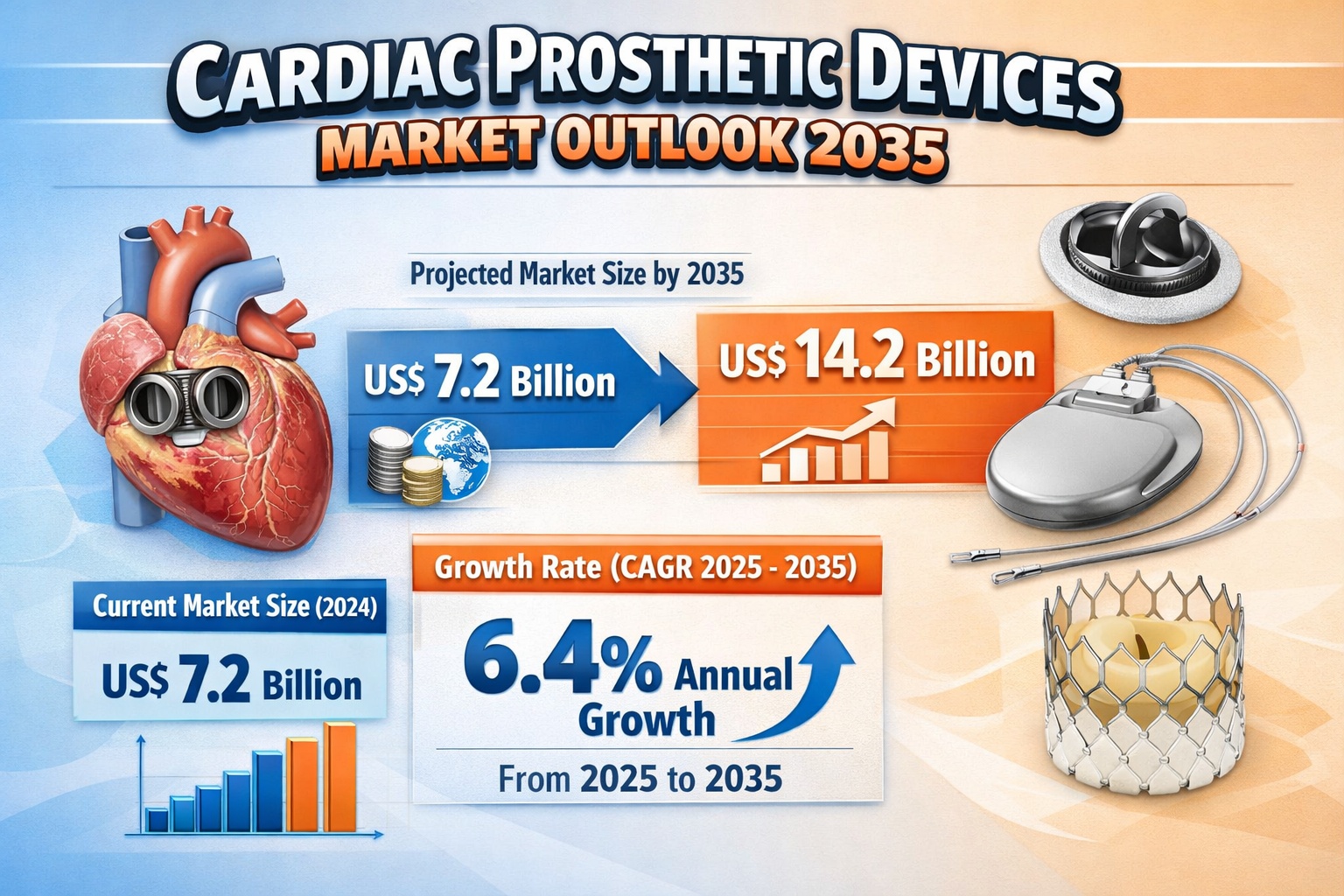
The global cardiac prosthetic devices market is witnessing steady and sustained growth, fueled by increasing cardiovascular disease prevalence and technological advancements in cardiac care. The market was valued at US$ 7.2 billion in 2024 and is projected to reach US$ 14.2 billion by 2035, expanding at a compound annual growth rate (CAGR) of 6.4% from 2025 to 2035.
This robust growth trajectory highlights the rising demand for advanced cardiac solutions such as prosthetic heart valves, pacemakers, and left ventricular assist devices (LVADs), which are essential for managing complex cardiovascular conditions.
Discover essential conclusions and data from our Report in this sample –
https://www.transparencymarketresearch.com/sample/sample.php?flag=S&rep_id=1721
Market Overview
Cardiac prosthetic devices are life-saving medical implants designed to support or replace damaged heart structures. These devices include artificial heart valves, pacemakers, and LVADs, all of which play a critical role in improving patient survival rates and quality of life.
Artificial valves ensure proper blood flow in patients with valvular heart diseases, while pacemakers regulate abnormal heart rhythms. LVADs assist heart function in patients suffering from severe heart failure, often serving as a bridge to transplantation or long-term therapy.
The market is evolving rapidly due to advancements in biomaterials, miniaturization, and minimally invasive surgical techniques. Additionally, the integration of digital health technologies and remote monitoring systems is transforming post-operative care and long-term patient management.
Hospitals and cardiac centers dominate the adoption of these devices, accounting for 68.7% of the market share in 2024, owing to their advanced infrastructure and specialized cardiac care services.
Key Market Growth Drivers
1. Increasing Prevalence of Cardiovascular Diseases
Cardiovascular diseases (CVDs) remain one of the leading causes of death globally. Factors such as sedentary lifestyles, unhealthy diets, smoking, and obesity have significantly contributed to the growing burden of heart diseases. As the global population ages, the incidence of heart-related conditions continues to rise, driving demand for cardiac prosthetic devices.
2. Rising Demand for Minimally Invasive Procedures
Patients and healthcare providers are increasingly opting for minimally invasive surgical techniques due to reduced recovery time, lower risk of complications, and shorter hospital stays. This shift is accelerating the adoption of advanced prosthetic devices compatible with minimally invasive procedures.
3. Technological Advancements and Innovation
Continuous innovation in device design, materials, and functionality is enhancing the performance and longevity of cardiac prosthetics. Improvements in biocompatibility are reducing complications such as thrombosis and infection.
4. Growth of Digital Health and Remote Monitoring
The integration of remote monitoring systems allows real-time tracking of patient health and device performance. These systems enable early detection of complications, improve patient compliance, and enhance overall clinical outcomes.
5. Aging Population
The elderly population is more susceptible to heart diseases, leading to increased demand for cardiac implants. This demographic trend is a major contributor to market expansion.
Analysis of Key Players – Key Player Strategies
Leading companies operating in the cardiac prosthetic devices market include:
- Abbott Laboratories
- Medtronic plc
- Edwards Lifesciences Corporation
- Boston Scientific Corporation
- BIOTRONIK SE & Co. KG
- MicroPort Scientific Corporation
Strategic Focus Areas
1. Product Innovation:
Companies are heavily investing in R&D to develop next-generation devices with improved durability, precision, and patient compatibility.
2. Minimally Invasive Solutions:
Key players are focusing on transcatheter technologies and minimally invasive implants to expand their market reach.
3. Strategic Collaborations and Acquisitions:
Mergers and acquisitions are enabling companies to strengthen their product portfolios and expand globally.
4. Digital Integration:
Integration of AI-driven analytics and remote monitoring capabilities is becoming a major competitive differentiator.
5. Geographic Expansion:
Companies are targeting emerging markets in Asia-Pacific and Latin America to capitalize on untapped opportunities.
Market Challenges & Opportunities
Challenges
- High Cost of Devices and Procedures: Advanced cardiac prosthetics are expensive, limiting accessibility in low- and middle-income countries.
- Stringent Regulatory Approvals: Lengthy and complex approval processes can delay product launches.
- Risk of Complications: Issues such as infection, device failure, and thrombosis remain concerns.
- Limited Skilled Professionals: Specialized training is required for implantation and post-operative care.
Opportunities
- Emerging Markets Growth: Increasing healthcare infrastructure in Asia-Pacific presents significant opportunities.
- Technological Advancements: AI, machine learning, and smart implants offer new growth avenues.
- Telehealth Expansion: Remote patient monitoring is enhancing long-term care efficiency.
- Personalized Medicine: Custom-designed devices tailored to individual patient needs are gaining traction.
Key Player Strategies
Market leaders are adopting a multi-pronged approach to sustain growth:
- Investment in advanced biomaterials to improve device longevity
- Development of next-generation pacemakers and valves
- Expansion into ambulatory surgical centers (ASCs)
- Strengthening distribution networks globally
- Enhancing patient engagement through digital platforms
These strategies are helping companies maintain competitive advantage and improve patient outcomes.
Recent Developments
- In July 2025, FineHeart S.A. received French regulator ANSM authorisation for starting its first-in-human (FIH) clinical trial of its fully implantable left ventricular assist device FlowMaker.
- In March 2024, Abbott Laboratories and Edwards Lifesciences entered into a definitive agreement for Edwards for acquiring Abbott’s structural heart business.
Investment Landscape and ROI Outlook
The cardiac prosthetic devices market presents a highly attractive investment landscape due to its stable growth, driven by essential healthcare demand.
Investment Highlights
- Strong CAGR of 6.4% ensures steady returns
- Increasing demand for life-saving cardiac devices
- Continuous technological innovation
- Expanding healthcare infrastructure in developing regions
ROI Outlook
Investors can expect long-term returns due to consistent demand and recurring revenue streams from device replacements and follow-up care. Companies focusing on innovation and emerging markets are likely to yield higher returns.
Market Segmentations
By Product
Valves
- Mechanical Valve
- Tissue Valve
- Stented Tissue Valve
- Stentless Tissue Valve
- Transcatheter Valve
Pacemakers
- Implantable Pacemakers
- Single-Chamber
- Dual-Chamber
- Triple-Chamber
- External Pacemakers
By End-user
- Hospitals & Cardiac Centers
- Ambulatory Surgical Centers (ASCs)
- Others
By Region
- North America (Leading region with 35.6% market share)
- Europe
- Asia Pacific (Fastest growing region)
- Latin America
- Middle East & Africa
North America dominates due to advanced healthcare infrastructure, while Asia-Pacific is emerging as a high-growth region due to improving access to cardiac care.
Why Buy This Report?
- Comprehensive analysis of market trends and growth drivers
- Detailed segmentation and regional insights
- In-depth profiles of key market players
- Strategic insights for investors and stakeholders
- Accurate forecasts up to 2035
- Coverage of recent developments and innovations
This report serves as a valuable resource for decision-makers, investors, healthcare providers, and industry participants.
FAQs
1. What is the current size of the cardiac prosthetic devices market?
The market was valued at US$ 7.2 billion in 2024 and is expected to reach US$ 14.2 billion by 2035.
2. What is driving the growth of this market?
Key drivers include rising cardiovascular diseases, technological advancements, and increasing adoption of minimally invasive procedures.
3. Which region dominates the market?
North America leads the market with a 35.6% share, supported by advanced healthcare systems.
4. Who are the major players in the market?
Leading companies include Medtronic plc, Abbott Laboratories, and Edwards Lifesciences Corporation.
5. What are the future opportunities in this market?
Opportunities lie in emerging markets, digital health integration, and the development of next-generation cardiac devices.


Leave a Reply