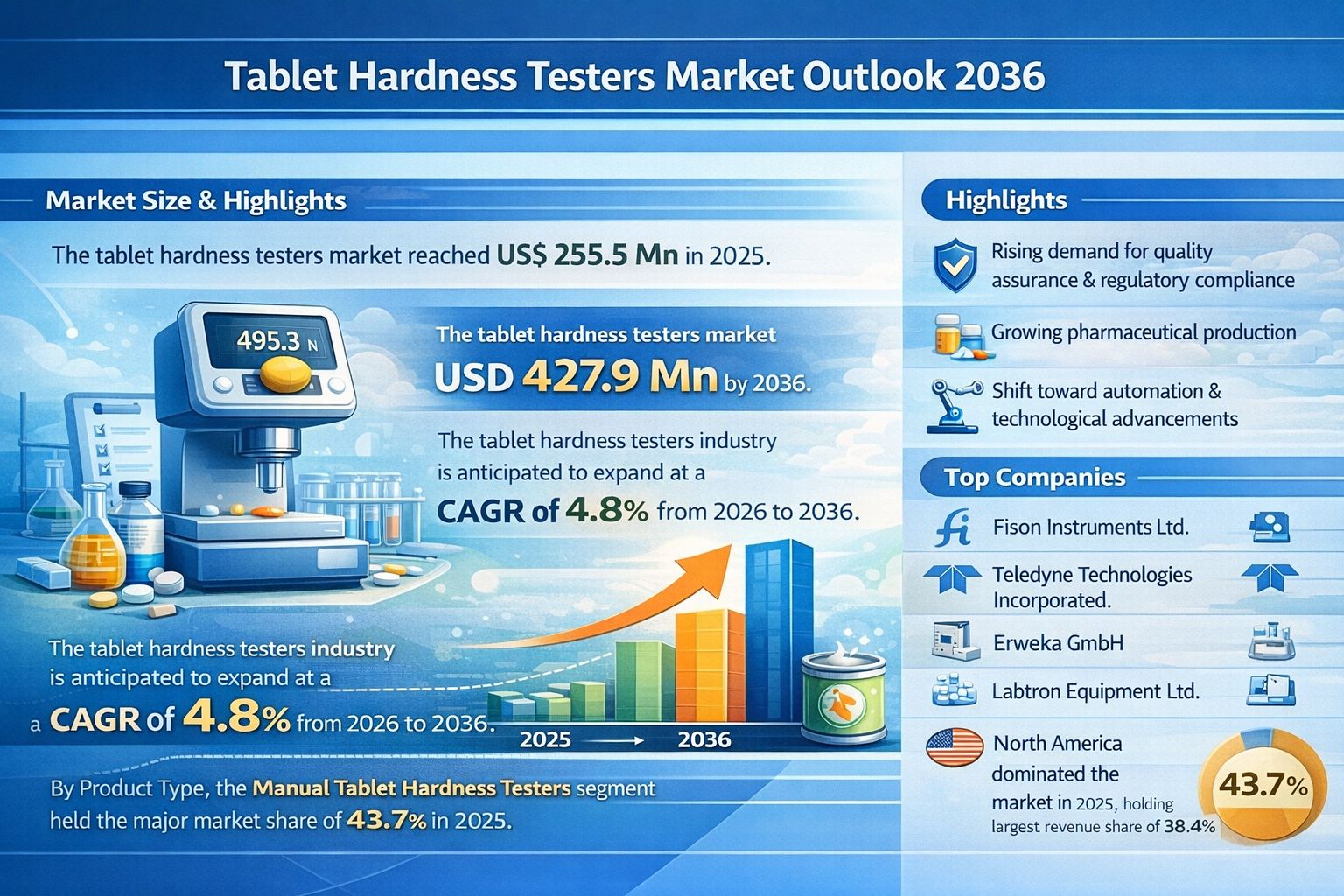
The global Tablet Hardness Testers Market is witnessing steady and consistent growth, supported by the expansion of pharmaceutical manufacturing and stringent regulatory requirements. The market was valued at US$ 255.5 Mn in 2025 and is projected to reach US$ 427.9 Mn by 2036, expanding at a CAGR of 4.8% from 2026 to 2036.
This growth trajectory reflects increasing adoption of advanced quality control instruments across pharmaceutical and nutraceutical industries. The rise in generic drug production, combined with global regulatory harmonization, is further strengthening demand for accurate and reliable tablet testing systems.
→Discover Market Opportunities – Request Your Sample Copy Now: https://www.transparencymarketresearch.com/sample/sample.php?flag=S&rep_id=39620
Market Overview
Tablet hardness testers are specialized instruments used to measure the mechanical strength of tablets, ensuring they can withstand handling, packaging, and transportation without breaking. These devices are critical in maintaining dosage consistency, dissolution rate, and patient safety.
Modern tablet hardness testers incorporate advanced technologies such as load cell-based measurement systems, strain gauge mechanisms, and digital data logging. Increasing integration with Laboratory Information Management Systems (LIMS), audit trails, and compliance tools such as 21 CFR Part 11 has transformed these instruments into essential components of pharmaceutical quality assurance ecosystems.
The market is evolving rapidly with a clear shift toward automation, multi-parameter testing, and digitalization, enabling manufacturers to improve throughput, accuracy, and compliance efficiency.
Key Market Growth Drivers
Rising Demand for Quality Assurance & Regulatory Compliance
One of the most significant drivers is the increasing emphasis on regulatory compliance across global pharmaceutical markets. Tablet hardness directly impacts friability, dissolution, and bioavailability, making it a critical quality parameter.
Pharmaceutical manufacturers must ensure consistent product quality across batches and geographies. Regulatory bodies mandate strict documentation, traceability, and reproducibility, pushing companies to adopt advanced testing equipment with features like:
- Electronic data recording
- Audit trails
- Real-time monitoring
- Automated reporting systems
Failure to meet these standards can result in product recalls, regulatory penalties, and financial losses, making investment in high-quality testing equipment essential.
Growing Pharmaceutical Production
The global rise in pharmaceutical production is another major growth catalyst. Increasing prevalence of chronic diseases such as diabetes and cardiovascular disorders, along with aging populations, has driven demand for oral solid dosage forms.
Emerging markets like India and Southeast Asia are witnessing rapid pharmaceutical expansion, further boosting demand for tablet hardness testers. Additionally, the growth of:
- Generic drug manufacturing
- Nutraceutical and OTC supplements
- Complex formulations (coated, chewable, controlled-release tablets)
is increasing the need for advanced testing systems capable of handling diverse tablet types.
Shift Toward Automation & Technological Advancements
Automation is transforming quality control processes. Manufacturers are increasingly adopting:
- Fully automated testers
- Multi-station testing systems
- IoT-enabled smart devices
These technologies reduce manual errors, enhance throughput, and ensure compliance with global standards, making them a key driver of market expansion.
Analysis of Key Players – Key Player Strategies
The global market is moderately fragmented, with several key players focusing on innovation, automation, and geographic expansion. Prominent companies include:
- Fison Instruments Ltd.
- Teledyne Technologies Incorporated
- Erweka GmbH
- Labtron Equipment Ltd.
- SOTAX
Strategic Focus Areas
- Product Innovation:
Companies are developing advanced testers with multi-parameter capabilities (hardness, thickness, diameter, weight). - Automation Integration:
Launch of fully automated systems with robotic handling and high-throughput capabilities. - Digital Compliance:
Incorporation of data integrity features such as electronic records, audit trails, and LIMS connectivity. - Expansion in Emerging Markets:
Strengthening distribution networks in Asia-Pacific, Latin America, and Africa. - Portable & In-Process Solutions:
Development of compact testers for real-time production monitoring.
Market Challenges & Opportunities
Challenges
High Initial Investment:
Advanced automated systems require significant capital, limiting adoption among small-scale manufacturers.
Complex Regulatory Compliance:
Continuous updates in regulatory standards increase operational complexity.
Limited Adoption in Low-Income Regions:
Budget constraints restrict the use of advanced testing technologies in developing markets.
Opportunities
Expansion of CDMOs:
Contract Development & Manufacturing Organizations are increasing demand for standardized testing equipment.
Growth in Nutraceutical Sector:
Rising health awareness is boosting supplement production, creating new demand.
Technological Advancements:
Integration of IoT, AI, and real-time analytics presents opportunities for innovation.
Emerging Markets:
Rapid industrialization in Asia-Pacific offers significant untapped potential.
→Explore Strategies & Trends – Request Full Report Access – https://www.transparencymarketresearch.com/sample/sample.php?flag=S&rep_id=39620
Key Player Strategies
Leading companies are adopting a combination of organic and inorganic strategies:
- Launching next-generation automated testers
- Investing in R&D for smart sensor technologies
- Forming strategic partnerships with pharmaceutical manufacturers
- Expanding product portfolios with multi-functional systems
- Enhancing after-sales services and training programs
These strategies are aimed at improving market penetration and strengthening competitive positioning.
Recent Developments (Use as it is from report RD)
- In October 2025, SOTAX announced new automated alignment technologies designed to transform tablet hardness testing. The company’s innovative solutions, namely, AutoAlign, SmartAlign and SmartLift, are designed to deliver precise, repeatable tablet positioning to ensure accurate strength measurements across all tablet shapes.
- In October 2025, ERWEKA GmbH announced the launch of TBH II Tablet Hardness Tester and 21 CFR Part 11 software for DT 950 Dissolution Series.
- In February 2022, SOTAX announced that it had introduced AT50, a tablet hardness tester solution designed to handle any tablet shape.
Investment Landscape and ROI Outlook
The tablet hardness testers market presents a moderate but stable ROI profile, making it attractive for long-term investors.
Investment Drivers
- Consistent pharmaceutical demand
- Regulatory-driven equipment upgrades
- Increasing automation adoption
ROI Potential
Companies investing in advanced testing technologies benefit from:
- Reduced operational errors
- Improved compliance efficiency
- Faster production cycles
- Lower product recall risks
The market’s steady CAGR of 4.8% ensures predictable returns, particularly for stakeholders focusing on innovation and emerging markets.
Market Segmentations (with Region)
By Product Type
- Manual Tablet Hardness Testers (43.7% share in 2025)
- Semi-Automatic Tablet Hardness Testers
- Automatic Tablet Hardness Testers
Manual testers dominate due to affordability, ease of use, and suitability for small-scale operations.
By Technology
- Load Cell-Based Testers
- Strain Gauge Technology
- Mechanical / Spring-Based Systems
Load cell-based systems are gaining popularity due to high precision and digital integration.
By Throughput
- Single-Tablet Testers
- Medium Capacity Systems (5–10 tablets)
- High Throughput Fully Automated Systems
By Connectivity
- Basic / Non-Connected
- Digital Output
- LIMS-Integrated
- IoT-Enabled Smart Testers
By Functionality
- Hardness-Only Testers
- Multi-Parameter Testers
By End-User
- Pharmaceutical Manufacturers
- CDMOs
- Nutraceutical Companies
- Academic & Research Institutes
- QC Laboratories
Regional Insights
North America dominated the market in 2025 with a 38.4% share, driven by a highly regulated pharmaceutical industry and strong R&D infrastructure.
Europe follows closely with strong compliance frameworks and technological adoption.
Asia-Pacific is the fastest-growing region due to expanding pharmaceutical manufacturing in countries like India and China.
Latin America and Middle East & Africa are emerging markets with increasing investments in healthcare infrastructure.
Why Buy This Report?
- Comprehensive analysis of market size, trends, and forecasts up to 2036
- Detailed segmentation across product types, technologies, and regions
- In-depth competitive landscape with company profiling
- Insights into regulatory trends and technological advancements
- Identification of growth opportunities and investment hotspots
- Strategic recommendations for stakeholders and investors
FAQs
- How big was the global tablet hardness testers market in 2025?
The market was valued at US$ 255.5 Mn in 2025.
- What is the projected market size by 2036?
The market is expected to reach US$ 427.9 Mn by 2036.
- What is driving the growth of the tablet hardness testers market?
Key drivers include rising demand for regulatory compliance, increasing pharmaceutical production, and growing adoption of automation technologies.
- What is the expected CAGR during the forecast period?
The market is projected to grow at a CAGR of 4.8% from 2026 to 2036.
- Who are the leading players in the market?
Major companies include Fison Instruments Ltd., Teledyne Technologies Incorporated, Erweka GmbH, Labtron Equipment Ltd., and SOTAX.
Buy Full Report Now: https://www.transparencymarketresearch.com/checkout.php?rep_id=39620<ype=S
→Explore Latest Research Reports by Transparency Market Research:
Hemostatic Agents Market: https://www.transparencymarketresearch.com/hemostatic-agents-market.html
Personal Mobility Devices Market: https://www.transparencymarketresearch.com/personal-mobility-devices-market.html
Nasopharyngeal Swabs Market: https://www.transparencymarketresearch.com/nasopharyngeal-swabs-market.html
About Transparency Market Research
Transparency Market Research, a global market research company registered at Wilmington, Delaware, United States, provides custom research and consulting services. Our exclusive blend of quantitative forecasting and trends analysis provides forward-looking insights for thousands of decision makers. Our experienced team of Analysts, Researchers, and Consultants use proprietary data sources and various tools & techniques to gather and analyses information.
Our data repository is continuously updated and revised by a team of research experts, so that it always reflects the latest trends and information. With a broad research and analysis capability, Transparency Market Research employs rigorous primary and secondary research techniques in developing distinctive data sets and research material for business reports.



Leave a Reply