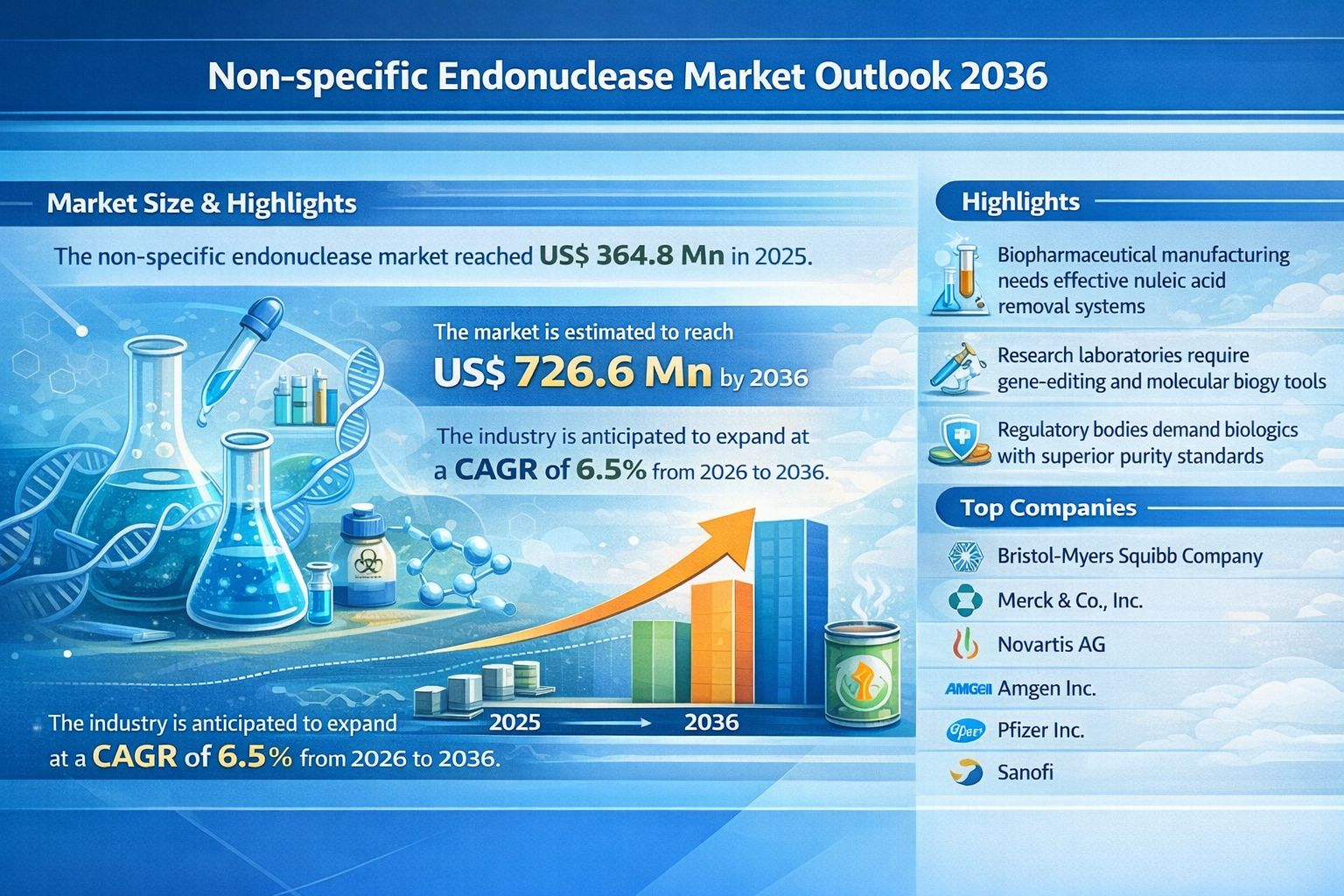
The global non-specific endonuclease market has emerged as a critical component of the modern biopharmaceutical ecosystem, reflecting its growing importance in ensuring product purity and regulatory compliance. The market was valued at US$ 364.8 Mn in 2025 and is projected to reach US$ 726.6 Mn by 2036, expanding at a compound annual growth rate (CAGR) of 6.5% from 2026 to 2036.
This steady growth trajectory highlights the increasing reliance of pharmaceutical manufacturers, contract development and manufacturing organizations (CDMOs), and research laboratories on enzymatic solutions for nucleic acid removal. The rise in biologics production, coupled with expanding pipelines of advanced therapeutics such as gene and cell therapies, is expected to sustain demand over the next decade.
North America led the global market with a 44.2% revenue share in 2025, while recombinant non-specific endonucleases accounted for 61.2% of the product segment, emphasizing their dominance due to consistency and scalability.
→Discover Market Opportunities – Request Your Sample Copy Now: https://www.transparencymarketresearch.com/sample/sample.php?flag=S&rep_id=86944
Market Overview
Non-specific endonucleases are enzymes designed to degrade DNA and RNA residues during biopharmaceutical manufacturing. These enzymes play a pivotal role in ensuring that final products such as monoclonal antibodies, vaccines, and recombinant proteins meet stringent purity standards.
The market is witnessing robust expansion due to the increasing complexity of biologic products and the need for efficient downstream processing technologies. As biologics manufacturing evolves, the integration of enzymatic purification steps has become essential for achieving both operational efficiency and regulatory compliance.
Moreover, the increasing adoption of viral vector-based therapies and mRNA vaccines has further strengthened the role of non-specific endonucleases. Their versatility across multiple applications—from small-scale laboratory research to industrial-scale production—makes them indispensable tools in modern biotechnology.
Government initiatives are also influencing market growth. For instance, regulatory frameworks introduced by health authorities to monitor synthetic nucleic acids are reinforcing the importance of high-quality enzymatic processing solutions in the industry.
Key Market Growth Drivers
Rising Demand for Efficient Nucleic Acid Removal in Biologics Production
One of the primary drivers of the non-specific endonuclease market is the growing need for effective nucleic acid removal in biologics manufacturing. Residual DNA and RNA contaminants must be eliminated to meet global safety standards, especially in the production of vaccines, recombinant proteins, and monoclonal antibodies.
As biologics pipelines expand globally, manufacturers are increasingly adopting high-performance enzymatic solutions to ensure compliance with regulatory requirements. The scalability and reliability of these enzymes make them essential in both traditional and next-generation bioprocessing systems.
Increasing Prevalence of Genetic Disorders
The rising incidence of genetic disorders is fueling demand for advanced diagnostic research and molecular biology tools. With the growing focus on personalized medicine and genomic testing, research institutions and healthcare providers are investing heavily in technologies that enable accurate disease characterization.
This trend is driving the adoption of non-specific endonucleases in genomics workflows, RNA analysis, and sequencing applications. Increased funding for genomic medicine initiatives globally further supports this demand.
Expansion of Cell and Gene Therapy Manufacturing
The rapid growth of cell and gene therapy pipelines has created a surge in demand for viral vectors and recombinant proteins. These applications require precise nucleic acid removal processes, thereby increasing reliance on non-specific endonucleases.
Additionally, the outsourcing of biologics production to CDMOs and the establishment of new bio-manufacturing facilities, particularly in Asia Pacific, are contributing significantly to market expansion.
Analysis of Key Players – Key Player Strategies
The competitive landscape of the non-specific endonuclease market is characterized by a mix of established biotechnology firms and emerging players focusing on innovation and product differentiation. Key companies include F. Hoffmann-La Roche AG, GenScript, Takara Bio Inc., Promega Corporation, Bio-Techne, New England Biolabs, ArcticZymes Technologies, Worthington Biochemical Corporation, and Thermo Fisher Scientific Inc.
Strategic Focus Areas:
- Product Innovation: Companies are investing in the development of recombinant and GMP-grade enzymes with enhanced stability and performance.
- Expansion of Manufacturing Capabilities: Leading players are scaling up production facilities to meet growing global demand.
- Partnerships and Collaborations: Strategic alliances with research institutions and biopharmaceutical companies are enabling faster product development and market penetration.
- Customization and Application-Specific Solutions: Firms are offering tailored enzymatic solutions to meet specific requirements of different applications such as viral vector manufacturing and mRNA vaccine production.
These strategies are helping companies strengthen their market position while addressing evolving customer needs.
Market Challenges & Opportunities
Challenges
Despite strong growth prospects, the market faces several challenges:
- High Production Costs: Manufacturing high-purity recombinant enzymes involves complex processes and significant investment.
- Regulatory Compliance Complexity: Stringent regulatory requirements across different regions can increase operational burdens for manufacturers.
- Limited Awareness in Emerging Markets: In certain regions, limited awareness about advanced enzymatic solutions may hinder adoption.
Opportunities
- Emerging Markets Expansion: Rapid growth in Asia Pacific presents lucrative opportunities due to increasing investments in biopharmaceutical infrastructure.
- Technological Advancements: Innovations in enzyme engineering and AI-driven protein design are opening new avenues for product development.
- Rising Demand for Personalized Medicine: Increasing focus on precision medicine is expected to boost demand for advanced molecular biology tools.
→Explore Strategies & Trends – Request Full Report Access – https://www.transparencymarketresearch.com/sample/sample.php?flag=S&rep_id=86944
Key Player Strategies
In addition to innovation and expansion, companies are focusing on:
- Launching GMP-compliant products to cater to clinical and commercial manufacturing needs
- Strengthening distribution networks globally
- Investing in R&D to improve enzyme efficiency and reduce costs
- Leveraging digital tools and AI for enzyme design and process optimization
These strategies are expected to enhance competitiveness and drive long-term growth.
Recent Developments
- In June 2025, ArcticZymes Technologies expanded its GMP product range with the launch of M-SAN HQ GMP, a new GMP-grade nuclease specifically designed for viral vector manufacturing.
- In June 2025, New England Biolabs (NEB) introduced its GMP-grade Salt Active Nuclease to the European market for use in biopharmaceutical and viral vector manufacturing workflows, particularly for the removal of nucleic acid impurities under high-salt conditions
- In April 2025, Worthington Biochemical introduced two new enzyme products for nucleic acid research and bioprocessing: NUCxyme DNA/RNA Nuclease, Recombinant, Animal-Free – a broad-spectrum, sequence-independent endonuclease derived from Serratia marcescens and produced recombinantly in yeast. Ribonuclease U2, Recombinant – an RNA-targeting endonuclease with defined specificity, also produced in yeast, designed for applications requiring non-animal-derived enzymes.
- In June 2025, the Ferruz Laboratory, at the Institute of Molecular Biology of Barcelona and Basecamp Research, a global leader in artificial intelligence (AI)-based protein and biological system design, announced the release of ZymCTRL (“enzyme control”), a tool that works similarly to ChatGPT and creates new sequences from scratch when a user enters an enzyme identification code that denotes the desired activity.
Investment Landscape and ROI Outlook
The non-specific endonuclease market presents a compelling investment landscape, driven by consistent demand across biopharmaceutical production and research applications. With a projected market size of over US$ 726.6 Mn by 2036, investors can expect stable returns supported by recurring demand for enzymatic products.
Investments are particularly attractive in:
- GMP-grade enzyme production facilities
- AI-driven enzyme design platforms
- Emerging biotechnology hubs in Asia Pacific
The return on investment (ROI) is expected to remain strong due to high entry barriers, technological complexity, and long-term supply contracts with pharmaceutical manufacturers.
Market Segmentations
The non-specific endonuclease market is segmented based on product, application, end-user, and region.
By Product
- Recombinant Non-Specific Endonucleases (dominant with 61.2% share)
- Natural Source Enzymes
- Engineered/Modified Variants
By Application
- Biopharmaceutical Production (mAbs, recombinant proteins, biosimilars)
- Cell & Gene Therapy (AAV, lentivirus, CAR-T therapies)
- Vaccine Manufacturing (mRNA and viral vector vaccines)
- Diagnostics & Research (molecular biology, RNA sequencing)
By End-user
- Biopharmaceutical & Biotechnology Companies
- CDMOs/CMOs
- Academic & Research Institutions
- Diagnostic Laboratories
By Region
- North America: Dominates with 44.2% share due to strong infrastructure and R&D investments
- Europe: Significant growth driven by regulatory support and advanced research initiatives
- Asia Pacific: Fastest-growing region due to expanding manufacturing capabilities in countries such as China and India
- Latin America and Middle East & Africa: Emerging markets with increasing adoption of biotechnology solutions
Why Buy This Report?
This report provides comprehensive insights into the global non-specific endonuclease market, enabling stakeholders to make informed business decisions. Key benefits include:
- In-depth analysis of market trends, drivers, and challenges
- Detailed segmentation and regional outlook
- Competitive landscape with profiles of leading players
- Insights into recent developments and technological advancements
- Investment analysis and future growth opportunities
The report is ideal for manufacturers, investors, research institutions, and policymakers seeking a strategic understanding of the market.
FAQs
- How big was the global non-specific endonuclease market in 2025?
The market was valued at US$ 364.8 Mn in 2025.
- What is the projected market size by 2036?
The market is expected to reach US$ 726.6 Mn by 2036.
- What are the key factors driving market growth?
Major drivers include rising demand for nucleic acid removal in biologics production and increasing prevalence of genetic disorders requiring advanced diagnostic research.
- What is the expected CAGR during the forecast period?
The market is projected to grow at a CAGR of 6.5% from 2026 to 2036.
- Which region dominates the market?
North America currently holds the largest share and is expected to maintain its dominance during the forecast period.
Buy Full Report Now: https://www.transparencymarketresearch.com/checkout.php?rep_id=86944<ype=S
→Explore Latest Research Reports by Transparency Market Research:
Mechanical Ventilators Market: https://www.transparencymarketresearch.com/mechanical-ventilators-market.html
Skincare Devices Market: https://www.transparencymarketresearch.com/skincare-devices-market.html
Diagnostic Catheters Market: https://www.transparencymarketresearch.com/diagnostic-catheter-market.html
About Transparency Market Research
Transparency Market Research, a global market research company registered at Wilmington, Delaware, United States, provides custom research and consulting services. Our exclusive blend of quantitative forecasting and trends analysis provides forward-looking insights for thousands of decision makers. Our experienced team of Analysts, Researchers, and Consultants use proprietary data sources and various tools & techniques to gather and analyses information.
Our data repository is continuously updated and revised by a team of research experts, so that it always reflects the latest trends and information. With a broad research and analysis capability, Transparency Market Research employs rigorous primary and secondary research techniques in developing distinctive data sets and research material for business reports.


Leave a Reply