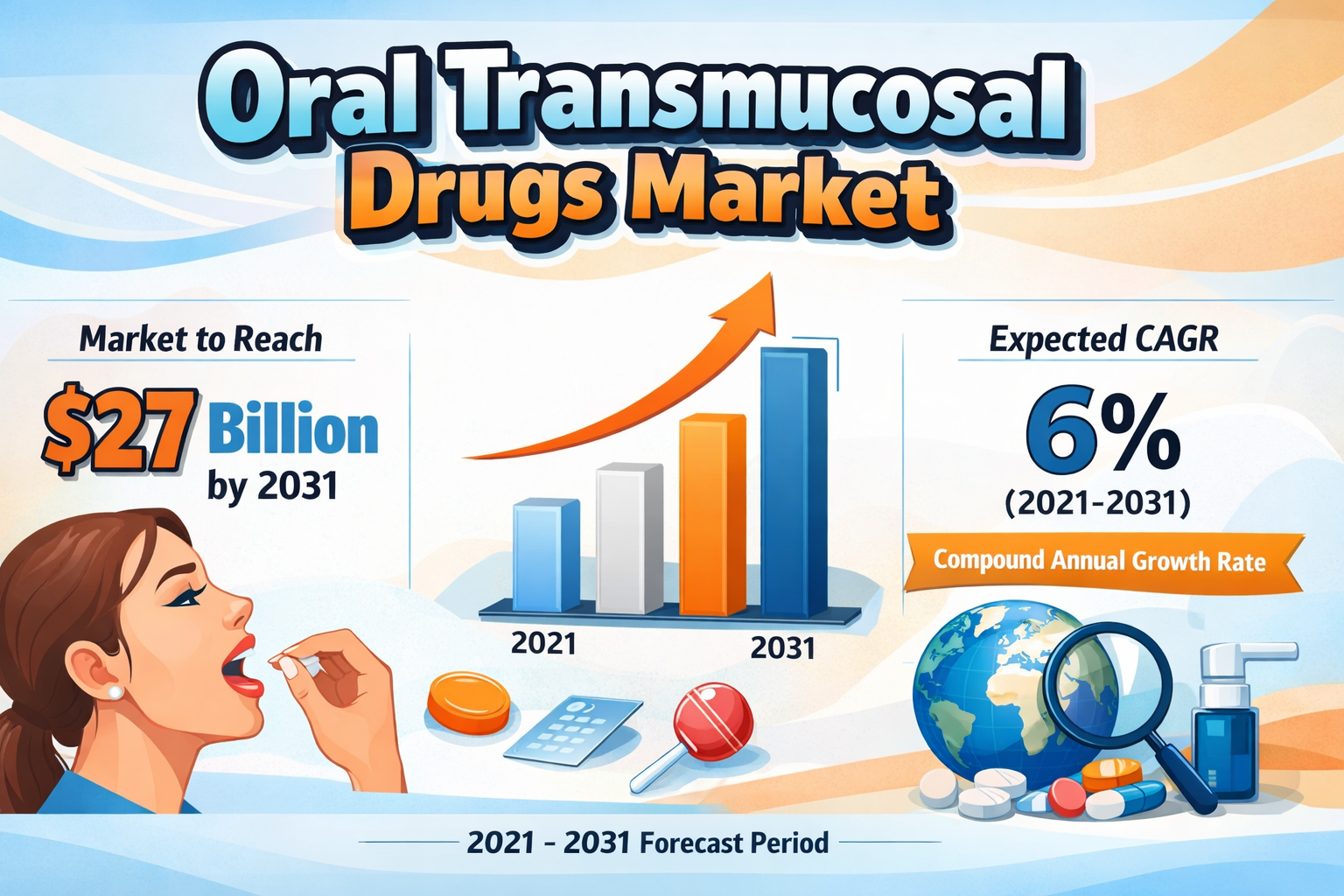
The global oral transmucosal drugs market is poised for steady expansion, projected to reach approximately US$ 27 billion by 2031, growing at a compound annual growth rate (CAGR) of around 6% during the forecast period from 2021 to 2031. This growth trajectory reflects increasing adoption of alternative drug delivery systems that bypass traditional gastrointestinal routes, ensuring faster therapeutic action and improved patient compliance.
The market’s expansion is further supported by the rising prevalence of chronic diseases, growing geriatric population, and increased demand for rapid-onset medications, particularly in emergency and palliative care settings.
Market Overview
Oral transmucosal drug delivery refers to the administration of drugs through the mucosal membranes of the oral cavity, including the buccal, sublingual, gingival, and palatal regions. This method allows drugs to directly enter systemic circulation, bypassing hepatic first-pass metabolism and ensuring higher bioavailability.
The market encompasses various dosage forms such as tablets, buccal films, liquid & sprays, gels, and other innovative formats. Among these, tablets have traditionally dominated due to their cost-effectiveness and ease of use. However, newer forms such as buccal films and oral thin films are rapidly gaining traction due to their flexibility, precision dosing, and enhanced patient comfort.
The COVID-19 pandemic significantly highlighted the importance of non-invasive drug delivery systems. Oral transmucosal drugs emerged as a critical solution in palliative and end-of-life care, enabling rapid symptom relief and facilitating administration by caregivers in non-clinical settings.
Key Market Growth Drivers
1. Increasing Demand for Non-Invasive Drug Delivery
Patients and healthcare providers are increasingly favoring non-invasive administration routes that reduce discomfort and eliminate the need for injections. Oral transmucosal delivery offers a convenient and pain-free alternative, boosting its adoption across various therapeutic areas.
2. Rapid Onset of Action
One of the most significant advantages of transmucosal delivery is its ability to provide rapid therapeutic effects. This is particularly crucial in conditions such as acute pain, cardiovascular emergencies, and sedation, where immediate drug action is required.
3. Rising Geriatric Population and Dysphagia Prevalence
Elderly patients often face difficulty swallowing conventional tablets and capsules. Oral transmucosal formulations, especially films and sprays, offer a practical solution, driving demand among aging populations.
4. Advancements in Mucoadhesive Polymers
Ongoing research and development in mucoadhesive polymers are enhancing drug retention time and absorption efficiency. These innovations are enabling more effective drug delivery across mucosal surfaces.
5. Growth in Chronic Disease Burden
The increasing prevalence of conditions such as diabetes, cardiovascular disorders, and erectile dysfunction is fueling demand for fast-acting and easily administered therapies, thereby supporting market growth.
Analysis of Key Players – Key Player Strategies
Leading pharmaceutical companies are actively investing in research and development to strengthen their position in the oral transmucosal drugs market. Their strategies focus on innovation, partnerships, and expansion of product portfolios.
Key players are emphasizing:
- Development of proprietary drug delivery platforms, particularly oral thin films and buccal systems
- Strategic collaborations with research institutions to advance polymer science and permeation technologies
- Expansion into emerging markets to tap into growing healthcare demand
- Enhancement of manufacturing capabilities to meet increasing global demand
Companies are also leveraging novel permeation enhancers and stabilizers to improve drug absorption through mucosal membranes, addressing one of the key limitations of transmucosal delivery.
Market Challenges & Opportunities
Challenges
- Limited Absorption Surface Area
The oral mucosa provides a relatively small surface area for drug absorption, which can limit the effectiveness of certain formulations. - Formulation Complexity
Developing stable and effective transmucosal formulations requires advanced technologies and precise control over drug release mechanisms. - Barrier Properties of Mucus
The mucosal layer can trap drug particles, leading to premature clearance and reduced efficacy. - Difficulty in Delivering Hydrophilic Drugs
Hydrophilic therapeutics face challenges in permeating mucosal membranes, necessitating advanced carrier systems.
Opportunities
- Innovation in Nanotechnology and Microcarriers
The development of micro and nanoscale drug carriers offers significant potential to overcome biological barriers and enhance drug delivery efficiency. - Growth of Oral Thin Films
Oral thin films are emerging as a highly promising segment due to their ease of use, rapid action, and precision dosing capabilities. - Expansion of Online Pharmacies
Increasing digitalization and consumer preference for online purchasing are expected to boost distribution channels. - Rising Demand in Palliative Care
The use of transmucosal drugs in palliative and end-of-life care presents a significant growth opportunity.
Key Player Strategies
Market participants are adopting a multi-faceted approach to maintain competitiveness and drive growth:
- Focus on Mucoadhesion Technologies
Enhancing drug residence time on mucosal surfaces to improve absorption. - Customization of Drug Formulations
Tailoring formulations to specific mucosal environments for optimized drug release. - Investment in Oral Film Technologies
Developing advanced oral soluble films with improved patient compliance and therapeutic outcomes. - Strengthening R&D Capabilities
Increasing expenditure on research to innovate new drug delivery systems. - Strategic Partnerships and Acquisitions
Collaborating with technology providers and biotech firms to accelerate innovation.
Recent Developments
- Increasing focus on developing novel permeation enhancers, stabilizers, and polymer blends to improve drug absorption through mucosal membranes
- Growing adoption of buccal films as a preferred alternative to buccal tablets due to enhanced flexibility and patient comfort
- Rising popularity of oral thin film technologies, enabling precision dosing and improved therapeutic outcomes
- Expansion of mucoadhesive polymer production to support diverse dosage forms including tablets, films, and semisolids
- Integration of micro and nanoscale drug carriers to facilitate sustained drug release and improved bioavailability
Investment Landscape and ROI Outlook
The oral transmucosal drugs market presents a highly attractive investment landscape, characterized by steady growth, technological innovation, and expanding therapeutic applications.
Investment Highlights
- Moderate but stable CAGR (~6%) ensures predictable returns
- High demand for innovative drug delivery systems creates opportunities for premium pricing
- Growing healthcare expenditure globally supports market expansion
- Strong pipeline of novel formulations enhances long-term growth potential
Investors are increasingly focusing on companies with strong R&D capabilities and proprietary technologies, particularly in oral film and nanotechnology-based delivery systems.
ROI Outlook
Return on investment in this market is expected to remain favorable due to:
- Continuous innovation driving product differentiation
- Expanding patient base across chronic and acute conditions
- Increasing adoption in both developed and emerging markets
Market Segmentations
By Type
- Tablets
- Sublingual tablets
- Buccal tablets
- Lozenges & troches
- Buccal Films
- Liquid & Spray
- Gels
- Others
By Route of Penetration
- Sublingual Mucosa
- Buccal Mucosa (dominant segment)
- Gingival Tissues
- Palatal Tissues
By Distribution Channel
- Hospital Pharmacies
- Retail Pharmacies
- Online Pharmacies (fastest-growing segment)
By Indication
- Cardiovascular Disorders
- Acute Pain Management
- Sedation
- Erectile Dysfunction
- Diabetes (high growth potential)
- Others
By Region
- North America (U.S., Canada)
- Europe (U.K., Germany, France, Italy, Spain, Rest of Europe)
- Asia Pacific (China, India, Japan, South Korea, Australia & New Zealand)
- Latin America (Brazil, Mexico)
- Middle East & Africa (GCC, South Africa)
North America currently leads the market due to advanced healthcare infrastructure and high adoption of innovative drug delivery systems, while Asia Pacific is expected to witness significant growth driven by increasing healthcare access and rising disease prevalence.
Why Buy This Report?
- Gain comprehensive insights into market trends, growth drivers, and challenges
- Understand competitive landscape and key player strategies
- Access detailed segmentation analysis across multiple parameters
- Identify emerging opportunities in high-growth segments
- Make informed decisions with data-driven forecasts up to 2031
- Evaluate investment potential and ROI outlook
- Stay ahead with latest technological advancements and innovations
FAQs
1. What is driving the growth of the oral transmucosal drugs market?
The market is primarily driven by the demand for non-invasive drug delivery, rapid onset of action, advancements in mucoadhesive technologies, and increasing prevalence of chronic diseases.
2. Which segment dominates the market by type?
Tablets currently dominate the market due to their stability and cost-effectiveness, while buccal films and oral thin films are rapidly gaining popularity.
3. Why are oral thin films gaining attention?
They offer advantages such as precision dosing, ease of use, rapid absorption, and improved patient compliance.
4. What are the key challenges in this market?
Major challenges include limited absorption surface area, formulation complexity, and difficulty in delivering hydrophilic drugs.
5. Which region is expected to grow the fastest?
Asia Pacific is anticipated to witness the fastest growth due to rising healthcare investments and increasing disease burden.


Leave a Reply