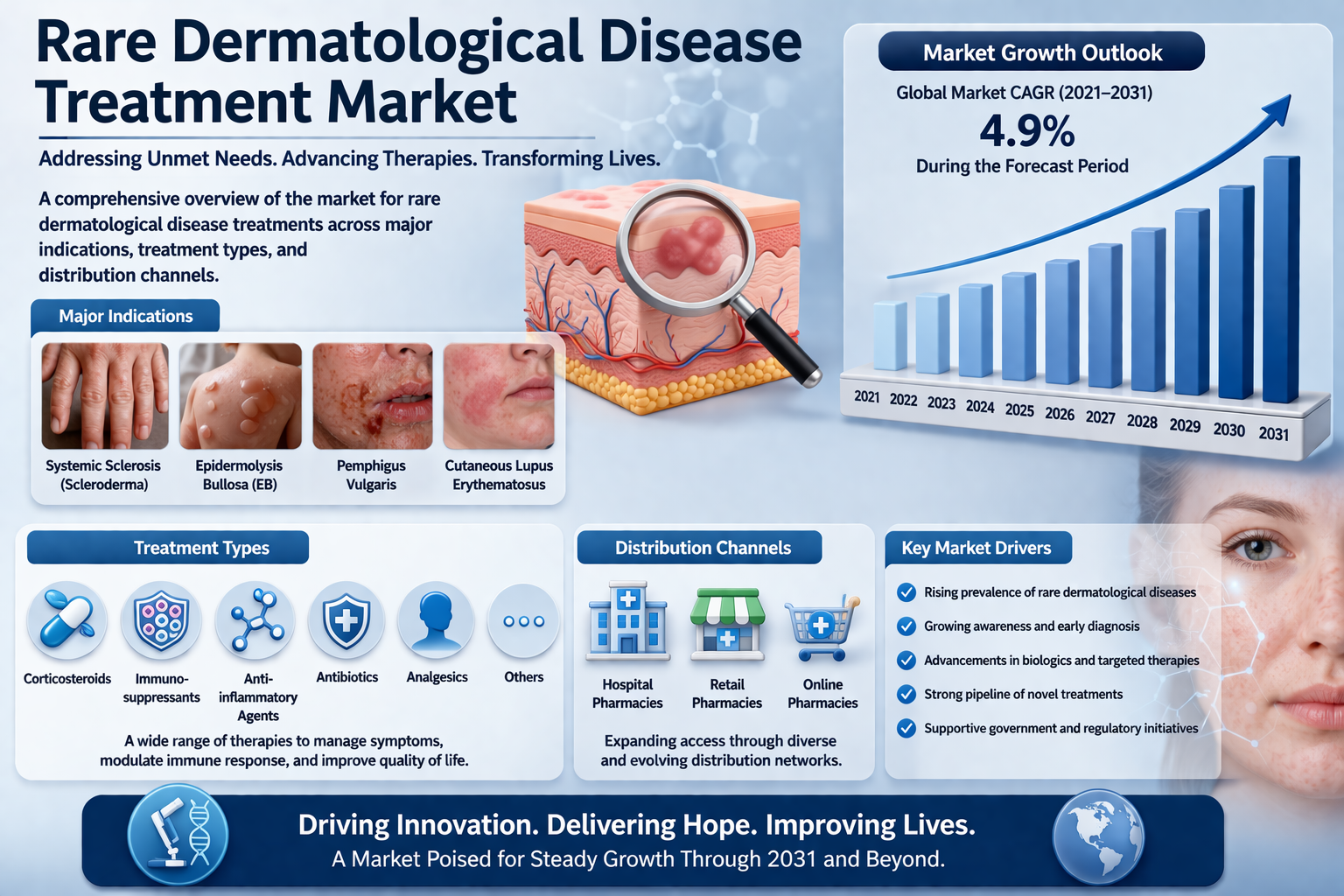
The rare dermatological disease treatment market is projected to grow steadily, registering a CAGR of 4.9% during the forecast period from 2021 to 2031. This growth is driven by increasing awareness of rare skin disorders, advancements in targeted therapies, and improved access to specialized treatments, although challenges such as high treatment costs and limited patient populations may impact market expansion.
👉 Get sample market research report copy today@ https://www.transparencymarketresearch.com/sample/sample.php?flag=S&rep_id=82783
Market Overview
Rare dermatological diseases encompass a group of more than 500 identified conditions, many of which are life-threatening or severely disfiguring. The market is currently undergoing a paradigm shift as advanced biotechnology—specifically ex vivo and in vivo gene therapies—replaces traditional topical steroids and emollients.
Key focus areas in the market include Epidermolysis Bullosa (EB), Pemphigus, Ichthyosis, and Cutaneous T-cell Lymphoma. The recent approval of the first topical gene therapies has demonstrated that the skin is an ideal target for genetic medicine due to its accessibility. Furthermore, the rise of JAK inhibitors and IL-23 antagonists is providing new hope for rare inflammatory skin disorders that were previously resistant to standard biologics.
The market is also benefiting from the integration of AI-driven diagnostic imaging, which is reducing the “diagnostic odyssey” for rare skin disease patients by identifying microscopic lesion patterns that human practitioners might overlook.
Analysts’ Viewpoint on the Global Rare Dermatological Disease Treatment Market
Analysts observe that 2026 marks “the year of molecular dermatology.” The industry is moving beyond managing symptoms like blistering and itching toward correcting the underlying genetic protein deficiencies. For instance, the expansion of COL7A1 gene therapies is fundamentally changing the prognosis for patients with dystrophic EB.
A major trend highlighted by analysts is the Growth of Novel Topicals. While systemic biologics dominate prevalent conditions like plaque psoriasis, rare skin diseases are seeing a surge in specialized topical gels and cell-corrected skin sheets. Analysts also point to the high “Orphan Drug” incentive utilization, with over 20 assets currently in Phase III clinical development across major markets.
However, analysts caution that access and affordability remain significant hurdles. With curative gene therapies often priced above US$ 600,000 per treatment course, the market is increasingly dependent on innovative “pay-for-performance” reimbursement structures to ensure patient access.
Analysis of Key Players in the Rare Dermatological Disease Treatment Market
The competitive landscape is characterized by a “specialization surge,” where mid-sized dermatology firms are pivoting toward rare indications to avoid the crowded atopic dermatitis and psoriasis markets.
Leading companies operating in the global rare dermatological disease treatment market include:
- Sanofi
- GlaxoSmithKline plc
- Novartis AG
- Castle Creek Biosciences, Inc.
- Merck & Co., Inc.
- Bristol-Myers Squibb Company
- Pfizer, Inc.
- F. Hoffmann-La Roche Ltd.
- Merck KGaA
- Eli Lilly and Company
- AbbVie, Inc.
- Krystal Biotech, Inc.
- Amryt Pharma plc
These players are focusing on autologous cell-based therapies and small-molecule pathway inhibitors that offer a high degree of personalization for ultra-rare patient cohorts.
Recent Developments in Rare Dermatological Disease Treatment Market
- February 2026: Leo Pharma announced a strategic pivot toward rare dermatology at the 2026 J.P. Morgan Healthcare Conference, focusing on the commercialization of Spevigo (spesolimab) for generalized pustular psoriasis.
- January 2026: Krystal Biotech reported expanded FDA approval for its redosable gene therapy gel, Vyjuvek, to include treatment for infants from birth, significantly broadening the addressable market for dystrophic EB.
- Late 2025: Abeona Therapeutics received commercial approval for Zevaskyn, an autologous cell-corrected skin sheet therapy, offering a permanent structural solution for patients with recessive dystrophic EB.
👉 Discuss Implications for Your Industry Request Sample Research Report PDF@ https://www.transparencymarketresearch.com/sample/sample.php?flag=B&rep_id=82783
Key Developments in the Rare Dermatological Disease Treatment Market
- Gene Correction via Topical Gels: Success of non-invasive genetic delivery systems for skin protein restoration.
- Emergence of Oral Biologics: Clinical progress of IL-23 receptor antagonists as oral alternatives to injections.
- Targeted JAK Inhibition: Widespread adoption of delgocitinib and other JAK inhibitors for chronic hand eczema and rare dermatitis.
- AI-First Diagnostics: Integration of machine learning to accelerate the identification of rare skin cancer variants.
- Expanded Newborn Screening: New mandates for genetic testing at birth to enable early-intervention skin therapies.
Key Player Strategies
🧬 Targeted Pipeline Diversification Moving assets from broad inflammatory indications to niche rare diseases to secure market exclusivity.
🧪 Ex Vivo Cell Engineering Harvesting patient cells to create gene-corrected tissue grafts that integrate permanently into the host skin.
📲 Tele-Dermatology & Digital Monitoring Using smartphone-based AI tools to track the healing of rare wounds in remote clinical trials.
🤝 Strategic Co-Promotion Deals Partnering with large pharmaceutical firms to leverage existing dermatology sales forces for rare disease launches.
🛡️ Orphan Drug Lifecycle Management Utilizing 7-year market exclusivity windows to maximize R&D returns before generic entry.
Challenges
- Ultra-Small Patient Populations: Difficulty in recruiting sufficient participants for statistically significant clinical trials.
- Prohibitive Pricing: High cost of specialized gene and cell therapies limiting global market penetration.
- Specialized Administration: Requirement for highly trained clinical centers to apply advanced skin grafts or gene gels.
- Regulatory Complexity: Varying definitions of “rare disease” across different global jurisdictions.
Opportunities
🩹 EB Wound Healing Revolution The move toward home-applied gene therapies for Dystrophic Epidermolysis Bullosa.
🧴 Specialized Medical Skincare Growth in adjunctive barrier-repair therapies designed specifically for fragile genetic skin.
🩺 Pediatric Dermatology Expansion Significant unmet need for safe, long-term systemic treatments for rare pediatric skin conditions.
🖥️ AI-Enabled Patient Identification Using big data to mine EHR records and identify undiagnosed patients with rare dermatological symptoms.
🌍 Emerging Market Orphan Laws New regulatory incentives in China and India designed to attract rare disease innovators.
Market Segmentation
➤ By Drug Class
- Biologics & Monoclonal Antibodies
- Gene & Cell Therapies (Fastest Growing)
- Small Molecule Inhibitors (JAK, PDE4)
- Topical Corticosteroids
➤ By Disease Indication
- Epidermolysis Bullosa (EB)
- Pemphigus & Pemphigoid
- Generalized Pustular Psoriasis (GPP)
- Rare Skin Cancers (CTCL, Merkel Cell)
- Ichthyosis
➤ By Route of Administration
- Topical (Highest Growth)
- Injectable
- Oral
➤ By End-User
- Specialized Dermatology Clinics
- Academic & Research Hospitals
- Home-Care Settings (Growing via Topical Gene Therapy)
➤ By Region
- North America – Dominant market (~42%) due to high orphan drug spending and FDA incentives.
- Europe – Strong focus on patient registry data and academic research collaborations.
- Asia-Pacific – Fastest-growing region driven by localized manufacturing in Japan and South Korea.
Conclusion
The rare dermatological disease treatment market is entering an era of unprecedented therapeutic potency. Through 2036, the focus will remain on refining genetic delivery systems and oral biologics that offer patients a standard of life previously thought impossible. As the industry successfully commercializes the first wave of gene therapies, the “skin-as-a-target” model will serve as a blueprint for the wider rare disease landscape.
👉 To buy this comprehensive market research report, click here to inquire@ https://www.transparencymarketresearch.com/checkout.php?rep_id=82783<ype=S
FAQs
- What is the total market worth of rare dermatological disease treatment market?
Rare dermatological disease treatment market is expected to surpass US$ 6.17 Bn by 2031
- What is the anticipated CAGR of the rare dermatological disease treatment market in the forecast period?
Rare dermatological disease treatment market is estimated to clock a CAGR of 4.9% from 2021 to 2031
- What are the key driving factors for the growth of the rare dermatological disease treatment market?
Rare dermatological disease treatment market is driven by increase in incidence of rare diseases and surge in research & development for orphan drugs
- Which is the rising prominent segment in the rare dermatological disease treatment market?
The systemic sclerosis segment dominated the global rare dermatological disease treatment market in 2020, and the trend is projected to continue during the forecast period
About Transparency Market Research
Transparency Market Research, a global market research company registered at Wilmington, Delaware, United States, provides custom research and consulting services. Our exclusive blend of quantitative forecasting and trends analysis provides forward-looking insights for thousands of decision makers. Our experienced team of Analysts, Researchers, and Consultants use proprietary data sources and various tools & techniques to gather and analyses information.
Our data repository is continuously updated and revised by a team of research experts, so that it always reflects the latest trends and information. With a broad research and analysis capability, Transparency Market Research employs rigorous primary and secondary research techniques in developing distinctive data sets and research material for business reports.
Contact:
Abhishek Budholiya
Transparency Market Research Inc.
State Tower, 90 State Street, Suite 700,
Albany NY – 12207, United States
Tel: +1-518-618-1030
USA – Canada Toll Free: 866-552-3453
Website: https://www.transparencymarketresearch.com
Sales Inquiries: sales@transparencymarketresearch.com
Media Inquiries: media@transparencymarketresearch.com


Leave a Reply