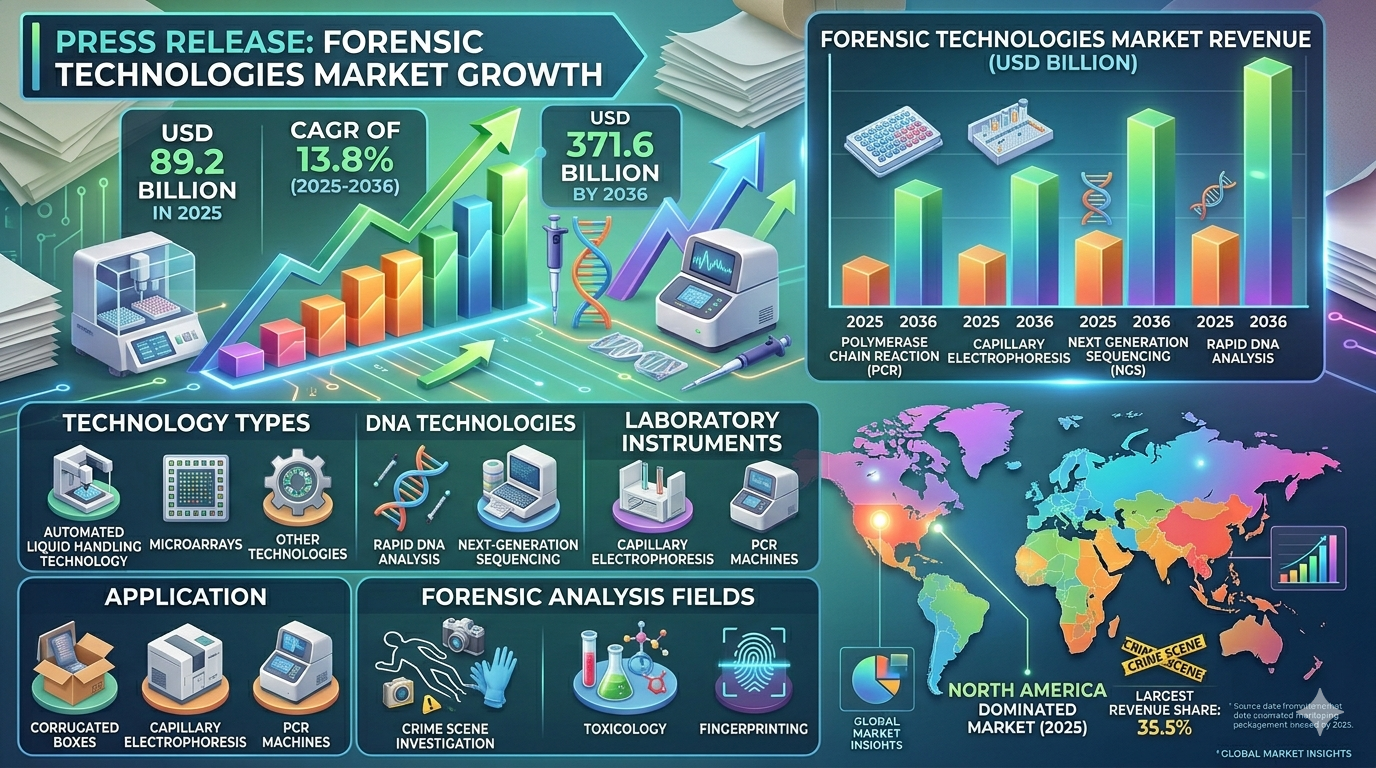
The global forensic technologies market was valued at USD 89.2 billion in 2025 and is projected to reach USD 371.6 billion by 2036, growing at a robust CAGR of 13.8% from 2025 to 2036. This strong growth is driven by increasing adoption of advanced forensic solutions across law enforcement, healthcare, and security sectors.
👉 Get sample market research report copy today@ https://www.transparencymarketresearch.com/sample/sample.php?flag=S&rep_id=819
Market Overview
The forensic technologies market is catalyzed by structural changes in law enforcement as well as judicial systems in place of episodic crime trends. Criminal investigations increasingly rely on scientific evidence for establishing credibility, reducing wrongful convictions, and strengthening prosecution outcomes. This has resulted in higher demand for validated forensic methods across toxicology, DNA analysis, trace evidence examination, and digital forensics.
The increased backlog of forensic cases has further highlighted the need for more automated and faster analytical solutions capable of handling huge sample volumes without compromising on precision. Governments across emerging and developed economies are prioritizing forensic modernization as a part of wider public safety reforms.
Analysts’ Viewpoint
The forensic technologies market is undergoing a transition from investigator-dependent, manual processes to technology-driven, standardized evidence generation frameworks. Growth is being driven by rising crime complexity, increased reliance on scientific evidence in judicial proceedings, and mounting pressure on law enforcement agencies to improve case resolution timelines.
Advancements in DNA profiling, toxicology, digital forensics, and biometrics are strengthening the evidentiary value of forensic outputs while lessening human bias. The key players like QIAGEN, Thermo Fisher Scientific, and Agilent Technologies are shaping the market through high-throughput platforms, automation, and integrated forensic workflows.
Investment by the public sector in forensic infrastructure, as well as the modernization of crime laboratories, continues to extend support to adoption. At the same time, the courts are increasingly demanding scientifically validated and reproducible evidence, thereby reinforcing the role of advanced forensic tools. On the whole, the market reflects a shift toward precision, speed, and standardization, thereby positioning forensic technologies as a foundational pillar of modern-day criminal justice systems.
Analysis of Key Players
The competitive landscape is a mix of life-science giants and specialized digital intelligence firms.
Leading companies operating in the global forensic technologies market include:
- Agilent Technologies
- GE Healthcare
- Thermo Fisher Scientific, Inc.
- NMS Labs
- Eurofins Medigenomix GmbH
- LGC Forensics
- Forensic Pathways
- SPEX Forensics
- Forensic Fluids Laboratories
- Pyramidal Technologies Ltd
- Other Prominent Players
Strategic moves in 2026 show a focus on Integrated Ecosystems, where companies like Cellebrite and Cisco (via Splunk) are bundling data extraction with AI-driven correlation tools to help analysts connect data across multiple devices simultaneously.
Recent Developments (2025–2026)
- April 2026: New survey data revealed that 97% of investigators now frequently use smartphones as a primary source of evidence, up from 73% in 2024.
- February 2026: Cellebrite secured a major government contract to deploy its Inseyets platform, designed to accelerate the extraction of lawful evidence from the latest encrypted mobile operating systems.
- Late 2025: Researchers successfully commercialized Rapid DNA kits that can provide a CODIS-compatible profile in under 90 minutes, enabling “booking station” DNA testing.
- In January 2023, Promega Corporation released the Power Plex 35GY system. This DNA analysis kit aids forensic laboratories in dealing more elaborately with specific demanding cases, especially sexual assault cases.
👉 Discuss Implications for Your Industry Request Sample Research Report PDF@ https://www.transparencymarketresearch.com/sample/sample.php?flag=B&rep_id=819
Key Developments & Trends
- AI-Powered Investigations: Automated correlation of data across disparate sources (social media, IoT, and mobile devices).
- Next-Generation Sequencing (NGS): Allowing for more detailed genetic profiles from smaller or more degraded samples.
- Pharmacogenetics: Expanding forensics into the study of how human DNA variation affects drug reactions, useful in toxicology.
- Real-time Mobile Extraction: Shift toward “Field-as-a-Service” (FaaS) where data is extracted at the scene rather than the lab.
- Cybersecurity Forensics: The fastest-growing sub-segment, addressing ransomware tracking and financial fraud.
Challenges
- Encryption Barriers: 86% of respondents report high difficulty in unlocking modern iOS devices, stalling investigation timelines.
- Labor & Skill Gaps: A global shortage of certified digital forensic analysts and molecular biologists.
- Data Volume Overload: A typical investigation now involves 2 to 5 devices, creating a “data lake” that is difficult for non-technical stakeholders to interpret.
- Privacy & Ethics: Mounting pressure to balance DNA database expansion with individual genetic privacy rights.
Opportunities
- Digital India & APAC Modernization: Massive state-led investments in forensic infrastructure in emerging economies.
- Biodefense & Bio-surveillance: Using forensic technology to track pathogens and biogenic threats in real-time.
- Private Sector Fraud Detection: High demand from the BFSI sector for forensic accounting and digital breach remediation.
- Unmanned Aerial Vehicle (UAV) Forensics: A new niche focused on extracting flight data and telemetry from drones used in criminal activity.
Market Segmentation
➤ By Type
- DNA Profiling (Market Leader ~45% share)
- Biometric Analysis
- Digital Forensics (Fastest Growing ~11.4% CAGR)
- Chemical Analysis & Toxicology
➤ By Location
- Laboratory Forensics (Dominant ~71% share)
- Portable/Field Forensics (High Growth)
➤ By Application
- Judicial & Law Enforcement (Largest segment ~36% share)
- Biodefense & Bio-surveillance
- Pharmacogenetics
- Corporate Investigations (High growth in BFSI)
Conclusion
The forensic technologies industry has evolved into the backbone of the modern justice system. Through 2036, the market will be defined by velocity. As criminal activity becomes more digital and genetically complex, the companies that can bridge the decryption gap and provide automated, defensible AI insights will lead the next generation of public safety.
👉 To buy this comprehensive market research report, click here to inquire@ https://www.transparencymarketresearch.com/checkout.php?rep_id=819<ype=S
About Transparency Market Research
Transparency Market Research, a global market research company registered at Wilmington, Delaware, United States, provides custom research and consulting services. Our exclusive blend of quantitative forecasting and trends analysis provides forward-looking insights for thousands of decision makers. Our experienced team of Analysts, Researchers, and Consultants use proprietary data sources and various tools & techniques to gather and analyses information.
Our data repository is continuously updated and revised by a team of research experts, so that it always reflects the latest trends and information. With a broad research and analysis capability, Transparency Market Research employs rigorous primary and secondary research techniques in developing distinctive data sets and research material for business reports.
Contact:
Abhishek Budholiya
Transparency Market Research Inc.
State Tower, 90 State Street, Suite 700,
Albany NY – 12207, United States
Tel: +1-518-618-1030
USA – Canada Toll Free: 866-552-3453
Website: https://www.transparencymarketresearch.com
Sales Inquiries: sales@transparencymarketresearch.com
Media Inquiries: media@transparencymarketresearch.com

Leave a Reply