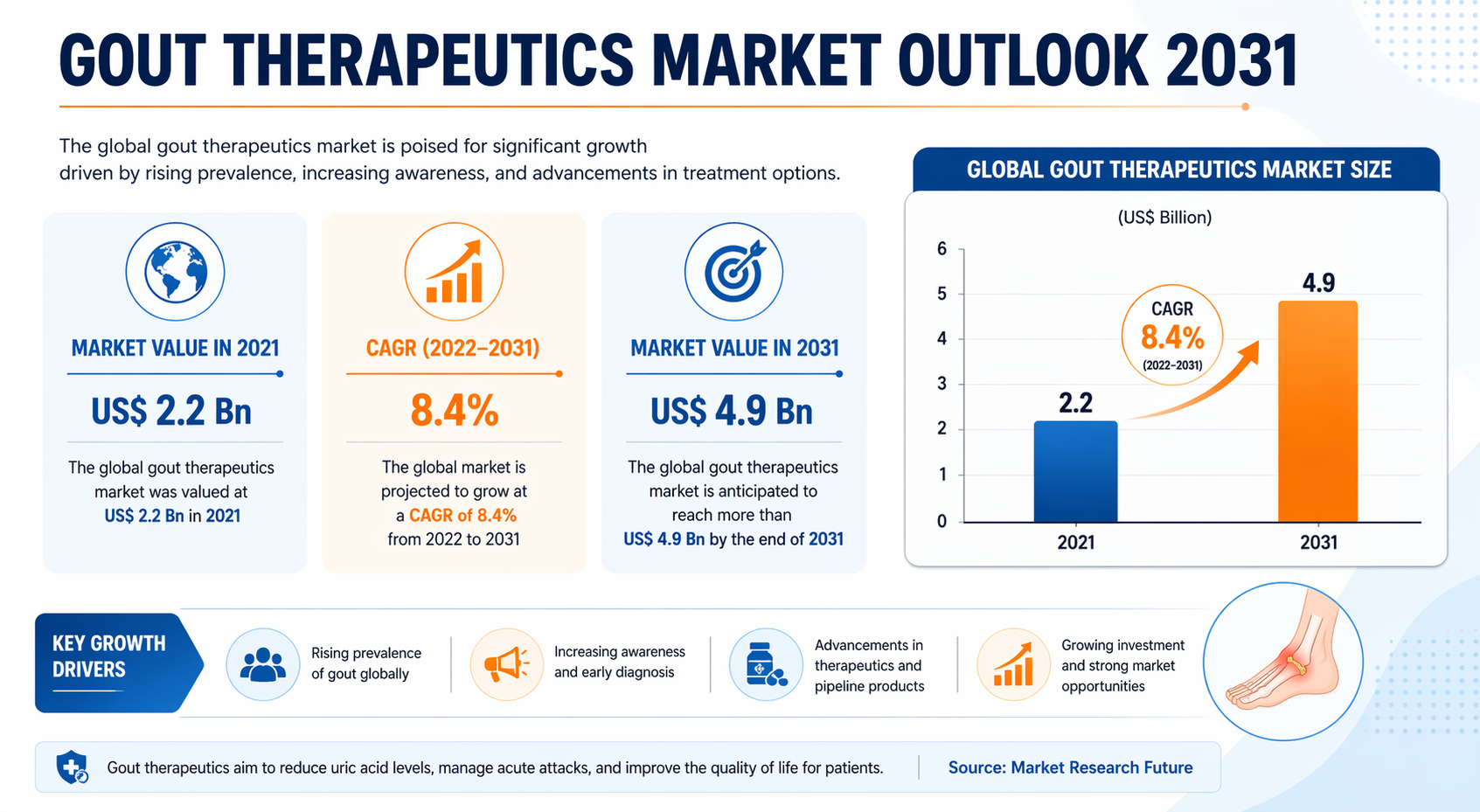
The global gout therapeutics market was valued at US$ 2.2 billion in 2021 and is projected to exceed US$ 4.9 billion by 2031, expanding at a CAGR of 8.4% from 2022 to 2031.
Growth is driven by increasing prevalence of gout, rising geriatric population, and expanding adoption of urate-lowering and anti-inflammatory therapies across global healthcare systems.
Review critical insights and findings from our Report in this sample –
https://www.transparencymarketresearch.com/sample/sample.php?flag=S&rep_id=66875
Market Overview
Gout is a metabolic and inflammatory arthritis caused by elevated uric acid levels leading to monosodium urate crystal deposition in joints. It is characterized by sudden, severe pain, swelling, redness, and recurrent inflammatory flare-ups.
The condition most commonly affects the big toe but can also impact knees, ankles, and other joints. Gout is more prevalent in men but increases significantly in post-menopausal women due to hormonal changes.
Treatment typically involves:
- Acute pain management (NSAIDs, colchicine, corticosteroids)
- Long-term urate control (urate-lowering drugs)
- Emerging biologic therapies targeting inflammatory pathways
The market is evolving with increased R&D activity focused on targeted therapies, biologics, and improved patient compliance solutions.
Key Market Growth Drivers
1. Rising Incidence of Gout Worldwide
The prevalence of gout has increased significantly due to lifestyle changes, obesity, metabolic disorders, hypertension, and diabetes. Aging populations further accelerate disease incidence.
2. Growing Geriatric Population
Older individuals are more susceptible to hyperuricemia and gout flare-ups, driving consistent demand for long-term treatment therapies.
3. High Burden of Comorbidities
Conditions such as chronic kidney disease, cardiovascular disorders, and metabolic syndrome increase gout prevalence and treatment complexity.
4. Advancements in Drug Development
Pharmaceutical companies are investing in biologics, urate-lowering therapies, and RNA-based treatments to improve efficacy and reduce recurrence.
5. Increasing Awareness and Diagnosis Rates
Improved diagnostic capabilities and awareness campaigns are leading to earlier detection and treatment initiation.
Analysis of Key Players – Key Player Strategies
The global gout therapeutics market is moderately consolidated, with major pharmaceutical companies dominating global distribution and R&D pipelines.
Key Players Include:
- Takeda Pharmaceutical Company Limited
- Novartis AG
- Merck & Co., Inc.
- Teva Pharmaceutical Industries Ltd.
- Mylan N.V.
- Hikma Pharmaceuticals plc
- Horizon Therapeutics plc
- Iroko Pharmaceuticals LLC
- Teijin Pharma Limited
- AstraZeneca
Key Player Strategies
- Pipeline Expansion: Development of biologics and next-generation urate-lowering therapies
- Strategic Collaborations: Partnerships for RNA-based and targeted gout treatments
- Regulatory Approvals: Expansion through FDA and global approvals for novel therapies
- Mergers & Acquisitions: Strengthening portfolios through acquisitions and licensing deals
- Geographic Expansion: Focus on emerging markets in Asia Pacific and Latin America
Market Challenges & Opportunities
Challenges
- Side effects associated with NSAIDs and corticosteroids
- Limited awareness in developing regions
- High treatment discontinuation rates
- Complex management of chronic gout cases
- Regulatory hurdles for biologics and novel drugs
Opportunities
- Rising demand for biologics and targeted therapies
- Expansion of online and retail pharmacy distribution
- Growth in emerging economies with increasing healthcare access
- Development of personalized gout treatment approaches
- Increasing adoption of combination therapy strategies
Investment Landscape and ROI Outlook
The gout therapeutics market offers strong long-term investment potential due to sustained disease prevalence and recurring treatment requirements.
- High ROI potential from chronic treatment dependency
- Stable revenue streams from long-term urate-lowering therapies
- Strong pipeline growth in biologics and RNA-based drugs
- Expanding emerging markets offering untapped growth potential
- Pharma partnerships increasing commercialization efficiency
Investors are increasingly focusing on companies with strong biologics pipelines and global distribution capabilities.
Market Segmentations
By Drug Type
- NSAIDs (Largest segment)
- Colchicine
- Corticosteroids
- Urate-lowering Drugs
- Biologics
NSAIDs dominate due to their effectiveness in acute pain relief and widespread clinical use.
By Distribution Channel
- Hospital Pharmacies (Dominant segment)
- Retail Pharmacies
- Online Pharmacies
Hospital pharmacies lead due to higher treatment of severe and chronic gout cases in clinical settings.
By Region
- North America – Largest market share
- Europe – Strong healthcare infrastructure and high diagnosis rates
- Asia Pacific – Fastest-growing region due to rising gout incidence
- Latin America – Moderate growth driven by healthcare expansion
- Middle East & Africa – Emerging market with increasing awareness
North America remains dominant due to high disease prevalence and strong pharmaceutical penetration.
Recent Developments
In August 2022, Synlogic, Inc., a clinical-stage biotechnology company developing medicines for metabolic and immunological diseases using its proprietary synthetic biology approach, announced the development of a new drug candidate for the treatment of gout in collaboration with Ginkgo Bioworks, a leading horizontal platform for cell programming
In July 2022, Horizon Therapeutics’ supplemental Biologics License Application (sBLA) for the Krystexxa (pegloticase) injection, given in conjunction with methotrexate, to help uncontrolled gout patients achieve a complete response to treatment received approval from the U.S. Food and Drug Administration (FDA).
In June 2021, Arrowhead Pharmaceuticals, Inc. and Horizon Therapeutics plc announced a global collaboration and license agreement for ARO-XDH, a previously unknown discovery-stage investigational RNA interference (RNAi) therapeutic being developed by Arrowhead as a potential treatment for uncontrolled gout
Why Buy This Report?
- Detailed global market size and forecast (2022–2031)
- Comprehensive segmentation by drug type and distribution channel
- Competitive landscape with key pharmaceutical strategies
- Investment insights and ROI analysis
- Emerging biologics and pipeline drug tracking
- Regional growth opportunities and market entry strategies
FAQs
1. What is the size of the gout therapeutics market?
The market was valued at US$ 2.2 billion in 2021.
2. What is the forecast value of the market by 2031?
It is expected to exceed US$ 4.9 billion by 2031.
3. What is the growth rate of the market?
The market is projected to grow at a CAGR of 8.4% from 2022 to 2031.
4. Which drug type dominates the market?
NSAIDs dominate due to their effectiveness in treating acute gout pain.
5. Which region leads the gout therapeutics market?
North America holds the largest share due to high disease prevalence and advanced healthcare systems



Leave a Reply