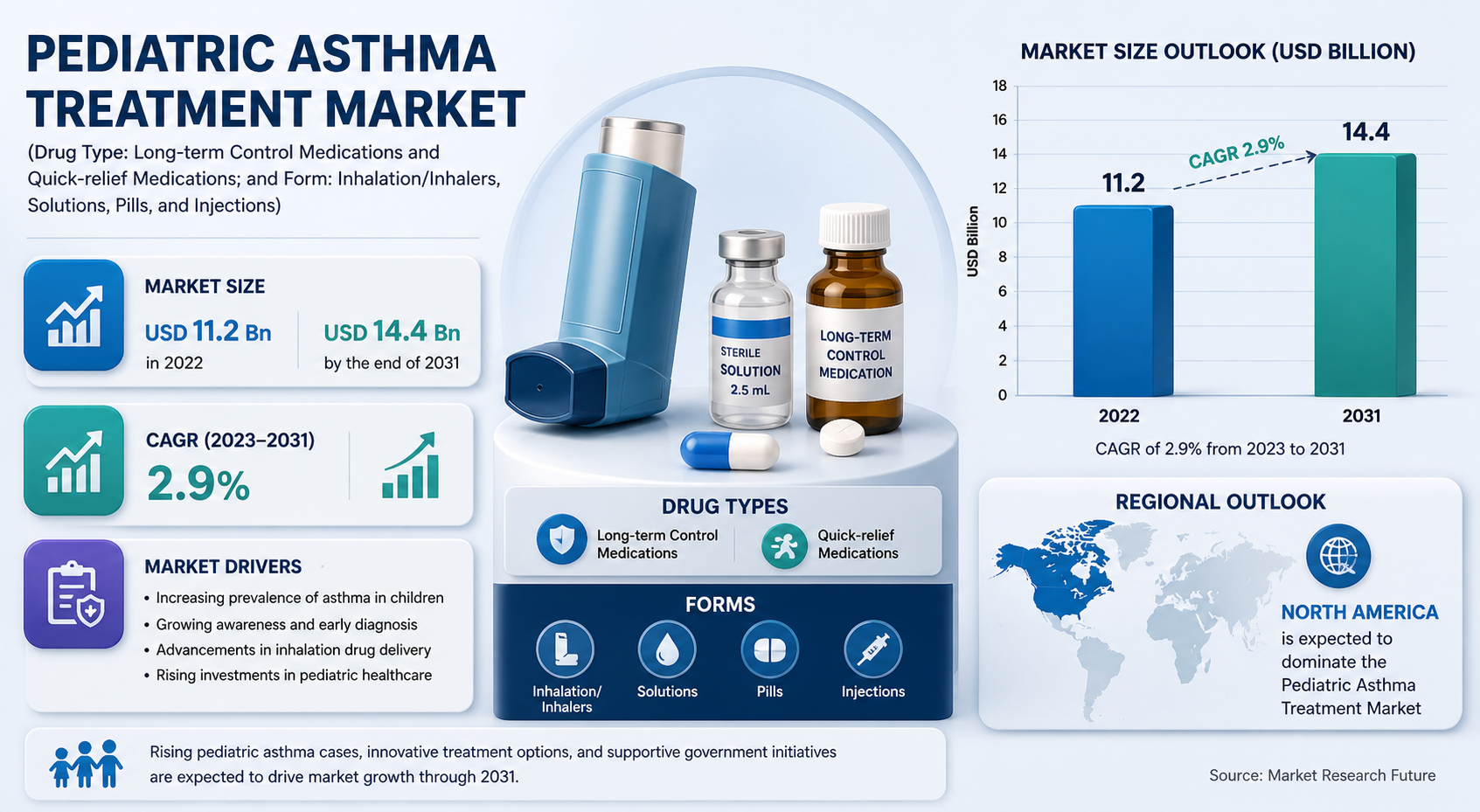
The pediatric asthma treatment market is expected to witness steady growth through 2031, driven by the rising prevalence of asthma among children and increasing awareness of early diagnosis and treatment. Valued at USD 11.2 billion in 2022, the market is projected to surpass USD 14.4 billion by the end of 2031, expanding at a CAGR of 2.9% from 2023 to 2031. Ongoing advancements in inhalation therapies, biologics, and pediatric-specific formulations, along with improved healthcare access, are supporting market expansion globally.
👉 Get sample market research report copy today@ https://www.transparencymarketresearch.com/sample/sample.php?flag=S&rep_id=53973
Market Overview
Pediatric asthma treatment is a medical approach for managing asthma symptoms in children. It typically includes a combination of medications, lifestyle changes, and regular medical check-ups to control airway inflammation, prevent symptoms, and manage sudden attacks. The treatment aims to improve the child’s quality of life and prevent complications associated with uncontrolled asthma.
Medications such as bronchodilators and corticosteroids are used to manage acute symptoms and prevent long-term lung damage. Inhaled corticosteroid is the preferred medication for controlling inflammation, as it has fewer side effects than oral steroids.
Lifestyle changes, such as avoiding triggers, improving air quality, and promoting physical activity, are also important components of asthma management. Development of new, targeted therapies and better adherence programs is an area of ongoing research and development in the field of asthma treatment in children.
Analysts’ Viewpoint
Rise in environmental irritants and increase in awareness about the severe effects of pediatric asthma are contributing to the global pediatric asthma treatment market growth. Various companies are obtaining FDA approvals for drugs used in the treatment of pediatric asthma.
Leading companies are arranging educative programs for children as well as healthcare professionals regarding the correct usage of inhalers through digital platforms. Rise in participation of several large organizations in spreading knowledge about disease control measures and available treatments for asthma is augmenting market statistics.
Analysis of Key Players
The pediatric market is controlled by an oligopoly of respiratory giants, but it is seeing increased activity from biotech firms focusing on child-friendly delivery systems.
Leading companies operating in the pediatric asthma treatment market include:
- AstraZeneca PLC
- Boehringer Ingelheim International GmbH
- CHIESI Farmaceutici S.p.A.
- ECU Health
- GlaxoSmithKline
- Novartis AG
- OPKO Health, Inc.
- Pfizer Inc.
- Sanofi
- Teva Pharmaceutical Industries Ltd.
Strategic moves in 2026 show a focus on Biosimilar Democratization, as the upcoming patent cliffs for major biologics are expected to lower entry barriers for cost-sensitive pediatric populations.
Key Developments in Global Pediatric Asthma Treatment Industry
- In 2022, Sanofi’s Dupixent was approved by the European Medicines Agency as an add-on maintenance therapy for children (6 to 11 years old) with severe asthma with type 2 inflammation.
- In September 2019, GSK announced the FDA approval for Nucala (mepolizumab), a monoclonal antibody that targets interleukin (IL)-5, for the treatment of severe eosinophilic asthma in children six years and older.
Each of these players has been profiled in the pediatric asthma treatment market report based on parameters such as financial overview, business segments, company overview, recent developments, product portfolio, and business strategies.
👉 Discuss Implications for Your Industry Request Sample Research Report PDF@ https://www.transparencymarketresearch.com/sample/sample.php?flag=B&rep_id=53973
Key Developments & Trends
- Early Intervention Guidelines: Shift from “watchful waiting” to immediate low-dose ICS for children under 5 with recurrent wheezing.
- Biologic Penetration: Increasing use of IL-4, IL-5, and TSLP inhibitors in children who fail traditional inhaled therapies.
- Green Inhaler Transition: Reformulation of pMDIs with climate-friendly propellants like HFO-1234ze to comply with ESG mandates.
- Tele-Monitoring: Proliferation of Bluetooth-enabled spacers and peak-flow meters for remote pediatrician oversight.
- Home-Based Autoinjectors: Emergence of “at-home” biologic dosing options to minimize school disruption for children.
Challenges
- Technique Variability: Over 50% of children struggle with correct MDI/DPI technique, leading to sub-optimal real-world efficacy.
- High Treatment Costs: Pediatric biologics remain prohibitively expensive (US$ 15k–40k/year), creating significant payer pushback.
- Growth Concerns: Ongoing clinical monitoring of long-term ICS use on child growth and bone density (updated labeling in 2026).
- Propellant Drag: The capital-intensive shift to eco-propellants is slowing the launch of new low-cost generic inhalers.
Opportunities
- Personalized “Indication Stacking”: Using drugs like Dupixent to treat pediatric asthma alongside comorbid Atopic Dermatitis.
- Soft Mist Inhalers (SMI): High growth potential for devices that require low inspiratory force, ideal for very young children.
- School Health Integration: Partnerships with educational districts for smart adherence programs.
- Biosimilars (2026-2030): Massive opportunity as omalizumab and mepolizumab biosimilars enter the market to expand access.
Market Segmentation
➤ By Treatment Type
- Long-term Control Medications (Market Leader ~58.5%)
- Quick-relief Medications (SABAs – Projected 6.45% CAGR)
- Supportive Therapies (Spacers, OPEP devices)
➤ By Drug Class
- Inhaled Corticosteroids (ICS – ~34.7% share)
- Biologics/Monoclonal Antibodies (Fastest Growing ~7.4% CAGR)
- Combination Therapies (ICS/LABA)
- Leukotriene Receptor Antagonists (Oral)
➤ By Route of Administration
- Inhalation (Dominant ~62.5% share)
- Injectable (Fastest Growing ~8.4% CAGR)
- Oral
➤ By End User
- Hospitals & Clinics (Largest Segment ~46.9%)
- Home Care (Fastest Growing ~10.7% CAGR)
Conclusion
The pediatric asthma treatment market in 2026 is moving toward precision and persistence. Through 2035, the industry will be defined by accessibility and digital integration. As healthcare shifts toward a “Total Child” approach—treating asthma alongside its common comorbidities—the companies that offer easy-to-use, tech-enabled, and cost-effective solutions will dominate the pediatric landscape.
👉 To buy this comprehensive market research report, click here to inquire@ https://www.transparencymarketresearch.com/checkout.php?rep_id=53973<ype=S
About Transparency Market Research
Transparency Market Research, a global market research company registered at Wilmington, Delaware, United States, provides custom research and consulting services. Our exclusive blend of quantitative forecasting and trends analysis provides forward-looking insights for thousands of decision makers. Our experienced team of Analysts, Researchers, and Consultants use proprietary data sources and various tools & techniques to gather and analyses information.
Our data repository is continuously updated and revised by a team of research experts, so that it always reflects the latest trends and information. With a broad research and analysis capability, Transparency Market Research employs rigorous primary and secondary research techniques in developing distinctive data sets and research material for business reports.
Contact:
Abhishek Budholiya
Transparency Market Research Inc.
State Tower, 90 State Street, Suite 700,
Albany NY – 12207, United States
Tel: +1-518-618-1030
USA – Canada Toll Free: 866-552-3453
Website: https://www.transparencymarketresearch.com
Sales Inquiries: sales@transparencymarketresearch.com
Media Inquiries: media@transparencymarketresearch.com


Leave a Reply