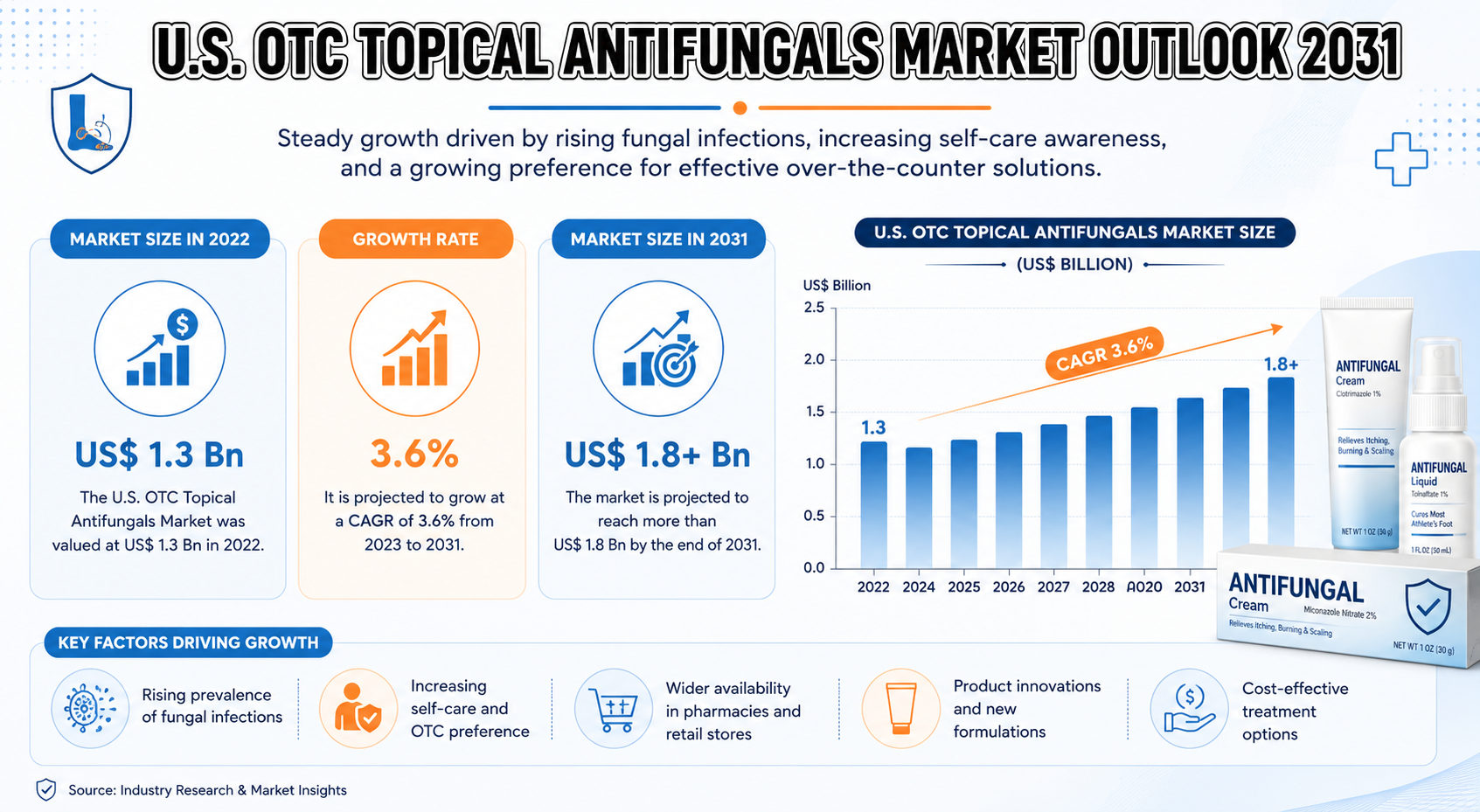
The U.S. OTC topical antifungals market is experiencing steady growth as rising prevalence of fungal skin infections, increasing consumer awareness regarding self-medication, and expanding availability of over-the-counter treatment products continue to drive market demand. According to recent industry analysis, the U.S. OTC topical antifungals market was valued at US$ 1.3 billion in 2022 and is projected to surpass US$ 1.8 billion by the end of 2031, expanding at a CAGR of 3.6% during the forecast period from 2023 to 2031.
The market is benefiting from changing consumer healthcare preferences, increasing inclination toward accessible non-prescription medications, and growing demand for convenient topical formulations such as creams, sprays, powders, and gels. Additionally, continuous advancements in antifungal formulations and strategic initiatives by major pharmaceutical manufacturers are supporting long-term market expansion across the United States.
Market Size and Industry Outlook
The U.S. OTC topical antifungals industry has emerged as an essential segment within the broader dermatology and consumer healthcare market. The industry generated revenue of US$ 1.3 billion in 2022 and is expected to witness consistent growth through 2031 due to increasing cases of fungal infections affecting the skin, scalp, nails, and hair.
The projected market value of more than US$ 1.8 billion by 2031 reflects rising demand for affordable and easily accessible antifungal medications. Consumers are increasingly relying on OTC solutions for common fungal infections such as athlete’s foot, ringworm, and jock itch, thereby reducing dependence on prescription-based therapies for mild to moderate conditions.
The market’s steady growth trajectory is also supported by increasing healthcare awareness campaigns, expanding pharmacy distribution networks, and growth in online pharmaceutical retailing.
Market Overview
OTC topical antifungals are non-prescription medications designed to treat fungal infections affecting the skin and surrounding tissues. These medications are available in several dosage forms, including creams, lotions, sprays, powders, ointments, and gels.
Common active ingredients used in OTC topical antifungal products include clotrimazole, miconazole, terbinafine, tolnaftate, ketoconazole, butenafine, and undecylenic acid. These antifungal agents work by inhibiting fungal growth and eliminating infection-causing organisms.
Topical antifungals are widely used to treat common fungal conditions such as:
- Athlete’s foot
- Ringworm
- Jock itch
- Vaginal fungal infections
- Nail fungal infections
- Skin yeast infections
The increasing convenience of OTC availability allows consumers to purchase these products directly from retail pharmacies and online platforms without requiring physician prescriptions. This accessibility is significantly contributing to market expansion.
Key Market Growth Drivers
Rising Prevalence of Fungal Infections
One of the primary factors driving the U.S. OTC topical antifungals market is the increasing prevalence of fungal infections across the country. Environmental conditions, poor hygiene practices, rising participation in communal activities, and growing exposure to warm and humid environments have contributed to higher infection rates.
Fungal infections thrive in areas such as locker rooms, swimming pools, fitness centers, and public showers. The increasing use of communal facilities has elevated the risk of transmission among consumers.
Ringworm remains one of the most common fungal infections in the United States. According to industry findings, approximately 10% to 20% of the population experiences ringworm infections during their lifetime. The southeastern region of the U.S. shows particularly high prevalence of tinea capitis or scalp ringworm.
The growing incidence of vaginal candidiasis is also supporting market growth. Vaginal candidiasis remains one of the most common fungal infections among women in the country, resulting in nearly 1.4 million medical consultations annually.
Surge in Consumer Awareness Regarding OTC Antifungal Treatments
Consumer awareness regarding fungal infection symptoms and available treatment options has improved significantly in recent years. Educational campaigns, digital healthcare platforms, and increasing access to healthcare information have encouraged early diagnosis and self-treatment of mild fungal conditions.
OTC antifungal products offer convenience, affordability, and immediate accessibility compared to prescription medications that require physician consultations. As consumers become more informed about fungal infection management, demand for non-prescription topical solutions continues to rise.
Minor fungal infections such as athlete’s foot and ringworm are increasingly being treated using OTC creams and sprays, thereby boosting market demand.
Growing Geriatric Population
The aging population in the United States is another key driver supporting industry expansion. Older adults are more susceptible to fungal infections due to weakened immune systems, chronic health conditions, and reduced skin barrier function.
According to recent demographic statistics, more than 54.1 million adults aged 65 years or older lived in the U.S. in 2022, accounting for approximately 16.3% of the total population. This demographic trend is expected to contribute significantly to future demand for topical antifungal medications.
Expanding Availability Through Retail Pharmacies and Online Channels
The widespread availability of OTC antifungal products through retail pharmacies and online distribution platforms is making treatment more accessible to consumers nationwide.
Retail pharmacies remain the dominant distribution channel due to consumer trust, product availability, and pharmacist recommendations. At the same time, online pharmacy platforms are gaining popularity among consumers seeking convenience, privacy, and home delivery services.
Analysis of Key Players – Key Player Strategies
The U.S. OTC topical antifungals market is relatively consolidated, with several major pharmaceutical companies accounting for a substantial share of total industry revenue. Key market participants are increasingly investing in product innovation, strategic acquisitions, and portfolio expansion to strengthen their competitive positions.
Leading companies operating in the market include:
- Novartis AG
- Merck KGaA
- Dr. Reddy’s Laboratories Ltd.
- Pfizer, Inc.
- Abbott Laboratories
- Bayer AG
- Sanofi
- Crown
Product Portfolio Expansion
Leading pharmaceutical manufacturers are actively expanding their topical antifungal product portfolios by introducing new formulations, delivery systems, and combination therapies.
Companies are focusing on improving product effectiveness, enhancing patient convenience, and extending product shelf life to differentiate themselves in the competitive market.
Strategic Alliances and Acquisitions
Industry participants are increasingly pursuing mergers, acquisitions, and licensing agreements to strengthen their market presence and broaden their product offerings.
Strategic collaborations allow companies to leverage established distribution networks, improve brand visibility, and accelerate commercialization of new products.
Focus on Research and Development
Manufacturers are making significant investments in research and development to create advanced antifungal products with improved efficacy and reduced side effects.
Innovation efforts are centered on developing formulations that provide faster symptom relief, enhanced absorption, and better patient compliance.
Distribution Channel Expansion
Companies are strengthening relationships with retail pharmacy chains, e-commerce platforms, and healthcare distributors to maximize product accessibility and consumer reach.
The increasing importance of online pharmacies is also encouraging manufacturers to optimize digital marketing and direct-to-consumer sales strategies.
Market Challenges & Opportunities
Challenges
Intense Market Competition
The OTC topical antifungals market is characterized by intense competition among branded and generic pharmaceutical manufacturers. The availability of low-cost generic alternatives may impact pricing strategies and profit margins for established companies.
Consumer Misdiagnosis and Self-Treatment Risks
While OTC accessibility offers convenience, self-diagnosis and improper product usage can sometimes delay appropriate medical treatment for severe fungal infections. Misuse of antifungal medications may also contribute to recurrent infections and treatment resistance.
Regulatory Compliance
Pharmaceutical manufacturers must comply with strict FDA regulations related to product safety, efficacy, labeling, and manufacturing standards. Regulatory requirements can increase product development costs and delay market entry for new formulations.
Opportunities
Growing Demand for Self-Care Healthcare Products
Consumers are increasingly adopting self-care practices and seeking non-prescription healthcare solutions for common medical conditions. This trend is creating substantial opportunities for OTC antifungal product manufacturers.
Expansion of E-Commerce and Online Pharmacies
The rapid growth of digital healthcare platforms and online pharmacies is opening new sales channels for OTC antifungal products. Consumers increasingly prefer online purchasing due to convenience, competitive pricing, and product variety.
Innovation in Advanced Formulations
There is rising demand for advanced topical formulations that offer faster relief, improved absorption, odor control, and enhanced cosmetic appeal. Manufacturers investing in innovative formulations are likely to gain competitive advantages in the market.
Recent Developments
In January 2023, Sandoz, a subsidiary of Novartis AG, acquired leading antifungal agent Mycamine from Astellas Pharma, a Japanese multinational pharmaceutical company.
In December 2016, Dr. Reddy’s Laboratories Ltd. launched anti-fungal ointment nystatin and triamcinolone acetonide in the U.S. The product is the generic equivalent of nystatin and triamcinolone acetonide cream, USP 1,00,000 units/g-0.1 percent manufactured by Taro Pharmaceuticals U.S.A., Inc.
Investment Landscape and ROI Outlook
The U.S. OTC topical antifungals market presents stable long-term investment opportunities driven by growing healthcare awareness, increasing prevalence of fungal infections, and expanding self-medication trends.
Investments in innovative antifungal formulations, digital healthcare distribution channels, and consumer-focused branding strategies are expected to generate favorable returns during the forecast period.
The consistent demand for affordable OTC treatment solutions provides a resilient revenue base for pharmaceutical manufacturers operating in this market. Companies with strong retail pharmacy partnerships, extensive product portfolios, and established consumer brands are well-positioned to achieve sustained growth.
Additionally, rising healthcare expenditure, aging demographics, and increased focus on preventive dermatological care are expected to support continued market expansion through 2031.
Market Segmentation
By Drug Class
Azoles
- Clotrimazole
- Fluconazole
- Ketoconazole
- Miconazole
- Others
Allylamine
- Terbinafine
- Butenafine
- Others
Tolnaftate
Undecylenic Acid
Others
By Indication
- Ringworm
- Jock Itch
- Athlete’s Foot
- Others
By Dosage Form
- Creams
- Gels
- Ointments
- Others
By Distribution Channel
- Hospital Pharmacies
- Retail Pharmacies
- Online Pharmacies
Why Buy This Report?
- Gain detailed insights into the U.S. OTC topical antifungals market from 2023 to 2031
- Understand major growth drivers, market challenges, and emerging opportunities
- Analyze competitive strategies adopted by leading pharmaceutical companies
- Evaluate investment opportunities and future ROI potential
- Access detailed market segmentation by drug class, indication, dosage form, and distribution channel
- Identify key market trends influencing consumer purchasing behavior
- Benefit from comprehensive company profiles and recent industry developments
- Support strategic planning and business expansion decisions with accurate market intelligence
Frequently Asked Questions (FAQs)
1. What is the projected size of the U.S. OTC topical antifungals market by 2031?
The market is projected to surpass US$ 1.8 billion by the end of 2031.
2. What is driving growth in the U.S. OTC topical antifungals market?
Key growth drivers include rising prevalence of fungal infections, growing consumer awareness, increasing geriatric population, and expanding retail pharmacy availability.
3. Which drug class dominates the market?
The azoles segment is expected to account for the largest market share due to widespread availability and effectiveness in treating fungal infections.
4. Which dosage form is most commonly used?
Creams represent the dominant dosage form because they are easy to apply, quickly absorbed, and highly effective for treating common fungal skin conditions.
5. Who are the leading companies in the U.S. OTC topical antifungals market?
Major companies include Novartis AG, Merck KGaA, Dr. Reddy’s Laboratories Ltd., Pfizer, Inc., Abbott Laboratories, Bayer AG, Sanofi, and Crown.


Leave a Reply