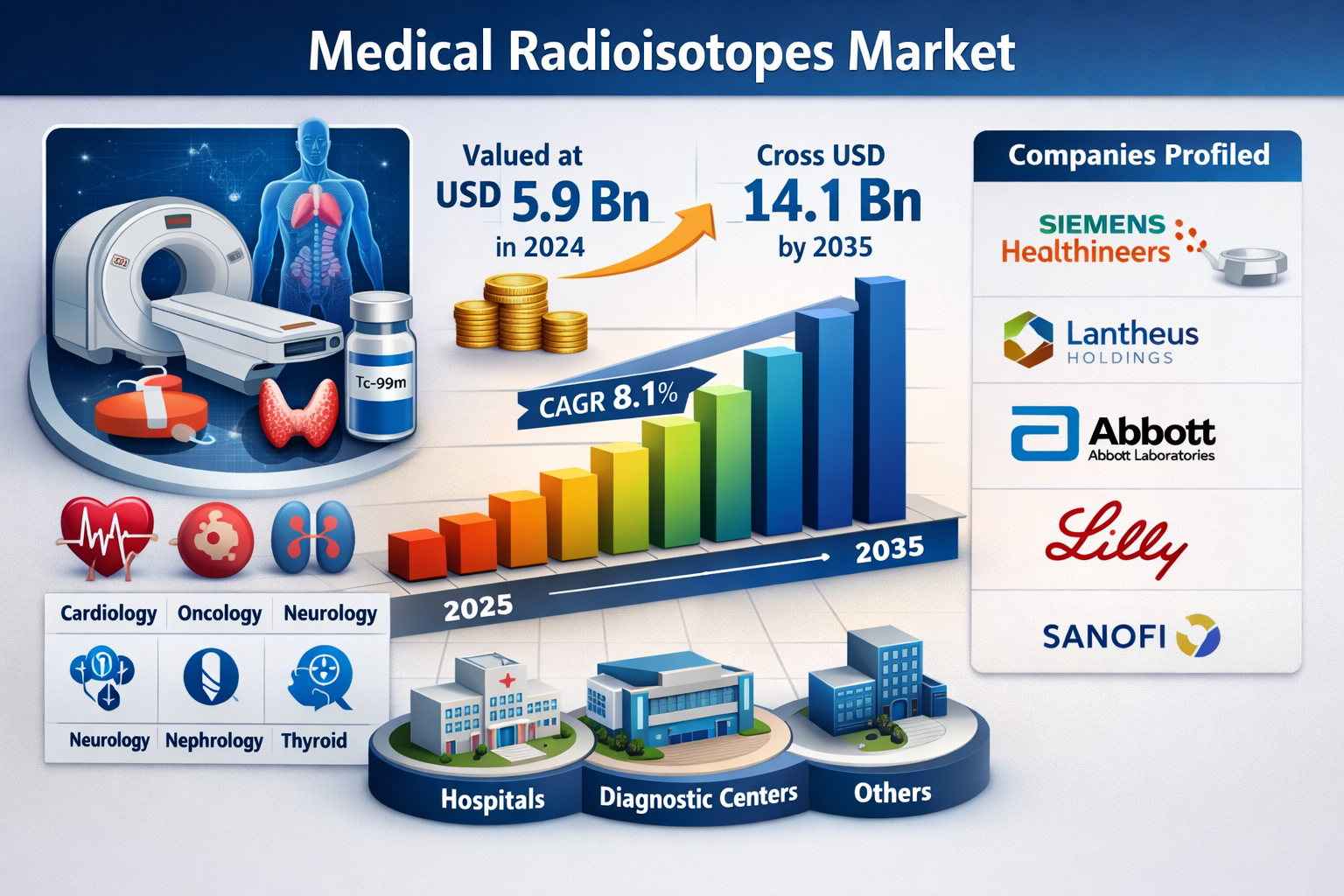
The global medical radioisotopes market was valued at approximately USD 6.6 Bn in 2025 and is projected to reach USD 14.9 Bn by 2036, expanding at a CAGR of 8.7% from 2026 to 2036. The market is at a pivotal crossroads as it shifts from a historical dependence on aging nuclear reactors to a decentralized, tech-forward infrastructure powered by cyclotrons and automated radiosynthesis.
👉 Get sample market research report copy today@ https://www.transparencymarketresearch.com/sample/sample.php?flag=S&rep_id=86586
Market Overview
Medical radioisotopes are radioactive substances used for diagnosing and treating various medical conditions, particularly in oncology, cardiology, and neurology. Such isotopes emit radiation that can be detected by imaging devices, thereby allowing healthcare professionals to visualize and assess internal bodily functions and structures.
Commonly used medical radioisotopes include technetium-99m, which is broadly employed in diagnostic imaging owing to its ideal properties, and iodine-131, utilized for treating thyroid disorders.
The applications of medical radioisotopes extend beyond diagnostics. They also play a crucial role in targeted therapies, delivering precise radiation doses to cancerous tissues while minimizing damage to surrounding healthy cells. The growing prevalence of chronic diseases and advancements in radiopharmaceuticals are driving demand for these isotopes.
Analysts’ Viewpoint on the Global Medical Radioisotopes Market
The medical radioisotopes market is expanding exponentially and is immensely influenced by the increasing demand for diagnostic imaging and therapeutic usage of medical practice The increasing incidence of chronic diseases, such as cancer and cardiovascular disease, is increasing demand for sophisticated imaging modalities such as positron emission tomography (PET) and single-photon emission computed tomography (SPECT).
These imaging techniques are highly reliant on medical radioisotopes, particularly fluorine-18 and technetium-99m, in order to make accurate diagnosis and treatment planning.
Secondly, pharmaceutical development of radiopharmaceuticals is enhancing the efficiency of targeted therapy, primarily in oncology. The accuracy of administering accurate radiation doses to cancer cells minimizes harm to neighboring healthy tissues and hence leads to improved patient outcomes as well as lower side effects.
Analysis of Key Players in the Medical Radioisotopes Market
The market is highly consolidated due to the extreme capital requirements and regulatory barriers involved in nuclear handling.
Leading companies include:
- Curium Pharma: The global leader in SPECT and PET infrastructure.
- GE HealthCare Technologies Inc.: Integrating cyclotron hardware with proprietary tracers.
- Cardinal Health: Dominating the “last-mile” distribution via the largest radiopharmacy network.
- Novartis AG (via AAA): A pioneer in radioligand therapy with blockbuster drugs like Pluvicto.
- Lantheus Holdings, Inc.: Pushing boundaries in F-18 and PSMA-targeted diagnostics.
- Bayer AG: Leading in alpha-emitter research and therapeutic supply agreements.
- NTP Radioisotopes & Nordion: Critical large-scale reactor-based suppliers.
Emerging players like NorthStar Medical Radioisotopes and SHINE Technologies are gaining ground by using non-uranium-based production methods to ensure a “greener” and more stable supply.
Recent Developments in Medical Radioisotopes Market
- January 2026: Curium completed the expansion of its Lu-177 production line in Europe, securing its position as the primary supplier for the surging metastatic prostate cancer market.
- November 2025: Bayer AG signed a multi-year supply agreement with Ionetix for high-purity Actinium-225, aiming to accelerate its alpha-therapy pipeline.
- August 2024: The U.S. Department of Energy (DOE) announced a US$ 30 million grant to bolster domestic production of Mo-99/Tc-99m, reducing reliance on aging foreign reactors.
👉 Discuss Implications for Your Industry Request Sample Research Report PDF@ https://www.transparencymarketresearch.com/sample/sample.php?flag=S&rep_id=86586
Key Developments in the Medical Radioisotopes Market
- Alpha-Emitter Momentum: Transitioning from beta-emitters to targeted alpha therapy (TAT) for treatment-resistant cancers.
- Cyclotron-based Tc-99m: Wide-scale adoption of the ARTMS method, allowing hospitals to produce their own diagnostic tracers locally.
- Neuro-PET Expansion: Rapid growth in F-18 tracers for detecting amyloid plaques and tau tangles in Alzheimer’s patients.
- Supply Chain Digitalization: Use of blockchain and real-time sensor monitoring to track radioactive decay during global transit.
Key Player Strategies
- 🚗 Theranostic Pairings: Developing “companion” isotopes (e.g., Ga-68/Lu-177) to ensure diagnostic accuracy before expensive treatments.
- 🧠 Precision Neurology: Investing in specific tracers for Parkinson’s and Epilepsy to broaden the market beyond oncology.
- 🌐 Geographic Redundancy: Building “sister facilities” across different continents to mitigate the impact of reactor outages.
- 📈 Strategic M&A: Large pharma acquiring radioisotope tech firms (e.g., Eli Lilly’s acquisition of Point Biopharma) to own the entire value chain.
- 🔐 LEU Conversion: Transitioning all production to Low-Enriched Uranium (LEU) to meet global non-proliferation standards.
Challenges
- The “Half-Life” Race: The physical reality of radioactive decay makes storage impossible and logistics expensive.
- Decommissioning Risk: Over 60% of the world’s Mo-99 still comes from a handful of reactors that are 40+ years old.
- High CAPEX: A single commercial cyclotron facility can cost upwards of US$ 50–100 Mn.
- Regulatory Rigidity: Stringent NRC and EMA guidelines for the handling, transport, and disposal of radioactive waste.
Opportunities
- 🤖 AI in Dosimetry: Using AI to calculate the exact radiation dose for each patient, minimizing side effects.
- 📊 CDMO Growth: Rise of Contract Development and Manufacturing Organizations specialized in radiopharmaceuticals.
- 🌍 APAC Infrastructure: High growth potential in China and India as they build out massive new hospital networks.
- 🚛 Mobile Radiopharmacies: Deploying van-based “mini-labs” to produce tracers at the point of care in rural areas.
Market Segmentation
➤ By Type
- Diagnostic Radioisotopes (Tc-99m, F-18, Ga-68, I-123)
- Therapeutic Radioisotopes (Lu-177, I-131, Ac-225, Ra-223, Pb-212)
➤ By Application
- Oncology (Largest segment; 60% share)
- Cardiology (SPECT/PET perfusion studies)
- Neurology (Early Alzheimer’s and Parkinson’s diagnosis)
- Equipment Sterilization (Cobalt-60)
➤ By Source
- Nuclear Reactors (Traditional large-scale supply)
- Cyclotrons & Accelerators (Fastest-growing decentralized source)
➤ By Region
- North America: Leading with ~45% share due to high PET adoption.
- Europe: Home to major tech innovators and strict “Green Nuclear” mandates.
- Asia-Pacific: Fastest-growing CAGR (9.5%+) driven by China and Japan.
Conclusion
The medical radioisotopes market is evolving from a fragile supply chain into a robust, high-tech pillar of personalized medicine. As therapeutic applications—particularly in alpha-emitters—continue to double every few years, the demand for stable, decentralized production will define the winners of the next decade. By 2036, the “nuclear pharmacy” will be a standard feature of every major global health system.
👉 To buy this comprehensive market research report, click here to inquire@ https://www.transparencymarketresearch.com/checkout.php?rep_id=86586<ype=S
Frequently Asked Questions
- How big was the global medical radioisotopes market in 2024?
It was valued at US$ 5.9 Bn in 2024.
- How big will the medical radioisotopes business be in 2035?
It was projected to cross US$ 14.1 Bn by the end of 2035.
- What are the factors driving the global medical radioisotopes market?
Growing awareness of nuclear medicine and rising demand for personalized medicine.
- How is the medical radioisotopes business expected to grow during the forecast period?
It is projected to advance at a CAGR of 8.1% from 2025 to 2035.
- Which region dominated the global medical radioisotopes market landscape in 2024?
North America was the dominant region in 2024.
About Transparency Market Research
Transparency Market Research, a global market research company registered at Wilmington, Delaware, United States, provides custom research and consulting services. Our exclusive blend of quantitative forecasting and trends analysis provides forward-looking insights for thousands of decision makers. Our experienced team of Analysts, Researchers, and Consultants use proprietary data sources and various tools & techniques to gather and analyses information.
Our data repository is continuously updated and revised by a team of research experts, so that it always reflects the latest trends and information. With a broad research and analysis capability, Transparency Market Research employs rigorous primary and secondary research techniques in developing distinctive data sets and research material for business reports.
Contact:
Transparency Market Research Inc.
CORPORATE HEADQUARTER DOWNTOWN,
1000 N. West Street,
Suite 1200, Wilmington, Delaware 19801 USA
Tel: +1-518-618-1030
USA – Canada Toll Free: 866-552-3453
Website: https://www.transparencymarketresearch.com
Email: sales@transparencymarketresearch.com



Leave a Reply