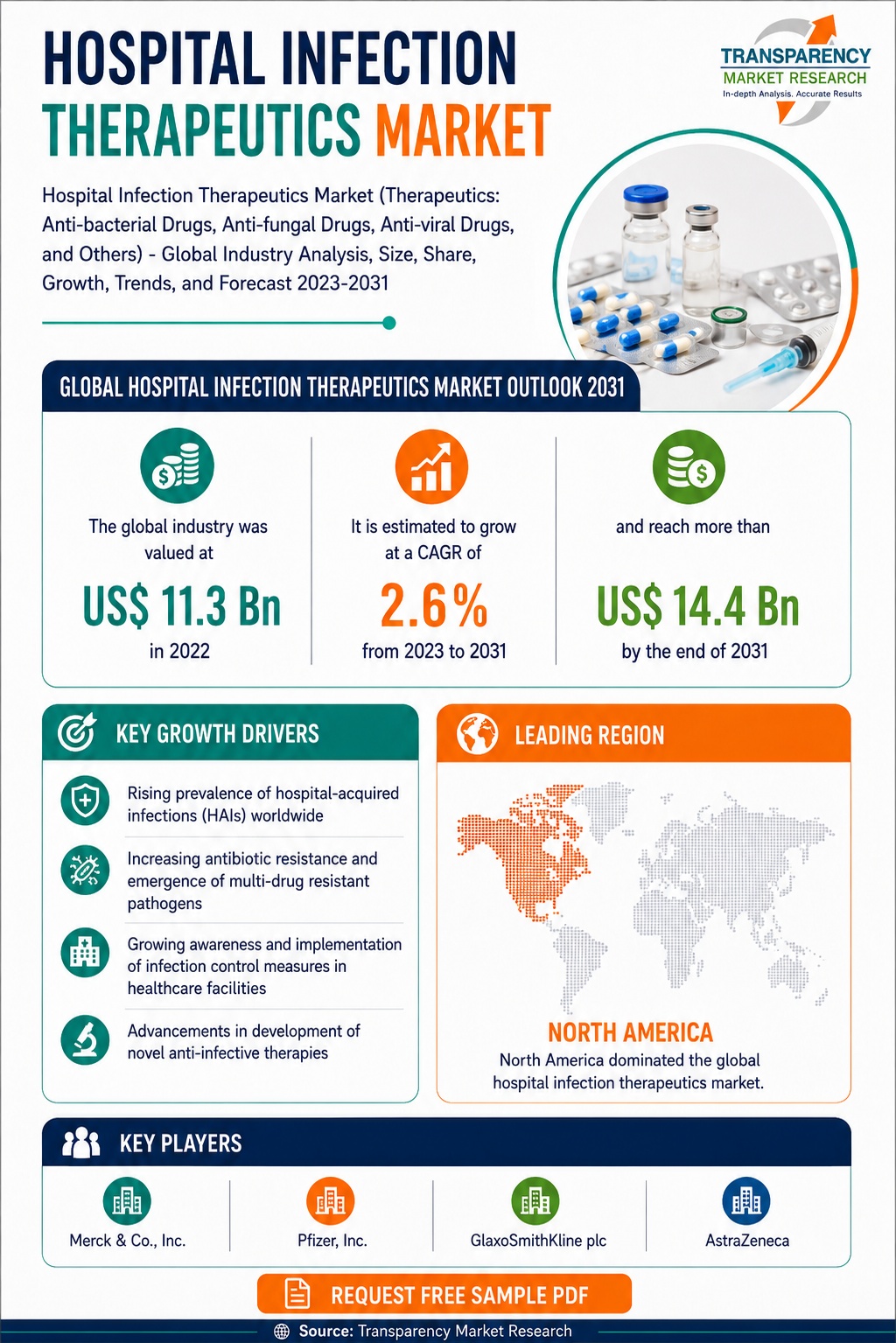
The global hospital infection therapeutics market is witnessing steady growth as healthcare systems across the world intensify efforts to combat hospital-acquired infections (HAIs) and antimicrobial resistance. Increasing hospitalization rates, growth in surgical procedures, aging populations, and advancements in anti-infective therapies are driving the expansion of the market. According to industry analysis, the global hospital infection therapeutics market was valued at US$ 11.3 Bn in 2022 and is projected to reach US$ 14.4 Bn by the end of 2031, expanding at a CAGR of 2.6% from 2023 to 2031.
Hospital-acquired infections continue to be a major healthcare challenge worldwide. These infections, commonly referred to as nosocomial infections, are acquired during treatment in healthcare facilities and often occur due to poor infection control practices, inadequate sterilization procedures, prolonged hospital stays, and the increasing prevalence of drug-resistant microorganisms.
The burden of hospital infections is especially significant in low- and middle-income countries where healthcare infrastructure may be inadequate. Infections such as hospital-acquired pneumonia, bloodstream infections, urinary tract infections, gastrointestinal infections, and surgical site infections create substantial healthcare costs while increasing mortality and morbidity rates.
The growing incidence of antibiotic-resistant bacteria has intensified the need for innovative hospital infection therapeutics. Pharmaceutical companies are therefore investing heavily in research and development to introduce advanced antibacterial, antiviral, and antifungal therapies that can effectively manage resistant infections.
Download to explore critical insights from our Report in this sample – https://www.transparencymarketresearch.com/sample/sample.php?flag=S&rep_id=1280
Market Overview
The hospital infection therapeutics market is evolving rapidly due to technological advancements in diagnostics, drug delivery systems, and treatment monitoring solutions. Rising awareness regarding infection prevention and improved healthcare infrastructure in emerging economies are further supporting market growth.
Healthcare providers are increasingly adopting rapid diagnostic tools and point-of-care testing technologies to identify infections quickly and initiate targeted treatment. These innovations help reduce transmission risks and improve patient outcomes.
The market includes a wide range of therapeutic categories such as anti-bacterial drugs, anti-fungal drugs, anti-viral drugs, and other anti-infective treatments. Among these, anti-bacterial drugs account for the largest market share due to the growing prevalence of bacterial infections in hospitals.
Furthermore, governments and international organizations are implementing initiatives to address antimicrobial resistance. Programs such as the World Health Organization’s Global Action Plan on Antimicrobial Resistance are encouraging healthcare institutions and pharmaceutical companies to develop new treatment solutions and infection control measures.
Key Drivers of Market Growth
Rise in Antibiotic Resistance
One of the most significant factors driving the hospital infection therapeutics market is the rapid increase in antibiotic resistance. Over time, bacteria and fungi develop resistance to existing drugs, making infections harder to treat. Antimicrobial-resistant infections are responsible for millions of deaths worldwide and represent a growing public health crisis.
Drug-resistant infections are prompting healthcare providers to adopt advanced therapeutic solutions and encouraging pharmaceutical companies to innovate next-generation antibiotics and alternative therapies.
Increasing Geriatric Population
The aging population is another major growth driver for the market. Elderly individuals are more susceptible to infections due to weakened immune systems, chronic illnesses, and frequent hospitalization. As the global geriatric population expands, the demand for effective hospital infection therapeutics is expected to increase significantly.
Advancements in Diagnostics and Drug Delivery
Technological innovations in diagnostics and drug delivery systems are positively influencing market expansion. Rapid diagnostic tests and digital health platforms allow healthcare professionals to detect infections quickly and monitor patients remotely.
Additionally, advanced drug delivery technologies such as nanoparticles and liposomal formulations improve treatment effectiveness while minimizing side effects and toxicity.
Rising Healthcare Expenditure
Increasing investments in healthcare infrastructure and infection control programs are supporting market development. Governments across developed and developing economies are prioritizing infection prevention measures to reduce healthcare-associated complications and costs.
Key Players and Industry Leaders
The competitive landscape of the hospital infection therapeutics market is characterized by the presence of several multinational pharmaceutical companies actively investing in anti-infective research and commercialization.
Key players operating in the market include:
- Merck & Co., Inc.
- Pfizer, Inc.
- GlaxoSmithKline plc
- AstraZeneca
- Johnson & Johnson Services, Inc.
- F. Hoffmann-La Roche Ltd.
- Bayer AG
- Allergan plc
- Sanofi S.A.
- Gilead Sciences, Inc.
- Basilea Pharmaceutica Ltd.
- Bristol-Myers Squibb Company
These companies are focusing on strategic partnerships, acquisitions, and product development initiatives to strengthen their market positions. Significant investments in R&D are enabling the development of therapies that can address evolving microbial resistance patterns.
Recent Developments
The hospital infection therapeutics market has witnessed several notable developments in recent years.
In June 2023, Pfizer, Inc. announced late-stage study data evaluating the effectiveness of the experimental antibiotic combination aztreonam-avibactam with metronidazole against complicated intra-abdominal infections and hospital-acquired pneumonia.
Similarly, in 2021, Sanofi S.A. reported positive results from its Phase III MELODY study involving nirsevimab for lower respiratory tract infections caused by respiratory syncytial virus (RSV) in newborns. The development marked a significant advancement in infection prevention therapies.
Companies are also increasingly exploring non-antibiotic treatment approaches, including bacteriophage therapies, immunotherapies, and microbiome-based therapeutics.
Key Trends for the Future
- Increasing investment in antibiotic resistance research
- Growing adoption of rapid diagnostic technologies
- Expansion of digital health and telemedicine solutions
- Rising focus on infection prevention and hospital hygiene
- Development of non-antibiotic therapeutic alternatives
- Growth in pharmaceutical manufacturing in Asia Pacific
- Increased partnerships for anti-infective drug development
New Opportunities and Challenges
Emerging Market Opportunities
Emerging economies such as India, China, Brazil, and Southeast Asian countries present lucrative growth opportunities for market participants. Rising income levels, expanding healthcare access, and increasing investments in hospital infrastructure are boosting demand for advanced infection therapeutics in these regions.
The growing pharmaceutical manufacturing capabilities in Asia Pacific are also supporting innovation and reducing production costs for anti-infective drugs.
Challenges Restricting Market Growth
Despite strong growth prospects, the market faces several challenges. Drug development for anti-infective therapies involves high costs, lengthy clinical trials, and significant failure rates. Regulatory hurdles and inadequate reimbursement policies further limit market expansion.
Additionally, the overuse and misuse of antibiotics continue to accelerate antimicrobial resistance, creating pressure on pharmaceutical companies to continuously innovate.
Market Trends & Innovations
Several emerging trends are reshaping the hospital infection therapeutics landscape.
Adoption of Precision Medicine
Healthcare providers are increasingly adopting personalized treatment approaches based on microbial profiling and patient-specific factors. Precision medicine enables more targeted therapies and improves treatment success rates.
Integration of Digital Health
Telemedicine platforms and digital healthcare solutions are improving infection monitoring and patient management. Remote consultations and AI-powered diagnostics are becoming increasingly common in infection control programs.
Development of Novel Drug Delivery Systems
Advanced drug delivery methods, including nanoparticles, liposomes, and controlled-release systems, are improving therapeutic efficacy while minimizing toxicity.
Focus on Combination Therapies
Combination therapies are gaining popularity for treating multidrug-resistant infections. These therapies improve effectiveness and reduce the likelihood of resistance development.
Buy this Premium Research Report to unlock essential market knowledge – https://www.transparencymarketresearch.com/checkout.php?rep_id=1280<ype=S
Future Outlook
The future of the hospital infection therapeutics market remains promising, driven by growing awareness of infection control and increasing global healthcare expenditure.
Pharmaceutical companies are expected to accelerate innovation in next-generation antibiotics, biologics, and non-antibiotic alternatives. Collaborative research initiatives between governments, academic institutions, and biotechnology companies are likely to strengthen the development pipeline.
Asia Pacific is anticipated to emerge as one of the fastest-growing regional markets due to the expansion of healthcare infrastructure and rising pharmaceutical investments. North America and Europe are expected to maintain strong market positions owing to advanced healthcare systems and supportive reimbursement frameworks.
The growing emphasis on antimicrobial stewardship programs and rapid diagnostic technologies will further contribute to market growth through 2031.
Market Segmentation
By Therapeutics
- Anti-bacterial Drugs
- Anti-fungal Drugs
- Anti-viral Drugs
- Others
By Infection
- Hospital Acquired Pneumonia
- Urinary Tract Infections
- Gastrointestinal Disorders
- Bloodstream Infections
- Surgical Site Infections
- Other Hospital Infections
By Region
- North America
- Latin America
- Europe
- Asia Pacific
- Middle East & Africa
Important FAQs with Answers
How big was the global hospital infection therapeutics market in 2022?
The global hospital infection therapeutics market was valued at US$ 11.3 Bn in 2022.
What is the projected market value by 2031?
The market is projected to reach US$ 14.4 Bn by the end of 2031.
What is the expected CAGR during the forecast period?
The market is estimated to expand at a CAGR of 2.6% from 2023 to 2031.
What are the key growth drivers of the market?
Major growth drivers include rising antibiotic resistance, advancements in diagnostics and drug delivery systems, increasing geriatric population, and higher healthcare expenditure.
Which therapeutics segment dominates the market?
The anti-bacterial drugs segment holds the largest share due to the high prevalence of bacterial hospital-acquired infections.
Which region accounted for the largest market share in 2022?
Europe accounted for a significant share of the global hospital infection therapeutics market in 2022.
Which companies are leading the hospital infection therapeutics market?
Leading companies include Merck & Co., Inc., Pfizer, Inc., Sanofi S.A., AstraZeneca, and GlaxoSmithKline plc.
More Related Reports –
Anti-Inflammatory Therapeutics Market: https://www.transparencymarketresearch.com/anti-inflammatory-therapeutics-market.html
CINV Existing and Pipeline Drugs Market: https://www.transparencymarketresearch.com/cinv-market.html
Foot and Mouth Disease Vaccine Market: https://www.transparencymarketresearch.com/foot-mouth-disease-vaccines.html
Radiodermatitis Market: https://www.transparencymarketresearch.com/radiodermatitis-market.html
About Us Transparency Market Research
Transparency Market Research, a global market research company registered at Wilmington, Delaware, United States, provides custom research and consulting services. The firm scrutinizes factors shaping the dynamics of demand in various markets. The insights and perspectives on the markets evaluate opportunities in various segments. The opportunities in the segments based on source, application, demographics, sales channel, and end-use are analysed, which will determine growth in the markets over the next decade.
Our exclusive blend of quantitative forecasting and trends analysis provides forward-looking insights for thousands of decision-makers, made possible by experienced teams of Analysts, Researchers, and Consultants. The proprietary data sources and various tools & techniques we use always reflect the latest trends and information. With a broad research and analysis capability, Transparency Market Research employs rigorous primary and secondary research techniques in all of its business reports.
Contact:
Abhishek Budholiya
Transparency Market Research Inc.
State Tower, 90 State Street, Suite 700,
Albany NY – 12207, United States
Tel: +1-518-618-1030
USA – Canada Toll Free: 866-552-3453
Website: https://www.transparencymarketresearch.com
Media Inquiries: media@transparencymarketresearch.com
Sales Inquiries: sales@transparencymarketresearch.com





Leave a Reply