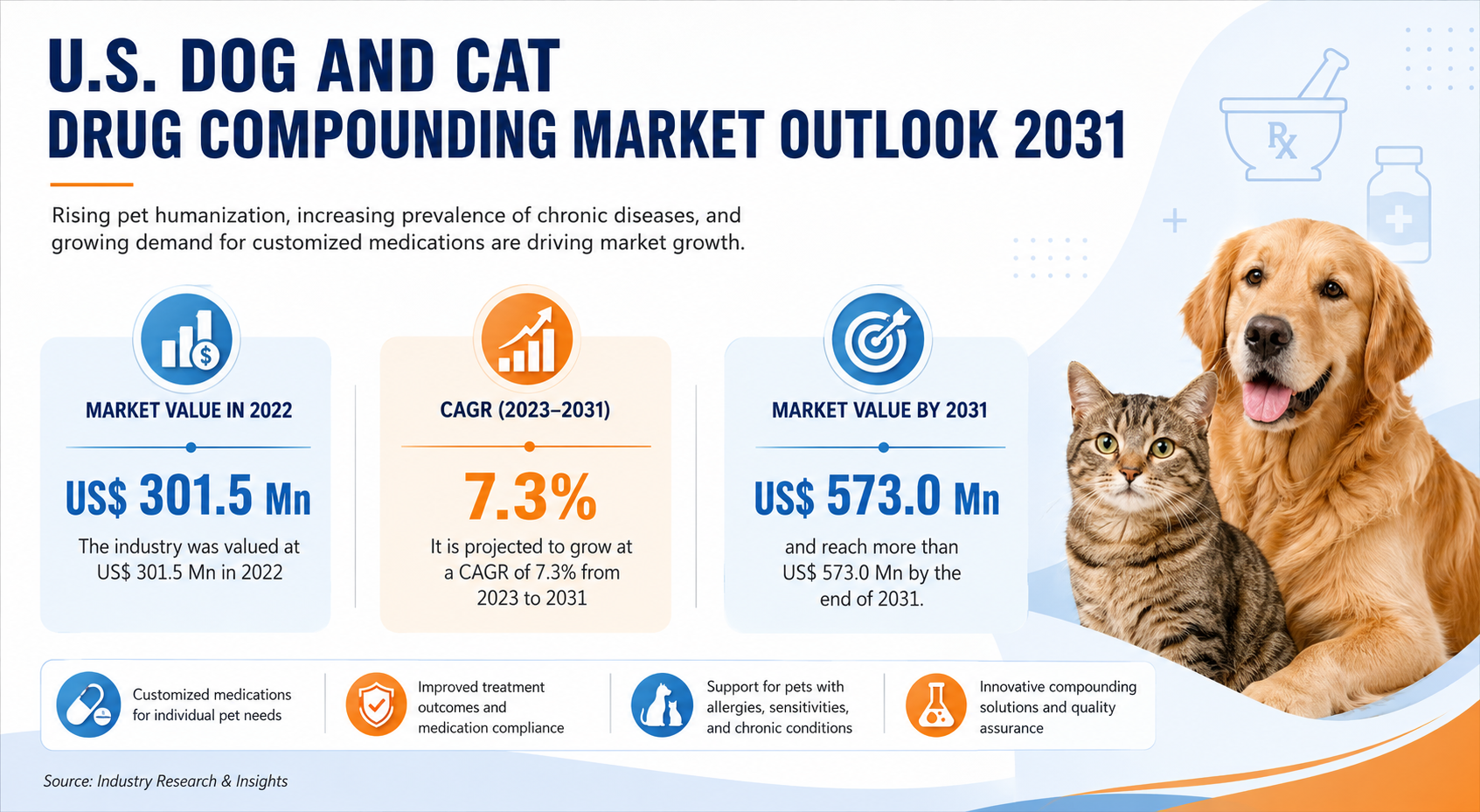
The U.S. Dog and Cat Drug Compounding Market was valued at US$ 301.5 Mn in 2022. Supported by rising demand for customized veterinary medications and increasing pet healthcare expenditure, the market is projected to expand at a CAGR of 7.3% from 2023 to 2031, ultimately reaching more than US$ 573.0 Mn by 2031.
Growth is primarily fueled by the expanding companion animal population, limited availability of species-specific FDA-approved drugs, and increasing acceptance of compounded veterinary medications among pet owners and veterinarians.
Explore the highlights and essential data from our Report in this sample –
https://www.transparencymarketresearch.com/sample/sample.php?flag=S&rep_id=85876
Market Overview
Veterinary drug compounding refers to the process of modifying, mixing, or combining pharmaceutical ingredients to create tailored medications for individual animals or small animal groups. In the case of dogs and cats, compounding plays a crucial role in bridging the gap between commercially available drugs and specific therapeutic requirements.
Compounded medications are typically prepared by licensed pharmacists or veterinarians under regulated frameworks such as the Federal Food, Drug, and Cosmetic Act (FD&C Act), which allows compounding using FDA-approved finished drug substances.
These customized medications are particularly important for companion animals that require:
- Adjusted dosages based on weight and condition
- Flavor-enhanced formulations for improved palatability
- Alternative dosage forms such as liquids or transdermal gels
- Treatments for conditions where no commercially approved veterinary drug exists
Companies in the market are increasingly strengthening their compounding capabilities, expanding ingredient sourcing networks, and investing in formulation databases to enhance accuracy and efficiency in prescription preparation.
Key Market Growth Drivers
1. Rising Pet Ownership and Humanization of Pets
The increasing adoption of pets in the United States is one of the most significant drivers of the market. According to industry surveys, more than 65.1 million U.S. households own dogs and approximately 46.5 million households own cats. Pet ownership trends reflect a broader cultural shift where pets are increasingly treated as family members.
This “humanization of pets” has directly contributed to higher spending on veterinary care, including specialized and compounded medicines.
2. Increasing Demand for Personalized Veterinary Medicine
Standard veterinary drugs are often insufficient to meet the unique needs of individual animals. Compounding allows precise customization of dosage strength, flavor, and formulation type, improving treatment compliance and outcomes.
This is especially important for:
- Senior pets with chronic diseases
- Animals with swallowing difficulties
- Behavioral disorders requiring CNS-targeted therapies
3. Growth in Veterinary CNS Disorders and Chronic Conditions
Central Nervous System (CNS) agents represent one of the most significant product segments due to increasing recognition of behavioral disorders in dogs, including ADHD-like symptoms, hyperactivity, and anxiety.
Studies indicate that 12%–15% of dogs exhibit hyperactivity and impulsivity, while 20% show inattention, driving demand for customized neurological treatments.
4. Limited Availability of FDA-Approved Veterinary Drugs
Many veterinary conditions lack species-specific approved treatments, especially in cats and exotic animals. Compounding provides an essential alternative when commercial formulations are unavailable or unsuitable.
5. Increasing Pet Healthcare Expenditure and Insurance Penetration
Rising spending on pet healthcare services, along with increasing availability of pet insurance products, is enabling owners to opt for advanced treatment options, including compounded medications.
Analysis of Key Players – Key Player Strategies
The U.S. Dog and Cat Drug Compounding Market is moderately consolidated, with several established veterinary pharmacies and pharmaceutical service providers competing on formulation quality, distribution capabilities, and veterinary partnerships.
Key players include:
- Wedgewood Pharmacy
- Mixlab Inc.
- PetMed Express Inc.
- Central Compounding Center South
- The Compounding Pharmacy of America
- Precision Compounding Pharmacy
- Triangle Compounding Pharmacy
- BEST PET RX
Key Strategic Approaches
1. Portfolio Expansion
Companies are expanding beyond basic antibiotics and anti-inflammatory drugs into CNS agents, GI medications, and hormonal therapies. This diversification helps address a broader range of veterinary needs.
2. Digital Prescription Management Integration
Firms such as Mixlab and others are integrating telehealth and digital prescription platforms, enabling faster fulfillment cycles and improved veterinarian collaboration.
3. Mergers and Acquisitions
Consolidation is a key strategy as companies seek scale advantages in procurement, compounding infrastructure, and nationwide distribution networks.
4. Quality Assurance and Compliance Enhancement
Strict adherence to FDA compounding guidelines and enhanced quality control systems are being prioritized to improve trust among veterinarians and pet owners.
5. Expansion into Multi-Species Compounding
Beyond dogs and cats, several players are expanding into horses, birds, and exotic animals to diversify revenue streams.
Market Challenges & Opportunities
Challenges
1. Regulatory Constraints
Compounded drugs are tightly regulated, and compliance with FDA guidelines can be complex, limiting flexibility for manufacturers.
2. Quality and Consistency Issues
Variability in compounded formulations can lead to concerns about dosage accuracy and therapeutic effectiveness.
3. Limited Awareness Among Pet Owners
While awareness is increasing, many pet owners remain unfamiliar with compounding as a viable veterinary treatment option.
4. Dependence on FDA-Approved Base Ingredients
Compounding pharmacies must rely on finished FDA-approved drug substances, which can restrict innovation.
Opportunities
1. Rising Demand for Personalized Medicine
The shift toward precision veterinary care presents a long-term growth opportunity.
2. Expansion of Pet Insurance Coverage
Increased insurance penetration enables higher adoption of advanced treatment options, including compounded medications.
3. Technological Advancements in Pharmaceutical Compounding
Automation, formulation databases, and AI-driven prescription systems are improving efficiency and accuracy.
4. Growth in Chronic Disease Management
Long-term conditions in pets, including diabetes, arthritis, and neurological disorders, are creating sustained demand for compounded drugs.
Key Player Strategies
Leading companies are focusing on:
- Strengthening veterinarian partnerships
- Enhancing compounding capabilities for flavored and liquid formulations
- Expanding nationwide distribution networks
- Investing in pharmacy automation systems
- Developing proprietary formulation databases
- Expanding digital prescription and telepharmacy services
These strategies are enabling faster turnaround times, improved compliance, and higher customer retention rates.
Recent Developments
In June 2023, Wedgewood Pharmacy, the largest veterinary compounding pharmacy in the U.S., announced merger with Blue Rabbit, an emerging leader in veterinary prescription management and pharmacy solutions
Investment Landscape and ROI Outlook
The U.S. Dog and Cat Drug Compounding Market presents a strong investment case due to its consistent demand base and recurring revenue structure.
Key Investment Highlights
- Stable long-term demand driven by pet ownership growth
- High-margin specialty pharmaceutical services
- Increasing adoption of subscription-based pet pharmacy models
- Expansion of telehealth-enabled veterinary care ecosystems
ROI Outlook
Investors are expected to benefit from:
- Scalable pharmacy networks
- Consolidation-driven valuation growth
- Strong cash flow from recurring prescription refills
- Cross-selling opportunities across veterinary services
Private equity and healthcare-focused investors are increasingly active in this sector, targeting consolidation opportunities among regional compounding pharmacies.
Market Segmentation
By Product
- Anti-infective Drugs
- Anti-inflammatory Drugs
- CNS Agents (leading segment)
- GI Drugs
- Others (including hormonal drugs)
By Dosage Form
- Tablets & Capsules
- Powder
- Solution (dominant segment)
- Others (Suspensions, etc.)
By Route of Administration
- Oral (leading segment)
- Injectable
- Topical
- Others (ocular, rectal, etc.)
By Animal Type
- Dog (largest share)
- Cat (fast-growing segment)
By Region
- United States (100% market scope in this study)
The U.S. remains the sole geographic focus, with strong regional penetration across urban and suburban veterinary healthcare networks.
Why Buy This Report?
This report provides a comprehensive strategic analysis of the U.S. Dog and Cat Drug Compounding Market, offering:
- Detailed market sizing and forecast (2022–2031)
- Growth trend analysis and demand drivers
- Competitive landscape and key player benchmarking
- Segmentation breakdown by product, dosage form, and administration route
- Investment insights and ROI evaluation
- Regulatory and operational insights for stakeholders
- Strategic developments and merger activity tracking
It is an essential resource for:
- Pharmaceutical companies
- Veterinary healthcare providers
- Investors and private equity firms
- Animal health product manufacturers
- Policy and regulatory stakeholders
FAQs
1. What is the size of the U.S. Dog and Cat Drug Compounding Market?
The market was valued at US$ 301.5 Mn in 2022 and is projected to exceed US$ 573.0 Mn by 2031.
2. What is the growth rate of the market?
The market is expected to grow at a CAGR of 7.3% from 2023 to 2031.
3. What factors are driving market growth?
Key drivers include rising pet ownership, increasing demand for personalized veterinary medicine, limited availability of FDA-approved veterinary drugs, and growing awareness of animal healthcare.
4. Which segment dominates the market?
CNS agents dominate the product segment, solution dosage forms lead overall, and oral administration remains the most widely used route.
5. Who are the key players in the market?
Major players include Wedgewood Pharmacy, Mixlab Inc., PetMed Express Inc., Central Compounding Center South, and several regional veterinary compounding pharmacies.



Leave a Reply