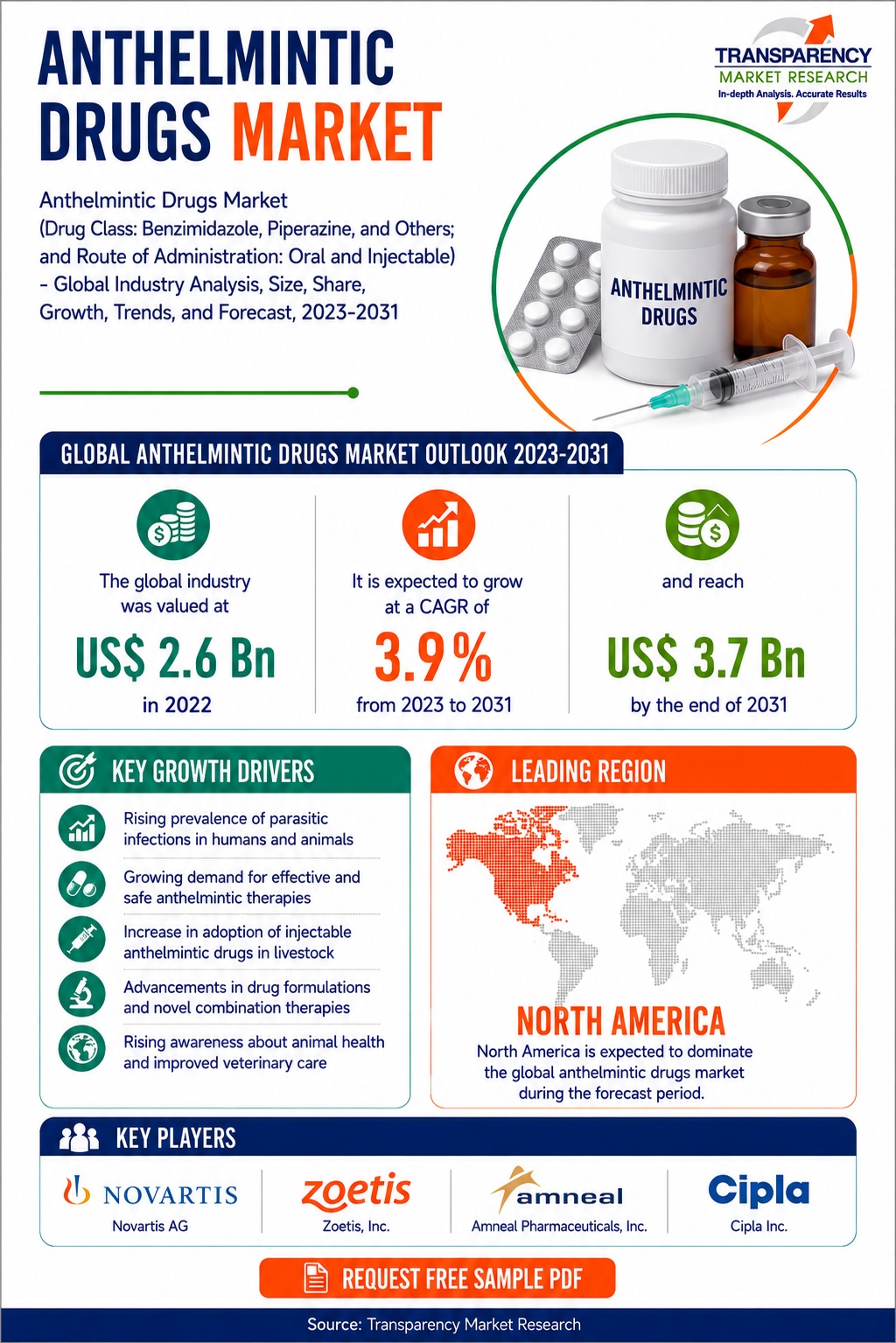
The global anthelmintic drugs market is witnessing steady expansion owing to the increasing prevalence of helminth infections among humans and animals worldwide. Growing awareness regarding parasitic diseases, rising veterinary healthcare expenditure, and continuous research in anti-parasitic medications are significantly contributing to the market’s development. According to recent industry analysis, the global anthelmintic drugs market was valued at US$ 2.6 Bn in 2022 and is projected to reach US$ 3.7 Bn by the end of 2031, expanding at a CAGR of 3.9% during the forecast period from 2023 to 2031.
Get a concise overview of key insights from our Report in this sample – https://www.transparencymarketresearch.com/sample/sample.php?flag=S&rep_id=50688
Market Overview
Anthelmintic drugs, commonly known as deworming medications, are pharmaceutical agents used to eliminate parasitic worms such as nematodes, trematodes, and cestodes from the body of humans and animals. These parasites can infect organs including the intestines, lungs, and body tissues, leading to severe health complications if untreated.
Anthelmintics work by either disrupting the metabolism of parasites or directly killing them, thereby enabling their removal from the host body. Widely used drugs in this category include albendazole, mebendazole, ivermectin, praziquantel, and piperazine compounds.
The growing burden of soil-transmitted helminth (STH) infections is one of the major factors fueling the market. According to the World Health Organization (WHO), more than 24% of the global population is affected by STH infections, particularly in low-income regions lacking proper sanitation and hygiene infrastructure. This has increased the need for effective anti-parasitic medications across both human healthcare and veterinary sectors.
Mass deworming programs initiated by governments and global healthcare organizations are also accelerating demand for anthelmintic drugs. School-going children, pregnant women, livestock, and vulnerable communities are the primary beneficiaries of these programs.
Key Drivers of Market Growth
Rising Incidence of Helminth Infections
One of the most significant drivers of the anthelmintic drugs market is the increasing prevalence of parasitic worm infections worldwide. Countries with inadequate sanitation facilities, contaminated water sources, and poor hygiene practices continue to experience high infection rates.
Regions such as Latin America, Asia Pacific, and Africa are particularly vulnerable to helminth outbreaks. Nations including Brazil, Mexico, Colombia, Haiti, Peru, and Guatemala account for a substantial number of reported cases. The growing health burden associated with these infections is prompting governments and healthcare organizations to strengthen deworming initiatives.
Growth in Veterinary Healthcare
The veterinary healthcare industry is playing a vital role in the expansion of the anthelmintic drugs market. Livestock and companion animals are increasingly being treated with anti-parasitic drugs to prevent infections that affect productivity and overall animal health.
Veterinary deworming medications such as pyrantel pamoate are commonly prescribed for dogs, cats, birds, rabbits, and rodents. The increasing focus on animal welfare and rising pet ownership are expected to support long-term market growth.
Extensive Research and Drug Development
Continuous research and development activities are accelerating innovation in the anthelmintic drugs market. Researchers are exploring new molecular compounds, plant-derived therapies, and screening technologies to develop safer and more effective anti-parasitic medications.
Advanced phenotyping assays and compound screening methods are helping researchers identify potent candidates against multiple parasitic pathogens. Open-source genomic information related to parasites has also facilitated the discovery of novel therapeutic targets.
Several companies are developing next-generation drugs capable of overcoming resistance associated with conventional therapies such as benzimidazoles and ivermectin.
Government and WHO Initiatives
Global health organizations including the WHO and Pan American Health Organization (PAHO) are actively supporting mass drug administration campaigns to reduce helminth infections. These initiatives involve the distribution of albendazole and mebendazole among school children and high-risk populations.
Programs aimed at eliminating lymphatic filariasis and other neglected tropical diseases are also contributing to market expansion. Such public health initiatives are expected to continue creating growth opportunities for manufacturers over the next decade.
Key Players and Industry Leaders
The competitive landscape of the global anthelmintic drugs market includes several multinational pharmaceutical and veterinary healthcare companies. Major market participants are focusing on product innovation, strategic collaborations, acquisitions, and expansion into emerging markets.
Prominent companies operating in the market include:
- Novartis AG
- Zoetis, Inc.
- Amneal Pharmaceuticals, Inc.
- Cipla Inc.
- Janssen Pharmaceuticals, Inc.
- Sun Pharmaceutical Industries Ltd.
- GlaxoSmithKline plc
- Bayer AG
- Merck & Co. Inc.
- Boehringer Ingelheim International GmbH
These companies are investing heavily in R&D to strengthen their product portfolios and improve therapeutic outcomes. Many players are also collaborating with global healthcare agencies to enhance accessibility of deworming medications in underserved regions.
Recent Developments
The market has witnessed several notable developments in recent years that are shaping industry growth and innovation.
In January 2022, Zoetis, Inc. received U.S. FDA approval for a new label indication for Simparica Trio. The product became the first and only combination medication designed to prevent infections that may lead to Lyme disease in dogs. This development strengthened Zoetis’ position in the veterinary anti-parasitic segment.
Additionally, pharmaceutical companies are increasingly focusing on plant-based anthelmintic agents with high egg-hatching inhibitory effects. These naturally derived formulations are gaining attention for their dose-dependent anti-parasitic activities and reduced side effects.
Researchers are also investigating small molecule inhibitors such as nemacol, which demonstrates promising anthelmintic potential against parasitic worms.
New Opportunities and Challenges
Emerging Opportunities
The increasing penetration of healthcare services in developing countries is expected to create significant growth opportunities for market participants. Government-backed deworming programs and improved awareness campaigns are encouraging the adoption of anti-parasitic medications in rural and underserved communities.
The expansion of online pharmacies and telemedicine platforms is also improving accessibility to deworming drugs. E-commerce channels are enabling manufacturers to reach wider consumer bases across remote regions.
Furthermore, rising investments in veterinary infrastructure and livestock healthcare are likely to open new revenue streams for manufacturers operating in the animal health segment.
Major Challenges
Despite positive growth prospects, the market faces several challenges. Drug resistance remains one of the biggest concerns in the anthelmintic drugs industry. Overuse and improper administration of anti-parasitic medications can lead to reduced drug effectiveness over time.
Limited healthcare infrastructure in low-income regions may also hinder treatment accessibility. In addition, the lengthy approval process for new pharmaceutical compounds and stringent regulatory requirements can delay product commercialization.
Another challenge involves the lack of awareness regarding parasitic infections in certain underdeveloped regions, which often leads to delayed diagnosis and treatment.
Market Trends & Innovations
The anthelmintic drugs market is evolving with the adoption of innovative technologies and modern treatment approaches.
Plant-Based Anthelmintic Therapies
Manufacturers are increasingly utilizing plant-derived compounds with proven anti-parasitic activity. Natural extracts demonstrating over 90% egg-hatching inhibitory effects are being explored as safer alternatives to synthetic drugs.
Advanced Compound Screening
High-throughput compound screening and phenotyping technologies are accelerating the discovery of next-generation anti-parasitic agents. These technologies enable rapid identification of potent compounds against resistant parasite strains.
Combination Therapies
Combination drug therapies are becoming increasingly popular due to their enhanced efficacy and reduced resistance risks. Pharmaceutical companies are developing multi-action formulations targeting multiple parasite types simultaneously.
Expansion of Veterinary Applications
Veterinary anthelmintics are witnessing growing demand owing to increased livestock production and rising pet ownership globally. Companies are launching innovative oral and injectable formulations specifically designed for animal healthcare applications.
Buy this Premium Research Report to explore detailed market trends – https://www.transparencymarketresearch.com/checkout.php?rep_id=50688<ype=S
Future Outlook
The future of the global anthelmintic drugs market appears promising, supported by increasing healthcare awareness, rising prevalence of parasitic infections, and growing investments in pharmaceutical research.
North America is expected to maintain its dominant position throughout the forecast period due to strong pharmaceutical infrastructure, advanced healthcare systems, and the presence of leading market players. Meanwhile, Asia Pacific and Latin America are anticipated to emerge as high-growth regions because of increasing infection rates and expanding healthcare initiatives.
Technological advancements in drug discovery, coupled with the integration of precision medicine and genomic research, are likely to revolutionize the development of anti-parasitic therapies over the coming years.
Furthermore, global partnerships between governments, NGOs, and pharmaceutical companies are expected to improve drug accessibility and strengthen mass deworming programs worldwide.
Market Segmentation
By Drug Class
- Benzimidazole
- Piperazine
- Others
By Route of Administration
- Oral
- Injectable
By Application
- Human
- Parenchymal Neurocysticercosis
- Gastrointestinal Infections
- Animal
By Target Pathogen
- Ascaris Lumbricoides (Roundworm)
- Trichuris Trichiura (Whipworm)
- Enterobius Vermicularis (Pinworm)
- Ancylostoma Duodenale (Hookworm)
- Others
By Distribution Channel
- Hospital Pharmacies
- Retail Pharmacies
- Online Pharmacies
- Veterinary Pharmacies
- Veterinary Hospitals & Clinics
By Region
- North America
- Europe
- Asia Pacific
- Latin America
- Middle East & Africa
Key Trends for the Future
Several emerging trends are expected to define the future trajectory of the anthelmintic drugs market:
- Growing use of AI-assisted drug discovery platforms
- Rising focus on resistance management strategies
- Increasing adoption of natural and herbal deworming agents
- Expansion of mass deworming initiatives in developing nations
- Higher investments in veterinary healthcare infrastructure
- Growing popularity of combination anti-parasitic therapies
- Expansion of online pharmaceutical distribution channels
These trends are likely to reshape the competitive landscape and create lucrative opportunities for both established players and new entrants.
Important FAQs with Answers
What are anthelmintic drugs?
Anthelmintic drugs are medications used to eliminate parasitic worms and internal parasites from humans and animals.
What is driving the growth of the anthelmintic drugs market?
The primary growth drivers include rising helminth infections, increased veterinary healthcare spending, extensive pharmaceutical research, and global deworming initiatives.
What was the market size in 2022?
The global anthelmintic drugs market was valued at US$ 2.6 Bn in 2022.
What is the expected market value by 2031?
The market is projected to reach US$ 3.7 Bn by the end of 2031.
Which region dominates the market?
North America currently holds the largest share of the global market due to advanced healthcare infrastructure and strong pharmaceutical presence.
Which are the major companies in the market?
Leading companies include Novartis AG, Zoetis, Inc., Cipla Inc., Bayer AG, Merck & Co. Inc., and Boehringer Ingelheim International GmbH.
More Related Reports –
Foot and Mouth Disease Vaccine Market: https://www.transparencymarketresearch.com/foot-mouth-disease-vaccines.html
Osteoporosis Drugs Market: https://www.transparencymarketresearch.com/osteoporosis-drug-market.html
Psychotropic Drugs Market: https://www.transparencymarketresearch.com/psychotropic-drugs-market.html
Non-Small Cell Lung Cancer Therapeutics Market: https://www.transparencymarketresearch.com/non-small-cell-lung-cancer-market.html
About Us Transparency Market Research
Transparency Market Research, a global market research company registered at Wilmington, Delaware, United States, provides custom research and consulting services. The firm scrutinizes factors shaping the dynamics of demand in various markets. The insights and perspectives on the markets evaluate opportunities in various segments. The opportunities in the segments based on source, application, demographics, sales channel, and end-use are analysed, which will determine growth in the markets over the next decade.
Our exclusive blend of quantitative forecasting and trends analysis provides forward-looking insights for thousands of decision-makers, made possible by experienced teams of Analysts, Researchers, and Consultants. The proprietary data sources and various tools & techniques we use always reflect the latest trends and information. With a broad research and analysis capability, Transparency Market Research employs rigorous primary and secondary research techniques in all of its business reports.
Contact:
Abhishek Budholiya
Transparency Market Research Inc.
State Tower, 90 State Street, Suite 700,
Albany NY – 12207, United States
Tel: +1-518-618-1030
USA – Canada Toll Free: 866-552-3453
Website: https://www.transparencymarketresearch.com
Media Inquiries: media@transparencymarketresearch.com
Sales Inquiries: sales@transparencymarketresearch.com



Leave a Reply