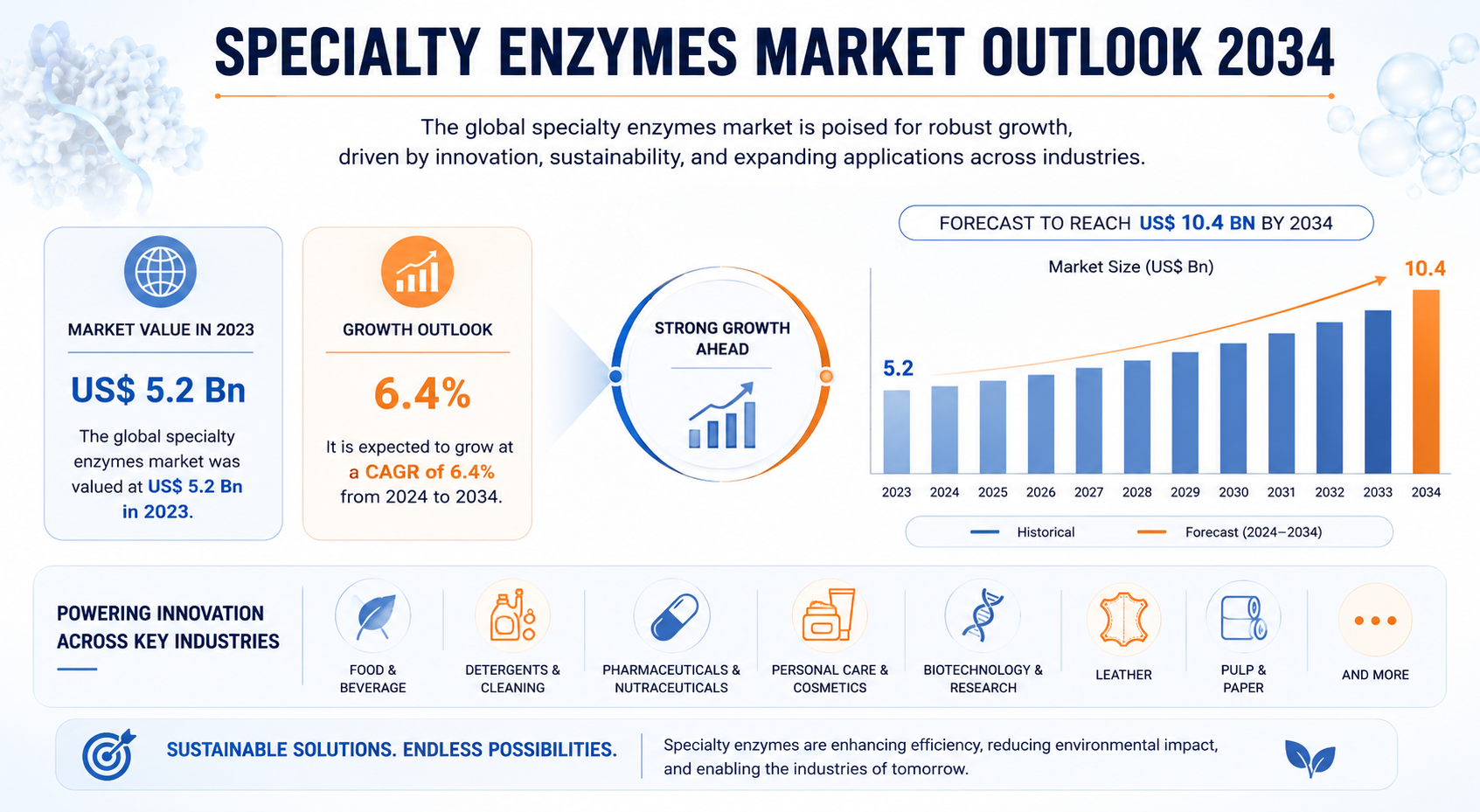
The global specialty enzymes market was valued at US$ 5.2 Bn in 2023 and is projected to reach US$ 10.4 Bn by the end of 2034, expanding at a CAGR of 6.4% during the forecast period from 2024 to 2034. The market is witnessing strong momentum due to the increasing use of specialty enzymes in pharmaceutical manufacturing, regenerative medicine, diagnostics, biotechnology research, and molecular biology applications.
Specialty enzymes are becoming indispensable in modern healthcare and biotechnology industries owing to their high specificity, eco-friendly properties, and ability to accelerate complex biochemical reactions. The growing emphasis on sustainable production processes and non-toxic catalysts is further strengthening market expansion worldwide.
Market Overview
Specialty enzymes are highly specific proteins that function as biological catalysts to accelerate biochemical reactions while ensuring selectivity and efficiency. These enzymes are widely utilized in pharmaceutical development, advanced therapeutics, biotechnology research, diagnostics, and industrial bioprocessing.
Proteases, carbohydrases, polymerases & nucleases, and lipases are among the major specialty enzyme categories gaining widespread commercial adoption. These enzymes help manufacturers improve process efficiency, reduce waste generation, lower energy consumption, and enhance product quality.
In pharmaceutical applications, specialty enzymes are used for active pharmaceutical ingredient (API) synthesis, drug development, targeted therapy manufacturing, and molecular diagnostics. Biotechnology companies increasingly rely on specialty enzymes for DNA sequencing, cloning, labeling, mutagenesis, and gene editing applications.
The rise in regenerative medicine and cell & gene therapies is significantly influencing demand patterns. Specialty enzymes of high purity and consistency are critical for advanced therapies involving stem cells, tissue engineering, and genetic modification technologies.
Growing investments in molecular biology research and advanced healthcare technologies are also contributing to the rapid adoption of specialty enzymes globally. Companies are introducing innovative enzyme formulations capable of supporting precision medicine and next-generation therapeutic development.
Key Market Growth Drivers
Rise in Investment in Regenerative Medicine
One of the primary growth drivers of the specialty enzymes market is the increasing global investment in regenerative medicine. Regenerative therapies focus on repairing, replacing, or regenerating damaged tissues and organs using advanced biological approaches such as stem cell therapy and tissue engineering.
Specialty enzymes play a critical role in these applications by accelerating biochemical reactions and enabling the development of highly targeted pharmaceutical formulations. Their high specificity and lower toxicity make them ideal for use in advanced therapeutic manufacturing.
Nanozymes, which are nanomaterials exhibiting enzyme-like characteristics, are also emerging as an important innovation within regenerative medicine. These materials combine catalytic functionality with magnetic, electrical, and fluorescent properties, creating opportunities in targeted cancer therapy, biosensing, and advanced diagnostics.
Increasing funding activity within regenerative medicine is accelerating market growth. Biotechnology firms and research organizations worldwide are expanding investments in enzyme-enabled therapies to improve treatment outcomes and commercial scalability.
Increasing Demand for Non-toxic Biological Catalysts
The growing preference for eco-friendly and non-toxic biological catalysts is another significant factor driving specialty enzyme adoption. Compared to conventional chemical catalysts, specialty enzymes offer superior selectivity, biodegradability, and operational efficiency under mild reaction conditions.
Biocatalysts are increasingly used across pharmaceutical and biotechnology industries because they help reduce toxic byproducts and improve sustainability in manufacturing operations. As environmental regulations become stricter globally, manufacturers are transitioning toward greener catalytic technologies.
The use of specialty enzymes in organic synthesis and pharmaceutical production is expected to increase steadily as industries seek sustainable alternatives to synthetic chemicals.
Expansion of Molecular Biology and Biotechnology Research
Rapid advancements in molecular biology and biotechnology research are generating strong demand for polymerases, nucleases, and other specialty enzymes. These enzymes are essential tools for DNA manipulation, sequencing, cloning, and gene editing applications.
Research institutions, biotechnology companies, and pharmaceutical firms are heavily investing in genomics, proteomics, and synthetic biology, thereby creating substantial opportunities for specialty enzyme suppliers.
The increasing popularity of precision medicine and gene-based therapies is further supporting long-term market growth.
Growing Pharmaceutical Manufacturing Activities
The pharmaceutical industry continues to expand globally due to rising healthcare expenditure, increasing prevalence of chronic diseases, and growing demand for personalized medicines. Specialty enzymes are extensively used in pharmaceutical manufacturing processes to improve efficiency and product purity.
Manufacturers are adopting enzyme-enabled processes to reduce production costs and enhance process sustainability while maintaining high product standards.
Analysis of Key Players – Key Player Strategies
The specialty enzymes market is highly competitive, with major players focusing on innovation, strategic partnerships, product development, and expansion of biotechnology capabilities.
Key companies operating in the market include:
- F. Hoffmann-La Roche Ltd.
- Novonesis Group
- Amano Enzyme Inc.
- Codexis, Inc.
- Advanced Enzymes Technologies Ltd.
- Thermo Fisher Scientific Inc.
- BBI Solutions
- Biocatalysts
- Amicogen
- American Laboratories, Inc.
Innovation and Product Development
Leading companies are investing heavily in research and development to create high-purity specialty enzymes tailored for regenerative medicine, advanced therapeutics, and biotechnology applications.
Manufacturers are introducing customized enzyme solutions capable of supporting highly specialized pharmaceutical and molecular biology workflows.
Strategic Collaborations
Partnerships between biotechnology firms, pharmaceutical companies, and research institutions are becoming increasingly common. These collaborations enable companies to accelerate innovation and commercialize next-generation enzyme technologies.
Collaborative initiatives are helping market participants strengthen manufacturing capabilities and expand their global customer base.
Expansion in Advanced Therapy Markets
Key players are targeting the rapidly growing cell and gene therapy sectors by developing enzymes specifically designed for advanced therapy applications. Companies are focusing on improving enzyme stability, specificity, and consistency to meet strict regulatory standards.
Geographic Expansion
Several companies are expanding their regional footprint across North America, Europe, and Asia Pacific to capitalize on growing biotechnology investments and rising pharmaceutical manufacturing activities.
Digitalization and Process Optimization
Advanced manufacturing technologies, AI-enabled analytics, and automated bioprocessing systems are increasingly being integrated into specialty enzyme production to improve scalability and operational efficiency.
Market Challenges & Opportunities
Challenges
High Development Costs
The development and commercialization of specialty enzymes require significant investment in R&D, purification technologies, and regulatory compliance. High production costs can create barriers for smaller companies entering the market.
Stringent Regulatory Requirements
Specialty enzymes used in pharmaceutical and biotechnology applications must comply with rigorous quality and safety regulations. Regulatory approval processes can be lengthy and expensive, potentially delaying product commercialization.
Stability and Storage Limitations
Certain specialty enzymes are sensitive to environmental conditions such as temperature and pH, creating challenges related to storage, transportation, and shelf life.
Competition from Synthetic Alternatives
Although specialty enzymes offer numerous advantages, synthetic catalysts and chemical alternatives continue to compete in certain industrial applications due to lower costs and established manufacturing processes.
Opportunities
Growth in Cell & Gene Therapy
The rapid expansion of cell and gene therapy markets presents substantial opportunities for specialty enzyme manufacturers. These therapies require highly specialized enzymes for genetic modification, cell culture processing, and molecular diagnostics.
Emerging Applications in Precision Medicine
Precision medicine and personalized healthcare are creating demand for advanced enzyme technologies capable of supporting targeted therapies and customized treatment approaches.
Rising Biotechnology Investments in Asia Pacific
Countries such as China, India, Japan, and South Korea are increasing investments in biotechnology research and pharmaceutical manufacturing, creating new growth avenues for specialty enzyme suppliers.
Sustainable Manufacturing Trends
The shift toward sustainable industrial processes and green chemistry is expected to boost adoption of biological catalysts over conventional chemical alternatives.
Key Player Strategies
Key players are implementing several strategic initiatives to strengthen their market position and enhance revenue generation.
- Investment in enzyme engineering and biotechnology innovation
- Development of customized specialty enzyme solutions
- Expansion of manufacturing facilities
- Strategic mergers and acquisitions
- Collaboration with pharmaceutical and biotechnology firms
- Focus on regenerative medicine and advanced therapies
- Geographic expansion in emerging economies
- Strengthening research partnerships with academic institutions
These strategies are enabling companies to address evolving customer requirements while improving production scalability and technological competitiveness.
Recent Developments
- In December 2023, Novozymes and Chr. Hansen announced their future name ‘Novonesis’. The name reflects the beginning of an era of biosolutions where Novonesis will unleash the full potential of biological solutions and generate significant value for all stakeholders and society at large.
- In March 2023, Amano Enzyme USA Co., Ltd., in conjunction with the University of Minnesota, announced it is sponsoring the first-ever Enzyme Technology Symposium between top academic researchers and industry professionals from North America and Japan.
Investment Landscape and ROI Outlook
The investment landscape for specialty enzymes remains highly attractive due to the growing demand for sustainable healthcare technologies, advanced therapeutics, and biotechnology innovations.
Investors are increasingly funding startups and established companies involved in regenerative medicine, molecular diagnostics, and enzyme engineering. Venture capital investments in biotechnology continue to rise as demand for precision medicine and gene-based therapies expands globally.
Specialty enzymes offer strong long-term ROI potential because they are essential components in high-growth industries such as pharmaceuticals, biotechnology, diagnostics, and regenerative medicine.
North America currently represents the largest investment hub due to strong biotechnology infrastructure, favorable research funding, and the presence of major pharmaceutical companies. Meanwhile, Asia Pacific is emerging as a high-growth investment destination owing to increasing healthcare expenditure and expanding biotech capabilities.
Companies focusing on advanced therapy enzymes, nanozymes, and sustainable biocatalysts are expected to generate significant returns over the forecast period.
Market Segmentations
By Product
- Proteases
- Carbohydrases
- Polymerases & Nucleases
- Lipases
- Others
Among these, polymerases & nucleases are witnessing strong demand due to extensive applications in molecular biology and genetic research.
By Application
- Research & Biotechnology
- Diagnostics
- Others
The research & biotechnology segment accounted for the largest market share in 2023 due to growing investment in genomics, proteomics, and DNA sequencing technologies.
By Region
North America
North America dominated the global market in 2023 due to strong pharmaceutical R&D activities, advanced biotechnology infrastructure, and increasing collaborations among industry players.
Europe
Europe represents a significant market driven by growing adoption of sustainable bioprocessing technologies and increasing investment in healthcare innovation.
Asia Pacific
Asia Pacific is expected to witness rapid growth owing to rising biotechnology investments, expanding pharmaceutical manufacturing, and increasing healthcare expenditure in China, India, and Japan.
Latin America
The Latin American market is gradually expanding due to improving healthcare infrastructure and increasing biotechnology awareness.
Middle East & Africa
The Middle East & Africa region is experiencing moderate growth supported by healthcare modernization initiatives and growing pharmaceutical investments.
Why Buy This Report?
- Gain comprehensive insights into the global specialty enzymes market from 2024 to 2034
- Understand key market growth drivers, challenges, and emerging opportunities
- Analyze competitive strategies adopted by leading market players
- Identify high-growth segments and regional investment opportunities
- Access detailed market forecasts and industry trends
- Evaluate the impact of regenerative medicine and biotechnology advancements
- Understand the role of specialty enzymes in pharmaceuticals and diagnostics
- Support strategic business planning and investment decision-making
- Obtain valuable insights into technological developments and innovation trends
- Benchmark company performance and competitive positioning
FAQs
1. What is driving growth in the specialty enzymes market?
The market is primarily driven by rising investments in regenerative medicine, increasing demand for non-toxic biological catalysts, and growing applications in biotechnology and pharmaceutical manufacturing.
2. Which region dominates the specialty enzymes market?
North America currently holds the largest market share due to strong biotechnology infrastructure, extensive R&D activities, and the presence of major pharmaceutical companies.
3. Which application segment accounts for the largest share?
The research & biotechnology segment accounts for the largest share owing to increasing investments in molecular biology, genomics, and DNA sequencing technologies.
4. What are the major challenges faced by the market?
High development costs, stringent regulatory requirements, and enzyme stability limitations are among the key challenges impacting market growth.
5. Who are the leading players in the specialty enzymes market?
Major companies include F. Hoffmann-La Roche Ltd., Novonesis Group, Amano Enzyme Inc., Codexis, Inc., Advanced Enzymes Technologies Ltd., Thermo Fisher Scientific Inc., BBI Solutions, Biocatalysts, Amicogen, and American Laboratories, Inc.




Leave a Reply