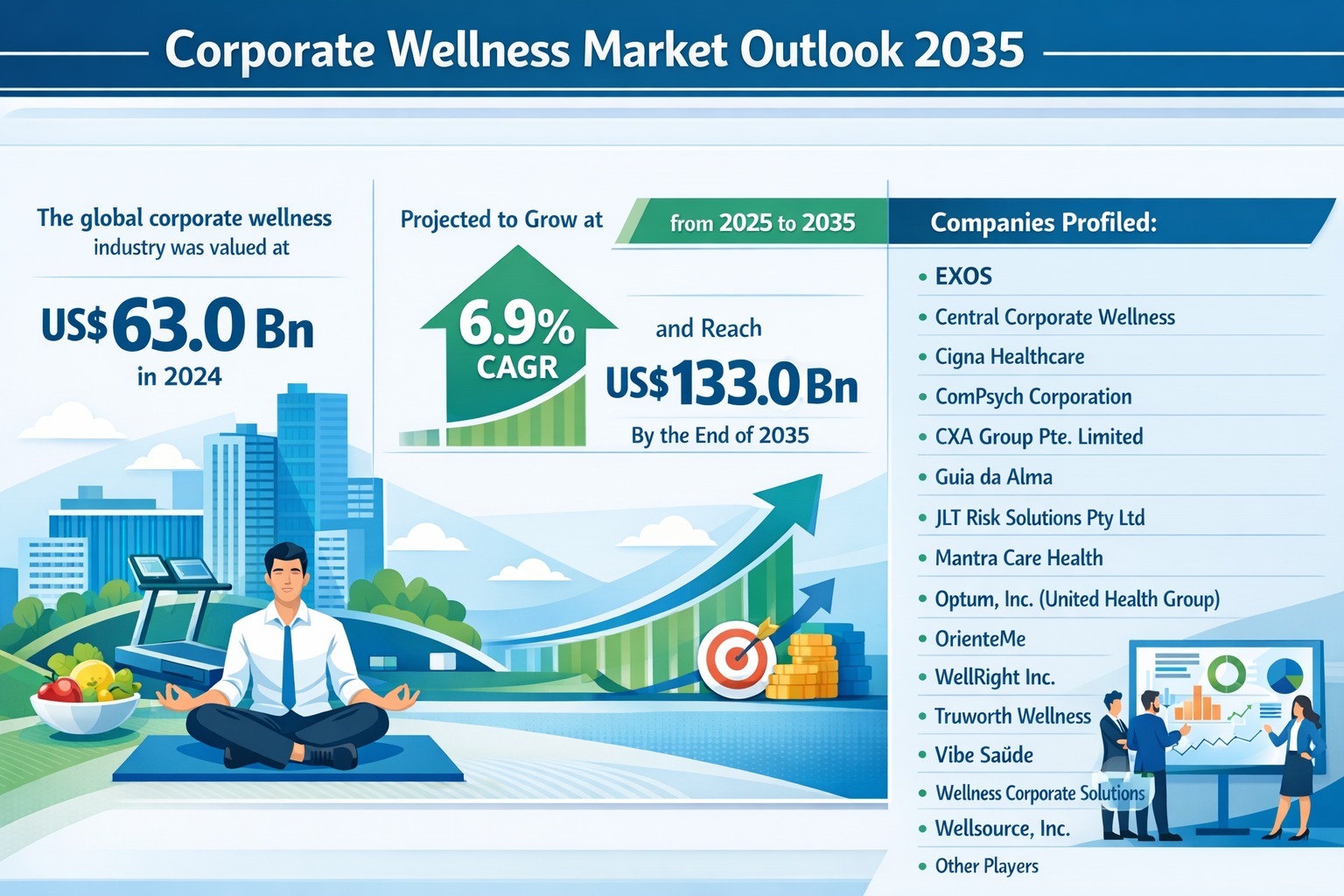
The global corporate wellness industry was valued at US$ 63.0 Bn in 2024 and is projected to expand at a CAGR of 6.9% from 2025 to 2035, reaching approximately US$ 133.0 Bn by the end of 2035. The market’s steady trajectory reflects the increasing institutionalization of employee health programs across small, medium, and large-scale organizations worldwide.
Historical data from 2020 to 2024 indicates consistent adoption of workplace wellness initiatives, particularly in North America and Europe. The forecast period (2025–2035) is expected to witness accelerated expansion fueled by digital transformation, mental health prioritization, and corporate cost-optimization strategies.
→Discover Market Opportunities – Request Your Sample Copy Now: https://www.transparencymarketresearch.com/sample/sample.php?flag=S&rep_id=4743
Analysts’ Viewpoint regarding Corporate Wellness Market
Analysts observe that rising awareness about employee health and wellness among employers and employees, combined with technological advancements, are significantly shaping the market’s future. Escalating healthcare costs are compelling companies to adopt proactive strategies that mitigate long-term insurance and medical expenditure.
However, the market also faces challenges such as high setup costs—especially for small and medium-sized businesses (SMBs)—low worker engagement levels, privacy concerns regarding sensitive health data, lack of customization, and limited management support. Despite these barriers, the long-term benefits in terms of productivity, profitability, and employee retention are expected to outweigh initial investment hurdles.
Market Overview
Corporate wellness refers to a comprehensive organizational approach designed to promote the physical, mental, and emotional well-being of employees. Programs typically include:
- Fitness challenges
- Stress management workshops
- Health screenings
- Nutrition counseling
- Smoking cessation initiatives
- Mental health counseling
The core objective of these programs is to build a healthier and more productive workforce. Corporate wellness initiatives have demonstrated measurable benefits, including:
- Reduced hospitalization expenses
- Lower emergency room visits
- Fewer specialist consultations and surgeries
- Decreased absenteeism
- Improved workplace productivity
According to a Corporate Executive Board study, businesses with highly engaged employees report 21% higher profitability. Furthermore, a study by the Centers for Disease Control and Prevention (CDC) revealed that for every US$ 1 invested in workplace wellness programs, companies can save US$ 3.27 in medical costs and US$ 2.73 in absenteeism-related expenses.
These compelling statistics are encouraging employers globally to embed wellness initiatives into their corporate culture.
Key Market Growth Drivers
- Rise in Awareness about Health and Wellness
One of the primary drivers of corporate wellness market growth is the heightened awareness among employers and employees regarding the importance of preventive healthcare. Organizations increasingly recognize the direct link between employee well-being and business performance.
Well-designed wellness programs help mitigate risks associated with chronic diseases such as diabetes, cardiovascular conditions, obesity, and chronic pain. Healthier employees lead to reduced insurance premiums, fewer sick days, and enhanced operational efficiency.
The International Foundation of Employee Benefit Plans reported that 73% of U.S. employers offered wellness programs in 2021, compared to 58% in 2018, highlighting the rapid adoption trend.
- Surge in Technological Advancements
Digital transformation is revolutionizing corporate wellness delivery. The integration of:
- Mobile health apps
- Wearable devices
- AI-powered health analytics
- Virtual wellness platforms
has improved program accessibility and engagement. Employees can now track physical activity, sleep patterns, heart rate, and stress levels in real time through smart devices.
These digital tools are particularly critical in hybrid and remote work environments. Data-driven insights allow employers to customize interventions and design targeted wellness initiatives, improving participation and measurable outcomes.
Market Challenges & Opportunities
Challenges
- High setup and implementation costs
- Low employee participation rates
- Data privacy concerns
- Lack of customization
- Weak management support
Opportunities
- Expansion into emerging markets
- AI-driven personalized wellness plans
- Mental health and stress management programs
- Subscription-based digital wellness platforms
- Government incentives promoting preventive healthcare
The growing mental health crisis and hybrid work culture present significant opportunities for innovation in digital and telehealth-based wellness services.
→Explore Strategies & Trends – Request Full Report Access – https://www.transparencymarketresearch.com/sample/sample.php?flag=S&rep_id=4743
Market Segmentations (with Region)
By Treatment Type
The market is segmented into:
- Health Risk Assessment
- Fitness
- Smoking Cessation
- Health Screening
- Weight Management
- Nutrition
- Others (Stress Management, Disease Management, Vaccination, etc.)
Among these, the Health Risk Assessment segment is projected to hold a significant share by 2028 and is expected to grow at a high CAGR during the forecast period. These assessments provide immediate insights into employees’ health conditions, enabling early intervention and personalized recommendations.
Preventive healthcare approaches are gaining traction as they significantly reduce long-term healthcare costs and chronic disease risks.
By Mode of Delivery
- Onsite
- Offsite
Onsite programs remain dominant among large organizations, while offsite and digital models are rapidly expanding due to remote workforce trends.
By End-user
- Small Scale Organizations
- Medium Scale Organizations
- Large Scale Organizations
Large enterprises currently dominate market revenue due to higher budgets and structured HR frameworks. However, adoption among SMBs is rising with the availability of scalable digital solutions.
Regional Outlook
North America held the largest market share in 2024 and is expected to maintain dominance through 2035. The U.S. leads regional growth due to high healthcare costs, chronic disease prevalence, mental health awareness, and strong employer-sponsored healthcare systems.
Other regions covered include:
- Europe (Germany, U.K., France, Italy, Spain)
- Asia Pacific (China, India, Japan, Australia & New Zealand)
- Latin America (Brazil, Mexico)
- Middle East & Africa (GCC Countries, South Africa)
Asia Pacific is projected to witness strong growth due to rapid corporate expansion and increasing awareness of preventive healthcare benefits.
Analysis of Key Players – Key Player Strategies
Leading companies are strengthening their service portfolios by offering integrated wellness solutions that combine fitness, mental health support, dietary guidance, stress management, and health assessments.
Major players include:
- EXOS
- Central Corporate Wellness
- Cigna Healthcare
- ComPsych Corporation
- CXA Group Pte. Limited
- Guia da Alma
- JLT Risk Solutions Pty Ltd
- Mantra Care Health
- Optum, Inc. (United Health Group)
- OrienteMe
- WellRight Inc.
- Truworth Wellness
- Vibe Saúde
- Wellness Corporate Solutions
- Wellsource, Inc.
Key Player Strategies
- Strategic collaborations with medical providers and mental health professionals
- Launch of bundled integrated wellness packages
- Deployment of AI-driven analytics for personalized engagement
- Expansion into emerging markets
- Investment in digital platforms and mobile-based wellness ecosystems
By offering holistic and customizable wellness solutions, these companies are enhancing employee engagement and delivering measurable ROI to employers.
Recent Developments (use as it is from report RD)
In February 2023, Seva At Home, Inc. unveiled the extension of its Seva PRO occupational health and safety services, encompassing onsite medical rooms, employee health check-ups, and cardiac preventive care program. This strategic move is a direct response to the increase in demand for comprehensive health and wellness solutions within the workplace, highlighting the significance of preventive care in promoting overall well-being.
In January 2023, Roga Life Inc. announced the launch of its corporate wellness program to reduce stress and burnout, and improve overall well-being, among workers. The program, which comes after the close of its successful beta program and official device launch, is piloting with its first batch of 30 customer companies.
Investment Landscape and ROI Outlook
The corporate wellness market presents a compelling investment case due to its predictable demand, recurring revenue models, and long-term cost-saving benefits.
With healthcare expenditures rising globally, companies are increasingly allocating budgets toward preventive health programs. The demonstrated ROI—US$ 3.27 in medical savings and US$ 2.73 in absenteeism savings per US$ 1 invested—provides strong financial justification.
Investors are particularly attracted to:
- Digital-first wellness startups
- AI-driven analytics platforms
- Mental health service providers
- Integrated health management ecosystems
The projected market expansion from US$ 63.0 Bn in 2024 to US$ 133.0 Bn by 2035 represents an incremental opportunity of US$ 70.0 Bn, signaling robust long-term growth potential.
Why Buy This Report?
- Comprehensive market size and forecast analysis (2020–2035)
- In-depth segmentation by treatment type, delivery mode, and end-user
- Regional and country-level insights
- Detailed competition landscape and company profiling
- Strategic analysis including drivers, restraints, and opportunities
- Investment outlook and ROI assessment
- Available in Electronic (PDF) + Excel format
- Customization scope available upon request
FAQs
- How big was the corporate wellness market in 2024?
The market was valued at US$ 63.0 Bn in 2024.
- How large will the corporate wellness industry be by 2035?
It is projected to reach approximately US$ 133.0 Bn by the end of 2035.
- What is the expected CAGR during 2025–2035?
The industry is anticipated to grow at a 6.9% CAGR during the forecast period.
- What factors are driving the corporate wellness market?
Key drivers include rising health awareness among employers and employees, technological advancements in digital health tools, and increasing healthcare costs prompting preventive investments.
- Which region will account for the largest share during the forecast period?
North America is expected to account for the largest share from 2025 to 2035.
Buy Full Report Now: https://www.transparencymarketresearch.com/checkout.php?rep_id=4743<ype=S
→Explore Latest Research Reports by Transparency Market Research:
Skincare Devices Market: https://www.transparencymarketresearch.com/skincare-devices-market.html
Diagnostic Catheters Market: https://www.transparencymarketresearch.com/diagnostic-catheter-market.html
In Vitro Fertilization Test Market: https://www.transparencymarketresearch.com/in-vitro-fertilization-test-market.html
About Transparency Market Research
Transparency Market Research, a global market research company registered at Wilmington, Delaware, United States, provides custom research and consulting services. Our exclusive blend of quantitative forecasting and trends analysis provides forward-looking insights for thousands of decision makers. Our experienced team of Analysts, Researchers, and Consultants use proprietary data sources and various tools & techniques to gather and analyses information.
Our data repository is continuously updated and revised by a team of research experts, so that it always reflects the latest trends and information. With a broad research and analysis capability, Transparency Market Research employs rigorous primary and secondary research techniques in developing distinctive data sets and research material for business reports.



Leave a Reply