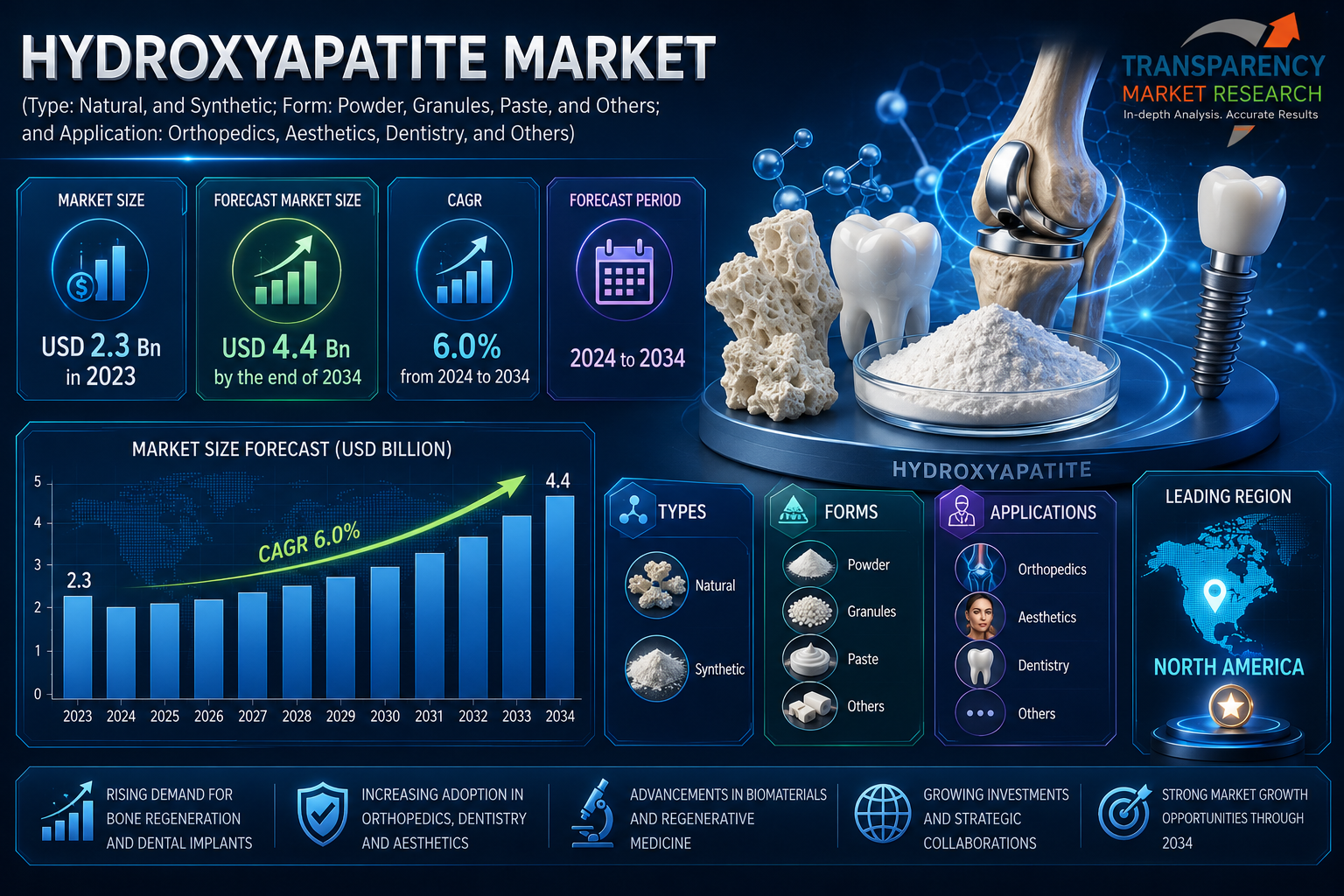
The global Hydroxyapatite Market was valued at USD 2.3 billion in 2023 and is projected to surpass USD 4.4 billion by the end of 2034. The market is expected to expand at a CAGR of 6.0% from 2024 to 2034, driven by increasing demand for biocompatible materials in orthopedic, dental, and biomedical applications. Growing adoption of hydroxyapatite in bone grafts, implant coatings, tissue engineering, and regenerative medicine, coupled with advancements in healthcare infrastructure and biomaterials research, is expected to support sustained market growth throughout the forecast period.
👉 Get sample market research report copy today@ https://www.transparencymarketresearch.com/sample/sample.php?flag=S&rep_id=54867
Market Overview
Hydroxyapatite is a biocompatible material widely used in medicine and dentistry, whose structure is similar to the mineral component of bone. It is extensively used in bone grafts and dental implants, among other orthopedic applications.
The latest range of products includes nano-sized HAp with better mechanical properties, broadening usage in biomedical applications. Significant innovations include HAp-based coatings for implants to enhance osseointegration and durability.
Hydroxyapatite is now increasingly used in novel applications, including dermal fillers and tooth remineralization products, due to its excellent biocompatibility and safety profile. Additional research and development activities, and clinical trials are ongoing to make it suitable for even more complex and diversified applications.
Analysts’ Viewpoint
High demand from the healthcare sector for bone grafts and dental implants is bolstering the hydroxyapatite market growth. Hydroxyapatite’s (Hap) biocompatibility and likeness to the structure of natural bone, and advances in medical technology, which lead to the development of more effective and durable HAp-based products, also propel market progress.
The aging population worldwide results in a higher incidence of bone-related ailments, increasing the need for HAp products. Further demand is driven by the surge in usage of HAp in cosmetics and aesthetic applications.
Continuous research and development in improving hydroxyapatite properties and discovering new applications is expected to fuel the hydroxyapatite market size. Additionally, supportive government policies and financing for healthcare infrastructure improvements, especially in emerging markets, adds impetus to market development.
Analysis of Key Players
The global hydroxyapatite market features a mix of multinational medical device companies, specialized chemical extractors, and advanced biotechnology startups.
Leading prominent players operating in this space include:
- Zimmer Biomet
- The Lubrizol Corporation
- Sangi Co., Ltd.
- Berkeley Advanced Biomaterials
- Fluidinova
- Cam Bioceramics B.V.
- SigmaGraft Biomaterials
- HAPPE Spine
- SofSera Corporation
- Medtronic plc
- Stryker Corporation
- Bio-Rad Laboratories, Inc.
The competitive landscape is defined by continuous product differentiation through custom synthesis methods. While legacy players command high volumes via proprietary plasma-spray coating contracts for large orthopedic OEMs, mid-tier players are establishing a competitive advantage through specialized additive manufacturing (3D printing) pastes and high-purity, bio-derived source extraction.
Recent Developments (2025-2026)
- Early 2026: Medical device registries highlighted that hydroxyapatite-coated titanium implants achieved a 95% to 98% long-term survival rate compared to 90% for bare titanium fixtures, prompting insurance providers in OECD nations to expand bundled reimbursement packages for HA-modified implants.
- Late 2025: Specialized tissue engineering labs accelerated the adoption of vat photopolymerization and direct-ink writing (3D printing) utilizing HA nanostructures to create custom, patient-specific craniofacial plates based directly on patient CT data.
- Mid 2025: High-purity bio-derived processing methods advanced significantly, with manufacturing lines scaling up the synthesis of sustainable HA from renewable, non-mammalian resources (such as eggshells and fish scales) to insulate supply chains against bovine safety cross-contamination risks.
👉 Discuss Implications for Your Industry Request Sample Research Report PDF@ https://www.transparencymarketresearch.com/sample/sample.php?flag=B&rep_id=54867
Key Developments & Trends
- Nanotechnology Proliferation: Rapid growth of the sub-100nm particle segment due to its unique structural mimicry of natural bone mineral crystals, leading to faster osseointegration times.
- Flouride-Free Oral Care Disruption: A major influx of premium toothpaste brands utilizing micro- and nano-HA as clinical, non-toxic alternatives for tooth remineralization and sensitivity management.
- Embedded 3D Bio-Scaffolds: Integration of HA into highly porous, custom-printed polymer cages to facilitate structured osteoblast migration during complex spinal fusion surgeries.
- Regulatory Tiering: Increased safety standardization and strict particle-size testing guidelines enforced by international bodies (such as the EU SCCS) regarding the use of non-aerosolized nano-fractions in consumer formulations.
Challenges
- High Manufacturing and Scale Complexity: Achieving highly consistent, narrow particle-size distributions without batch contamination demands expensive cleanroom setups and complex wet-chemical precipitation methods.
- Strict Regulatory Approval Roadblocks: Navigating fragmented international healthcare and chemical safety compliance frames, particularly regarding the long-term systemic clearance of nano-sized particles in the human body.
- Inhalation Hazards in Processing: The specialized handling of fine, dry nano-HA powders introduces workplace safety concerns regarding potential pulmonary inflammation, requiring heavy capital investment in isolated automated handling lines.
- Competition from Advanced Synthetics: Emerging competition from alternative bioactive glasses and composite hydrogels that offer competing degradation kinetics in soft-tissue regeneration environments.
Opportunities
- Used EV Battery/Bio-Waste Synergy: Upcycling industrial calcium-rich agricultural bioproducts into medical-grade hydroxyapatite, satisfying corporate ESG targets while lowering raw material overheads.
- Injectable Dermal Contouring Fillers: Expanding aesthetic medicine lines by formulating long-lasting, highly biocompatible HA micro-spheres that stimulate natural sub-dermal collagen synthesis.
- Smart Controlled-Release Drug Carriers: Leveraging the highly porous, functionalized surface of synthetic HA granules to create localized, slow-release antibiotic or targeted oncology delivery systems inside bone tissue.
- Orthopedic Point-of-Care Spraying: Supplying dental clinics and regional outpatient surgical centers with compact, localized surface-treatment equipment for customized, chair-side implant modification.
Market Segmentation
➤ By Particle Size
- Nano-Sized (<100 nm) (Leading & Fastest Growing Segment – Capturing over 54% market share due to its enhanced biological reactivity, rapid cellular absorption, and extensive adoption in premium oral care and tissue engineering).
- Micro-Sized (100 nm to 10 µm) (Foundational Segment – Heavily utilized in conventional biomedical applications, standard bone fillers, and heavy orthopedic plasma coatings due to high structural predictability and lower manufacturing costs).
- Macro-Sized (>10 µm) (Niche Segment – Restricted to specific load-bearing structural bone void grafting scenarios requiring prolonged mechanical stability).
➤ By Source
- Synthetic Grades (Dominant Segment – Representing more than 70% of global revenue, driven by highly predictable chemical purity, controllable grain size, and absolute freedom from pathogen risks).
- Bio-Derived Grades (Emerging Segment – Growing at a swift CAGR of ~6.8% as sustainable refinement methods successfully extract highly compatible HA structures from bovine bone, marine coral, and eggshell waste).
➤ By Application
- Orthopedics (Leading Application – Dominating nearly 45% of total market value, propelled by the rising incidence of joint replacements, spinal fusion surgeries, and the utilization of HA-coated trauma plates).
- Dental Care (Major Volume Segment – Accounting for roughly 31% to 36% share, fueled by cosmetic dental implants, bone augmentation procedures, and the mass adoption of enamel remineralization products).
- Plastic & Cosmetic Surgery (Fastest Growing Sector – Expanding rapidly at a double-digit CAGR due to the clinical shift toward HA-based soft tissue augmentation and biocompatible facial contouring fillers).
- Drug Delivery & Industrial Uses (Niche Sector – Evolving around advanced bioactive carriers for controlled-release therapeutics and protein purification chromatography).
➤ By Geography
- Asia-Pacific (Largest and Fastest Growing Region – Controlling roughly 39% to 42% of global market revenue. Growth is supercharged by the massive healthcare infrastructure investments in China and South Korea, coupled with Japan’s massive, elderly demographic demanding restorative orthopedic treatments).
- North America (Highly Lucrative Segment – Accounting for approximately 38% market share, driven by mature implant manufacturing networks, high volume elective surgeries, and extensive biomaterial R&D funding).
- Europe (Stable Core Segment – Anchored strongly by leading dental clinics and premium consumer personal care manufacturers across Germany, France, and the UK).
👉 To buy this comprehensive market research report, click here to inquire@ https://www.transparencymarketresearch.com/checkout.php?rep_id=54867<ype=S
About Transparency Market Research
Transparency Market Research, a global market research company registered at Wilmington, Delaware, United States, provides custom research and consulting services. Our exclusive blend of quantitative forecasting and trends analysis provides forward-looking insights for thousands of decision makers. Our experienced team of Analysts, Researchers, and Consultants use proprietary data sources and various tools & techniques to gather and analyses information.
Our data repository is continuously updated and revised by a team of research experts, so that it always reflects the latest trends and information. With a broad research and analysis capability, Transparency Market Research employs rigorous primary and secondary research techniques in developing distinctive data sets and research material for business reports.
Contact:
Abhishek Budholiya
Transparency Market Research Inc.
State Tower, 90 State Street, Suite 700,
Albany NY – 12207, United States
Tel: +1-518-618-1030
USA – Canada Toll Free: 866-552-3453
Website: https://www.transparencymarketresearch.com
Sales Inquiries: sales@transparencymarketresearch.com
Media Inquiries: media@transparencymarketresearch.com



Leave a Reply