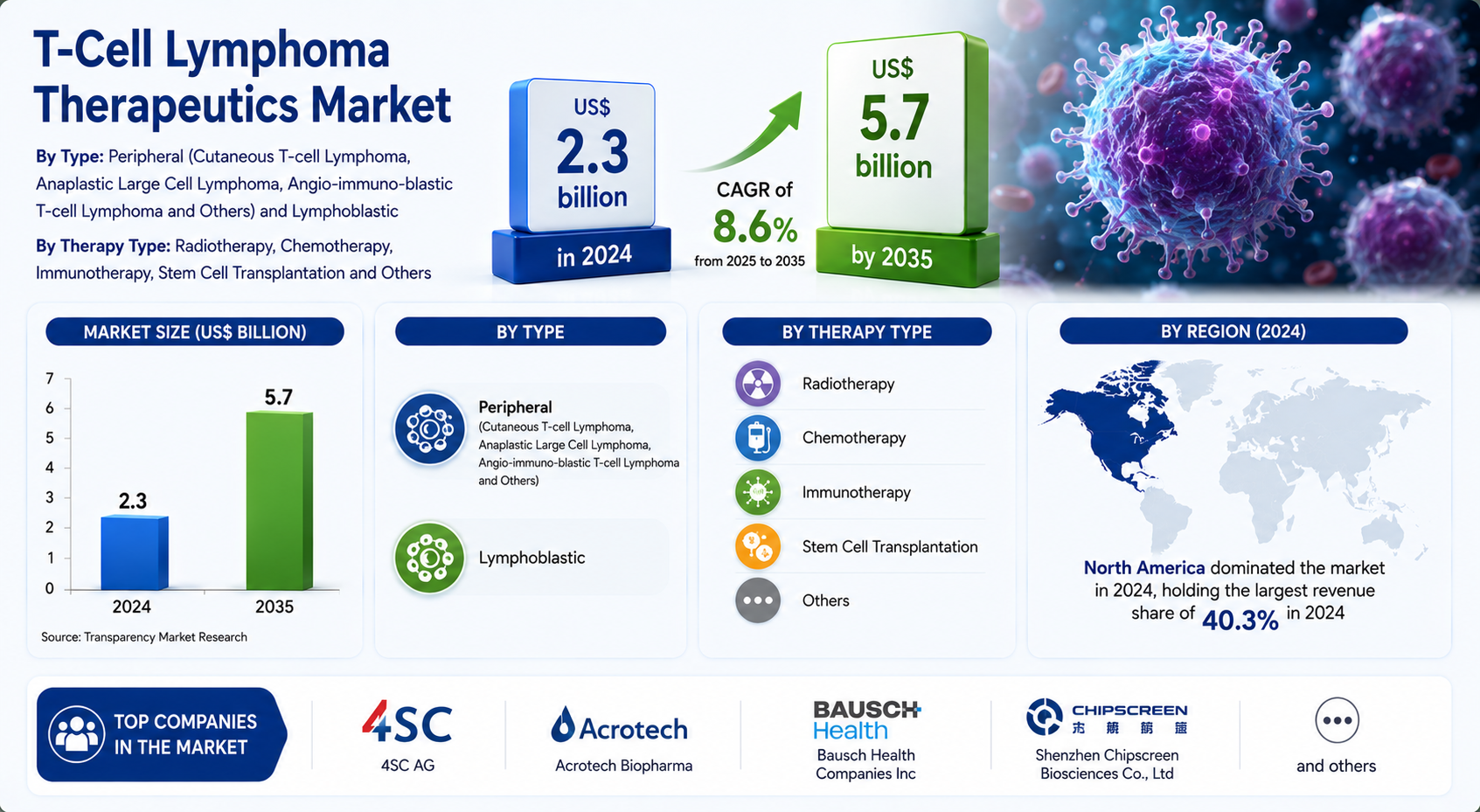
The global T-Cell Lymphoma Therapeutics Market is poised for substantial growth over the coming decade, driven by the rapid expansion of targeted oncology solutions, increasing demand for novel immunotherapies, and growing investments in advanced biopharmaceutical infrastructure. According to recent industry analysis, the market was valued at USD 2.3 billion in 2024 and is projected to reach USD 5.7 billion by 2035, expanding at a CAGR of 8.6% from 2025 to 2035.
As healthcare providers worldwide seek to improve clinical outcomes, enhance patient survival rates, and mitigate the complex resistance patterns of hematologic malignancies, specialized T-cell lymphoma treatments have become a critical component of modern oncology operations. The integration of biomarker-driven targeted therapies, next-generation cellular engineering, and combination immunotherapy regimens is further transforming the market landscape and creating new opportunities for manufacturers and investors.
Review significant findings and insights from our Report in this sample – https://www.transparencymarketresearch.com/sample/sample.php?flag=S&rep_id=86859
Market Overview
T-cell lymphomas are a form of non-Hodgkin lymphoma (NHL) that are capable of developing in lymphoid tissues like the lymph nodes and spleen, or outside of lymphoid tissues (i.e., liver, gastrointestinal tract, nasal cavity, skin, and others). Each particular subtype of T-cell lymphoma is uncommon. They can be indolent (slow-growing) or aggressive (fast-growing). Treatments involve targeted therapy, chemotherapy, immunotherapy, and stem cell transplant.
The growth of the T-cell lymphoma (TCL) therapeutics market is expected to be significant, which is attributed to the array of available treatments based on therapeutic advances, including targeted therapies and immunotherapies. Continual advancements in disease awareness and diagnosis are raising the number of TCL cases, while new agents, including HDAC inhibitors, monoclonal antibodies, cell therapies, and checkpoint inhibitors, are changing the therapeutic landscape.
Key Market Growth Drivers
Expansion of Biomarker-Driven and Targeted Therapies
The rapid growth of molecular oncology is a major factor driving T-cell lymphoma therapeutics demand globally. Complex Subtypes—including Peripheral T-Cell Lymphoma (PTCL) and Cutaneous T-Cell Lymphoma (CTCL)—require distinct therapeutic mechanism profiles to maximize objective response rates and structural tumor reduction.
Commercial laboratories are increasingly investing in pipeline assets to target unique surface antigens, minimize off-target toxicities, and meet stringent regulatory safety metrics.
Increasing Prevalence of T-Cell Malignancies and Autoimmune Conditions
Rising global incidence rates of non-Hodgkin lymphomas, particularly within aging populations, are encouraging healthcare networks to prioritize advanced specialized therapeutics. Clinical research has also tied rising global autoimmune disease rates to heightened T-cell mutagenesis risk, helping clinical developers capture expanded patient cohorts and increase pipeline commercialization viability.
Regulatory Acceleration and Orphan Drug Designations
Regulatory bodies worldwide are implementing pathways to accelerate life-saving cancer solutions, offering fast-track approvals, breakthrough designations, and orphan drug statuses to incentivize rare blood cancer development. These policies encourage biopharma developers to replace general cytostatic treatments with high-efficacy targeted compounds that clear rigorous clinical efficacy boundaries.
Manufacturers are responding by advancing specialized formulations, including single-dose ready-to-use injection solutions and newly approved targeted variations.
Adoption of Next-Generation CAR-T and Cellular Platforms
The integration of gene editing, cellular manipulation, and advanced immunotherapeutic engineering is opening up significant avenues within the market. Modern biological developers can systematically program autologous or allogeneic immune cells to locate specific lymphoma markers, drastically boosting durable complete response rates and minimizing overall cycle resistance.
Analysis of Key Players
The T-cell lymphoma therapeutics market is highly competitive and R&D-intensive, with multi-national pharmaceutical entities and agile biotech firms focusing on formulation innovation, target expansion, and integrated clinical diagnostics to strengthen their market positions.
Leading companies operating in the market include Seagen Inc. (Pfizer), Bristol Myers Squibb Company, Merck & Co., Inc., Takeda Pharmaceutical Company Limited, Kyowa Kirin Co., Ltd., Acrotech Biopharma LLC, Secura Bio, Inc., HUYA Bioscience International, Innate Pharma, Johnson & Johnson, and Roche.
Recent industry developments demonstrate a profound pivot toward specialized targeted formulations and long-term clinical pipeline validations. Significant activity in the first half of 2026 underscored this momentum; for instance, the FDA granted approval for an advanced single-dose, ready-to-use romidepsin injection formulation, expanding options for pre-treated cutaneous T-cell lymphoma (CTCL) cases. On the clinical trial front, Secura Bio expanded evaluation frameworks for its ongoing PI3K inhibitor assets at late-stage hematology assemblies, while international research organizations like Innate Pharma progressed key Phase II clinical programs targeting peripheral T-cell lines, signaling an impending wave of precision regulatory entries over the coming forecast window.
Key Player Strategies
Leading manufacturers are implementing several strategic initiatives to enhance market competitiveness and capitalize on emerging opportunities:
- Development of high-purity, multi-antigen targeted antibody conjugates
- Integration of artificial intelligence in early-stage lead optimization and trial design
- Expansion of off-the-shelf (allogeneic) cellular therapy pipelines
- Strategic partnerships and collaborations with academic medical centers and clinical research networks
- Investment in patient support infrastructure and specialized safety-monitoring workflows
- Introduction of novel oral combination therapies to optimize long-term maintenance cycles
- Geographic expansion into emerging healthcare systems and modernizing hospital networks
- Enhancement of companion diagnostic access to accurately identify patient tumor markers
These strategies are helping companies differentiate their offerings while addressing evolving clinical and regulatory requirements.
Access detailed insights by visiting our full report – https://www.transparencymarketresearch.com/t-cell-lymphoma-therapeutics-market.html
Market Challenges & Opportunities
Challenges
Despite exceptionally strong growth fundamentals, the market faces clear headwinds. The staggering development overhead for precision oncology platforms can drastically elevate consumer pricing structures, occasionally straining regional insurance reimbursement systems. Additionally, the intensive logistical cold-chain and technical cleanroom settings required to manufacture and administer complex cellular modifications create adoption friction outside specialized academic transplant networks.
Stricter safety guidelines surrounding multi-drug toxicities also challenge developers to continually innovate localized delivery mechanics.
Opportunities
The structural transition toward personalized healthcare and out-patient maintenance models presents massive opportunities for therapeutics developers. Fixed-duration oral treatment combinations and low-toxicity bispecific constructs are gaining major traction among healthcare systems looking to lower hospitalization stays and maximize quality of life scores.
The expanding integration of digitized molecular profiling, digital-twin trial modeling, and value-based healthcare frameworks is expected to unlock further growth avenues for enterprises delivering elite, data-backed clinical results.
Investment Landscape and ROI Outlook
The T-Cell Lymphoma Therapeutics Market continues to attract substantial capital flows from institutional life-science funds, venture capital firms, healthcare conglomerates, and sovereign wellness funds. The rising priority of global health security, targeted medicine deployment, and robust cell-processing networks is reinforcing long-term market fundamentals.
Particular investment interest is being channeled toward entities developing breakthrough bispecific T-cell engagers (BiTEs), high-affinity ADCs, specialized small-molecule inhibitors, and highly efficient manufacturing automated bioreactors. As medical communities progressively upgrade legacy protocols toward selective precision models, market participants stand to realize lucrative long-term returns on capital projects.
The combination of increasing disease tracking, intense clinical innovation, and favorable global regulatory tailwinds positions the T-cell lymphoma therapeutics market as a highly promising investment segment through 2035.
Market Segmentation
The T-cell lymphoma therapeutics market is segmented by lymphoma type, therapy type, end-user, distribution channel, and region.
By lymphoma type, the Peripheral T-Cell Lymphoma (PTCL) segment dominates the market landscape, commanding a major 67.8% revenue share in 2024. This leadership is driven by the higher relative incidence rates of PTCL variations and the subsequent density of specialized targeted solutions approved for these specific indicators. Cutaneous T-cell lymphoma and T-cell lymphoblastic lines maintain a smaller but highly active secondary market presence.
By therapy type, chemotherapy holds the largest historical volume share due to its entrenched status within global baseline clinical pathways. However, immunotherapy—comprising monoclonal antibodies, checkpoint inhibitors, and CAR-T platforms—represents the fastest-accelerating therapeutic branch as standard-of-care preferences pivot away from broad systemic toxicity.
By end-user, specialized oncology centers and large-scale research hospitals lead overall application metrics, supported by the extensive technical expertise, intensive monitoring equipment, and multispecialty teams required to deliver advanced biological lines.
By distribution channel, specialized institutional hospital pharmacies dominate financial transaction volumes due to the high-value nature of specialized oncological procurement. Retail and specialty online networks are expanding incrementally, primarily serving long-term oral maintenance segments.
Regionally, North America led the T-cell lymphoma therapeutics market in 2024, accounting for the largest revenue share of 38.6%, powered by an exceptionally mature biotech ecosystem, substantial research budgets, and rapid early adoption curves for advanced immunotherapies. Europe follows closely, backed by sophisticated public health networks, deep clinical trial participation, and rigid therapeutic evaluation standards. The Asia Pacific region is expanding at the fastest CAGR, propelled by rapid medical infrastructure modernization, expanding middle-class clinical spending, and substantial patient groups opening up across China, Japan, and India. Latin America and the Middle East & Africa represent highly promising emerging arenas experiencing localized therapeutic availability upgrades.
Why Buy This Report?
- Gain comprehensive insights into current and future T-cell lymphoma therapeutics market trends
- Access detailed market size estimates and forecasts through 2035
- Understand key growth drivers, challenges, and emerging opportunities
- Evaluate competitive positioning of major industry participants
- Analyze regional and segment-level market dynamics
- Identify high-growth investment opportunities across the value chain
- Track recent product launches, partnerships, and technological advancements
- Support strategic business planning and investment decisions
Buy this Premium Research Report to gain valuable industry intelligence – https://www.transparencymarketresearch.com/checkout.php?rep_id=86859<ype=S
About Transparency Market Research
Transparency Market Research, a global market research company registered at Wilmington, Delaware, United States, provides custom research and consulting services. Our exclusive blend of quantitative forecasting and trends analysis provides forward-looking insights for thousands of decision makers. Our experienced team of Analysts, Researchers, and Consultants use proprietary data sources and various tools & techniques to gather and analyses information.
Our data repository is continuously updated and revised by a team of research experts, so that it always reflects the latest trends and information. With a broad research and analysis capability, Transparency Market Research employs rigorous primary and secondary research techniques in developing distinctive data sets and research material for business reports.
Contact:
Abhishek Budholiya
Transparency Market Research Inc.
State Tower, 90 State Street, Suite 700,
Albany NY – 12207, United States
Tel: +1-518-618-1030
USA – Canada Toll Free: 866-552-3453
Website: https://www.transparencymarketresearch.com
Sales Inquiries: sales@transparencymarketresearch.com
Media Inquiries: media@transparencymarketresearch.com



Leave a Reply