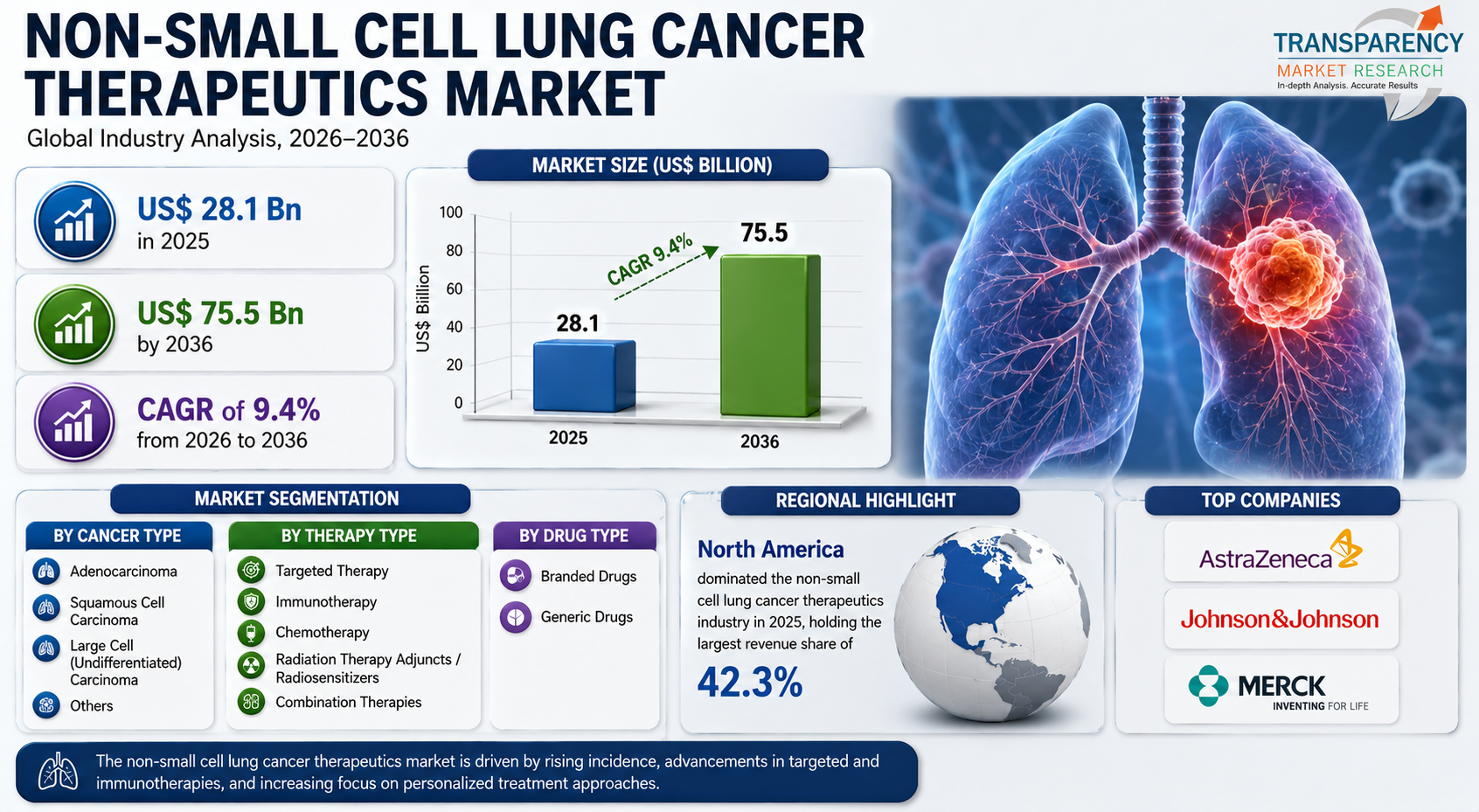
The global Non-Small Cell Lung Cancer (NSCLC) Therapeutics Market is poised for remarkable growth over the coming decade, driven by the rising global prevalence of lung cancer, the growing adoption of targeted therapies and immunotherapies, increasing investments in oncology research, and continuous advancements in precision medicine. According to recent industry analysis, the market was valued at USD 28.1 billion in 2025 and is projected to reach USD 75.5 billion by 2036, expanding at a CAGR of 9.4% from 2026 to 2036.
As healthcare providers increasingly focus on personalized treatment approaches and early cancer diagnosis, NSCLC therapeutics have become an essential component of modern oncology care. The integration of biomarker-driven therapies, companion diagnostics, next-generation sequencing (NGS), and combination treatment regimens is transforming the treatment landscape and creating substantial opportunities for pharmaceutical companies, biotechnology firms, and investors.
Review significant findings and insights from our Report in this sample – https://www.transparencymarketresearch.com/sample/sample.php?flag=S&rep_id=504
Market Overview
Non-Small Cell Lung Cancer (NSCLC) accounts for nearly 85% of all lung cancer cases and encompasses several histological subtypes, including adenocarcinoma, squamous cell carcinoma, and large cell carcinoma. The disease remains one of the leading causes of cancer-related mortality worldwide, highlighting the urgent need for more effective therapeutic options.
NSCLC therapeutics include chemotherapy, targeted therapy, immunotherapy, monoclonal antibodies, angiogenesis inhibitors, combination therapies, and emerging gene-targeted treatments. Modern treatment strategies increasingly rely on molecular profiling and biomarker testing to identify actionable genetic mutations such as EGFR, ALK, ROS1, BRAF, KRAS, MET, RET, and NTRK, enabling personalized treatment plans with improved clinical outcomes.
As oncology shifts toward precision medicine, NSCLC therapeutics are evolving from conventional chemotherapy regimens into highly targeted and immune-based treatment solutions that improve survival rates while minimizing treatment-related toxicity.
Key Market Growth Drivers
Rising Global Burden of Lung Cancer
The increasing incidence of lung cancer remains one of the primary drivers of the NSCLC therapeutics market. Factors such as tobacco consumption, air pollution, occupational exposure to carcinogens, and aging populations continue to contribute to growing disease prevalence worldwide.
Early diagnosis programs and increased awareness are further expanding the eligible patient population requiring advanced therapeutic interventions.
Rapid Advancements in Targeted Therapy and Precision Medicine
Targeted therapies have revolutionized NSCLC treatment by enabling physicians to address specific genetic mutations responsible for tumor growth. Personalized medicine approaches significantly improve treatment efficacy while reducing adverse effects compared to traditional chemotherapy.
Continuous discoveries of new biomarkers and targeted drug candidates are expanding therapeutic options for patients with advanced NSCLC.
Growing Adoption of Immunotherapy
Immune checkpoint inhibitors have transformed the treatment paradigm for NSCLC. Therapies targeting the PD-1, PD-L1, and CTLA-4 pathways have demonstrated improved survival across multiple disease stages.
Combination immunotherapy regimens with chemotherapy or targeted therapies are increasingly becoming standard treatment options, driving substantial market growth.
Increasing Investments in Oncology Research and Clinical Trials
Pharmaceutical companies and research institutions continue to invest heavily in oncology drug development. Numerous clinical trials evaluating novel immunotherapies, bispecific antibodies, antibody-drug conjugates (ADCs), cell therapies, and cancer vaccines are expected to expand the future therapeutic landscape.
Government funding, accelerated regulatory approvals, and orphan drug incentives further support innovation in NSCLC treatment.
Analysis of Key Players
The non-small cell lung cancer therapeutics market is highly competitive, with leading pharmaceutical and biotechnology companies focusing on innovative drug development, precision oncology, immunotherapy expansion, and strategic collaborations to strengthen their market positions.
Leading companies operating in the market include AstraZeneca PLC, F. Hoffmann-La Roche Ltd., Merck & Co., Inc., Bristol Myers Squibb, Pfizer Inc., Novartis AG, Johnson & Johnson, Eli Lilly and Company, Amgen Inc., Boehringer Ingelheim International GmbH, Takeda Pharmaceutical Company Limited, Sanofi, BeiGene Ltd., Daiichi Sankyo Company, Limited, and GSK plc.
Recent industry developments demonstrate increasing emphasis on next-generation targeted therapies, expanded indications for immunotherapy products, companion diagnostic development, AI-assisted drug discovery, and global clinical trial expansion. Strategic licensing agreements, acquisitions, and co-development partnerships continue to accelerate innovation across the oncology ecosystem.
Key Player Strategies
Leading companies are implementing several strategic initiatives to strengthen their competitive positions:
- Development of next-generation targeted therapies
- Expansion of immunotherapy indications across NSCLC stages
- Investment in biomarker research and companion diagnostics
- Strategic collaborations with biotechnology companies
- Advancement of antibody-drug conjugates (ADCs) and bispecific antibodies
- Expansion of global oncology clinical trial programs
- Integration of AI-driven drug discovery platforms
- Geographic expansion into emerging healthcare markets
- Strengthening regulatory approval pipelines
- Continuous investment in precision oncology research
These strategies are helping manufacturers deliver innovative treatment options while improving patient outcomes and addressing the growing global burden of lung cancer.
Access detailed insights by visiting our full report – https://www.transparencymarketresearch.com/sample/sample.php?flag=B&rep_id=504
Market Challenges & Opportunities
Challenges
Despite strong growth prospects, the market faces several challenges. High treatment costs associated with targeted therapies and immunotherapies may limit patient accessibility in developing regions. Additionally, drug resistance, tumor heterogeneity, and varying patient responses continue to present clinical challenges.
Regulatory complexities, lengthy clinical development timelines, and reimbursement limitations also require pharmaceutical companies to invest significantly in research, real-world evidence generation, and healthcare partnerships.
Opportunities
The continued advancement of precision oncology presents substantial opportunities for market participants. Increasing adoption of molecular diagnostics, liquid biopsy technologies, AI-assisted treatment selection, and personalized combination therapies is expected to drive future market expansion.
Emerging therapeutic modalities such as cancer vaccines, gene-editing technologies, CAR-T cell therapies, and novel immune checkpoint inhibitors are expected to create significant long-term growth opportunities.
Expanding healthcare infrastructure and improving access to advanced oncology treatments in emerging economies will further support market development during the forecast period.
Investment Landscape and ROI Outlook
The Non-Small Cell Lung Cancer Therapeutics Market continues to attract significant investment from pharmaceutical companies, biotechnology firms, venture capital investors, healthcare institutions, and government research organizations.
Particular investment interest is focused on precision medicine platforms, targeted oncology drugs, immunotherapies, companion diagnostics, genomic testing technologies, and AI-enabled drug discovery.
As the global burden of lung cancer continues to rise and personalized treatment approaches become increasingly standard, the market is expected to generate attractive long-term returns on investment through 2036.
The combination of scientific innovation, expanding clinical pipelines, favorable regulatory support, and increasing healthcare expenditure positions the NSCLC therapeutics market as one of the fastest-growing segments within the global oncology industry.
Market Segmentation
The non-small cell lung cancer therapeutics market is segmented by therapy type, drug class, biomarker, route of administration, distribution channel, end-user, and region.
By therapy type, targeted therapies account for the largest market share owing to their superior clinical efficacy and increasing adoption in biomarker-positive patients. Immunotherapies continue to experience the fastest growth, while chemotherapy maintains an important role in combination treatment regimens.
By drug class, PD-1/PD-L1 inhibitors dominate the market due to widespread clinical adoption across multiple stages of NSCLC. EGFR inhibitors, ALK inhibitors, ROS1 inhibitors, KRAS inhibitors, MET inhibitors, VEGF inhibitors, monoclonal antibodies, and emerging targeted therapies also contribute significantly to market growth.
By biomarker, EGFR mutation-positive NSCLC represents a major market segment, followed by ALK, ROS1, KRAS, BRAF, RET, MET, and other actionable mutations that increasingly guide personalized treatment decisions.
By route of administration, injectable therapies account for the largest market share due to the extensive use of immunotherapies and biologics. Oral targeted therapies continue to witness rapid adoption owing to improved patient convenience and long-term treatment adherence.
By distribution channel, hospital pharmacies dominate the market due to specialized oncology treatment protocols. Specialty pharmacies and retail pharmacy networks are also expanding as oral targeted therapies become increasingly available.
By end-user, hospitals and comprehensive cancer centers represent the leading segment owing to their advanced oncology infrastructure, multidisciplinary treatment capabilities, and access to innovative therapies. Specialty oncology clinics and academic research institutions also contribute significantly to market demand.
Regionally, North America dominates the non-small cell lung cancer therapeutics market due to advanced healthcare infrastructure, strong oncology research, high adoption of precision medicine, and favorable reimbursement policies. Europe follows closely, supported by increasing cancer screening programs and access to innovative therapies. Asia Pacific is expected to witness the fastest growth owing to the rising incidence of lung cancer, expanding healthcare expenditure, improving diagnostic capabilities, and growing pharmaceutical investments across China, Japan, South Korea, and India. Latin America and the Middle East & Africa are emerging markets benefiting from improving access to advanced cancer treatments and expanding healthcare infrastructure.
Why Buy This Report?
- Gain comprehensive insights into current and future non-small cell lung cancer therapeutics market trends
- Access detailed market size estimates and forecasts through 2036
- Understand key growth drivers, challenges, and emerging opportunities
- Evaluate the competitive positioning of leading oncology companies
- Analyze advancements in precision medicine, targeted therapies, and immunotherapy
- Assess regional and segment-level market dynamics
- Identify high-growth investment opportunities across the oncology value chain
- Track recent drug approvals, clinical trials, partnerships, and acquisitions
- Support strategic business planning and product development decisions
- Obtain actionable market intelligence to strengthen competitive positioning
Buy this Premium Research Report to gain valuable industry intelligence – https://www.transparencymarketresearch.com/checkout.php?rep_id=504<ype=S
About Transparency Market Research
Transparency Market Research, a global market research company registered at Wilmington, Delaware, United States, provides custom research and consulting services. Our exclusive blend of quantitative forecasting and trends analysis provides forward-looking insights for thousands of decision makers. Our experienced team of Analysts, Researchers, and Consultants use proprietary data sources and various tools & techniques to gather and analyses information.
Our data repository is continuously updated and revised by a team of research experts, so that it always reflects the latest trends and information. With a broad research and analysis capability, Transparency Market Research employs rigorous primary and secondary research techniques in developing distinctive data sets and research material for business reports.
Contact:
Abhishek Budholiya
Transparency Market Research Inc.
State Tower, 90 State Street, Suite 700,
Albany NY – 12207, United States
Tel: +1-518-618-1030
USA – Canada Toll Free: 866-552-3453
Website: https://www.transparencymarketresearch.com



Leave a Reply