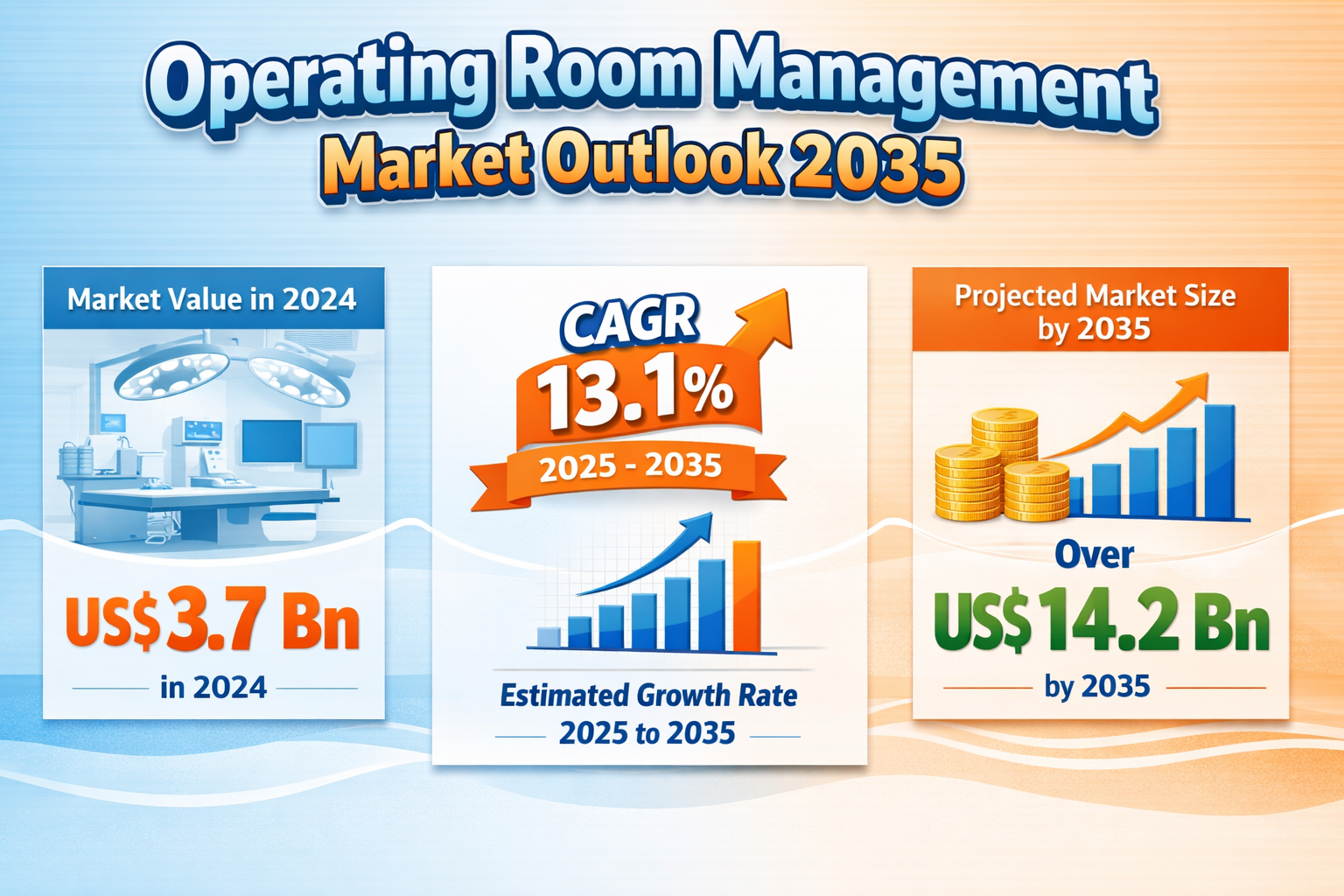
The global Operating Room Management (ORM) Market is poised for substantial expansion over the next decade, with industry revenues expected to grow from US$ 3.7 billion in 2024 to more than US$ 14.2 billion by 2035, registering a strong compound annual growth rate (CAGR) of 13.1% during the forecast period from 2025 to 2035.
The growth trajectory of the market is being fueled by rising surgical volumes worldwide, increasing hospital focus on cost containment and operational efficiency, growing adoption of artificial intelligence (AI) and advanced data analytics, and a surge in strategic collaborations among key industry players. As healthcare systems transition toward value-based care models, operating room optimization has emerged as a critical priority for hospitals and surgical centers globally.
Market Overview: Efficiency and Digitalization at the Core
Operating rooms represent one of the most resource-intensive and revenue-generating departments within healthcare facilities. Hospitals are under mounting pressure to deliver high-quality care while controlling escalating operational costs. In response, healthcare providers are increasingly investing in comprehensive operating room management solutions that improve workflow efficiency, reduce surgical delays, optimize staffing, and enhance patient safety.
Operating Room Management solutions encompass software and services designed to streamline surgical scheduling, supply management, anesthesia documentation, data communication, and intraoperative coordination. These systems integrate with electronic health records (EHRs) and hospital information systems, providing real-time data insights that enhance clinical and administrative decision-making.
With the shift toward digital transformation and interoperability, hospitals are rapidly replacing paper-based and legacy systems with integrated digital platforms. This transition is helping reduce medical errors, lower administrative burden, and improve overall surgical outcomes.
Rising Surgical Procedures and Chronic Disease Burden Drive Demand
The increasing prevalence of chronic diseases such as cardiovascular disorders, cancer, orthopedic conditions, and neurological diseases has significantly contributed to rising surgical volumes worldwide. Aging populations, particularly in developed economies, are further intensifying the demand for complex surgical interventions.
Minimally invasive and robotic-assisted surgeries are also expanding rapidly, requiring sophisticated workflow coordination and advanced data management capabilities. These procedures demand real-time monitoring, predictive analytics, and seamless device integration — capabilities that modern ORM software platforms are designed to provide.
The growing complexity of surgical environments necessitates intelligent scheduling systems that minimize bottlenecks, ensure optimal utilization of operating rooms, and prevent costly delays. Advanced decision-support tools embedded within ORM platforms enable automated conflict detection, resource allocation, and predictive case duration analysis.
Artificial Intelligence and Data Analytics Transform the Operating Room
Artificial intelligence and machine learning technologies are reshaping the operating room landscape. AI-enabled ORM systems analyze historical surgical data to predict case durations, optimize room utilization, reduce turnover times, and enhance staffing efficiency.
In June 2024, Johnson & Johnson MedTech launched Polyphonic, an open and secure digital ecosystem designed to create a more connected surgical experience. The platform integrates software applications that are data-source agnostic and focused on delivering actionable insights in real time. Future releases aim to provide an open development marketplace, enabling third-party digital innovation within surgical environments.
Such technological advancements underscore the growing emphasis on data-driven surgical ecosystems. Hospitals are increasingly leveraging AI-powered platforms to improve clinical decision-making, enhance patient safety, and optimize operational performance.
Strategic Partnerships Accelerate Innovation
Collaborations between healthcare technology companies are accelerating product innovation and market expansion. Strategic alliances are enabling companies to integrate AI-driven analytics, advanced visualization systems, and digital workflow platforms into comprehensive operating room solutions.
In November 2021, Surgio Health partnered with DARVIS, a pioneer in AI-based hospital logistics digitization. The collaboration enhanced operating room software capabilities by integrating advanced real-world visual intelligence systems, driving adoption of AI-enabled OR management platforms.
In April 2023, RIWOlink — a digital subsidiary of Richard Wolf — joined forces with Sony Healthcare Solutions Europe to develop advanced OR integration technologies. Through this partnership, the Sony NUCLeUS platform became a core component of RIWOlink’s digital operating system infrastructure, enabling harmonized video management, device control, and communication solutions within surgical environments.
These partnerships reflect a broader industry trend toward interoperability, platform-based ecosystems, and digital transformation of surgical workflows.
Software Segment Dominates Market Share
Based on component, the market is segmented into software and services, with the software segment accounting for the dominant share in 2024. The growing integration of ORM software with EHR systems, surgical scheduling tools, anesthesia information systems, and hospital supply chain platforms has solidified software as the backbone of operating room digitization.
The increasing adoption of electronic health records across healthcare facilities has further amplified demand for ORM software solutions that seamlessly integrate patient data, surgical documentation, and resource allocation modules. Modern ORM platforms support advanced functionalities such as:
-
Surgical scheduling and workflow automation
-
Real-time patient tracking
-
Operating room supply chain management
-
Anesthesia information management
-
Performance analytics and reporting
As hospitals continue to expand minimally invasive and robotic surgical programs, demand for intelligent software systems capable of managing complex surgical pathways is expected to rise significantly.
Deployment Trends: Cloud-Based Adoption Gains Momentum
While on-premise solutions remain prevalent in large hospital systems, cloud and web-based deployments are witnessing accelerated adoption. Cloud-based ORM platforms offer scalability, remote accessibility, lower upfront infrastructure costs, and enhanced interoperability.
Healthcare organizations are increasingly favoring cloud models to facilitate seamless data exchange, centralized monitoring, and real-time collaboration across multi-site hospital networks. Enhanced cybersecurity frameworks and regulatory compliance measures are further strengthening confidence in cloud adoption.
Workflow Optimization Across Surgical Phases
Operating room management solutions are applied across preoperative, intraoperative, and postoperative workflows:
-
Preoperative phase: Scheduling optimization, patient data verification, resource planning
-
Intraoperative phase: Real-time documentation, anesthesia management, device integration
-
Postoperative phase: Recovery tracking, outcomes reporting, performance analytics
Integrated platforms ensure continuity of care and data consistency across all surgical stages, enhancing patient safety and clinical efficiency.
North America Leads Global Market
North America held the largest share of the global operating room management market in 2024. The region’s dominance is attributed to advanced healthcare infrastructure, strong digital transformation initiatives, high healthcare expenditure, and widespread adoption of healthcare IT systems.
Government initiatives focused on patient safety, interoperability, and cost containment are further supporting ORM adoption. The region also benefits from the presence of leading technology vendors and a robust ecosystem of healthcare IT innovators.
In February 2024, Veradigm completed the acquisition of ScienceIO to enhance AI-driven data analysis and strengthen its healthcare data intelligence capabilities. The move aims to improve customer experience and patient outcomes through advanced analytics solutions.
In April 2023, Medical Information Technology signed an agreement with Canada Health Infoway to enable electronic prescription transmission through its Expanse EHR platform, highlighting the ongoing push toward digital healthcare integration in North America.
Competitive Landscape: Innovation and Expansion Strategies
The global operating room management market is moderately consolidated, with several major players competing through technological innovation, strategic partnerships, acquisitions, and product launches.
Prominent market participants include:
-
Oracle (Cerner Corporation)
-
Epic Systems Corporation
-
GE HealthCare
-
Becton, Dickinson and Company
-
Brainlab AG
-
Getinge AB
-
Steris Corporation
-
Surgical Information Systems
-
eClinicalWorks
-
Picis Clinical Solutions Inc
In July 2024, Getinge AB announced the launch of its Corin OR table and Ezea surgical light at the Association of periOperative Registered Nurses (AORN) conference in Nashville. These technologies are designed to streamline surgical workflows while supporting high levels of patient and clinician safety.
In December 2022, Epic Systems Corporation introduced the Connection Hub, a platform aimed at simplifying interoperability for third-party applications and strengthening the healthcare digital ecosystem.
Companies are increasingly focusing on platform-based ecosystems, AI integration, and cloud deployment to differentiate their offerings and capture market share.
Future Outlook: Toward Intelligent, Connected Surgical Ecosystems
The operating room of the future will be fully digital, interconnected, and data-driven. Real-time analytics, predictive scheduling, AI-assisted documentation, and seamless device integration will become standard components of surgical environments.
The growing emphasis on patient safety, value-based reimbursement models, and performance transparency will continue to drive investment in ORM solutions. Hospitals that leverage advanced operating room management technologies are expected to achieve measurable improvements in surgical throughput, cost efficiency, and clinical outcomes.
Emerging markets in Asia Pacific, Latin America, and the Middle East & Africa are also anticipated to offer lucrative growth opportunities as healthcare infrastructure modernization accelerates in these regions.
With increasing surgical demand, technological innovation, and strategic industry collaboration, the global operating room management market is entering a transformative growth phase. As healthcare providers strive to balance quality care delivery with financial sustainability, ORM solutions will remain central to optimizing surgical performance and improving patient outcomes worldwide.




Leave a Reply