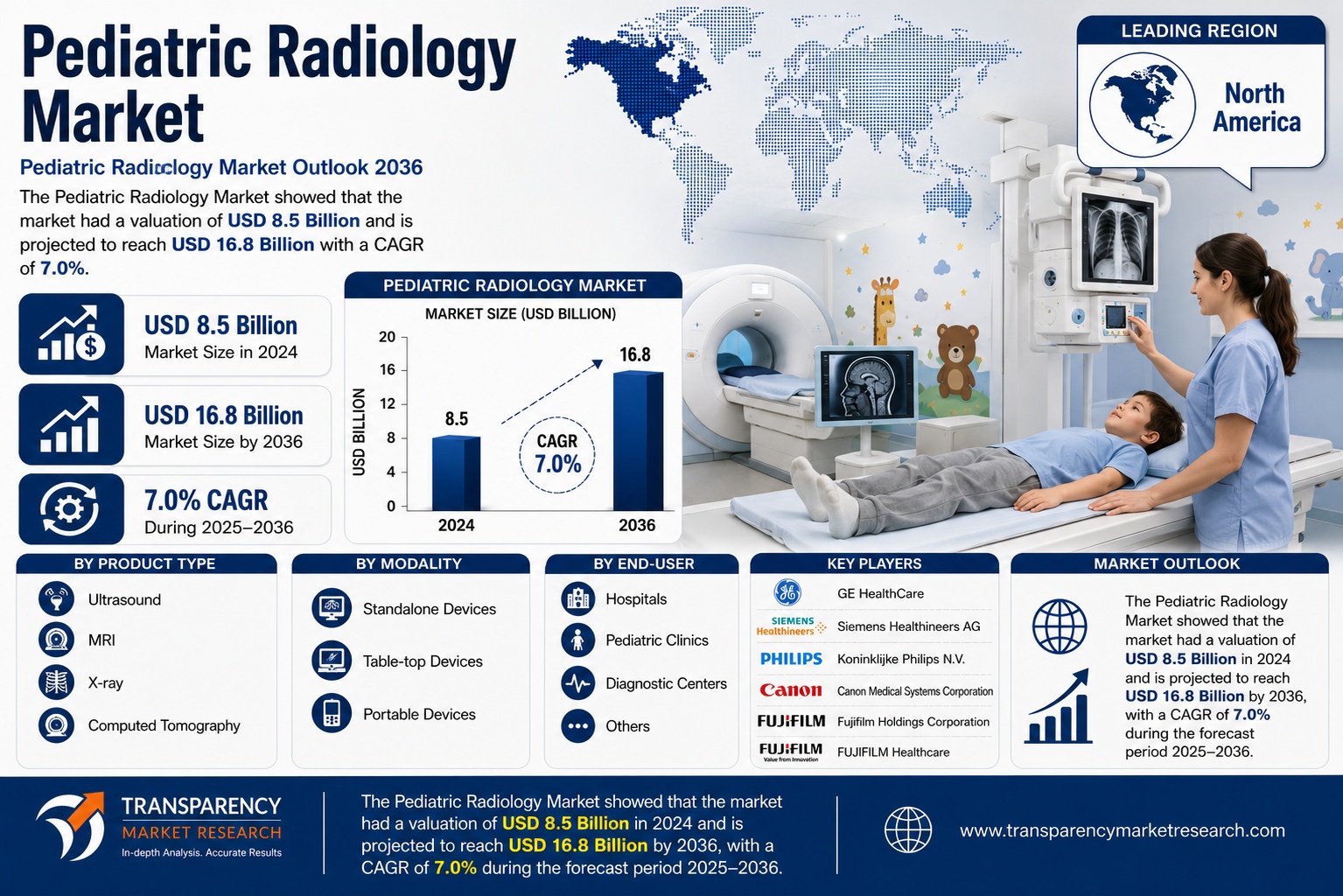
The global Pediatric Radiology Market is witnessing significant growth as healthcare providers increasingly prioritize safe, accurate, and child-friendly diagnostic imaging solutions. The market was valued at USD 8.5 Billion in 2025 and is projected to reach USD 16.8 Billion by 2036, expanding at a CAGR of 7.0% during the forecast period from 2026 to 2036.
Pediatric radiology plays a crucial role in diagnosing fractures, congenital abnormalities, respiratory infections, neurological disorders, abdominal diseases, and trauma-related injuries among infants, children, and adolescents. Unlike adult imaging, pediatric radiology requires specialized equipment and protocols that minimize radiation exposure while maintaining high-quality diagnostic accuracy. Increasing awareness regarding radiation safety, technological advancements in imaging systems, and the growing prevalence of childhood diseases are collectively driving market expansion.
Hospitals, pediatric specialty centers, and diagnostic imaging facilities are increasingly investing in digital radiography, portable imaging devices, low-dose CT scanners, MRI technologies, and ultrasound systems specifically designed for pediatric patients. The integration of artificial intelligence (AI) into imaging workflows is further improving diagnostic precision and operational efficiency, making pediatric radiology an essential component of modern healthcare.
Explore core findings and critical insights from our Report in this sample – https://www.transparencymarketresearch.com/sample/sample.php?flag=S&rep_id=39860
Key Drivers of Market Growth
The increasing incidence of pediatric injuries and emergency cases is one of the primary factors fueling market growth. Children frequently require imaging for fractures, sports injuries, head trauma, respiratory complications, and abdominal disorders, making rapid diagnostic imaging essential for timely treatment.
Growing awareness regarding radiation safety has also accelerated the adoption of low-dose imaging technologies. Healthcare providers are implementing pediatric-specific imaging protocols that significantly reduce radiation exposure while preserving image quality. Regulatory recommendations encouraging optimized imaging practices have strengthened demand for advanced digital radiography systems, MRI scanners, ultrasound devices, and AI-assisted imaging platforms.
Furthermore, rising cases of congenital disorders, chronic respiratory illnesses, neurological conditions, and childhood cancers are increasing the need for early and accurate diagnosis. As preventive healthcare gains momentum worldwide, pediatric imaging is becoming an indispensable part of disease detection and treatment planning.
Key Players and Industry Leaders
The Pediatric Radiology Market remains highly competitive, with leading companies focusing on innovation, AI integration, low-dose imaging solutions, and child-friendly diagnostic equipment.
Major industry participants include:
- GE HealthCare
- Siemens Healthineers AG
- Koninklijke Philips N.V.
- Canon Medical Systems Corporation
- Fujifilm Holdings Corporation
- FUJIFILM Healthcare
- Mindray Medical International Limited
- Samsung Medison Co., Ltd.
- Esaote SpA
- Analogic Corporation
These companies continue to invest heavily in research and development to introduce advanced pediatric MRI systems, digital X-ray platforms, portable ultrasound devices, AI-powered imaging software, and next-generation CT technologies designed specifically for children.
Key Trends for the Future
Several emerging trends are reshaping the Pediatric Radiology Market. Artificial intelligence is rapidly transforming diagnostic imaging by enabling automated image analysis, workflow optimization, improved image reconstruction, and faster diagnosis.
Portable imaging technologies are also gaining popularity, allowing healthcare providers to deliver bedside diagnostic services, particularly in neonatal intensive care units and emergency departments.
Another notable trend is the increasing preference for non-ionizing imaging techniques such as MRI and ultrasound. These modalities provide high diagnostic accuracy without exposing children to radiation, making them particularly suitable for repeated examinations and long-term disease monitoring.
Healthcare facilities are also investing in child-friendly imaging environments that reduce anxiety and improve patient cooperation during imaging procedures, ultimately minimizing repeat scans and enhancing diagnostic efficiency.
New Opportunities and Challenges
Emerging economies present substantial growth opportunities for pediatric radiology equipment manufacturers. Rising healthcare investments, expanding pediatric hospitals, improving diagnostic infrastructure, and increasing healthcare accessibility are creating favorable conditions for market expansion across Asia-Pacific, Latin America, and the Middle East.
AI-enabled diagnostic solutions, cloud-based imaging platforms, mobile radiology systems, and tele-radiology services offer additional growth opportunities, particularly in underserved and remote regions.
Despite these opportunities, the market continues to face several challenges. High equipment costs, limited availability of pediatric radiologists, stringent regulatory requirements, and concerns regarding radiation exposure remain key barriers. Smaller healthcare facilities may also struggle to adopt advanced imaging technologies due to budget limitations.
Market Trends & Innovations
Technological innovation remains at the center of market development. Manufacturers are increasingly focusing on reducing scan times, improving image quality, minimizing radiation doses, and enhancing patient comfort.
Recent innovations include flexible pediatric MRI coils, AI-assisted image reconstruction, digital detector technology, portable X-ray systems, motion correction software, cloud-enabled imaging platforms, and pediatric-specific workflow solutions.
Collaborations between healthcare institutions and medical imaging companies are accelerating research in next-generation pediatric imaging technologies. These partnerships aim to develop safer diagnostic solutions capable of delivering faster and more accurate results while improving the overall patient experience.
Buy this Premium Research Report to access comprehensive analysis – https://www.transparencymarketresearch.com/checkout.php?rep_id=39860<ype=S
Future Outlook
The Pediatric Radiology Market is expected to maintain steady growth throughout the forecast period as demand for early disease diagnosis and child-specific imaging solutions continues to rise.
North America is expected to remain the largest regional market due to advanced healthcare infrastructure, strong adoption of innovative imaging technologies, and widespread implementation of radiation safety protocols. Meanwhile, Asia-Pacific is anticipated to witness the fastest growth owing to expanding healthcare infrastructure, increasing pediatric patient populations, and rising healthcare expenditure.
As AI, machine learning, cloud imaging, and low-dose diagnostic technologies continue to evolve, pediatric radiology will become increasingly efficient, accurate, and patient-centered. Manufacturers that prioritize innovation, radiation safety, and child-friendly imaging technologies are expected to strengthen their competitive positions over the coming decade.
Market Segmentation
By Product Type
- Ultrasound, MRI, X-ray, Computed Tomography (CT)
By Modality
- Standalone Devices, Table-top Devices, Portable Devices
By End-user
- Hospitals, Pediatric Clinics, Diagnostic Centers, Others
By Region
- North America, Europe, Asia Pacific, Latin America, Middle East & Africa
Important FAQs with Answers
- What is the projected size of the Pediatric Radiology Market by 2036?
The market is projected to reach USD 16.8 Billion by 2036, growing from USD 8.5 Billion in 2025. - What is driving the growth of the Pediatric Radiology Market?
Growth is primarily driven by rising pediatric injuries, increasing childhood disease diagnosis, growing adoption of low-dose imaging technologies, AI-enabled diagnostic systems, and expanding pediatric healthcare infrastructure. - Which product segment dominates the market?
The X-ray segment holds the largest market share of 36.0%, owing to its affordability, speed, and widespread use in emergency and routine pediatric diagnosis. - Which region leads the Pediatric Radiology Market?
North America dominates the market with approximately 40.0% revenue share, supported by advanced healthcare infrastructure, specialized pediatric hospitals, and strong adoption of innovative imaging technologies. - Who are the leading companies operating in the Pediatric Radiology Market?
Key players include GE HealthCare, Siemens Healthineers AG, Koninklijke Philips N.V., Canon Medical Systems Corporation, Fujifilm Holdings Corporation, FUJIFILM Healthcare, Mindray Medical International Limited, Samsung Medison Co., Ltd., Esaote SpA, and Analogic Corporation.
More Related Reports –
Thoracic Endoscope Market: https://www.transparencymarketresearch.com/thoracic-endoscope-market.html
X-ray Market: https://www.transparencymarketresearch.com/x-ray-market.html
Diagnostic Imaging Market: https://www.transparencymarketresearch.com/diagnostic-imaging-market.html
Magnetic Resonance Imaging Market: https://www.transparencymarketresearch.com/magnetic-resonance-imaging-market.html
About Us Transparency Market Research
Transparency Market Research, a global market research company registered at Wilmington, Delaware, United States, provides custom research and consulting services. The firm scrutinizes factors shaping the dynamics of demand in various markets. The insights and perspectives on the markets evaluate opportunities in various segments. The opportunities in the segments based on source, application, demographics, sales channel, and end-use are analyzed, which will determine growth in the markets over the next decade.
Our exclusive blend of quantitative forecasting and trends analysis provides forward-looking insights for thousands of decision-makers, made possible by experienced teams of Analysts, Researchers, and Consultants. The proprietary data sources and various tools & techniques we use always reflect the latest trends and information. With a broad research and analysis capability, Transparency Market Research employs rigorous primary and secondary research techniques in all of its business reports.
Contact:
Abhishek Budholiya
Transparency Market Research Inc.
State Tower, 90 State Street, Suite 700,
Albany NY – 12207, United States
Tel: +1-518-618-1030
USA – Canada Toll Free: 866-552-3453
Website: https://www.transparencymarketresearch.com
Media Inquiries: media@transparencymarketresearch.com
Sales Inquiries: sales@transparencymarketresearch.com




Leave a Reply