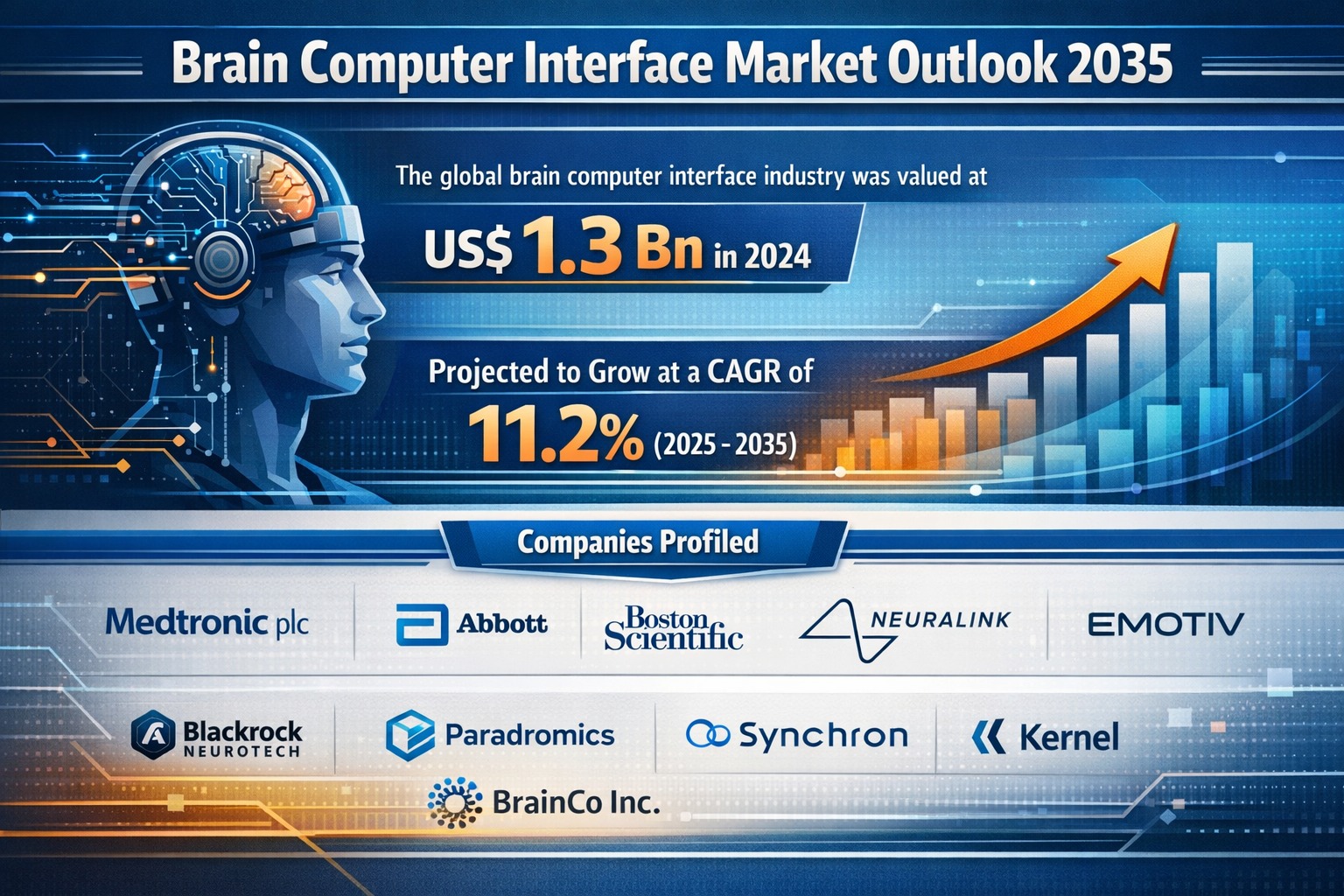
The global brain computer interface (BCI) market was valued at US$ 1.3 Bn in 2024 and is projected to grow at a moderate CAGR of 11.2% from 2025 to 2035, crossing US$ 4.3 Bn by the end of 2035. The steady double-digit expansion reflects increasing demand for advanced neurorehabilitation technologies, expanding clinical applications, and growing commercialization of non-invasive and implantable neurotech devices.
The market’s upward trajectory is supported by rising investments in neuroscience research, AI-driven signal processing, and miniaturized implantable systems. Historical data from 2020 to 2023 indicate consistent growth momentum, setting the stage for accelerated adoption across healthcare and emerging consumer applications.
→Discover Market Opportunities – Request Your Sample Copy Now: https://www.transparencymarketresearch.com/sample/sample.php?flag=S&rep_id=4670
Analysts’ Viewpoint Regarding Brain Computer Interface Market Scenario
The brain computer interface market is expected to witness remarkable growth prospects due to the rising incidence of neurological diseases, continuous improvements in neurorehabilitation technologies, and expanding investments in non-invasive and implantable neurotech products.
Encouraged by the inclusion of artificial intelligence (AI), wearable devices, and in-clinic real-time brain monitoring systems, advancements are accelerating the uptake of BCI technologies. These innovations primarily target stroke recovery, Parkinson’s disease management, and assistive communication for individuals with severe motor impairments.
However, high development costs, lengthy regulatory pathways, and limited awareness in developing regions pose certain restraints. Nevertheless, growing research funding, supportive government initiatives, and emerging applications in mental health and home-based neurocare indicate strong expansion opportunities over the forecast period.
Market Overview
A brain computer interface (BCI) enables direct communication between the human brain and an external device such as a computer, robotic limb, or prosthetic system without requiring physical movement. BCIs capture brain signals—typically through electroencephalography (EEG) or functional near-infrared spectroscopy (fNIRS)—and translate these signals into actionable commands.
Traditionally, BCIs have been used in:
- Neurorehabilitation
- Assistive communication
- Management of neurological disorders
Emerging applications now include:
- Mental health monitoring
- Cognitive training
- Human-computer interaction
- Smart healthcare integration
With advancements in AI-driven signal decoding and hardware miniaturization, BCIs are transitioning from experimental laboratory tools to scalable commercial healthcare solutions.
Key Market Growth Drivers
- Rising Prevalence of Neurological Disorders
The increasing incidence of neurological disorders is a primary growth driver. As global populations age and exposure to lifestyle-related risk factors increases, conditions such as stroke, epilepsy, Parkinson’s disease, Alzheimer’s disease, depression, and spinal cord injuries are becoming more prevalent.
These disorders often result in partial or total loss of motor or cognitive function, creating a critical demand for assistive technologies. BCIs bridge this gap by enabling individuals to regain communication, mobility, and independence through direct neural signal interpretation.
Healthcare systems worldwide are increasingly prioritizing long-term neurorehabilitation programs, thereby expanding clinical demand for BCI-based therapies.
- Advancements in BCI Technology
Technological progress is significantly accelerating market expansion. Breakthroughs in:
- Signal processing algorithms
- Machine learning integration
- Neuroimaging accuracy
- Hardware miniaturization
are enhancing system reliability and user experience.
Integration with emerging technologies such as virtual reality (VR), robotics, and the Internet of Things (IoT) is creating interactive rehabilitation environments and smart healthcare ecosystems. As technological barriers decline, new entrants are entering the market, intensifying innovation and broadening application areas.
Market Challenges & Opportunities
Key Challenges
- High research and development costs
- Complex and time-consuming regulatory approvals
- Ethical considerations related to neural data privacy
- Limited awareness in low- and middle-income regions
Implantable BCIs, in particular, face strict clinical validation requirements and surgical risks, which can delay commercialization timelines.
Key Opportunities
- Expansion of non-invasive wearable EEG devices
- Growth in home-based neurorehabilitation solutions
- Rising mental health applications
- AI-powered adaptive neurofeedback systems
- Government-funded neuroscience initiatives
As reimbursement frameworks improve and regulatory pathways become clearer, adoption is expected to accelerate globally.
→Explore Strategies & Trends – Request Full Report Access – https://www.transparencymarketresearch.com/sample/sample.php?flag=S&rep_id=4670
Non-invasive BCI Segment Drives Market Growth
Among types of BCIs, the non-invasive BCI segment dominates due to its safety, affordability, and ease of use. These systems require no surgical intervention and are widely utilized in neurorehabilitation, mental health monitoring, and cognitive training applications.
Wearable EEG headsets have gained traction in both clinical and consumer wellness markets. As consumer-grade neurotechnology evolves, non-invasive BCIs are expected to maintain their leading market share through 2035.
In contrast, invasive and partially invasive BCIs are witnessing increasing R&D investment, particularly for severe paralysis and advanced neuroprosthetic control.
Hospitals and Clinics Segment Driving Market Growth
Hospitals and clinics represent the largest end-user segment in the BCI market. These institutions serve as primary centers for diagnosing and treating neurological disorders.
BCIs are utilized in:
- Neurological monitoring
- Stroke rehabilitation
- Parkinson’s disease management
- Epilepsy treatment
- Advanced therapies such as deep brain stimulation
Hospitals benefit from established infrastructure, trained neurologists, and integrated care systems, making them the dominant adopters of BCI technologies.
Rehabilitation centers and home-care settings are expected to grow rapidly during the forecast period, driven by telehealth integration and portable neurotech devices.
Regional Outlook of Brain Computer Interface Market
North America leads the global BCI market, supported by advanced healthcare infrastructure, strong R&D funding, and the presence of prominent neurotechnology companies.
The U.S. remains the dominant contributor due to robust clinical trial activity and a favorable regulatory environment encouraging innovation in implantable and non-invasive BCI systems.
Europe follows closely, driven by supportive public healthcare systems and research collaborations. Asia Pacific is expected to witness the fastest growth rate due to expanding healthcare access in China, India, and Japan, along with rising neurological disease prevalence.
Latin America and the Middle East & Africa present emerging opportunities as healthcare modernization initiatives gain momentum.
Analysis of Key Players – Key Player Strategies
The global BCI market is moderately consolidated, with key players focusing on innovation, clinical validation, and strategic collaborations.
Prominent companies include:
- Medtronic plc
- Abbott
- Boston Scientific Corporation
- Neuralink
- EMOTIV
- Blackrock Neurotech
- Paradromics
- Synchron
- Kernel
- BrainCo Inc.
Key Player Strategies
- Heavy investment in clinical trials and regulatory approvals
- Partnerships with academic and research institutions
- AI-driven signal decoding enhancement
- Product portfolio diversification across invasive and non-invasive segments
- Expansion into consumer wellness and mental health monitoring markets
Companies are prioritizing scalable, wireless, and minimally invasive systems to improve patient compliance and commercial viability.
Recent Developments
In November 2024, Neuralink announced that it had launched the PRIME Study, a clinical trial for its fully implantable, wireless brain computer interface (BCI). The basic purpose was to evaluate the safety of its N1 Implant and R1 surgical robot, while testing the ability of the BCI system to help individuals with quadriplegia control external devices such as computers and smartphones using their thoughts.
In September 2024, INBRAIN Neuroelectronics announced the world’s first human procedure of its cortical interface in a patient undergoing brain tumor resection. INBRAIN’s BCI technology was able to differentiate between cancerous and healthy brain tissue with micrometer-scale precision.
Investment Landscape and ROI Outlook
The BCI industry is attracting significant venture capital, government grants, and strategic investments from large medical device companies. Investors are particularly interested in:
- Implantable neuroprosthetics
- AI-integrated signal processing platforms
- Consumer-grade wearable neurotechnology
- Rehabilitation robotics integration
With projected market growth from US$ 1.3 Bn to over US$ 4.3 Bn by 2035, the sector offers compelling long-term ROI potential. Early-stage investors in clinical-grade neurotechnology platforms are expected to benefit from high-value acquisitions and IPO opportunities.
Market Segmentation
By Type of BCI
- Invasive BCI
- Non-invasive BCI
- Partially Invasive BCI
By Application
- Epilepsy
- Parkinson’s disease
- Stroke
- Depression
- Spinal cord injury
- Others
By End-user
- Hospitals and clinics
- Rehabilitation centers
- Home care settings
- Others
By Region
- North America
- Europe
- Asia Pacific
- Latin America
- Middle East & Africa
Why Buy This Report?
- Comprehensive analysis of market drivers, restraints, and opportunities
- Detailed segmentation and regional outlook
- Competitive landscape and company profiling
- Historical data (2020–2023) and forecast analysis (2025–2035)
- Investment insights and ROI assessment
- Strategic guidance for stakeholders and investors
The report is available in electronic format (PDF) along with Excel-based quantitative data for deeper financial analysis.
Frequently Asked Questions (FAQs)
Q.How big was the global brain computer interface market in 2024?
A.The global brain computer interface market was valued at US$ 1.3 Bn in 2024.
Q.How large is the market expected to be by 2035?
A.The market is projected to cross US$ 4.3 Bn by the end of 2035.
Q.What will be the CAGR during the forecast period?
A.The industry is anticipated to grow at a CAGR of 11.2% from 2025 to 2035.
Q.What factors are driving the global brain computer interface market?
A.Rising prevalence of neurological disorders and advancements in BCI technology are the primary growth drivers.
Q.Which region dominates the global BCI market?
A.North America is expected to account for the largest market share during the forecast period.
Buy Full Report Now: https://www.transparencymarketresearch.com/checkout.php?rep_id=4670<ype=S
→Explore Latest Research Reports by Transparency Market Research:
Hearing Aids Market: https://www.transparencymarketresearch.com/hearing-aid-market.html
Magnetic Beads Market: https://www.transparencymarketresearch.com/magnetic-beads-market.html
In Vitro Fertilization Market: https://www.transparencymarketresearch.com/in-vitro-fertilization-market.html
About Transparency Market Research
Transparency Market Research, a global market research company registered at Wilmington, Delaware, United States, provides custom research and consulting services. Our exclusive blend of quantitative forecasting and trends analysis provides forward-looking insights for thousands of decision makers. Our experienced team of Analysts, Researchers, and Consultants use proprietary data sources and various tools & techniques to gather and analyses information.
Our data repository is continuously updated and revised by a team of research experts, so that it always reflects the latest trends and information. With a broad research and analysis capability, Transparency Market Research employs rigorous primary and secondary research techniques in developing distinctive data sets and research material for business reports.




Leave a Reply