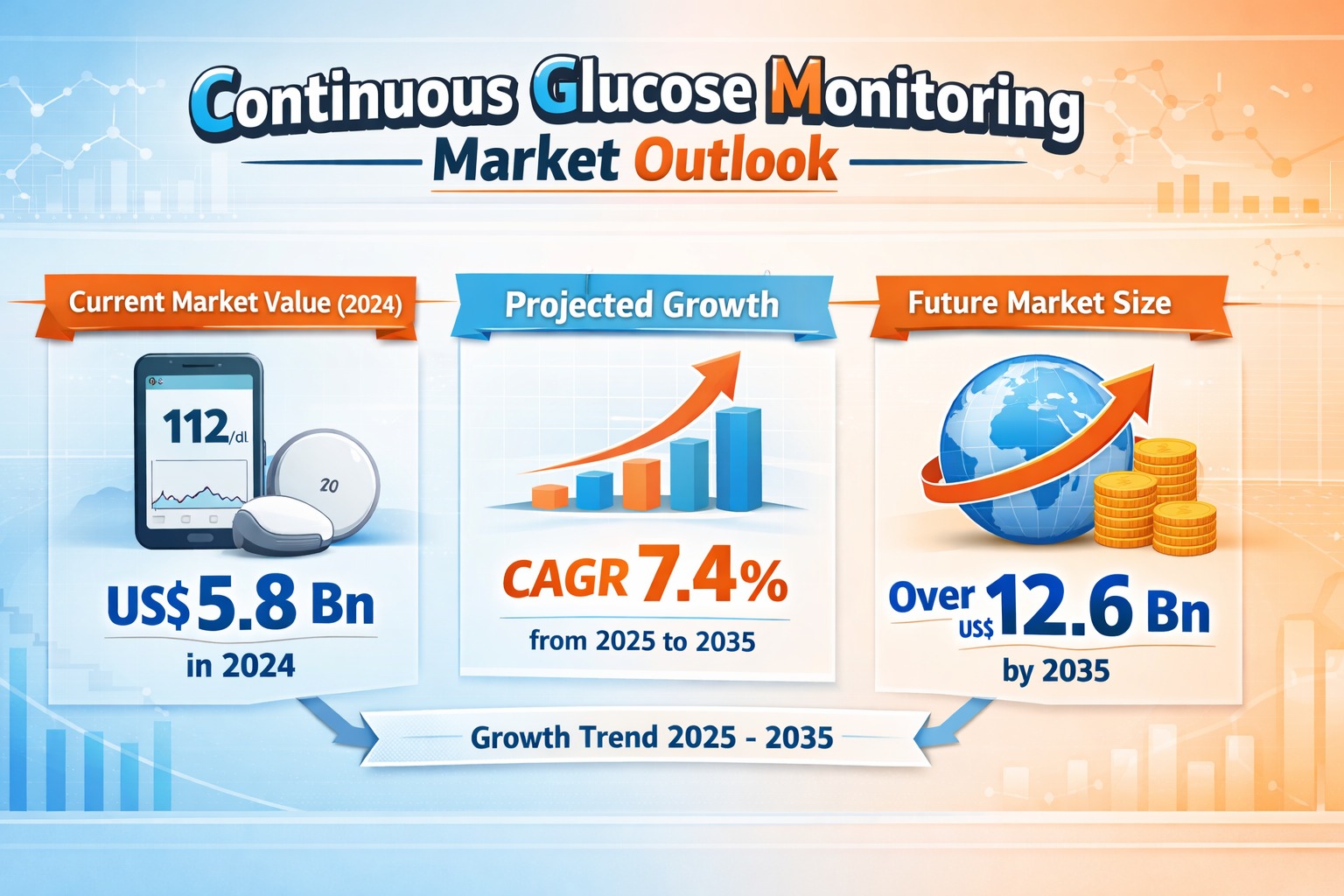
The global Continuous Glucose Monitoring (CGM) market was valued at US$ 5.8 Billion in 2024 and is projected to reach US$ 12.6 Billion by 2035, expanding at a compound annual growth rate (CAGR) of 7.4% from 2025 to 2035. The sustained rise in diabetes prevalence, growing adoption of remote patient monitoring systems, and rapid technological advancements in sensor accuracy and connectivity are collectively fueling market expansion worldwide.
As healthcare systems increasingly transition toward preventive, personalized, and digitally enabled care models, CGM systems are emerging as a cornerstone of modern diabetes management. The market outlook remains highly optimistic, supported by regulatory approvals, competitive product launches, and increasing integration with telehealth ecosystems.
Explore the highlights and essential data from our Report in this sample –
https://www.transparencymarketresearch.com/sample/sample.php?flag=S&rep_id=1169
Market Overview
Continuous Glucose Monitoring (CGM) systems represent a transformative advancement in diabetes care. Unlike traditional finger-stick blood glucose testing, CGM devices continuously measure glucose levels in interstitial fluid through a small sensor inserted beneath the skin. These systems provide real-time glucose readings, trend analysis, and customizable alerts, enabling proactive intervention to prevent hypoglycemic and hyperglycemic episodes.
Modern CGM devices consist of three primary components:
-
Sensor – Measures glucose levels continuously
-
Transmitter – Sends data wirelessly
-
Receiver/Smartphone App – Displays glucose readings and trends
With increasing patient demand for convenience, accuracy, and digital connectivity, CGMs have evolved into sophisticated wearable systems integrated with smartphones and cloud-based healthcare platforms. They empower both patients and healthcare providers through remote monitoring, data analytics, and personalized treatment planning.
North America currently leads the global CGM market due to strong healthcare infrastructure, high diabetes prevalence, technological innovation, and favorable regulatory frameworks. However, Europe and Asia Pacific are also demonstrating accelerated adoption driven by rising awareness and expanding healthcare access.
Key Market Growth Drivers
1. Rising Prevalence of Diabetes
The growing global burden of Type 1 and Type 2 diabetes remains the most significant driver of CGM adoption. Millions of patients require continuous glucose monitoring to prevent complications such as cardiovascular disease, neuropathy, and kidney failure. CGM systems offer superior glycemic control compared to conventional glucose testing methods.
2. Growing Demand for Remote Patient Monitoring and Telemedicine
The rapid expansion of telemedicine and remote healthcare services has significantly boosted CGM market growth. CGM devices seamlessly integrate with telehealth platforms, enabling clinicians to remotely monitor glucose levels and provide timely interventions. The COVID-19 pandemic further accelerated virtual care adoption, making CGMs essential tools in decentralized healthcare delivery models.
3. Technological Advancements in CGM Devices
Technological innovation is reshaping the CGM landscape. Key advancements include:
-
Improved sensor accuracy and stability
-
Faster response times
-
Longer-lasting sensors
-
Miniaturized and minimally invasive designs
-
Real-time data sharing capabilities
-
Integration with wearable devices and smartphones
Emerging artificial intelligence (AI) and machine learning algorithms are enabling predictive analytics, allowing users to forecast glucose fluctuations and make proactive lifestyle and medication adjustments.
4. Regulatory Approvals and Expanding Product Portfolios
Increasing regulatory clearances from authorities such as the FDA and CE marking bodies are encouraging competition and innovation. As new entrants gain approval, pricing pressure is expected to improve affordability, expanding patient access to advanced CGM systems.
5. Shift Toward Preventive and Personalized Healthcare
Healthcare systems globally are prioritizing preventive care and patient empowerment. CGM devices support data-driven decision-making and personalized treatment plans, aligning perfectly with modern value-based healthcare frameworks.
Analysis of Key Players – Key Player Strategies
The global CGM market is characterized by strong competition among leading players investing heavily in R&D, strategic partnerships, and product innovation. Prominent companies include:
-
Dexcom, Inc.
-
Abbott
-
Medtronic
-
Ypsomed AG
-
Senseonics Holdings, Inc.
-
F. Hoffmann-La Roche Ltd
-
Nemaura
-
Bionime Corporation
-
Intelligo BV
Key Strategic Focus Areas
-
Product Innovation: Development of smaller, more accurate, and longer-lasting sensors.
-
Smartphone Integration: Enhancing compatibility with mobile operating systems for seamless user experience.
-
Regulatory Expansion: Securing approvals in new geographic markets.
-
Partnerships & Collaborations: Integrating CGMs with insulin pumps and digital health platforms.
-
Cost Optimization: Scaling manufacturing to reduce product costs and improve affordability.
Companies are also investing in AI-driven analytics and predictive glucose monitoring features to differentiate their product offerings.
Market Challenges & Opportunities
Market Challenges
-
High Initial Costs: Advanced CGM systems remain expensive in certain markets, limiting access in low- and middle-income countries.
-
Reimbursement Barriers: Variability in insurance coverage impacts patient adoption.
-
Data Security Concerns: Increasing connectivity raises cybersecurity and data privacy issues.
-
Sensor Calibration & Accuracy Limitations: While improving, sensor precision remains critical for patient safety.
Market Opportunities
-
Expansion in Emerging Markets: Asia Pacific and Latin America offer untapped growth potential.
-
AI-Driven Predictive Analytics: Next-generation CGMs can forecast glucose trends.
-
Implantable Sensors: Long-term implantable CGMs offer enhanced convenience.
-
Integration with Closed-Loop Systems: Development of automated insulin delivery systems presents major growth prospects.
Key Player Strategies
Leading companies are focusing on:
-
Launching second-generation and next-generation CGMs
-
Expanding into pediatric and geriatric segments
-
Strengthening telehealth integration
-
Investing in user-friendly design improvements
-
Leveraging cloud-based analytics platforms
The competitive landscape is expected to intensify as new entrants challenge established players through innovation and cost differentiation.
Recent Developments
-
In February 2025, DexCom, Inc. (U.S.) launched Dexcom ONE+ in Spain, Belgium, and Poland. It is a customizable continuous glucose monitoring solution consisting of a wearable sensor, a transmitter, and a smartphone-compatible app. The device can be worn on three sites in the body. The water-resistant sensor measures blood glucose levels and sends these CGM readings to smartphones compatible with the Dexcom One application.
-
In January 2024, Medtronic plc declared that their MiniMed 780G system with Simplera Sync received the CE Mark approval. Simplera Sync is a technology that enhances the user experience through a simplified two-step insertion process. In addition, this new sensor is half the size of its precursors. The MiniMed 780G system with Simplera Sync sensor is anticipated to be launched in Europe through a limited release in the spring of 2024, followed by a phased commercial launch in the summer of the same year.
Investment Landscape and ROI Outlook
The CGM market presents strong investment potential due to consistent demand, recurring revenue models (sensor replacements), and expanding global adoption. Investors are particularly attracted to:
-
High-margin sensor technology
-
Subscription-based digital health ecosystems
-
AI-powered predictive analytics integration
-
Strategic acquisitions and partnerships
With a projected CAGR of 7.4%, the market offers stable long-term growth prospects. Venture capital interest in wearable medical devices and digital therapeutics further strengthens ROI expectations. Companies that innovate in affordability, interoperability, and predictive intelligence are likely to capture significant market share and deliver strong shareholder returns.
Market Segmentations
By Type
-
Real-Time CGM
-
Intermittently Scanned CGM
By Component
-
Sensor
-
Transmitter
-
Receiver
By Age Group
-
Children
-
Adults
By Indication
-
Type 1 Diabetes
-
Type 2 Diabetes
-
Others
By End-user
-
Hospitals & Clinics
-
Homecare Settings
-
Others
By Region
-
North America
-
Europe
-
Asia Pacific
-
Latin America
-
Middle East & Africa
North America leads the global market, while Asia Pacific is anticipated to witness the fastest growth due to rising diabetes prevalence and healthcare digitization.
Why Buy This Report?
-
Comprehensive market size analysis (2020–2035)
-
Detailed segmentation insights
-
In-depth competitive landscape profiling
-
Regional growth outlook and forecasts
-
Strategic insights into drivers, restraints, and opportunities
-
Investment and ROI assessment
-
Coverage of key recent developments
-
Market trend analysis and value chain evaluation
This report provides actionable intelligence for investors, healthcare providers, device manufacturers, policymakers, and strategic planners.
FAQs
1. What is the projected size of the Continuous Glucose Monitoring market by 2035?
The market is projected to reach US$ 12.6 Billion by 2035, growing at a CAGR of 7.4% from 2025 to 2035.
2. What are the key drivers of market growth?
Major drivers include rising diabetes prevalence, remote patient monitoring adoption, technological advancements, and regulatory approvals.
3. Which region dominates the CGM market?
North America currently leads due to strong healthcare infrastructure, high awareness, and innovation activity.
4. What component segment holds the largest share?
The sensor segment dominates due to its critical role in continuous glucose measurement and technological advancements.
5. What opportunities exist for investors?
Emerging markets expansion, AI integration, implantable CGMs, and closed-loop insulin delivery systems offer high-growth opportunities.




Leave a Reply