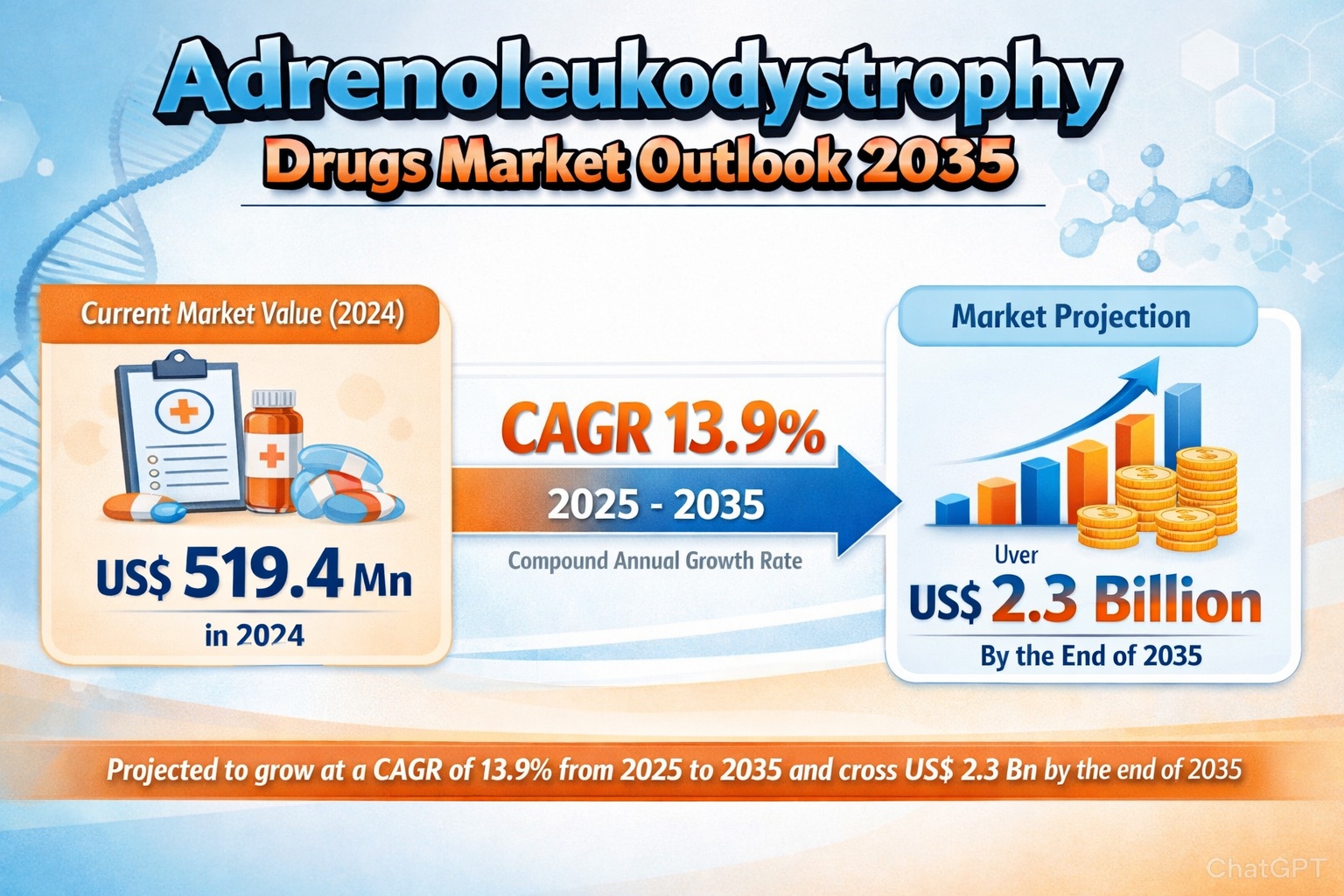
The global Adrenoleukodystrophy (ALD) Drugs Market was valued at US$ 519.4 Mn in 2024 and is projected to grow at a CAGR of 13.9% from 2025 to 2035, crossing US$ 2.3 Bn by the end of 2035. The robust growth outlook reflects increasing research investments, rising diagnostic rates, and growing adoption of advanced therapeutic approaches—particularly gene therapies.
The market is witnessing a paradigm shift from symptomatic management toward curative and disease-modifying treatments. With regulatory agencies encouraging rare disease innovation and expanding orphan drug incentives, the ALD drugs market is positioned for sustained double-digit expansion through 2035.
Explore pivotal insights and conclusions from our Report in this sample –
https://www.transparencymarketresearch.com/sample/sample.php?flag=S&rep_id=86448
Market Overview
Adrenoleukodystrophy (ALD) is a rare genetic disorder caused by mutations in the ABCD1 gene, leading to the accumulation of very-long-chain fatty acids (VLCFAs) in the brain, spinal cord, and adrenal glands. The disease progressively damages the myelin sheath surrounding nerve cells, resulting in severe neurological deterioration and adrenal insufficiency.
ALD manifests in different clinical forms, including:
- Childhood cerebral adrenoleukodystrophy (CALD)
- Adrenomyeloneuropathy (AMN)
- Addison’s disease associated with ALD
Among these, childhood CALD is the most severe and rapidly progressive form, often requiring urgent therapeutic intervention.
Historically, treatment options were limited to hematopoietic stem cell transplantation (HSCT) and supportive care. However, recent advancements in gene therapy have opened new avenues for disease-modifying interventions, driving strong momentum in the ALD drugs market.
The industry is supported by:
- Expanding newborn screening programs
- Increasing awareness among healthcare professionals
- Favorable regulatory pathways for orphan drugs
- Growing collaboration between biotech firms and academic institutions
Explore our report to gain an in-depth view of the key findings –
https://www.transparencymarketresearch.com/adrenoleukodystrophy-drugs-market.html
Key Market Growth Drivers
- Increasing Research & Development Activities and Rising FDA Approvals
One of the primary drivers of the ALD drugs market is the rapid expansion of R&D initiatives focused on rare genetic disorders. Biotechnology companies are actively developing innovative therapies that directly address the underlying genetic cause of ALD.
Regulatory agencies, particularly in North America and Europe, have implemented fast-track, orphan drug designation, and priority review pathways to accelerate rare disease treatment approvals. These supportive frameworks have significantly reduced time-to-market for novel ALD therapies.
Growing scientific understanding of ALD pathophysiology has enabled targeted therapeutic development, including:
- Gene replacement therapies
- Anti-inflammatory agents
- Metabolic modulators
- Neuroprotective treatments
- Rising Prevalence and Diagnostic Rates of Childhood CALD
The increasing adoption of newborn screening programs has significantly improved early detection of ALD. Early diagnosis is critical because therapeutic interventions are most effective before severe neurological damage occurs.
Greater awareness among pediatric neurologists and endocrinologists has improved identification of:
- Childhood cerebral ALD (CALD)
- Adrenomyeloneuropathy (AMN)
- Addison’s disease linked to ALD
Improved diagnostic technologies and genetic testing platforms are further contributing to higher case identification rates globally.
- Dominance of Gene Therapy as a Transformative Treatment Modality
Gene therapy has emerged as the most promising therapeutic approach for ALD. Unlike traditional therapies that manage symptoms, gene therapy addresses the root cause by introducing functional copies of the defective gene.
Clinical success of gene therapy in ALD has demonstrated:
- Stabilization of neurological decline
- Prevention of disease progression
- Improved survival rates
As a result, gene therapy dominates the drug type segment and is expected to remain the most lucrative category through 2035.
- Preference for Parenteral Route of Administration
Parenteral administration dominates the route of administration segment due to:
- High bioavailability
- Rapid systemic absorption
- Controlled dosing under medical supervision
Gene therapies and advanced biologics require intravenous or intramuscular administration to ensure optimal therapeutic efficacy. Oral therapies remain relevant but are secondary in advanced ALD treatment protocols.
Analysis of Key Players – Key Player Strategies
The competitive landscape of the global ALD drugs market is moderately consolidated, with several biotechnology innovators leading therapeutic development.
Major Players Include:
- Minoryx Therapeutics
- Bluebird Bio
- Nutricia
- Poxel SA
- Orpheris, Inc.
- MedDay Pharmaceuticals
Strategic Focus Areas:
- Pipeline Expansion:
Companies are investing heavily in gene therapy pipelines to establish first-mover advantage in rare genetic diseases. - Regulatory Engagement:
Active collaboration with regulatory authorities for accelerated approvals under orphan drug designations. - Strategic Partnerships:
Collaborations with research institutions and pharmaceutical partners to share development costs and enhance market access. - Geographic Expansion:
Expansion into high-diagnosis markets such as North America and Europe to capitalize on advanced healthcare infrastructure. - Patient Advocacy Collaboration:
Partnerships with ALD foundations and patient advocacy groups to increase awareness and improve trial enrollment.
Market Challenges & Opportunities
Key Challenges
- High Treatment Costs
Gene therapies often involve significant upfront costs, creating reimbursement challenges. - Small Patient Population
ALD is a rare disease, limiting the addressable patient base. - Regulatory Complexity
Strict compliance requirements and post-marketing surveillance add operational burdens. - Clinical Trial Recruitment
Limited patient pool makes trial enrollment challenging.
Emerging Opportunities
- Expansion of Newborn Screening Programs
Broader screening initiatives are expected to increase early diagnosis rates. - Advancements in Genetic Editing Technologies
CRISPR-based and next-generation gene therapies could further improve outcomes. - Expansion into Emerging Markets
Growing healthcare investments in Asia Pacific and Latin America present untapped opportunities. - Personalized Medicine
Customized gene therapies tailored to specific mutations may drive premium pricing and improved patient outcomes.
Recent Developments
- In May 2024, Minoryx Therapeutics announced that the EMA’s Committee for Medicinal Products for Human Use (CHMP) had recommended not to grant marketing authorization for NEZGLYAL (leriglitazone) as a treatment for CALD following the completion of the re-examination procedure.
- In June 2022, POXEL SA announced its participation at the ULF (United Leukodystrophy Foundation) Scientific Symposium and Family Conference at Illinois, U.S. by using PXL065, two proprietary promising candidates that are focused on the treatment of adrenoleukodystrophy (ALD) that is a rare and genetic disease in adults.
Investment Landscape and ROI Outlook
The ALD drugs market presents a compelling investment case due to:
- High CAGR of 13.9%
- Strong regulatory incentives
- Premium pricing power for orphan drugs
- Growing venture capital inflows into gene therapy startups
Investors are particularly attracted to:
- Late-stage gene therapy candidates
- Companies with orphan drug designation
- Firms with strong IP portfolios
Despite high R&D risks, the return on investment (ROI) potential remains substantial due to limited competition and high unmet medical need.
Strategic mergers and acquisitions are expected to increase as large pharmaceutical companies seek to strengthen their rare disease portfolios.
Market Segmentation
By Drug Type
- Gene Therapy
- Others
By Route of Administration
- Oral
- Parenteral
By Indication
- Childhood cerebral adrenoleukodystrophy
- Addison’s disease
- Adrenomyeloneuropathy
By Distribution Channel
- Hospital Pharmacies
- Retail Pharmacies
- Online Pharmacies
- Others (Ambulances, etc.)
Regional Analysis
North America
North America dominates the global market due to:
- Strong healthcare infrastructure
- Rising FDA approvals
- Growing R&D investments
- Expanding newborn screening programs
The U.S. represents the largest revenue contributor within the region, supported by increasing awareness and healthcare funding.
Europe
Europe follows closely, driven by regulatory support from the EMA and active clinical research initiatives.
Asia Pacific
The Asia Pacific market is projected to grow steadily due to improving healthcare access and expanding diagnostic capabilities.
Latin America
Gradual adoption of advanced therapies is expected, supported by increasing healthcare expenditure.
Middle East & Africa
Market growth remains moderate due to limited awareness but is expected to improve over the forecast period.
Why Buy This Report?
- Comprehensive market size analysis (2020–2035)
- In-depth segmentation and regional insights
- Detailed competitive landscape profiling
- Investment trend evaluation
- Regulatory impact analysis
- Strategic recommendations for stakeholders
- Forecast modeling with CAGR projections
- Value chain and opportunity mapping
This report provides actionable intelligence for pharmaceutical companies, investors, healthcare providers, and policymakers aiming to capitalize on the evolving ALD treatment landscape.
Frequently Asked Questions (FAQs)
- What is the projected size of the Adrenoleukodystrophy Drugs Market by 2035?
The market is projected to surpass US$ 2.3 Bn by 2035. - What is driving the growth of the ALD drugs market?
Key drivers include increasing R&D activities, rising FDA approvals, improved diagnostic rates, and advancements in gene therapy. - Which drug type segment dominates the market?
Gene therapy dominates due to its disease-modifying potential. - Which region leads the global market?
North America currently leads due to strong healthcare infrastructure and regulatory support. - What are the main challenges in this market?
High treatment costs, small patient population, regulatory complexity, and clinical trial recruitment difficulties.
About Us Transparency Market Research
Transparency Market Research, a global market research company registered at Wilmington, Delaware, United States, provides custom research and consulting services. The firm scrutinizes factors shaping the dynamics of demand in various markets. The insights and perspectives on the markets evaluate opportunities in various segments. The opportunities in the segments based on source, application, demographics, sales channel, and end-use are analysed, which will determine growth in the markets over the next decade.
Our exclusive blend of quantitative forecasting and trends analysis provides forward-looking insights for thousands of decision-makers, made possible by experienced teams of Analysts, Researchers, and Consultants. The proprietary data sources and various tools & techniques we use always reflect the latest trends and information. With a broad research and analysis capability, Transparency Market Research employs rigorous primary and secondary research techniques in all of its business reports.
Contact Us
CORPORATE HEADQUARTER DOWNTOWN,
1000 N. West Street,
Suite 1200, Wilmington, Delaware 19801 USA
Tel: +1-518-618-1030
USA – Canada Toll Free: 866-552-3453
Website: https://www.transparencymarketresearch.com
Blog: https://tmrblog.com
Email: sales@transparencymarketresearch.com
Leave a Reply