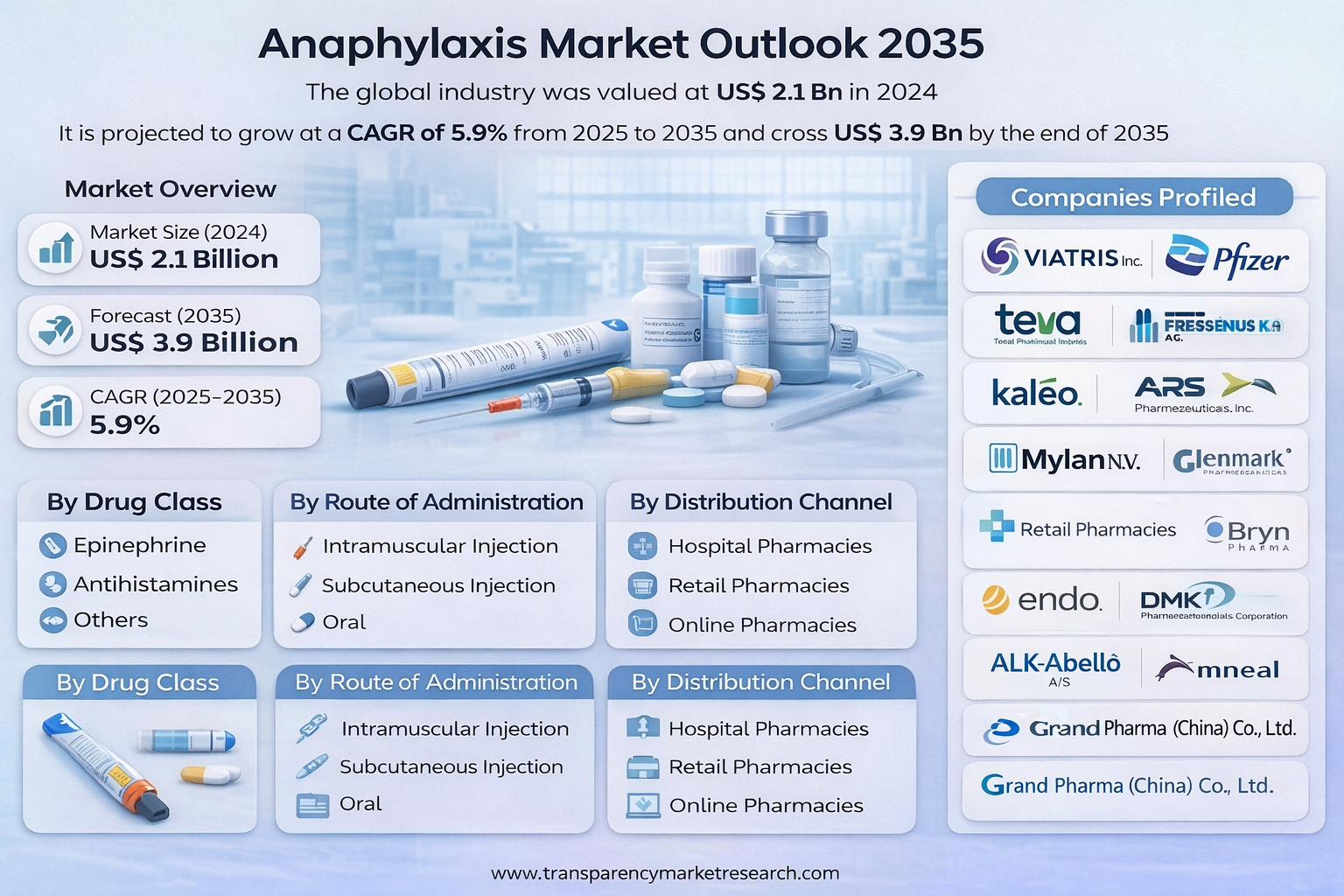
The global anaphylaxis market was valued at US$ 2.1 Bn in 2024 and is projected to grow at a CAGR of 5.9% from 2025 to 2035, surpassing US$ 3.9 Bn by the end of 2035. Market expansion is being fueled by the increasing incidence of allergies and asthma, heightened public awareness of anaphylaxis management, regulatory support for innovative therapies, and continuous advancements in drug delivery technologies.
Access key findings and insights from our Report in this sample – https://www.transparencymarketresearch.com/sample/sample.php?flag=S&rep_id=86653
Market Overview
Anaphylaxis is a severe, rapid-onset allergic reaction that can become life-threatening within minutes of exposure to allergens such as certain foods (including peanuts and shellfish), insect stings, medications, and latex. The immune system’s exaggerated response releases histamines and other chemicals, leading to airway swelling, breathing difficulties, hives, and sudden drops in blood pressure.
Immediate administration of epinephrine remains the gold standard first-line treatment for anaphylaxis. Epinephrine acts as a potent vasoconstrictor and bronchodilator, reversing airway obstruction and stabilizing blood pressure. It is commonly delivered via auto-injectors designed for ease of use during emergencies. Patients are advised to seek immediate medical attention following administration due to the possibility of biphasic reactions.
Key Market Drivers
Rising Prevalence of Allergies
The increasing global burden of allergies is a major driver of the anaphylaxis market. Food allergies alone affect up to 10% of the population in developed nations. According to data from the American Academy of Allergy, Asthma & Immunology, allergic rhinitis impacts between 10% and 30% of the global population, while drug reactions affect approximately 10% of individuals worldwide and up to 20% of hospitalized patients.
Survey findings from NHIS indicate that in 2021, nearly 1 in 20 children suffered from food allergies. As diagnoses rise, so does the risk of anaphylactic episodes, intensifying the demand for effective emergency treatments—particularly epinephrine auto-injectors. The growing prevalence of environmental allergens and respiratory conditions such as asthma further amplifies the need for rapid-response therapeutic solutions.
Heightened Awareness about Anaphylaxis
Over the past decade, public health initiatives, advocacy campaigns, and educational programs have significantly improved awareness of anaphylaxis symptoms and emergency response protocols. Healthcare providers are increasingly proactive in allergy screening and patient education, ensuring earlier diagnosis and improved management.
Institutions such as schools and workplaces are adopting emergency preparedness policies, including staff training on recognizing anaphylactic reactions and administering auto-injectors. This shift toward proactive safety measures has enhanced accessibility to life-saving treatment and strengthened demand for user-friendly drug delivery systems.
Analysis of Key Players
The competitive landscape of the anaphylaxis market is characterized by strong pharmaceutical participation and innovation in drug delivery mechanisms. Companies are focusing on developing user-friendly epinephrine auto-injectors with ergonomic designs, safety locks, and voice-guided instructions to enhance compliance and reduce administration errors.
Key players operating in the global market include Viatris Inc., Pfizer Inc., Teva Pharmaceutical Industries Ltd., Fresenius Kabi AG, kaleo, Inc., ARS Pharmaceuticals, Inc., Mylan N.V., Glenmark Pharmaceuticals, Bryn Pharma, Aquestive Therapeutics, Inc., Endo, Inc., DMK Pharmaceuticals Corporation, ALK-Abelló A/S, Amneal Pharmaceuticals LLC, and Grand Pharma (China) Co., Ltd.
Market Challenges & Opportunities
Despite strong growth prospects, the anaphylaxis market faces challenges such as pricing pressures, device recalls, limited accessibility in low-income regions, and the need for greater patient education. Additionally, reliance on epinephrine as the primary therapy underscores the importance of ensuring consistent supply and affordability.
However, significant opportunities exist in expanding over-the-counter availability of emergency drugs, increasing digital health integration for patient monitoring and education, and developing alternative delivery systems such as nasal sprays and oral formulations. Collaborative initiatives between pharmaceutical firms and healthcare institutions are also driving awareness campaigns and improving emergency preparedness across communities.
Explore our report to uncover in-depth insights – https://www.transparencymarketresearch.com/anaphylaxis-market.html
Market Segmentation
By Drug Type:
- Epinephrine
- Antihistamines
- Beta-agonists
- Corticosteroids
The epinephrine segment dominates the market, as it is the first-line treatment for anaphylaxis. Its rapid mechanism of action in reversing airway constriction and hypotension makes it indispensable in emergency care settings.
By Drug Class:
- Sympathomimetic agents
- Antihistamines
- Bronchodilators
- Anti-inflammatory agents
By Distribution Channel:
- Hospital Pharmacies
- Retail Pharmacies
- Online Pharmacies
By End-user:
- Hospitals
- Clinics
- Homecare Settings
Regional Outlook
Leading Region: North America
North America dominated the global anaphylaxis market in 2024, supported by a high prevalence of allergies and advanced healthcare infrastructure. Approximately 8% of children and 4% of adults in the United States are estimated to have food allergies, contributing to a significant number of anaphylaxis cases.
The region benefits from strong regulatory support, widespread use of epinephrine auto-injectors, and proactive allergy management policies in schools and workplaces. Furthermore, the presence of a robust pharmaceutical industry and continuous R&D activities in allergy therapeutics contribute to sustained market leadership.
Other regions, including Europe and Asia Pacific, are witnessing growth due to rising allergy awareness, expanding healthcare infrastructure, and improved access to emergency treatments.
Key Developments
- In March 2025, ARS Pharmaceuticals, Inc. announced that the U.S. Food and Drug Administration (FDA) approved neffy 1 mg (epinephrine nasal spray) for the treatment of Type I Allergic Reactions, including anaphylaxis, in children who are aged 4 years and older and weigh 15 to < 30 kilograms (33 to < 66 lb.). The approval represents the first significant innovation in the delivery of epinephrine for this patient population in more than 35 years.
- In February 2025, Glenmark Pharmaceuticals announced the launch of generic version of Epinephrine injection multiple-dose vial in the US, with an eligibility of competitive generic therapy exclusivity for 180 days. The newly approved drug is bioequivalent and therapeutically equivalent to the reference-listed drug of BPI Labs, LLC.
Why Buy This Report?
- Comprehensive analysis of market size and forecast through 2035
- Detailed evaluation of growth drivers, restraints, and emerging opportunities
- Competitive landscape profiling of major industry participants
- In-depth regional and segment-wise analysis
- Insights into regulatory environment and technological advancements
Buy this Premium Research Report for exclusive, in-depth insights – https://www.transparencymarketresearch.com/checkout.php?rep_id=86653<ype=S
FAQs
- What is the current size of the global anaphylaxis market?
The market was valued at US$ 2.1 Bn in 2024. - What is the projected growth rate of the market?
It is expected to grow at a CAGR of 5.9% from 2025 to 2035. - Which drug type dominates the anaphylaxis market?
Epinephrine leads the market as the first-line treatment for anaphylaxis. - Which region holds the largest market share?
North America dominated the market in 2024. - What factors are driving market growth?
Rising allergy prevalence, increased awareness, regulatory support, and innovation in drug delivery systems are key growth drivers.
More Trending Reports by Transparency Market Research –
Sleep Apnea Devices Market: https://www.transparencymarketresearch.com/sleep-apnea-devices-market.html
Skin Antiseptic Market: https://www.transparencymarketresearch.com/skin-antiseptic-market.html
Cancer Biomarkers Market: https://www.transparencymarketresearch.com/cancer-biomarkers-market.html
Medical Devices Outsourcing Market: https://www.transparencymarketresearch.com/medical-devices-outsourcing-market.html
About Transparency Market Research
Transparency Market Research, a global market research company registered at Wilmington, Delaware, United States, provides custom research and consulting services. Our exclusive blend of quantitative forecasting and trends analysis provides forward-looking insights for thousands of decision makers. Our experienced team of Analysts, Researchers, and Consultants use proprietary data sources and various tools & techniques to gather and analyses information.
Our data repository is continuously updated and revised by a team of research experts, so that it always reflects the latest trends and information. With a broad research and analysis capability, Transparency Market Research employs rigorous primary and secondary research techniques in developing distinctive data sets and research material for business reports.
Contact:
Transparency Market Research Inc.
CORPORATE HEADQUARTER DOWNTOWN,
1000 N. West Street,
Suite 1200, Wilmington, Delaware 19801 USA
Tel: +1-518-618-1030
USA – Canada Toll Free: 866-552-3453
Leave a Reply