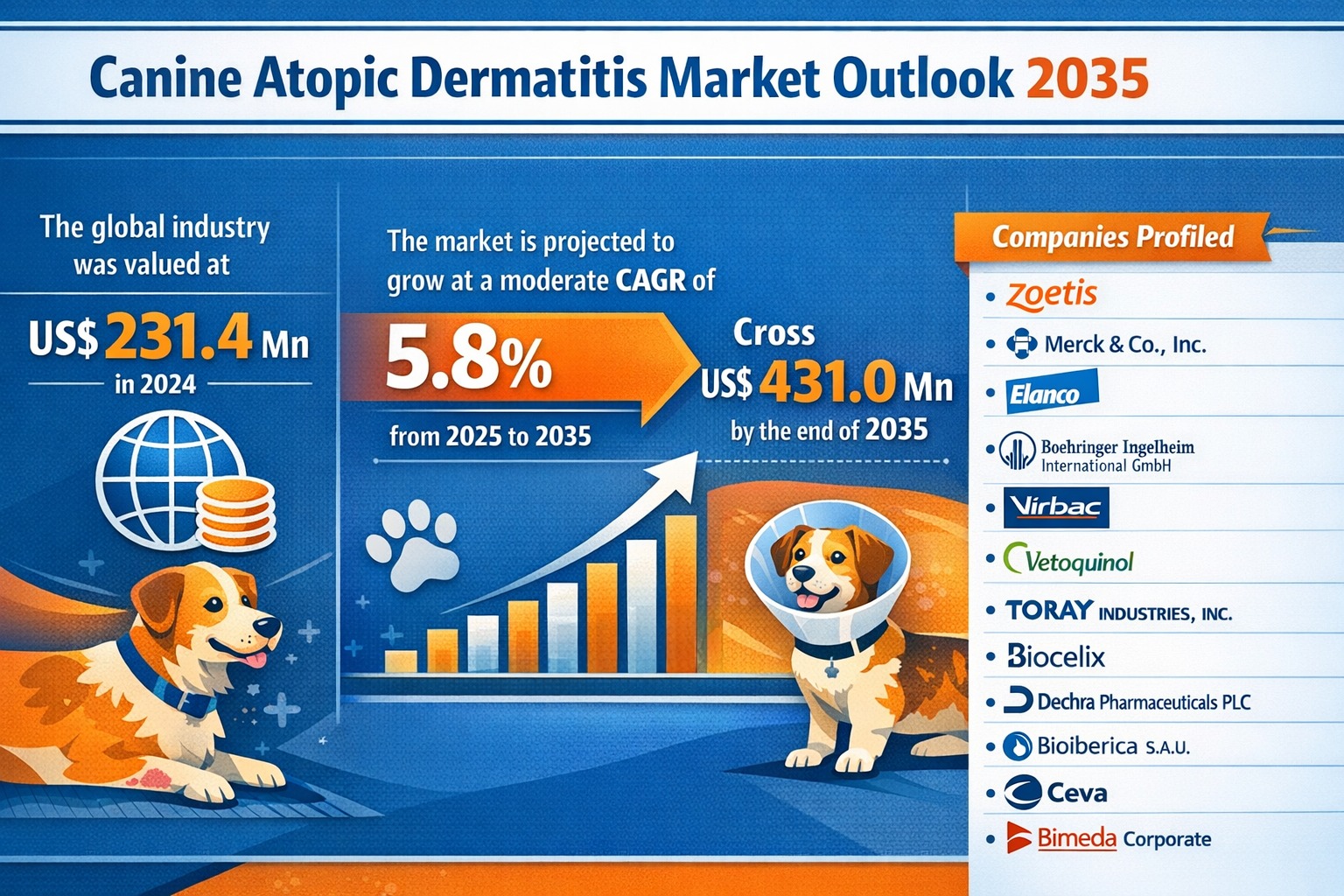
The global canine atopic dermatitis market was valued at US$ 231.4 Mn in 2024 and is projected to grow at a moderate CAGR of 5.8% from 2025 to 2035, crossing US$ 431.0 Mn by the end of 2035. This steady growth trajectory reflects increasing pet healthcare expenditure, expanding therapeutic innovations, and heightened awareness of chronic dermatological conditions in dogs.
Historical data from 2020 to 2024 indicates consistent revenue expansion, supported by improved diagnosis rates and a growing number of veterinary consultations related to allergic skin diseases. Over the next decade, the market is expected to nearly double in value, underlining the sustained demand for effective long-term management solutions.
→Discover Market Opportunities – Request Your Sample Copy Now: https://www.transparencymarketresearch.com/sample/sample.php?flag=S&rep_id=86479
→Analysts’ Viewpoint Regarding Canine Atopic Dermatitis Market Scenario
Industry analysts highlight that the increasing prevalence of atopic dermatitis in dogs, coupled with rising pet ownership and healthcare spending, is significantly boosting global demand. Chronic pruritus (itching) and characteristic skin lesions define atopic dermatitis, often linked to IgE antibodies reacting to environmental allergens in genetically predisposed dogs.
Environmental triggers such as pollen, mites, mold, pollutants, and food allergens continue to intensify the incidence of allergic skin reactions. As diagnosis rates improve and awareness spreads among pet owners, the demand for targeted and innovative therapies is expected to accelerate further.
Key market participants are heavily investing in research and development (R&D) to introduce advanced treatment options, including monoclonal antibodies such as Cytopoint and immunosuppressants such as Apoquel, offering long-term symptom relief and improved quality of life for affected dogs.
→Market Overview
Canine atopic dermatitis (CAD) is a chronic inflammatory skin disease in dogs caused by an allergic response to environmental allergens. It is a genetically predisposed immune-mediated condition characterized by excessive pruritus, erythema, recurrent ear infections, licking, and hair loss. The condition typically manifests between six months and three years of age.
Diagnosis involves clinical assessment, exclusion of other dermatological conditions, and allergy testing. Although CAD is not curable, effective management includes:
- Allergen avoidance
- Medicated shampoos
- Antihistamines
- Corticosteroids
- Immunotherapy
- Omega-3 fatty acid supplementation
- Specialized diets
With early intervention and structured management, affected dogs can experience substantial improvements in quality of life, supporting sustained demand for therapeutic products and services.
→Key Market Growth Drivers
- Increase in Incidence of Atopic Dermatitis in Dogs
The rising global incidence of canine atopic dermatitis is a primary growth driver. According to research published by MDPI in 2023, canine atopic dermatitis affects approximately 20–30% of dogs worldwide, making it one of the most common allergic skin diseases.
Urbanization and environmental pollution are significant contributors. Exposure to air pollution, indoor allergens, and chemical irritants has increased dramatically, particularly in urban and suburban areas. These environmental shifts have heightened allergic responses in pets, expanding the patient pool requiring ongoing treatment.
As case numbers rise, veterinary clinics and pharmaceutical companies are responding by developing more effective and long-lasting therapies, thereby driving revenue growth.
- Surge in Pet Ownership
The expansion of pet ownership globally is another powerful driver. In the United States alone, the 2023–2024 National Pet Owners Survey by the American Pet Products Association (APPA) indicates that 66% of U.S. households—approximately 86.9 million families—own a pet. This marks a significant increase from 56% in 1988.
Globally, pet ownership is also accelerating. Brazil, for instance, has approximately 35 million domestic dogs, making it the second-largest dog population globally. Such figures highlight strong demand potential in both developed and emerging economies.
The growing trend of pet humanization—where pets are increasingly treated as family members—has led to greater spending on veterinary care, premium therapies, and preventive treatments. This behavioral shift significantly supports the expansion of the canine atopic dermatitis market.
→Market Segmentations
→By Product Type
The market is segmented into:
- Glucocorticoids
- Immunosuppressants
- Monoclonal Antibodies
- Calcineurin Inhibitors
- Janus Kinase (JAK) Inhibitors
- Others
Monoclonal antibodies and JAK inhibitors are witnessing strong growth due to their targeted mechanisms and improved safety profiles compared to traditional corticosteroids.
→By Route of Administration
- Topical
- Oral
- Injectable
The oral route of administration dominates the global market. Oral formulations offer convenience, improved compliance, and systemic therapeutic effects. Their ease of use and palatability enhance treatment adherence, making them a preferred option among pet owners and veterinarians.
→By Distribution Channel
- Veterinary Hospitals and Clinics
- Veterinary Pharmacies & Drug Stores
- E-commerce
- Others
Veterinary hospitals and clinics lead the distribution channel segment due to their specialized care and ability to prescribe advanced therapies unavailable in retail settings. Rising veterinary visits for dermatological conditions continue to strengthen this segment.
→By Region
- North America
- Europe
- Asia Pacific
- Latin America
- Middle East & Africa
→Explore Strategies & Trends – Request Full Report Access – https://www.transparencymarketresearch.com/sample/sample.php?flag=S&rep_id=86479
→Regional Outlook of Canine Atopic Dermatitis Market Industry
North America holds the largest share of the global market. High pet ownership rates, advanced veterinary infrastructure, and strong collaboration between pharmaceutical companies and veterinary professionals drive regional dominance.
The region’s proactive approach to pet healthcare, widespread availability of biologics, and growing awareness of dermatological conditions contribute significantly to market expansion.
Europe follows closely, driven by regulatory advancements and strong animal welfare policies. Meanwhile, Asia Pacific is expected to exhibit notable growth due to rising disposable incomes, expanding urban pet ownership, and improving veterinary infrastructure in countries such as China, India, and Japan.
→Analysis of Key Players – Key Player Strategies
Prominent companies operating in the global canine atopic dermatitis market include:
- Zoetis
- Merck & Co., Inc.
- Elanco
- Boehringer Ingelheim International GmbH
- Virbac Corporation
- Vetoquinol
- TORAY INDUSTRIES, INC.
- Biocelix
- Dechra Pharmaceuticals PLC
- Bioiberica S.A.U.
- Ceva
- Bimeda Corporate
These companies are profiled based on financial performance, product portfolio, geographic presence, strategic initiatives, and recent developments.
→Core Strategies Adopted by Key Players
- Heavy investment in R&D for biologics and next-generation immunomodulators
- Strategic partnerships with veterinary clinics and research institutions
- Expansion into emerging markets
- Regulatory approvals to strengthen product portfolios
- Focus on long-term safety and efficacy
→Recent Developments
In September 2024, Elanco Animal Health Incorporated announced the U.S. Food and Drug Administration (FDA) has approved Zenrelia, a safe, highly effective, and convenient once-daily oral JAK inhibitor for control of pruritus (itching) associated with allergic dermatitis and control of atopic dermatitis in dogs at least 12 months of age.
In June 2024, OKAVA Pharmaceuticals, Inc., a clinical stage research and development company focused on diseases of aging in dogs and cats, announced the publication of a pilot clinical study in Veterinary Dermatology, the journal published on behalf of The European Society of Veterinary Dermatology and American College of Veterinary Dermatology. The study investigates a novel therapeutic approach to managing atopic dermatitis in dogs that have not responded adequately to conventional treatments.
→Market Challenges & Opportunities
→Challenges
- High cost of biologic therapies
- Side effects associated with long-term corticosteroid use
- Limited awareness in developing regions
- Regulatory complexities
→Opportunities
- Growing demand for personalized veterinary medicine
- Expansion of e-commerce veterinary platforms
- Increased insurance coverage for pet healthcare
- Development of safer immunomodulatory therapies
Emerging markets present untapped growth potential, particularly as veterinary infrastructure improves and middle-class pet ownership rises.
→Investment Landscape and ROI Outlook
The canine atopic dermatitis market presents a stable and moderate-growth investment opportunity. With a projected CAGR of 5.8% over the forecast period, the industry offers predictable revenue streams driven by chronic disease management requirements.
Biologics and JAK inhibitors are expected to deliver strong ROI due to premium pricing and recurring treatment cycles. Additionally, strategic mergers and acquisitions in the veterinary pharmaceutical space are likely to enhance market consolidation and value creation.
Investors are particularly focusing on companies with diversified product portfolios and strong regulatory pipelines, ensuring long-term sustainability.
→Why Buy This Report?
- Comprehensive market size analysis from 2020 to 2035
- Detailed segmentation across product type, route of administration, and distribution channel
- In-depth regional analysis
- Competitive landscape and company profiling
- Insights into market drivers, challenges, and opportunities
- Strategic outlook for investors and stakeholders
- Available in Electronic (PDF) + Excel format
- Customization scope available upon request
→FAQs
Q.How big was the canine atopic dermatitis market in 2024?
A.The market was valued at US$ 231.4 Mn in 2024.
Q.How big will the canine atopic dermatitis market be in 2035?
A.The market is projected to cross US$ 431.0 Mn by the end of 2035.
Q.What factors are driving the market?
A.The increase in incidence of atopic dermatitis in dogs and the surge in pet ownership are the primary drivers.
Q.What will be the CAGR during the forecast period?
A.The market is anticipated to grow at a CAGR of 5.8% from 2025 to 2035.
Q.Which region will account for a major share?
A.North America is expected to account for the largest share during the forecast period.
Buy Full Report Now: https://www.transparencymarketresearch.com/checkout.php?rep_id=86479<ype=S
→Explore Latest Research Reports by Transparency Market Research:
Smart Pulse Oximeters Market: https://www.transparencymarketresearch.com/smart-pulse-oximeters-market.html
Hearing Aids Market: https://www.transparencymarketresearch.com/hearing-aid-market.html
Magnetic Beads Market: https://www.transparencymarketresearch.com/magnetic-beads-market.html
About Transparency Market Research
Transparency Market Research, a global market research company registered at Wilmington, Delaware, United States, provides custom research and consulting services. Our exclusive blend of quantitative forecasting and trends analysis provides forward-looking insights for thousands of decision makers. Our experienced team of Analysts, Researchers, and Consultants use proprietary data sources and various tools & techniques to gather and analyses information.
Our data repository is continuously updated and revised by a team of research experts, so that it always reflects the latest trends and information. With a broad research and analysis capability, Transparency Market Research employs rigorous primary and secondary research techniques in developing distinctive data sets and research material for business reports.



Leave a Reply