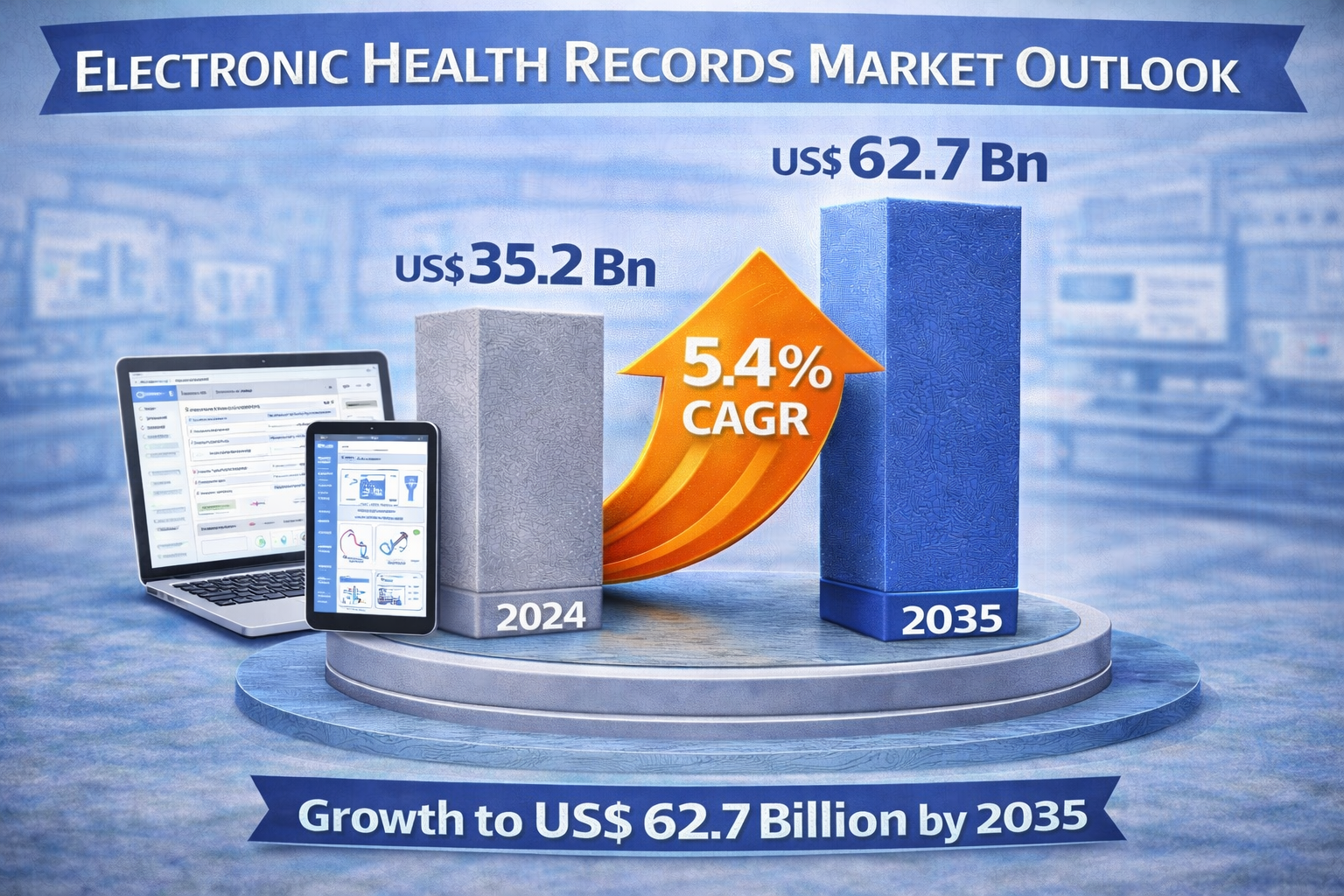
The global Electronic Health Records (EHR) market was valued at US$ 35.2 Bn in 2024 and is projected to expand at a CAGR of 5.4% from 2025 to 2035, crossing US$ 62.7 Bn by the end of 2035. The steady rise in healthcare digitalization, increasing regulatory mandates, and growing demand for interoperable patient data systems are fueling long-term market expansion.
Access key findings and insights from our Report in this sample – https://www.transparencymarketresearch.com/sample/sample.php?flag=S&rep_id=4153
Market Overview
An electronic health record (EHR) is a digital version of a patient’s comprehensive medical history maintained over time by healthcare providers. EHRs include critical information such as diagnoses, medications, treatment plans, immunization dates, allergies, laboratory results, and radiology images.
Unlike traditional paper-based systems, EHRs are designed to be shared across healthcare environments—including hospitals, clinics, laboratories, and pharmacies—facilitating coordinated and efficient care. These systems also support clinical decision-making through evidence-based tools, quality management systems, analytics, and outcomes reporting.
As healthcare systems increasingly transition toward value-based care models, EHR platforms are becoming foundational digital infrastructure supporting care coordination, operational efficiency, and patient engagement.
Key Market Growth Drivers
Rising Demand for Efficient Healthcare Data Management and Patient-Centric Care
Healthcare organizations worldwide are prioritizing integrated digital systems that streamline workflow management, improve care coordination, and enhance clinical decision-making. EHRs provide real-time access to comprehensive patient information, enabling seamless collaboration among care teams.
EHR platforms empower patients by allowing secure access to their health records, fostering transparency and engagement. The transition to electronic systems enhances operational efficiency, improves data accuracy, and aligns with global shifts toward value-based care models.
Government initiatives have significantly accelerated EHR adoption. Regulatory frameworks such as the European Health Data Space regulation, effective from March 2025, aim to standardize electronic health records across the European Union, enhance interoperability, and strengthen patient control over personal health data.
Expansion of Telemedicine and Remote Patient Monitoring Solutions
The rapid proliferation of telemedicine platforms and remote patient monitoring devices is another major driver of EHR market growth. As virtual healthcare becomes more mainstream, interoperable digital systems are essential for seamless integration and secure data exchange across care settings.
EHRs enable real-time access to curated patient data, supporting effective care coordination, particularly when transitioning between virtual and in-person visits. This integration enhances chronic disease management, improves patient satisfaction, streamlines administrative processes, and supports long-term digital health innovation.
Market Segmentation
By Product Type
- Web-Based EHR Systems
- Cloud-Based EHR Systems
- On-Premise EHR Systems
The web and cloud-based segment is expected to dominate the market due to scalability, cost-effectiveness, and elimination of extensive IT infrastructure requirements. Cloud-based systems provide remote access to patient records, facilitate collaboration among care teams, and integrate easily with AI-powered analytics and emerging digital health tools.
By End-User
- Hospitals
- Ambulatory Surgical Centers
- Specialty Clinics
- Physician Offices
- Others
Hospitals remain the largest end-user segment due to high patient volumes and complex care coordination requirements. However, physician offices and ambulatory centers are increasingly adopting cloud-based EHR systems for improved workflow efficiency and compliance.
Explore our report to uncover in-depth insights – https://www.transparencymarketresearch.com/electronic-health-records-market.html
Regional Outlook
Leading Region: North America
North America is expected to maintain its leadership position in the global EHR market. Strong government support for health information technology adoption, widespread digital infrastructure, and substantial investments in digital health innovation underpin regional dominance.
The United States serves as the primary market driver, with nearly all non-federal acute care hospitals using certified EHR systems. A majority of office-based physicians have also adopted certified EHR solutions, reinforcing widespread digital integration across care settings.
Canada has also advanced EHR adoption through a national strategy promoting secure, timely digital access to health information and virtual care expansion. Technological advancements in interoperability, mobile access, and cloud computing continue to strengthen the region’s position as the largest consumer of EHR software.
Other regions, including Europe and Asia Pacific, are witnessing steady growth supported by regulatory reforms, digital transformation initiatives, and expanding telehealth ecosystems.
Analysis of Key Players
The global Electronic Health Records market is highly competitive, with major players focusing on product innovation, cloud integration, AI capabilities, and interoperability enhancements.
Leading companies include Oracle, McKesson Corporation, athenahealth, eClinicalWorks, Practice Fusion, Inc., Medical Information Technology, Inc., Greenway Health, LLC, CureMD Healthcare, Harmony Healthcare IT, NXGN Management, LLC., EverHealth Solutions Inc., and Infor-Med Inc..
These companies compete on parameters such as product portfolio strength, interoperability capabilities, financial performance, AI integration, cloud deployment models, and strategic partnerships. Continuous R&D investment, acquisitions, and platform upgrades are shaping competitive dynamics.
Market Challenges & Opportunities
High upfront implementation costs remain a major barrier, especially for small and mid-sized healthcare providers. Data privacy and cybersecurity risks also require continuous investment and regulatory compliance.
Interoperability limitations across disparate systems can hinder seamless data exchange, affecting clinical efficiency. However, advancements in standardized data exchange frameworks and cloud infrastructure are gradually addressing these issues.
Opportunities lie in AI-driven analytics, predictive modeling, workflow automation, voice-enabled documentation, and expanding digital health ecosystems. As healthcare providers increasingly seek data-driven insights and patient engagement tools, EHR systems are evolving into comprehensive clinical intelligence platforms.
Key Developments of Electronic Health Records Market
- In November 2024, CarolinaEast launched new Epic Electronic Health Record System (EHR). This widely used system is designed to improve care delivery and strengthen the connection between patients and their healthcare experiences.
- In October 2024, Oracle introduced a new electronic health record (EHR) system. Oracle’s new EHR integrates cloud and AI technology, eliminating menus and drop-downs and allowing doctors to retrieve information using voice commands. This setup aims to reduce time spent searching records, enabling doctors to focus more on patient care.
Why Buy This Report?
- Comprehensive analysis of market size, trends, and forecast through 2035
- Detailed evaluation of drivers, restraints, and emerging opportunities
- In-depth competitive landscape and company profiling
- Regional insights with growth outlook
- Strategic intelligence for healthcare providers, investors, policymakers, and technology vendors
Buy this Premium Research Report for exclusive, in-depth insights – https://www.transparencymarketresearch.com/checkout.php?rep_id=4153<ype=S
FAQs
- What is the projected size of the Electronic Health Records market by 2035?
The market is expected to exceed US$ 62.7 Bn by 2035. - What is the expected CAGR during the forecast period?
The market is projected to grow at a CAGR of 5.4% from 2025 to 2035. - Which region leads the EHR market?
North America is the leading region due to strong digital infrastructure and regulatory support. - What is driving EHR adoption globally?
Key drivers include healthcare digitalization, telemedicine expansion, value-based care models, and AI-enabled cloud platforms. - What are the main challenges in the EHR market?
High implementation costs, data privacy concerns, and interoperability challenges are the primary restraints.
More Trending Reports by Transparency Market Research –
Sleep Apnea Devices Market: https://www.transparencymarketresearch.com/sleep-apnea-devices-market.html
Skin Antiseptic Market: https://www.transparencymarketresearch.com/skin-antiseptic-market.html
Cancer Biomarkers Market: https://www.transparencymarketresearch.com/cancer-biomarkers-market.html
Microscopy Devices Market: https://www.transparencymarketresearch.com/microscopy-market.html
About Transparency Market Research
Transparency Market Research, a global market research company registered at Wilmington, Delaware, United States, provides custom research and consulting services. Our exclusive blend of quantitative forecasting and trends analysis provides forward-looking insights for thousands of decision makers. Our experienced team of Analysts, Researchers, and Consultants use proprietary data sources and various tools & techniques to gather and analyses information.
Our data repository is continuously updated and revised by a team of research experts, so that it always reflects the latest trends and information. With a broad research and analysis capability, Transparency Market Research employs rigorous primary and secondary research techniques in developing distinctive data sets and research material for business reports.
Contact:
Transparency Market Research Inc.
CORPORATE HEADQUARTER DOWNTOWN,
1000 N. West Street,
Suite 1200, Wilmington, Delaware 19801 USA
Tel: +1-518-618-1030
USA – Canada Toll Free: 866-552-3453

Leave a Reply