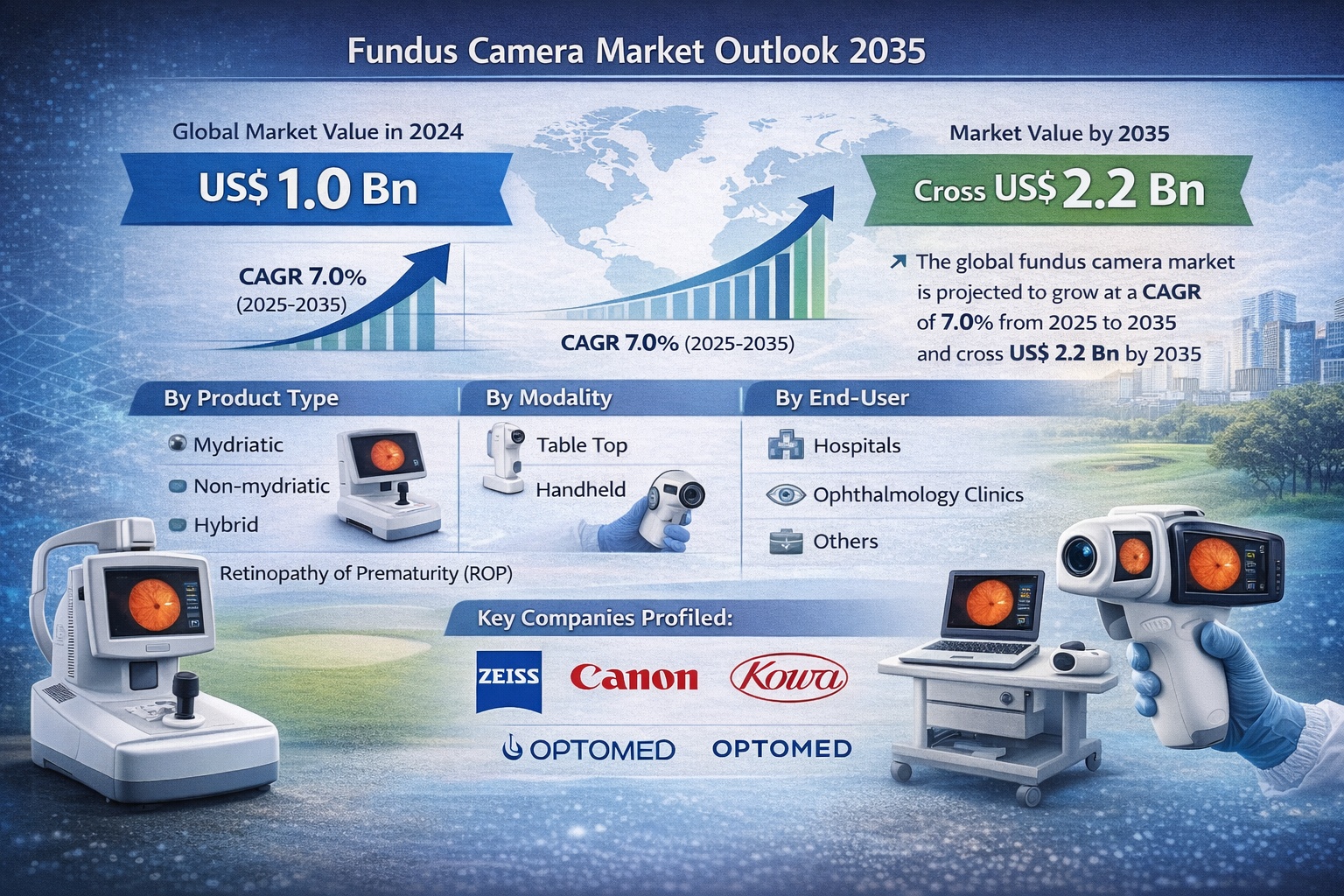
The global fundus camera market is witnessing consistent expansion as demand for early diagnosis of retinal disorders continues to rise. Valued at US$ 1.0 Bn in 2024, the industry is projected to grow at a CAGR of 7.0% from 2025 to 2035, crossing US$ 2.2 Bn by the end of 2035. Growth is being fueled by the increasing prevalence of chronic diseases such as diabetes and hypertension, rising awareness about vision care, and rapid technological advancements in ophthalmic imaging.
Fundus cameras play a vital role in capturing high-resolution images of the retina, optic disc, macula, and posterior pole of the eye. These images are essential for detecting and monitoring conditions including diabetic retinopathy, age-related macular degeneration, glaucoma, and hypertensive retinopathy. As healthcare systems emphasize early screening and preventive care, retinal imaging devices are becoming indispensable tools in modern ophthalmology.
Market Overview
Fundus photography provides critical clinical information about retinal health and enables early diagnosis and timely intervention. Retinal cameras are available in various configurations, including mydriatic, non-mydriatic, and hybrid systems.
- Mydriatic cameras require pupil dilation to achieve enhanced visualization.
- Non-mydriatic cameras capture retinal images without dilation, offering greater patient comfort and faster workflow.
- Hybrid systems combine features of both technologies.
Additionally, fundus cameras are offered in table-top and handheld modalities, making them suitable for hospitals, ophthalmology clinics, outpatient centers, and even remote screening programs.
The increasing burden of chronic diseases, coupled with the need to preserve eyesight and prevent blindness, continues to generate strong demand for advanced retinal imaging systems. Continuous improvements in digital imaging, automation, and telemedicine integration further enhance the utility and efficiency of fundus cameras.
Gain a preview of important insights from our Report in this sample – https://www.transparencymarketresearch.com/sample/sample.php?flag=S&rep_id=1012
Key Drivers of Market Growth
Multidisciplinary Engagement and Enhanced Patient Safety
Modern healthcare emphasizes collaborative, multidisciplinary care. Fundus cameras support this model by enabling ophthalmologists, endocrinologists, neurologists, and primary care physicians to share high-quality retinal images for comprehensive patient management.
Retinal imaging is particularly crucial in diagnosing diabetic retinopathy and macular degeneration. Access to clear retinal photographs facilitates accurate diagnosis, shared decision-making, and coordinated treatment plans. This collaborative approach enhances patient outcomes and strengthens the role of fundus cameras in routine practice.
Moreover, patient safety is a top priority in healthcare systems worldwide. Fundus cameras offer non-invasive imaging, eliminating the need for surgical or invasive diagnostic procedures. Their safe and efficient monitoring capabilities align with patient-centered care models, thereby driving market growth.
Increasing Number of Product Launches
Continuous innovation and frequent product launches by leading manufacturers are expanding the market landscape. Companies are introducing devices with enhanced field-of-view imaging, automated alignment, improved image resolution, and user-friendly interfaces.
The availability of handheld models has expanded access to retinal screening in rural and underserved areas. These portable devices are particularly useful in teleophthalmology programs, mobile clinics, and community health camps.
Innovation also intensifies competition among manufacturers, encouraging differentiation in terms of features, price, and performance. This competitive environment accelerates technology adoption and market expansion.
Market Trends & Innovations
Non-Mydriatic and Table-Top Modalities Leading the Market
Non-mydriatic fundus cameras are gaining significant traction due to their convenience and patient comfort. These systems allow retinal imaging without pupil dilation, making them ideal for primary care settings and routine screening programs.
Table-top models continue to dominate clinical environments due to their stability, durability, and superior image quality. Their robust specifications make them suitable for detailed examinations required for diagnosing complex ocular pathologies.
Technological innovations such as digital imaging enhancements, artificial intelligence (AI)-assisted diagnostics, automated screening capabilities, and telemedicine connectivity are further improving device efficiency and clinical value.
Integration with Telemedicine
The growing adoption of telehealth solutions has expanded the application of fundus cameras. Remote screening programs enable healthcare providers to capture retinal images in one location and analyze them in another, improving access to eye care services in remote regions.
AI-driven algorithms are increasingly being incorporated into imaging software to assist in automated detection of diabetic retinopathy and other retinal disorders, enhancing diagnostic accuracy and reducing clinician workload.
Key Players and Industry Leaders
The global fundus camera market features several established medical device manufacturers competing through innovation, strategic partnerships, and geographic expansion. Prominent players include:
- Carl Zeiss Meditec, Inc.
- Canon, Inc.
- Kowa Company, Ltd.
- Optomed Oy
- Centervue S.p.A.
- NIDEK Co. Ltd.
- Topcon Medical Systems, Inc.
- S4OPTIK LLC.
- Shenzhen Thondar Technology Co.
- Epipole Ltd.
- Revenio Group Corporation
- Haag-Streit Holding AG
- Forus Health Pvt. Ltd.
- Heidelberg Engineering GmbH
- Phelcom Technologies
These companies are focusing on regulatory approvals, technological advancements, acquisitions, and collaborations to strengthen their market positions.
Recent Developments
The market has witnessed several noteworthy developments in 2024:
- In October 2024, Visionix introduced the VX 610, a non-mydriatic automated fundus camera featuring auto alignment, auto focus, and auto capture capabilities. The device is compact, tablet-driven, and telehealth-ready, making it suitable for diabetic retinopathy screening.
- In May 2024, Remidio Inc. announced deployment of its 1000th FOP-NM handheld fundus camera in the U.S., highlighting growing acceptance of portable retinal imaging solutions.
Such innovations demonstrate the industry’s commitment to expanding access and improving diagnostic efficiency.
New Opportunities and Challenges
Opportunities
- Rising Prevalence of Retinal Disorders
Increasing incidence of diabetes and hypertension globally creates sustained demand for retinal screening solutions. - Expansion in Emerging Markets
Developing economies in Asia Pacific, Latin America, and Africa present untapped opportunities due to improving healthcare infrastructure. - AI-Based Diagnostic Tools
Integration of artificial intelligence offers new revenue streams and enhances clinical efficiency. - Teleophthalmology Growth
Remote screening initiatives create demand for portable and connected fundus cameras.
Challenges
- Premium pricing of advanced retinal cameras
- Shortage of skilled ophthalmologists in emerging regions
- Reimbursement complexities in certain markets
- Intense price competition among manufacturers
Despite these challenges, ongoing technological improvements and healthcare investments are expected to offset restraints.
Market Segmentation
By Product Type
- Mydriatic
- Non-mydriatic
- Hybrid
- Retinopathy of Prematurity (ROP)
By Modality
- Table Top
- Handheld
By End-user
- Hospitals
- Ophthalmology Clinics
- Others
By Region
- North America
- Europe
- Asia Pacific
- Latin America
- Middle East & Africa
North America leads the global market, driven by advanced healthcare infrastructure, strong reimbursement systems, and high adoption of innovative technologies. Europe follows closely, while Asia Pacific is projected to experience rapid growth due to expanding diabetic populations and increasing healthcare investments.
Buy this Premium Research Report to explore detailed market trends – https://www.transparencymarketresearch.com/checkout.php?rep_id=1012<ype=S
Key Trends for the Future
- Growing integration of AI in retinal diagnostics
- Increasing adoption of portable and handheld devices
- Expansion of telemedicine-based screening programs
- Enhanced connectivity and cloud-based image storage
- Product miniaturization and user-friendly interfaces
- Rising strategic acquisitions and collaborations
These trends are expected to shape the competitive dynamics and technological landscape of the fundus camera industry over the next decade.
Future Outlook
The global fundus camera market is set for steady and sustained growth through 2035. With revenues projected to surpass US$ 2.2 Bn and a CAGR of 7.0%, the industry reflects strong demand driven by technological innovation, increasing chronic disease prevalence, and expanding screening initiatives.
As healthcare systems worldwide prioritize preventive diagnostics and patient safety, fundus cameras will continue to play a critical role in early detection of retinal diseases. Companies investing in automation, AI integration, and cost-effective solutions are likely to gain significant competitive advantages.
The future of retinal imaging lies in portability, connectivity, and intelligent diagnostics—transforming eye care delivery across hospitals, clinics, and remote communities.
Important FAQs with Answers
How big was the global fundus camera market in 2024?
The market was valued at US$ 1.0 Bn in 2024.
How large will the market be by 2035?
It is projected to cross US$ 2.2 Bn by the end of 2035.
What will be the CAGR during the forecast period?
The market is expected to grow at a CAGR of 7.0% from 2025 to 2035.
What factors are driving market growth?
Rising prevalence of retinal disorders, multidisciplinary engagement, enhanced patient safety, and frequent product launches.
Which region will hold the largest share?
North America is expected to account for the major share during the forecast period.
Who are the prominent providers?
Leading companies include Carl Zeiss Meditec, Inc., Canon, Inc., Kowa Company, Ltd., Optomed Oy, Centervue S.p.A., NIDEK Co. Ltd., Topcon Medical Systems, Inc., and others.
More Related Reports-
Microscopy Devices Market: https://www.transparencymarketresearch.com/microscopy-market.html
Dental 3D Printing Market: https://www.transparencymarketresearch.com/dental-3d-printer-market.html
Autoinjectors Market: https://www.transparencymarketresearch.com/autoinjectors-market.html
Medical Laser Systems Market: https://www.transparencymarketresearch.com/medical-laser-systems-market.html
About Us Transparency Market Research
Transparency Market Research, a global market research company registered at Wilmington, Delaware, United States, provides custom research and consulting services. The firm scrutinizes factors shaping the dynamics of demand in various markets. The insights and perspectives on the markets evaluate opportunities in various segments. The opportunities in the segments based on source, application, demographics, sales channel, and end-use are analysed, which will determine growth in the markets over the next decade.
Our exclusive blend of quantitative forecasting and trends analysis provides forward-looking insights for thousands of decision-makers, made possible by experienced teams of Analysts, Researchers, and Consultants. The proprietary data sources and various tools & techniques we use always reflect the latest trends and information. With a broad research and analysis capability, Transparency Market Research employs rigorous primary and secondary research techniques in all of its business reports.
Contact Us
Transparency Market Research Inc.
CORPORATE HEADQUARTER DOWNTOWN,
1000 N. West Street,
Suite 1200, Wilmington, Delaware 19801 USA
Tel: +1-518-618-1030
USA – Canada Toll Free: 866-552-3453
Leave a Reply