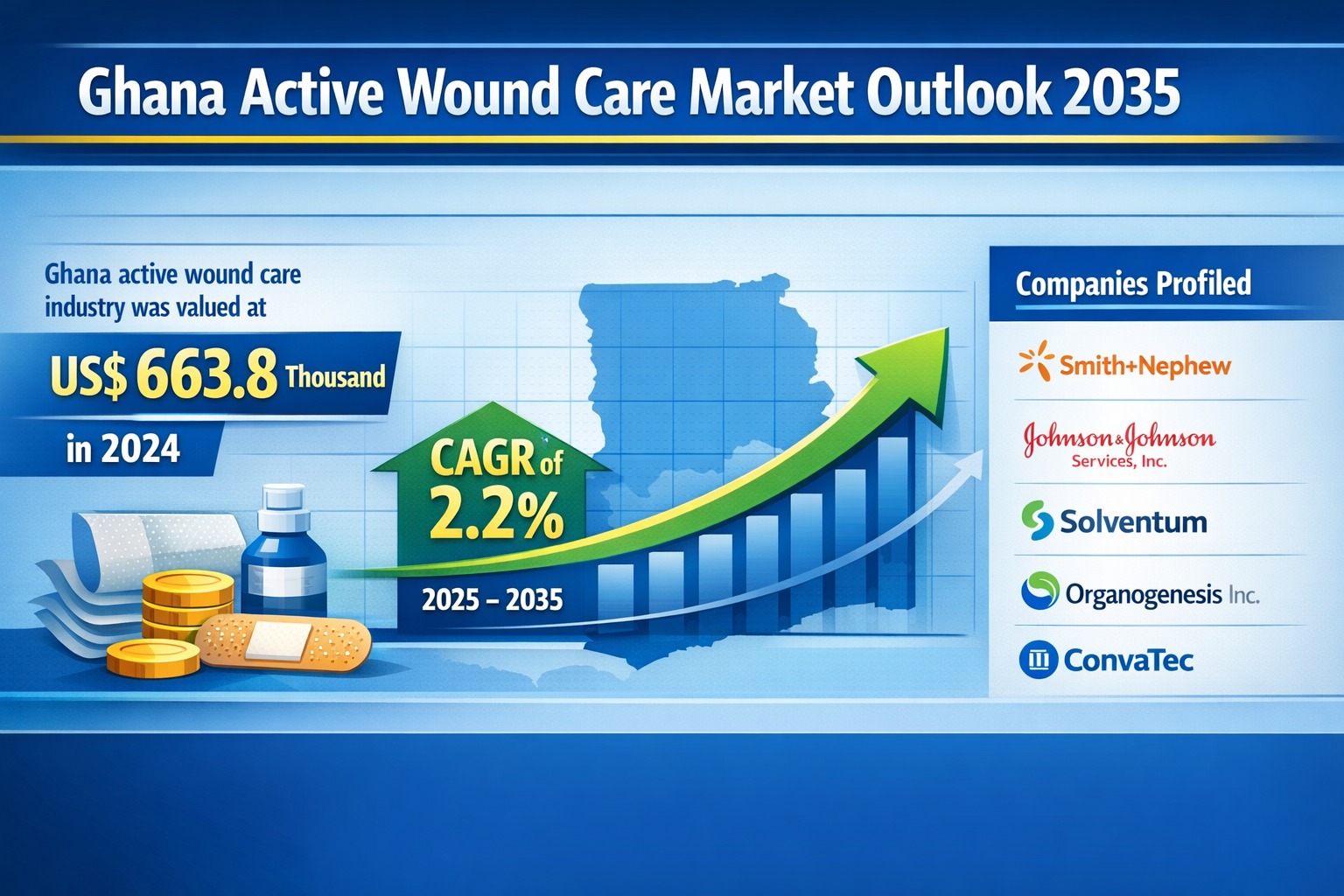
The Ghana active wound care market was valued at US$ 663.8 Thousand in 2024 and is projected to cross US$ 863.0 Thousand by the end of 2035, expanding at a compound annual growth rate (CAGR) of 2.2% from 2025 to 2035. The steady growth trajectory of this market is largely attributed to the increasing prevalence of chronic wounds, improved healthcare infrastructure, and the growing adoption of advanced wound care products such as biomaterials, skin substitutes, and growth factor-based therapies.
Active wound care has become increasingly essential in modern healthcare systems as it promotes faster healing, reduces infection risks, and improves patient outcomes. Ghana’s healthcare sector is gradually adopting advanced medical technologies and therapeutic solutions, creating a favorable environment for the expansion of active wound care products and services.
→Discover Market Opportunities – Request Your Sample Copy Now: https://www.transparencymarketresearch.com/sample/sample.php?flag=S&rep_id=86737
Market Overview
Active wound care represents a modern therapeutic approach designed to manage complex wounds and accelerate the healing process through advanced technologies and biological agents. Unlike traditional wound care methods that primarily involve basic cleaning and dressing, active wound care employs specialized products such as biomaterials, skin substitutes, and growth factors that actively stimulate tissue regeneration.
The need for active wound care solutions has increased significantly due to the growing incidence of chronic diseases such as diabetes, obesity, and vascular disorders. These conditions often result in wounds that heal slowly or fail to heal entirely, leading to complications such as infections, amputations, and prolonged hospitalization.
Biomaterials play a crucial role in this segment by providing materials that interact with biological systems to promote tissue regeneration. These materials, which may be derived from natural or synthetic sources, are widely used in hydrogels, foams, and film-based dressings that maintain a moist environment conducive to wound healing.
Skin substitutes also represent an important advancement in wound care technology. These substitutes may be derived from biological sources or developed synthetically to replace damaged skin tissues. They are particularly effective in treating severe wounds by supporting tissue regeneration and restoring skin functionality.
Growth factors further enhance healing by stimulating cellular activities such as proliferation, migration, and angiogenesis. By accelerating the formation of granulation tissue and improving blood supply, growth factors significantly improve healing outcomes in chronic wound patients.
Analysts’ Viewpoint regarding Ghana Active Wound Care Market
Analysts indicate that the Ghana active wound care market is experiencing gradual but consistent growth due to multiple healthcare and demographic factors. Increasing incidences of chronic wounds associated with diseases such as diabetes and hypertension are significantly influencing demand for advanced wound care solutions.
Additionally, rising awareness among healthcare professionals and patients regarding advanced wound care products—including biomaterials and bioactive dressings—has contributed to the adoption of innovative wound management practices.
The expansion of Ghana’s healthcare infrastructure, coupled with the entry of multinational and domestic medical technology companies offering innovative wound care products, is further supporting market development.
Furthermore, public and private investments in healthcare programs, along with the growing use of telemedicine and digital health platforms, are improving patient monitoring and follow-up care. These advancements are enabling healthcare providers to better manage chronic wounds, thereby supporting long-term market growth.
Key Market Growth Drivers
Rising Incidence of Chronic Wounds in Ghana
One of the primary factors driving the Ghana active wound care market is the increasing prevalence of chronic wounds. These wounds are typically associated with conditions such as diabetes, venous insufficiency, and pressure ulcers.
In Ghana, the rising incidence of non-communicable diseases (NCDs), particularly diabetes and hypertension, has significantly increased the number of patients suffering from chronic wounds. According to an article published in PubMed Central, the prevalence of diabetic foot ulcers in Ghana ranges between 3.8% and 11%, with 6% to 23% of these ulcers progressing to severe complications that may lead to amputation.
Additionally, Ghana is reported to be the second most endemic country for Buruli ulcer, accounting for 17% of the global disease burden. These statistics highlight the growing need for advanced wound care solutions in the country.
Another major factor contributing to the rise in chronic wounds is the aging population. Data from the Ghana Statistical Service (GSS) indicates that the elderly population has increased dramatically over the past six decades, rising from 213,477 individuals in 1960 to approximately 1,991,736 in 2021. Older individuals are more susceptible to wounds due to reduced skin elasticity, impaired blood circulation, and underlying medical conditions.
Healthcare Infrastructure Development in Ghana
The development of healthcare infrastructure is another key factor accelerating market growth. Ghana has made substantial investments in medical facilities, equipment, and healthcare workforce training to improve healthcare accessibility and service quality.
For example, in April 2025, Czech President Petr Pavel inaugurated a new hospital built by Vamed Health Projects on the outskirts of Accra. The 40-bed hospital is designed to serve a population of approximately 100,000 people and is part of a broader initiative to establish 12 healthcare centers across various districts in Ghana.
Additionally, the Ghanaian government announced several healthcare initiatives in April 2025 aimed at strengthening the national healthcare system. One notable initiative is Mahama Cares, which introduces the Ghana Medical Care Trust Fund to address healthcare financing gaps. This fund is expected to support treatments for patients suffering from chronic conditions such as diabetes, hypertension, kidney failure, and cardiovascular diseases—conditions that are closely associated with chronic wounds.
Market Challenges & Opportunities
Despite promising growth prospects, the Ghana active wound care market faces several challenges. One of the key barriers is the limited availability of advanced wound care products in rural and underserved areas. Healthcare facilities outside major urban centers often lack the infrastructure and trained personnel necessary to implement sophisticated wound care technologies.
Another challenge is the relatively high cost of advanced wound care products compared to traditional wound management methods. Many patients in Ghana rely on public healthcare services or out-of-pocket expenditures, which may limit the adoption of premium wound care therapies.
However, these challenges also present opportunities for market expansion. Increasing government investments in healthcare infrastructure and the introduction of insurance schemes are expected to improve patient access to advanced medical treatments.
Furthermore, the growing use of telemedicine platforms in Ghana offers new possibilities for remote wound monitoring and patient management. Digital healthcare tools can enable healthcare providers to track healing progress, reduce hospital visits, and improve treatment outcomes.
→Explore Strategies & Trends – Request Full Report Access – https://www.transparencymarketresearch.com/sample/sample.php?flag=S&rep_id=86737
Market Segmentations
The Ghana active wound care market can be segmented based on product type, application, and end user.
Based on product type, the market includes biomaterials, skin substitutes (biological and synthetic), and growth factors. Among these, biomaterials dominate the market due to their ability to promote tissue regeneration and accelerate wound healing. These materials mimic the natural structure of human tissues and are widely used for treating surgical wounds, ulcers, and burns.
In terms of application, the market is divided into chronic wounds and acute wounds. The chronic wound segment holds the largest share, driven by the rising prevalence of diabetes-related ulcers, pressure sores, and vascular ulcers. Chronic wounds often require specialized treatments and long-term care, increasing demand for advanced wound care solutions.
By end user, the market includes hospitals, clinics, and other healthcare facilities. Hospitals account for the largest share of the market as they handle complex wound cases requiring specialized treatments and surgical interventions.
Geographically, the market is concentrated within Ghana, with major healthcare facilities and advanced treatment centers primarily located in urban regions such as Accra and Kumasi.
Analysis of Key Players – Key Player Strategies
Several global healthcare companies operate in the Ghana active wound care market, focusing on product innovation, training programs, and strategic partnerships to strengthen their market presence.
Leading companies include Smith+Nephew, Johnson & Johnson Services, Inc., Solventum, Organogenesis Inc., and Convatec.
These companies are actively investing in educational initiatives aimed at training healthcare professionals in modern wound care techniques. Workshops, seminars, and certification programs are being conducted to enhance the knowledge and skills of medical practitioners in Ghana.
Additionally, many companies are collaborating with hospitals and clinics to introduce advanced wound care products and expand distribution networks across the country.
Key Player Strategies
Key strategies adopted by market players include product innovation, clinical research collaborations, and awareness campaigns aimed at educating both healthcare providers and patients about advanced wound care technologies.
Companies are also focusing on expanding their presence in emerging markets by partnering with local distributors and healthcare institutions. This strategy enables them to increase product accessibility while strengthening their market footprint.
Another strategic focus area is research and development, particularly in the field of bioengineered tissues, regenerative medicine, and gene therapy-based wound treatments.
Recent Developments
In April 2025, Abeona Therapeutics Inc. announced that the U.S. Food and Drug Administration (FDA) had approved ZEVASKYN (prademagene zamikeracel) gene-modified cellular sheets as the first and only autologous cell-based gene therapy for the treatment of wounds in adult and pediatric patients with recessive dystrophic epidermolysis bullosa (RDEB). The FDA approval of ZEVASKYN is based on the pivotal Phase 3 VIITAL study (NCT04227106), a multi-center, randomized, intrapatient-controlled trial that met its two co-primary efficacy endpoints.
In February 2025, the U.S. FDA granted breakthrough therapy designation to SkinTE for the treatment of Wagner grade 1 diabetic foot ulcers (DFUs). The designation was supported by data from a phase 2 (NCT03881254) multicenter, randomized, controlled trial. Results of the study demonstrated that by 12 weeks, there were significantly more wound closures in the experimental group (35 of 50 patients) than in the control group (17 of 50 patients). For the secondary end point of percentage area reduction, the experimental group had a greater percentage at 80.7% as compared to the control group at 26.8% over 8 weeks.
In August 2024, Vericel Corporation announced that the U.S. Food and Drug Administration (FDA) approved a pediatric indication for NexoBrid (anacaulase-bcdb) for eschar removal in pediatric patients with deep partial-thickness and/or full-thickness thermal burns. The approval was based on results of a global Phase 3 clinical trial, Children Innovation Debridement Study (CIDS), which evaluated the safety and efficacy of NexoBrid in hospitalized pediatric patients, as well as additional pediatric data available from Phase 3 and Phase 2 studies conducted during the clinical development of NexoBrid.
Investment Landscape and ROI Outlook
The investment landscape in Ghana’s active wound care market is gradually evolving as healthcare modernization continues across the country. Government initiatives aimed at strengthening healthcare infrastructure, combined with the expansion of private healthcare providers, are creating favorable conditions for medical device and biotechnology companies.
Investors are increasingly focusing on innovative wound care technologies such as regenerative medicine, bioengineered skin substitutes, and advanced biomaterial-based dressings. Although the market size remains relatively small, its steady growth rate and increasing healthcare spending indicate promising long-term returns on investment.
Why Buy This Report?
This report provides a comprehensive analysis of the Ghana active wound care market, including market size, growth projections, and industry trends through 2035. It offers detailed insights into market drivers, challenges, and opportunities that influence the industry’s development.
The report also includes competitive landscape analysis, key player strategies, and recent technological advancements shaping the wound care sector. Additionally, it provides in-depth segmentation analysis covering product types, applications, and end users.
Healthcare providers, investors, medical device manufacturers, and policymakers can use this report to make informed decisions regarding market entry, expansion strategies, and investment planning.
FAQs
Q.How big was Ghana active wound care market in 2024?
A.Ghana active wound care market was valued at US$ 663.8 Thousand in 2024.
Q.How big will Ghana active wound care business be in 2035?
A.The market is projected to reach more than US$ 863.0 Thousand by the end of 2035.
Q.What are the factors driving Ghana active wound care market?
A.Key drivers include the rising incidence of chronic wounds, increasing awareness of advanced wound care products, and improvements in healthcare infrastructure in Ghana.
Q.What will be the CAGR of Ghana active wound care industry during the forecast period?
A.The market is expected to expand at a CAGR of 2.2% from 2025 to 2035.
Q.Who are the prominent players in Ghana active wound care market?
A.Major players include Smith+Nephew, Johnson & Johnson Services, Inc., Solventum, Organogenesis Inc., and Convatec.
Buy Full Report Now: https://www.transparencymarketresearch.com/checkout.php?rep_id=86737<ype=S
→Explore Latest Research Reports by Transparency Market Research:
Cervical Cerclage Market: https://www.transparencymarketresearch.com/cervical-cerclage-market.html
Venous Stents Market: https://www.transparencymarketresearch.com/venous-stents-market.html
Dental Dust Collector Market: https://www.transparencymarketresearch.com/dental-dust-collector-market.html
About Transparency Market Research
Transparency Market Research, a global market research company registered at Wilmington, Delaware, United States, provides custom research and consulting services. Our exclusive blend of quantitative forecasting and trends analysis provides forward-looking insights for thousands of decision makers. Our experienced team of Analysts, Researchers, and Consultants use proprietary data sources and various tools & techniques to gather and analyses information.
Our data repository is continuously updated and revised by a team of research experts, so that it always reflects the latest trends and information. With a broad research and analysis capability, Transparency Market Research employs rigorous primary and secondary research techniques in developing distinctive data sets and research material for business reports.
Leave a Reply