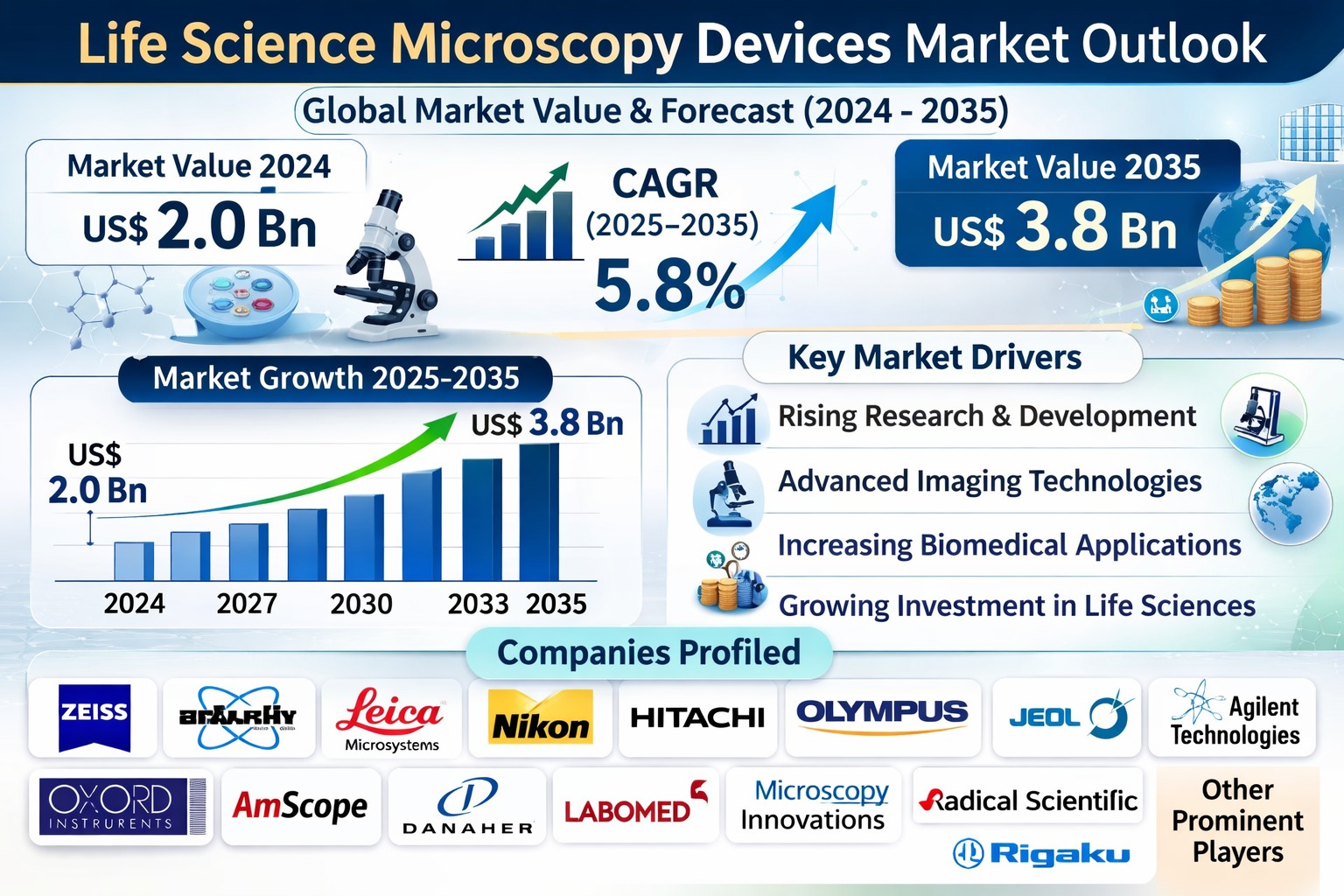
The global life science microscopy devices market was valued at US$ 2.0 Bn in 2024 and is projected to reach US$ 3.8 Bn by the end of 2035, expanding at a steady CAGR of 5.8% from 2025 to 2035. The market’s sustained growth reflects increasing adoption of advanced imaging technologies across biomedical research, clinical diagnostics, drug discovery, and academic institutions.
Historical data from 2020 to 2023 indicates consistent demand driven by expanding healthcare R&D investments and the rapid evolution of digital microscopy systems. Over the next decade, industry revenues are expected to benefit from the integration of AI-powered analytics, super-resolution imaging, and automated workflows that enhance laboratory productivity and reproducibility.
→Discover Market Opportunities – Request Your Sample Copy Now: https://www.transparencymarketresearch.com/sample/sample.php?flag=S&rep_id=4017
Analysts’ Viewpoint
Ongoing technological advancements and the rising number of biomedical research applications are major factors boosting the life science microscopy instrumentation market. Greater dependence on high-definition imagery for studying cells, tissues, and molecular interactions is propelling industry-level growth.
Advances in digital integration, automation, and enhanced image-processing software are significantly improving accuracy and efficiency in data analysis. These improvements are particularly crucial in cancer research, neuroscience, immunology, and molecular biology. Analysts observe that laboratories are increasingly transitioning from conventional optical systems to fully digital, AI-enabled platforms capable of high-throughput imaging and remote collaboration.
Market Introduction
Life science microscopy devices are precision instruments designed to observe and analyze biological specimens at cellular and molecular levels. They play a vital role in research, diagnostics, and drug development by enabling visualization of structures invisible to the naked eye.
Common device categories include:
- Optical microscopes
- Electron microscopes (Transmission Electron Microscope – TEM, Scanning Electron Microscope – SEM)
- Fluorescence microscopes
- Confocal microscopes
- Scanning probe microscopes such as AFM and STM
These tools are widely used in cell biology, pathology, microbiology, genetics, hematology, and pharmacology. With the rising focus on personalized medicine and biologics, microscopy has become indispensable in preclinical testing and molecular profiling.
Key Market Growth Drivers
- Shift Toward Digital and Automated Microscopy Systems
One of the primary drivers accelerating market expansion is the transition from traditional analog microscopy to digital and automated platforms. Modern systems provide:
- High-resolution image capture
- Cloud-based data storage and sharing
- Automated slide scanning
- AI-driven image classification
- Reduced human error and enhanced reproducibility
For example, in February 2023, Olympus Corporation launched the SLIDEVIEW VS200 digital slide scanner to address the growing demand for high-throughput imaging in neuroscience and cancer research. The system allows full-size slide scanning at high resolution and supports remote inspection—accelerating collaborative research and time-sensitive discoveries.
Digital microscopes are transforming laboratory operations by streamlining workflows and enabling large-scale biological image analysis. As more laboratories embrace automation and digital integration, demand for next-generation microscopy devices continues to rise.
- Growing Demand in Drug Discovery and Development
Pharmaceutical and biotechnology companies increasingly rely on advanced microscopy to study cellular responses, molecular interactions, and structural biology. The growing complexity of targeted therapies and biologics has made high-resolution imaging indispensable in drug discovery pipelines.
In April 2023, Thermo Fisher Scientific introduced its Tundra Cryo-TEM system to simplify structural analysis for pharmaceutical and research laboratories. The system enables high-resolution visualization of biomolecules, making structural biology more accessible to smaller research institutions.
With the global pharmaceutical sector investing heavily in biologics and precision medicine, microscopy technologies are becoming central to accelerating therapeutic discovery and improving treatment outcomes.
- Expanding Biomedical Research Funding
Public and private investments in healthcare R&D continue to expand globally. Institutions are upgrading laboratory infrastructure with high-performance imaging tools, thereby strengthening long-term market demand.
Government-backed research programs and industry-academic collaborations further support adoption of advanced microscopy systems in both developed and emerging economies.
Market Challenges & Opportunities
Challenges
Despite strong growth prospects, the industry faces several constraints:
- High capital costs of advanced electron and super-resolution microscopes
- Maintenance and operational complexity
- Need for skilled personnel to operate sophisticated systems
- Budget constraints in smaller research institutions
Additionally, integration of AI and digital systems requires substantial IT infrastructure, posing adoption barriers for some laboratories.
Opportunities
However, these challenges also create opportunities:
- Development of cost-effective compact systems
- Subscription-based software and AI analytics models
- Expansion in emerging markets such as India, China, and Brazil
- Integration with telepathology and digital diagnostics platforms
- Increased adoption in CROs and personalized medicine facilities
Portable and mobile microscopy devices represent another emerging opportunity, particularly in decentralized research settings and remote healthcare environments.
→Explore Strategies & Trends – Request Full Report Access – https://www.transparencymarketresearch.com/sample/sample.php?flag=S&rep_id=4017
Market Revenue Growth Trends
In line with recent industry trends, manufacturers are heavily investing in:
- Super-resolution microscopy
- Live-cell imaging systems
- AI-powered image analysis
- Automation-enabled high-content screening
Companies are collaborating with academic institutions, biotech firms, and hospitals to co-develop specialized imaging solutions. These partnerships expand product adoption and enhance real-world validation.
As laboratories demand scalable and precision-focused imaging systems, digital microscopy continues to capture a growing share of overall industry revenue.
Segment Analysis
By Type
Among all microscopy device types, light microscopy dominates the global market due to its cost-effectiveness, versatility, and ease of use. It includes brightfield, fluorescence, phase contrast, confocal, and differential interference contrast microscopy.
Super-resolution and live-cell imaging capabilities have significantly expanded the utility of light microscopy in cancer biology, neuroscience, and developmental research.
Electron microscopy (TEM and SEM) holds a substantial share in structural biology and nanotechnology research, while scanning probe microscopy (AFM, STM) plays a niche yet critical role in molecular-scale analysis.
By Application
Key application areas include:
- Disease diagnosis (pathology, hematology, microbiology)
- Drug development (pharmacology, toxicology)
- Medical education and research
- Surgical procedures
- Personalized medicine
Drug development and disease diagnosis collectively account for a significant portion of market revenue due to their reliance on high-precision imaging.
By End-user
Major end-users include:
- Hospitals and outpatient facilities
- Diagnostic laboratories
- Pharmaceutical & biotechnology companies
- Academic & research institutes
- Contract Research Organizations (CROs)
Pharmaceutical and biotechnology companies represent a high-growth segment due to rising R&D intensity.
By Region
North America leads the global market, supported by:
- Strong research infrastructure
- Advanced healthcare facilities
- Significant NIH funding
- Presence of major microscopy manufacturers
The U.S. remains the dominant contributor in the region.
Europe follows closely with strong academic research hubs in Germany, the U.K., and France. Asia Pacific is expected to witness the fastest growth, driven by expanding biotech ecosystems in China, India, and Japan.
Latin America and the Middle East & Africa are emerging markets benefiting from gradual improvements in healthcare infrastructure.
Regional Outlook
North America is expected to maintain the largest share from 2025 to 2035. The presence of industry leaders such as Thermo Fisher Scientific, Bruker Corporation, and Danaher (Leica Microsystems) ensures continuous product innovation and technological leadership.
Strong regulatory frameworks, industry-academic collaborations, and growing adoption of digital pathology further strengthen regional dominance.
Asia Pacific is projected to register accelerated growth due to rising healthcare expenditure, government-backed research initiatives, and expanding pharmaceutical manufacturing bases.
Analysis of Key Players – Strategies and Competitive Landscape
The market features a competitive landscape with established global players and regional manufacturers. Prominent companies include:
Carl Zeiss AG, Bruker, Leica Microsystems, Nikon Instruments, Hitachi High-Technologies Corporation, Olympus, JEOL INDIA PVT LTD, Agilent Technologies, Oxford Instruments, AmScope, Danaher, Labomed, Microscopy Innovations, LLC, Radical Scientific Equipments Pvt. Ltd., and Rigaku Europe SE.
Key Player Strategies
- Continuous R&D investments in super-resolution imaging
- Expansion of digital microscopy portfolios
- Strategic acquisitions and partnerships
- Geographic expansion into emerging markets
- AI-based software development
- Customized solutions for specialized research applications
Companies are focusing on improving imaging clarity, automation efficiency, and workflow integration to sustain competitive advantage.
Recent Developments
In December 2024, researchers at the European Molecular Biology Laboratory (EMBL) in Heidelberg unveiled a groundbreaking mobile microscope. This innovative device, developed by the Prevedel group, is characterized by its small size, rapid imaging capabilities, and remarkably high resolution.
In May 2024, Danaher Corporation launched the VIVENTIS LS2, featuring light sheet technology. This innovation is designed to produce high-depth images of live samples, improving clarity and detail in cellular imaging. It enhances live-cell imaging applications, making it ideal for researchers focusing on dynamic biological processes in real time.
Investment Landscape and ROI Outlook
The life science microscopy devices market offers stable long-term returns supported by:
- Predictable research funding cycles
- Growing pharmaceutical R&D budgets
- Increasing demand for precision diagnostics
With a projected CAGR of 5.8%, investors can expect steady revenue expansion over the next decade. The integration of AI and digital pathology platforms presents additional high-margin revenue streams through software and service-based offerings.
Emerging economies present strong growth potential, offering attractive ROI opportunities for manufacturers expanding their regional footprint.
Why Buy This Report?
- Comprehensive market size and forecast from 2025 to 2035
- Detailed segment and regional analysis
- In-depth competitive landscape evaluation
- Insights into key drivers, challenges, and opportunities
- Coverage of recent technological developments
- Strategic profiling of leading industry players
- Customization options available upon request
The report is available in Electronic (PDF) + Excel format.
FAQs
- How big was the life science microscopy devices market in 2024?
The market was valued at US$ 2.0 Bn in 2024. - How big will the life science microscopy devices market be in 2035?
It is projected to cross US$ 3.8 Bn by the end of 2035. - What are the factors driving the market?
The shift toward digital and automated microscopy systems and increasing demand in drug discovery and development are primary growth drivers. - What will be the CAGR during the forecast period?
The market is expected to expand at a CAGR of 5.8% from 2025 to 2035. - Which region will account for a major share of the market?
North America is expected to account for the largest share during the forecast period.
Buy Full Report Now: https://www.transparencymarketresearch.com/checkout.php?rep_id=4017<ype=S
→Explore Latest Research Reports by Transparency Market Research:
| Herbal Essentials Market | https://www.transparencymarketresearch.com/herbal-essentials-market.html |
| Sinus Dilation Devices Market | https://www.transparencymarketresearch.com/sinus-dilation-devices-market.html |
| Spinal Implants Market | https://www.transparencymarketresearch.com/spinal-implants-market.html |
About Transparency Market Research
Transparency Market Research, a global market research company registered at Wilmington, Delaware, United States, provides custom research and consulting services. Our exclusive blend of quantitative forecasting and trends analysis provides forward-looking insights for thousands of decision makers. Our experienced team of Analysts, Researchers, and Consultants use proprietary data sources and various tools & techniques to gather and analyses information.
Our data repository is continuously updated and revised by a team of research experts, so that it always reflects the latest trends and information. With a broad research and analysis capability, Transparency Market Research employs rigorous primary and secondary research techniques in developing distinctive data sets and research material for business reports.
Leave a Reply