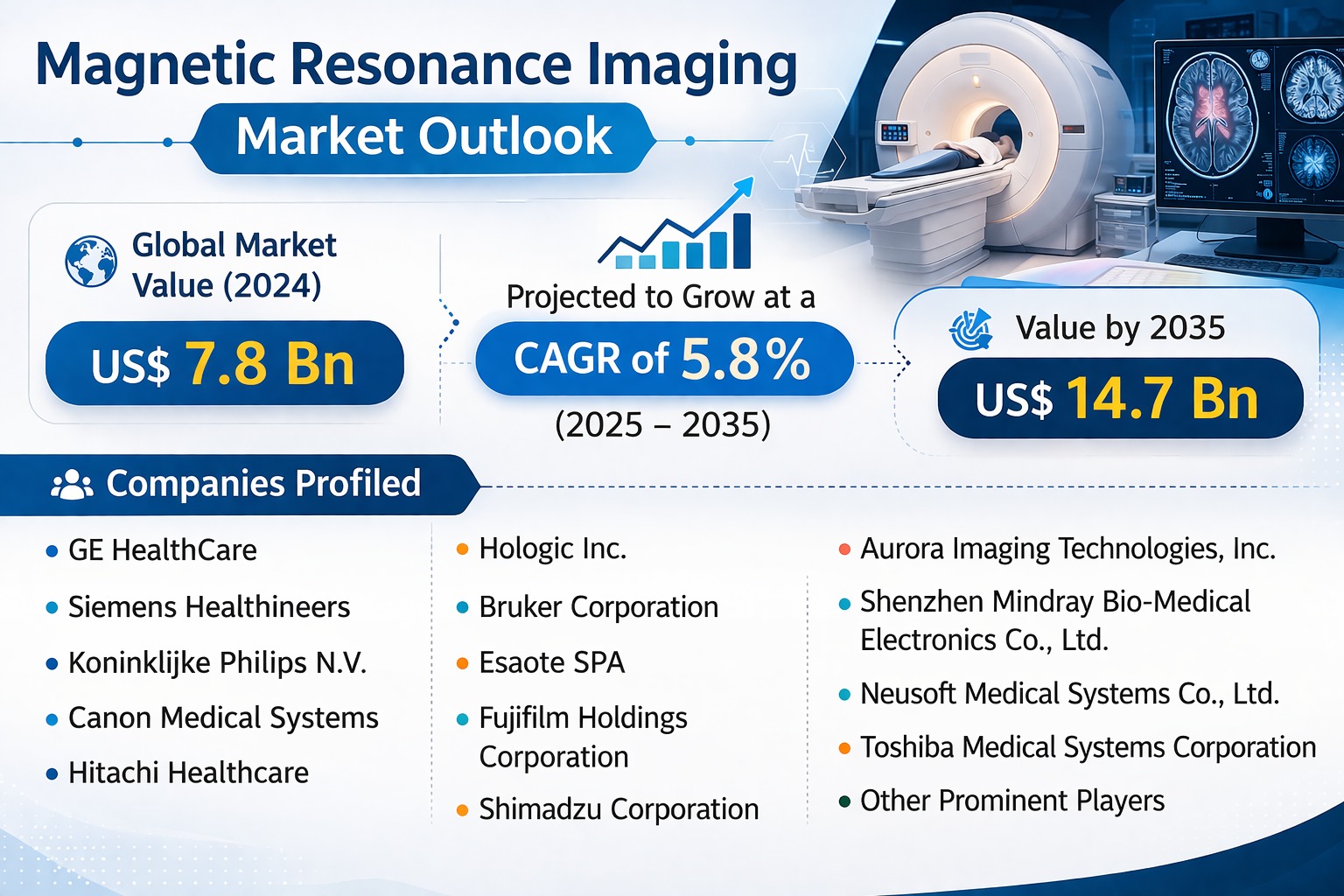
The global magnetic resonance imaging (MRI) market continues to expand steadily as healthcare systems worldwide increasingly adopt advanced imaging technologies for early disease diagnosis and treatment planning. The industry was valued at US$ 7.8 Bn in 2024 and is projected to grow at a compound annual growth rate (CAGR) of 5.8% from 2025 to 2035, reaching US$ 14.7 Bn by the end of 2035.
Growth of the market is supported by the increasing prevalence of chronic diseases, rising demand for radiation-free diagnostic procedures, and technological advancements in imaging technologies such as artificial intelligence (AI)-enabled MRI systems and ultra-high-field scanners.
According to industry analysts, MRI has become one of the most critical diagnostic imaging tools for detecting complex diseases including neurological disorders, musculoskeletal conditions, cardiovascular abnormalities, and cancer. The global healthcare sector is increasingly prioritizing early diagnosis and precision medicine, which is significantly contributing to the long-term growth of the MRI industry.
→Discover Market Opportunities – Request Your Sample Copy Now: https://www.transparencymarketresearch.com/sample/sample.php?flag=S&rep_id=191
Market Overview
Magnetic resonance imaging is a non-invasive imaging technology that uses strong magnetic fields and radio waves to generate detailed images of organs, tissues, and skeletal systems. Unlike X-ray or CT scanning, MRI does not involve ionizing radiation, making it a safer diagnostic method for repeated imaging procedures.
The global MRI market is witnessing consistent growth due to the increasing incidence of diseases such as cancer, neurological disorders, cardiovascular diseases, and musculoskeletal conditions. These diseases require accurate diagnostic imaging for early detection and effective treatment monitoring.
In addition, the rapid aging of the global population is creating strong demand for advanced medical imaging solutions. Older populations are more susceptible to chronic diseases and degenerative disorders, which significantly increases the demand for MRI examinations.
Technological advancements in MRI systems are also playing a major role in improving diagnostic capabilities. New innovations such as 3T MRI systems, 7T ultra-high-field scanners, functional MRI (fMRI), diffusion tensor imaging, and hybrid imaging technologies are enhancing imaging precision while reducing scan times.
Furthermore, healthcare providers are increasingly adopting patient-centric diagnostic approaches. As a result, innovations such as open MRI systems and portable MRI scanners are gaining popularity due to improved patient comfort and accessibility.
Overall, MRI continues to remain a gold-standard imaging technology in modern healthcare systems and is expected to maintain strong adoption levels throughout the forecast period.
Key Market Growth Drivers
Rising Prevalence of Chronic and Neurological Disorders
One of the major factors driving the growth of the magnetic resonance imaging market is the increasing global prevalence of chronic diseases and neurological disorders. Conditions such as Alzheimer’s disease, Parkinson’s disease, epilepsy, stroke, and brain tumors require highly precise imaging for accurate diagnosis and treatment planning.
MRI provides superior soft-tissue contrast compared to other imaging modalities such as CT scans and X-rays. This makes it particularly useful for diagnosing neurological conditions and monitoring disease progression.
According to the World Health Organization (WHO), more than 6.8 million people died in 2016 due to neurological disorders, highlighting the growing need for advanced diagnostic technologies.
MRI is also widely used in oncology imaging to detect and monitor cancers affecting the brain, liver, prostate, and other organs. With increasing global cancer incidence and rising healthcare expenditures, demand for MRI scans is expected to grow significantly across both developed and developing economies.
Technological Advancements and AI Integration
Technological innovation is another major driver of the MRI market. Modern MRI scanners are capable of producing highly detailed images while significantly reducing scan times.
Advanced technologies such as functional MRI (fMRI), diffusion tensor imaging, high-field MRI scanners, and hybrid imaging technologies are expanding the clinical applications of MRI systems.
The integration of artificial intelligence into MRI imaging is also transforming diagnostic workflows. AI algorithms are capable of accelerating image reconstruction, improving image quality, and assisting radiologists in detecting abnormalities.
For instance, a study published in Radiology: Artificial Intelligence in 2023 revealed that AI-assisted MRI technology can reduce brain-scan times by nearly 40% while maintaining diagnostic accuracy.
In addition to improving efficiency, AI-powered imaging systems are helping healthcare providers reduce operational costs and increase patient throughput in hospitals and diagnostic centers.
Portable MRI devices are also emerging as a promising innovation, enabling imaging services in outpatient clinics, rural healthcare facilities, and emergency departments.
Market Challenges & Opportunities
Despite strong growth prospects, the magnetic resonance imaging market faces several challenges.
One of the primary challenges is the high cost of MRI systems, which can range from several hundred thousand to millions of dollars depending on system configuration. This makes it difficult for smaller hospitals and diagnostic centers in developing regions to adopt advanced MRI technologies.
Additionally, MRI procedures require specialized infrastructure, skilled radiologists, and maintenance support, which further increases operational costs.
However, these challenges also present opportunities for innovation and market expansion. Manufacturers are increasingly focusing on developing cost-effective MRI systems, compact scanners, and portable imaging devices that can be deployed in smaller healthcare facilities.
Emerging economies such as India, China, Thailand, and Brazil are investing heavily in healthcare infrastructure, which is expected to create new growth opportunities for MRI manufacturers over the next decade.
Furthermore, the increasing adoption of AI-enabled imaging solutions and cloud-based diagnostics is expected to improve efficiency and accessibility in diagnostic imaging services.
→Explore Strategies & Trends – Request Full Report Access – https://www.transparencymarketresearch.com/sample/sample.php?flag=S&rep_id=191
Market Segmentations (with Region)
The magnetic resonance imaging market can be segmented based on type, strength, application, end-user, and region.
Based on type, the market includes open MRI systems and closed MRI systems. Open MRI systems are gaining popularity due to their patient-friendly design, especially for obese patients, pediatric patients, and individuals suffering from claustrophobia.
By strength, the market includes low-to-mid field MRI systems below 1.5T, high-field MRI systems between 1.5T and 3.0T, very high-field MRI systems between 4.0T and 5.0T, and ultra-high-field MRI systems above 6.0T.
By application, MRI is widely used in musculoskeletal imaging, orthopedic imaging, head and neck imaging, neurology, cardiovascular diagnostics, abdominal and prostate imaging, and breast imaging.
In terms of end-users, the major segments include hospitals, diagnostic imaging centers, ambulatory surgical centers, and other healthcare facilities.
Regionally, the MRI market is segmented into North America, Europe, Asia Pacific, Latin America, and Middle East & Africa.
Among these regions, North America dominates the global MRI market, driven by advanced healthcare infrastructure, strong reimbursement policies, and high adoption of advanced diagnostic technologies.
The United States has one of the highest MRI utilization rates globally. According to the Organization for Economic Cooperation and Development (OECD), there are over 111 MRI examinations per 1,000 people annually in the U.S.
Asia Pacific is expected to witness the fastest growth during the forecast period due to expanding healthcare infrastructure, increasing medical investments, and growing demand for diagnostic imaging in countries such as China, India, Japan, and South Korea.
Analysis of Key Players – Key Player Strategies
The global MRI market is highly competitive and dominated by several multinational medical imaging companies.
Major players are focusing on technological innovation, product portfolio expansion, strategic partnerships, and geographic expansion to strengthen their market presence.
Leading companies such as GE HealthCare, Siemens Healthineers, and Koninklijke Philips N.V. are investing heavily in research and development to introduce next-generation MRI scanners with enhanced imaging quality and improved workflow efficiency.
These companies are also forming collaborations with hospitals, academic institutions, and artificial intelligence developers to accelerate innovation in MRI technology.
In addition, regional and mid-tier manufacturers are competing by introducing cost-effective MRI systems targeted at emerging markets, particularly in Asia Pacific and Latin America.
Key companies operating in the MRI market include GE HealthCare, Siemens Healthineers, Koninklijke Philips N.V., Canon Medical Systems, Hitachi Healthcare, Hologic Inc., Bruker Corporation, Esaote SPA, Fujifilm Holdings Corporation, Shimadzu Corporation, Aurora Imaging Technologies, Shenzhen Mindray Bio-Medical Electronics Co., Ltd., Neusoft Medical Systems Co., Ltd., and Toshiba Medical Systems Corporation.
Recent Developments
In March 2025, Polarean Imaging plc expanded its Xenon MRI imaging platform to support pharmaceutical-sponsored research. The company partnered with VIDA Diagnostics and introduced a new service model enabling advanced research applications.
In October 2023, Siemens Healthineers partnered with Cardiff University to advance imaging research and precision diagnostics. The collaboration focuses on innovation in brain imaging technologies and MRI research through Cardiff’s Brain Research Imaging Centre (CUBRIC).
These developments highlight the industry’s growing focus on innovation, research collaboration, and technological advancements in MRI imaging.
Investment Landscape and ROI Outlook
Investment in the MRI market is expected to remain strong over the next decade due to the increasing demand for advanced diagnostic imaging technologies.
Healthcare institutions worldwide are allocating significant budgets toward upgrading diagnostic imaging equipment. Hospitals are increasingly investing in high-field MRI systems, AI-enabled imaging software, and open MRI systems to enhance patient experience and diagnostic accuracy.
Emerging economies are also attracting investment from both government and private healthcare providers seeking to improve diagnostic infrastructure.
From an investor perspective, the MRI market offers stable long-term returns due to consistent demand for diagnostic imaging services. The adoption of AI-integrated imaging systems and portable MRI technologies is expected to generate additional revenue opportunities for manufacturers.
Overall, the MRI industry presents a favorable investment landscape with strong growth potential through 2035.
Why Buy This Report?
This market research report provides a comprehensive analysis of the global magnetic resonance imaging industry.
The report offers detailed insights into market size, growth forecasts, key drivers, and emerging technological trends. It includes a thorough analysis of competitive strategies adopted by major industry players and highlights investment opportunities across different regions.
Additionally, the report provides in-depth segmentation analysis covering MRI types, imaging strengths, applications, end-users, and regional markets.
Industry stakeholders, investors, healthcare providers, and medical device manufacturers can use this report to make informed strategic decisions and identify growth opportunities in the evolving MRI market.
FAQs
- How big was the magnetic resonance imaging market in 2024?
The global magnetic resonance imaging market was valued at US$ 7.8 Bn in 2024. - How large will the MRI market be by 2035?
The MRI market is projected to reach US$ 14.7 Bn by the end of 2035. - What factors are driving the MRI market growth?
The market is driven by the rising prevalence of chronic and neurological disorders and technological advancements including AI integration. - What will be the CAGR of the MRI market during the forecast period?
The MRI industry is expected to grow at a CAGR of 5.8% between 2025 and 2035. - Which region dominates the MRI market?
North America is expected to hold the largest share of the global MRI market due to advanced healthcare infrastructure, strong reimbursement systems, and high adoption of diagnostic imaging technologies.
Buy Full Report Now: https://www.transparencymarketresearch.com/checkout.php?rep_id=191<ype=S
→Explore Latest Research Reports by Transparency Market Research:
Intrauterine Devices Market: https://www.transparencymarketresearch.com/intrauterine-devices-market.html
Soft Tissue Repair Market: https://www.transparencymarketresearch.com/soft-tissue-repair-market.html
Tuberculosis Testing Market: https://www.transparencymarketresearch.com/tuberculosis-testing-market.html
About Transparency Market Research
Transparency Market Research, a global market research company registered at Wilmington, Delaware, United States, provides custom research and consulting services. Our exclusive blend of quantitative forecasting and trends analysis provides forward-looking insights for thousands of decision makers. Our experienced team of Analysts, Researchers, and Consultants use proprietary data sources and various tools & techniques to gather and analyses information.
Our data repository is continuously updated and revised by a team of research experts, so that it always reflects the latest trends and information. With a broad research and analysis capability, Transparency Market Research employs rigorous primary and secondary research techniques in developing distinctive data sets and research material for business reports.
![The global positron emission tomography [PET] scanners market is projected to grow at a CAGR of 3.2% from 2025 to 2035 and cross US$ 3.1 Bn by the end of 2035](https://www.keepfacts.com/wp-content/uploads/2026/03/CAGR-of-4.8-4.png)
Leave a Reply