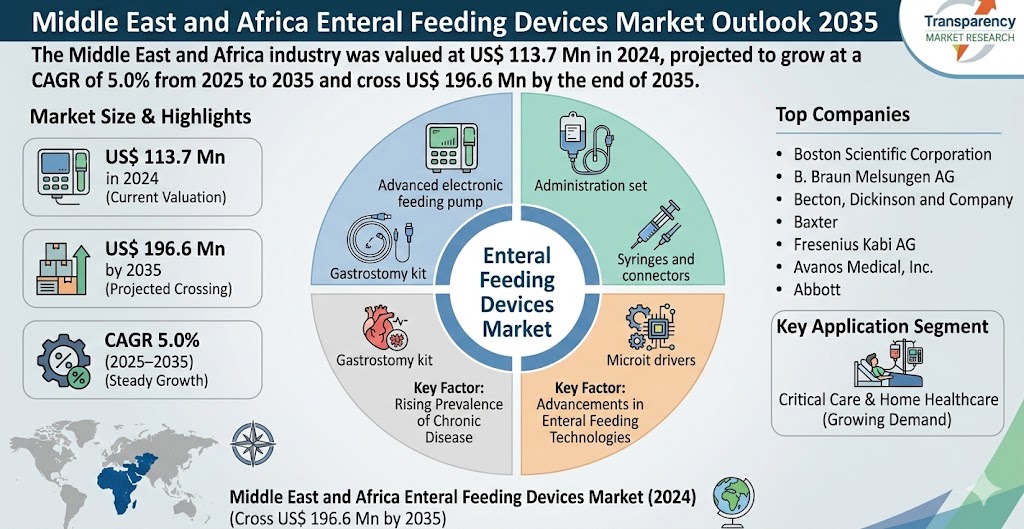
The Middle East and Africa (MEA) enteral feeding devices market was valued at US$ 113.7 Mn in 2024 and is projected to expand at a CAGR of 5.0% from 2025 to 2035, surpassing US$ 196.6 Mn by the end of 2035. The market is expected to grow steadily due to the rising prevalence of chronic diseases, increasing geriatric population, improving healthcare infrastructure, and growing awareness about clinical nutrition across the region.
Enteral feeding devices are medical tools used to deliver nutrition directly to the gastrointestinal tract in patients who are unable to consume food orally. These devices are widely used in hospitals, long-term care facilities, and home care settings for patients suffering from neurological disorders, cancer, gastrointestinal diseases, and critical illnesses.
Get your sample market research report copy today@ https://www.transparencymarketresearch.com/sample/sample.php?flag=S&rep_id=86693
Market Overview
The demand for enteral feeding devices in the Middle East and Africa is being driven by demographic and epidemiological shifts. Non-communicable diseases such as cancer, diabetes, stroke, and neurological conditions are increasing across the region. Many of these conditions impair a patient’s ability to swallow or consume adequate nutrition, necessitating the use of enteral feeding systems.
Healthcare reforms and investments in countries such as Saudi Arabia, the United Arab Emirates, South Africa, and Egypt are contributing to the adoption of advanced medical devices. Governments are focusing on strengthening hospital infrastructure, expanding critical care services, and improving access to specialized treatments.
In addition, rising awareness regarding the importance of nutritional support in patient recovery and long-term disease management is fueling demand for enteral feeding devices in both acute and home care settings.
Key Market Drivers
Rising Prevalence of Chronic Diseases
The MEA region is witnessing a growing burden of chronic illnesses, including cancer, diabetes, cardiovascular diseases, and neurological disorders. These conditions often require long-term nutritional support, driving the need for enteral feeding devices.
Growing Geriatric Population
Although the region has a relatively younger demographic compared to Western markets, the aging population is steadily increasing. Elderly individuals are more prone to swallowing disorders, stroke-related complications, and degenerative diseases, increasing demand for enteral feeding solutions.
Expansion of Healthcare Infrastructure
Several Middle Eastern countries are investing heavily in healthcare modernization as part of national development strategies. The construction of new hospitals, specialty clinics, and intensive care units is creating significant opportunities for enteral feeding device manufacturers.
Increasing Adoption of Home Healthcare
Home-based enteral feeding is gaining popularity due to cost-effectiveness and improved patient comfort. Advancements in portable feeding pumps and user-friendly tube systems are supporting the transition from hospital to home care.
Improved Awareness of Clinical Nutrition
Healthcare professionals are increasingly recognizing the importance of early nutritional intervention in improving patient outcomes. This shift toward proactive nutritional management is boosting demand for enteral feeding systems.
Key Developments in Enteral Feeding Devices Industry
- In November 2024, Avanos Medical, Inc. announced the launch of its CORGRIP SR Nasogastric/Nasointestinal Tube Retention System, strengthening its enteral feeding portfolio. The newly launched device featuring a monofilament thread is a nasal bridle solution designed to offer several advantages over conventional tape, such as reduction in risk of dislodgement and the complications associated with replacement of nasal tubes. The system is also designed to enhance visibility and flexibility.
- In March 2024, Vanderbilt Health announced the company’s shift to enteral feeding connectors. The company announced its plan to replace all existing feeding tubes for inpatients, outpatients and in-home care patients with ENFit connectors that are designed to enhance patient safety and reduce the risk of tubing misconnections, as per recommendations by the International Organization of Standardization.
Regional Insights
The Middle East and Africa region presents diverse growth patterns across countries.
Gulf Cooperation Council (GCC) countries such as Saudi Arabia and the UAE lead the market due to advanced healthcare systems, higher healthcare expenditure, and increasing adoption of modern medical technologies.
South Africa represents a significant market within Sub-Saharan Africa, supported by relatively developed healthcare infrastructure and growing awareness about clinical nutrition.
Other African nations are gradually improving healthcare access, although limited infrastructure and affordability constraints may restrict rapid adoption in certain areas.
Overall, economic diversification initiatives and healthcare reforms across the Middle East are expected to create sustained opportunities for market expansion.
Get this premium report for strategic insights: https://www.transparencymarketresearch.com/checkout.php?rep_id=86693<ype=S
Competitive Landscape
The MEA enteral feeding devices market is moderately competitive, with the presence of global medical device manufacturers and regional distributors. Companies are focusing on expanding their regional footprint through partnerships with local healthcare providers and distributors.
- Boston Scientific Corporation
- B. Braun Melsungen AG
- Becton, Dickinson and Company
- Baxter
- Fresenius Kabi AG
- Avanos Medical, Inc.
- Abbott
- Cook Medical
- Koninklijke Philips N.V.
- Vygon
- Cardinal Health
- EUKON S.r.l.
- Romsons Scientific & Surgical Pvt. Ltd.
- Bicakcilar
- Danone
Product innovation remains a key competitive strategy. Manufacturers are developing advanced feeding pumps with improved safety alarms, anti-clogging mechanisms, and enhanced portability. Additionally, companies are investing in training programs for healthcare professionals to promote correct device usage and patient safety.
Strategic collaborations with hospitals and government healthcare programs are also strengthening market presence.
Market Challenges
Despite steady growth prospects, the market faces certain challenges. High device costs and limited reimbursement policies in some African countries may hinder widespread adoption. In addition, lack of trained healthcare professionals in remote areas can affect proper device utilization.
Regulatory variations across countries and logistical challenges related to supply chain distribution also pose barriers to market growth.
However, increasing investments in healthcare infrastructure and international support programs aimed at improving medical access are gradually addressing these challenges.
Future Outlook
The Middle East and Africa enteral feeding devices market is expected to demonstrate stable growth through 2035. Rising awareness of clinical nutrition, expanding hospital networks, and growing adoption of home healthcare solutions will continue to drive demand.
Technological advancements such as smart feeding pumps with digital monitoring capabilities and improved biocompatible materials for feeding tubes are anticipated to enhance patient safety and comfort. Moreover, government initiatives focused on healthcare modernization and disease management will further support market expansion.
By the end of 2035, the market is projected to exceed US$ 196.6 Mn, reflecting consistent demand for enteral nutrition support systems across the region. With a forecast CAGR of 5.0%, the industry presents promising opportunities for medical device manufacturers, healthcare providers, and investors seeking growth in emerging healthcare markets.
FAQs – Middle East and Africa Enteral Feeding Devices Market
Q1. What is the projected market size by 2035?
The market is expected to cross US$ 196.6 Mn by 2035.
Q2. What is the expected CAGR during the forecast period?
The market is projected to grow at a CAGR of 5.0% from 2025 to 2035.
Q3. What are the primary growth drivers?
Key drivers include rising chronic disease prevalence, expanding healthcare infrastructure, and increasing adoption of home healthcare solutions.
Q4. Which end-user segment dominates the market?
Hospitals currently account for the largest share of the market.
Q5. Which countries lead the regional market?
GCC countries such as Saudi Arabia and the UAE, along with South Africa, are major contributors to regional growth.
More Trending Research Reports-
Food Processing Equipment Market: https://www.transparencymarketresearch.com/food-processing-equipment-market.html
Polyvinylpyrrolidone (PVP) Market: https://www.transparencymarketresearch.com/polyvinylpyrrolidone-market.html
Air Purification Systems Market: https://www.transparencymarketresearch.com/air-purification-systems-market.html
About Transparency Market Research
Transparency Market Research, a global market research company registered at Wilmington, Delaware, United States, provides custom research and consulting services. Our exclusive blend of quantitative forecasting and trends analysis provides forward-looking insights for thousands of decision makers. Our experienced team of Analysts, Researchers, and Consultants use proprietary data sources and various tools & techniques to gather and analyses information.
Our data repository is continuously updated and revised by a team of research experts, so that it always reflects the latest trends and information. With a broad research and analysis capability, Transparency Market Research employs rigorous primary and secondary research techniques in developing distinctive data sets and research material for business reports.
Contact Us:
Transparency Market Research Inc.
CORPORATE HEADQUARTER DOWNTOWN,
1000 N. West Street,
Suite 1200, Wilmington, Delaware 19801 USA
Tel: +1-518-618-1030
USA – Canada Toll Free: 866-552-3453
Leave a Reply