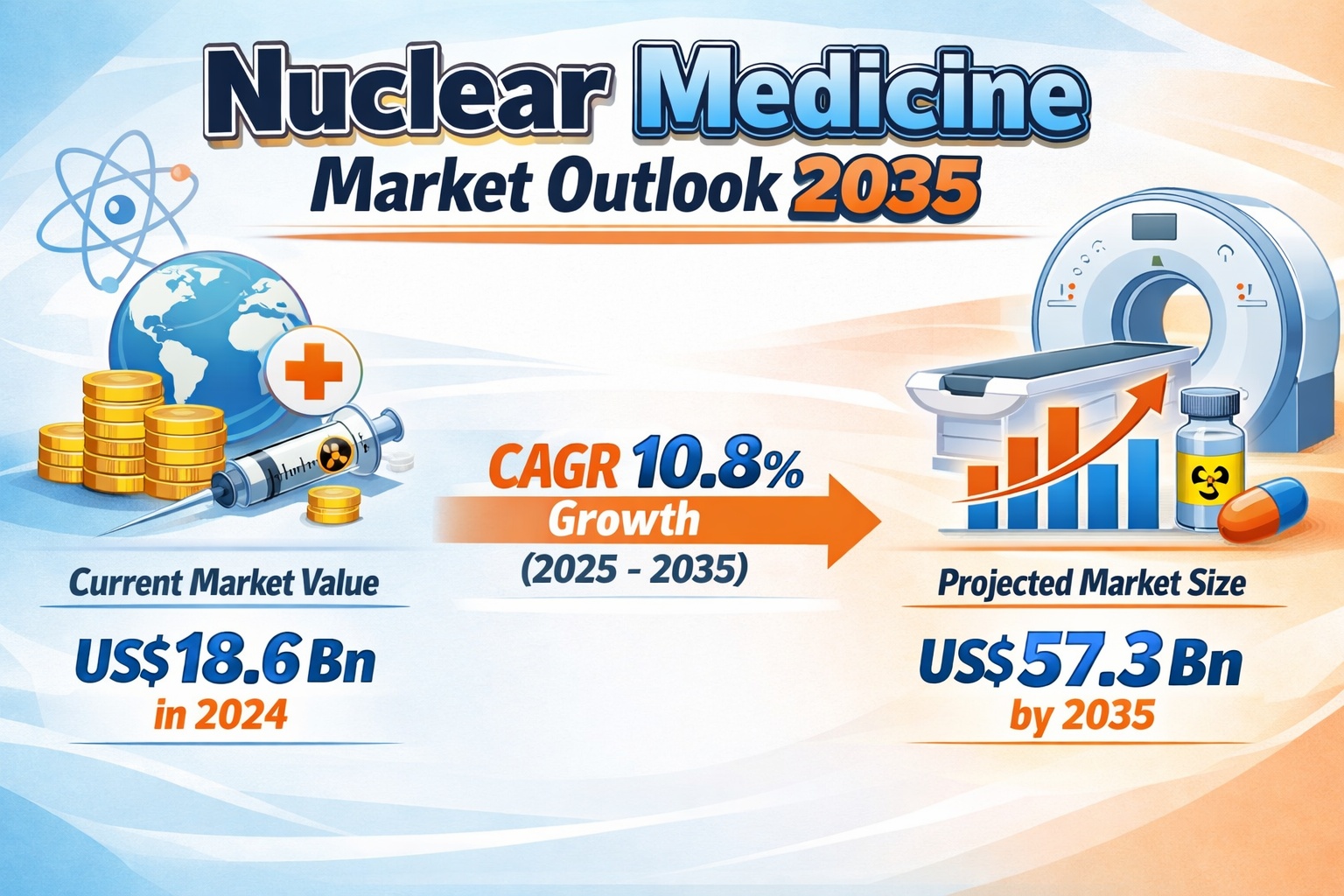
The global nuclear medicine market is witnessing robust expansion as healthcare systems increasingly adopt advanced diagnostic and therapeutic technologies. According to recent industry analysis, the global nuclear medicine market was valued at US$ 18.6 billion in 2024 and is projected to grow significantly to US$ 57.3 billion by the end of 2035. During the forecast period 2025 to 2035, the market is expected to expand at a compound annual growth rate (CAGR) of 10.8%.
The strong growth trajectory reflects the rising demand for early and accurate disease diagnosis, technological advancements in imaging equipment, and the increasing application of radiopharmaceuticals in both diagnostics and targeted therapy. Nuclear medicine is becoming an essential component of modern healthcare systems, particularly for diagnosing and treating complex diseases such as cancer, cardiovascular disorders, and neurological conditions.
Increasing investment in healthcare infrastructure, especially in emerging economies, along with growing adoption of hybrid imaging systems, is further contributing to the rapid expansion of the nuclear medicine industry worldwide.
Get a concise overview of key insights from our Report in this sample –
https://www.transparencymarketresearch.com/sample/sample.php?flag=S&rep_id=4672
Market Overview
Nuclear medicine is a specialized medical imaging field that utilizes radiopharmaceuticals (radioactive substances) to diagnose and treat various diseases. These substances are administered to patients in small quantities and allow physicians to observe the functioning of tissues and organs in real time.
Unlike conventional imaging methods that primarily display anatomical structures, nuclear medicine provides functional imaging, enabling doctors to detect abnormalities at a very early stage. This capability is particularly important in detecting diseases such as cancer, cardiovascular disorders, and neurological conditions before they become more severe.
Two of the most widely used imaging technologies in nuclear medicine include:
-
Positron Emission Tomography (PET)
-
Single Photon Emission Computed Tomography (SPECT)
These technologies allow healthcare professionals to assess biological processes in the body and develop accurate treatment plans.
In addition to diagnostic imaging, nuclear medicine is increasingly used in targeted radionuclide therapy, where radioactive isotopes are used to selectively destroy cancer cells while minimizing damage to surrounding healthy tissues. Continuous research in radiopharmaceutical development and imaging technologies is expanding the scope of nuclear medicine, making it an integral part of personalized and precision medicine.
Key Market Growth Drivers
Growing Adoption of Hybrid Imaging Systems
One of the most significant factors driving the growth of the nuclear medicine market is the increasing adoption of hybrid imaging systems, such as PET/CT and SPECT/CT scanners. These systems combine functional imaging from nuclear medicine with anatomical imaging from computed tomography (CT), offering comprehensive diagnostic insights.
Hybrid imaging technologies improve diagnostic accuracy by providing detailed information about both the structure and function of organs and tissues. This enables physicians to identify diseases earlier, determine their exact location, and design more effective treatment strategies.
Healthcare facilities across the globe are investing heavily in these advanced systems to improve diagnostic capabilities and enhance patient outcomes.
Increasing Demand for Early and Accurate Diagnosis
The global healthcare industry is increasingly focusing on early disease detection to improve treatment success rates and reduce healthcare costs. Nuclear medicine plays a crucial role in identifying diseases in their early stages, particularly cancer, heart disease, and neurological disorders.
The growing awareness among patients and healthcare providers about the benefits of early diagnosis has significantly increased the demand for nuclear imaging procedures.
Rising Prevalence of Chronic Diseases
The growing prevalence of chronic diseases worldwide is another key factor fueling market growth. Conditions such as cancer, cardiovascular diseases, and neurodegenerative disorders require accurate diagnostic tools and targeted treatment approaches.
Nuclear medicine technologies enable physicians to monitor disease progression, evaluate treatment response, and tailor therapies based on individual patient needs.
Expanding Geriatric Population
The global population is aging rapidly, and elderly individuals are more prone to chronic diseases that require frequent diagnostic imaging and monitoring. This demographic trend is expected to significantly increase the demand for nuclear medicine procedures over the coming decade.
Analysis of Key Players – Key Player Strategies
The global nuclear medicine market is highly competitive, with several prominent companies actively investing in innovation, strategic partnerships, and product development to strengthen their market positions.
Major companies operating in the market include:
-
Cardinal Health
-
Jubilant Pharma Company
-
The Bracco Group
-
Nordion (Canada) Inc.
-
NTP Radioisotopes SOC Ltd.
-
ECZACIBAŞI-MONROL
-
Lantheus
-
China Isotope & Radiation Corporation
-
Eckert & Ziegler Medical
-
Mallinckrodt plc
-
GE HealthCare
-
Blue Earth Diagnostics
-
NorthStar Medical Radioisotopes, LLC
-
B. J. Madan & Co
-
Curium Pharma
-
Novartis AG
-
Bayer AG
These companies are focusing on expanding their product portfolios, enhancing research and development activities, and entering strategic collaborations to improve diagnostic and therapeutic solutions.
Key players are also investing in radiopharmaceutical innovation, which plays a crucial role in nuclear medicine imaging and therapy. The development of new isotopes and targeted therapies is expected to create significant growth opportunities in the coming years.
Market Challenges & Opportunities
Despite strong growth prospects, the nuclear medicine market faces several challenges that could potentially limit its expansion.
Regulatory Challenges
Radiopharmaceuticals and nuclear imaging technologies are subject to strict regulatory approvals due to safety concerns associated with radioactive materials. Complex regulatory frameworks can delay product approvals and market entry for new technologies.
High Cost of Nuclear Medicine Procedures
Nuclear imaging systems and radiopharmaceutical production involve significant costs. The high price of equipment and diagnostic procedures can limit adoption, particularly in developing countries with constrained healthcare budgets.
Limited Availability of Radioisotopes
The production and distribution of radioisotopes require specialized facilities and strict safety protocols. Shortages of certain isotopes, such as Technetium-99m, can disrupt supply chains and affect diagnostic procedures.
However, these challenges also present opportunities for innovation. Advances in isotope production technology, alternative radiopharmaceutical development, and increased government investment in nuclear medicine infrastructure are expected to help overcome these barriers.
Key Player Strategies
Leading companies in the nuclear medicine market are implementing several strategic initiatives to strengthen their global presence.
-
Research and Development Investments
Companies are investing heavily in R&D to develop innovative radiopharmaceuticals and imaging technologies that offer improved diagnostic accuracy and treatment outcomes. -
Strategic Partnerships and Collaborations
Partnerships with research institutions, hospitals, and biotechnology firms enable companies to accelerate product development and expand their technological capabilities. -
Geographic Expansion
Market leaders are expanding their presence in emerging markets across Asia Pacific and Latin America, where healthcare infrastructure development and increasing disease prevalence are driving demand for advanced diagnostic solutions. -
Product Portfolio Expansion
Firms are continuously introducing new radiopharmaceuticals and imaging solutions to address diverse medical conditions and strengthen their competitive positions.
Recent Developments
In June 2025, GE HealthCare received U.S. FDA’s approval for its Vizamyl PET imaging agent for beta-amyloid detection. The updated label expands indications, facilitates quantitative analysis, and removes limitations such as monitoring patient response to anti-amyloid therapy. This improves diagnostic confidence and allows for precise treatment strategies.
In March 2025, Actinium Pharmaceuticals announced ATNM-400, a novel, non-PSMA targeting, first-in-class radiotherapy for prostate cancer. The ATNM-400 targets a different marker than Pluvicto, which is overexpressed in prostate cancer patients.
Investment Landscape and ROI Outlook
The nuclear medicine industry presents significant investment opportunities due to its strong growth potential and increasing importance in modern healthcare.
Investors are particularly interested in companies developing innovative radiopharmaceuticals, advanced imaging systems, and targeted radionuclide therapies. These technologies are expected to transform disease diagnosis and treatment, creating substantial long-term value.
The increasing adoption of personalized medicine and precision oncology is further enhancing the investment attractiveness of the nuclear medicine market. Venture capital firms and healthcare investors are actively funding research initiatives focused on novel isotopes and targeted therapies.
With a projected CAGR of 10.8%, the nuclear medicine market offers promising returns for stakeholders investing in advanced imaging technologies and radiopharmaceutical development.
Market Segmentations
The nuclear medicine market is segmented based on product type, application, end-user, and region.
By Product Type
-
Diagnostics Products
-
SPECT
-
Technetium-99m (TC-99m)
-
Thallium-201 (Tl-201)
-
Gallium-67 (GA-67)
-
Iodine-123 (I-123)
-
-
PET
-
Fluorine-18 (F-18)
-
Rubidium-82 (Rb-82)/Strontium-82 (Sr-82)
-
Nitrogen-13 (N-13)
-
-
Others (In-vitro Diagnostic Kits)
-
-
Therapeutic Products
-
Alpha Emitters
-
Beta Emitters
-
Brachytherapy
-
By Application
-
Cardiology
-
Neurology
-
Oncology
-
Thyroid
-
Lymphoma
-
Bone Metastasis
-
Endocrine Tumor
-
Others
By End-user
-
Hospitals and Clinics
-
Diagnostic Centers
-
Research Laboratories
By Region
-
North America
-
Europe
-
Asia Pacific
-
Latin America
-
Middle East & Africa
Among these regions, North America currently dominates the global nuclear medicine market, driven by advanced healthcare infrastructure, strong research capabilities, and widespread adoption of innovative imaging technologies.
Why Buy This Report?
This comprehensive nuclear medicine market report provides valuable insights for stakeholders, healthcare organizations, and investors.
Key benefits include:
-
Detailed analysis of global market size, growth trends, and forecasts
-
In-depth evaluation of market drivers, challenges, and opportunities
-
Comprehensive segmentation analysis across products, applications, and regions
-
Strategic insights into key industry players and their competitive strategies
-
Coverage of recent technological developments and innovations
-
Investment outlook and ROI analysis for market participants
The report serves as a valuable resource for organizations seeking to understand the evolving dynamics of the nuclear medicine industry and identify emerging growth opportunities.
FAQs
1. What is the current size of the global nuclear medicine market?
The global nuclear medicine market was valued at US$ 18.6 billion in 2024.
2. What is the expected market size by 2035?
The market is projected to reach US$ 57.3 billion by 2035.
3. What is the CAGR of the nuclear medicine market during the forecast period?
The market is expected to grow at a CAGR of 10.8% from 2025 to 2035.
4. Which region leads the nuclear medicine market?
North America currently holds the largest share of the global nuclear medicine market.
5. What are the key technologies used in nuclear medicine imaging?
The primary imaging technologies include Positron Emission Tomography (PET) and Single Photon Emission Computed Tomography (SPECT).
Leave a Reply