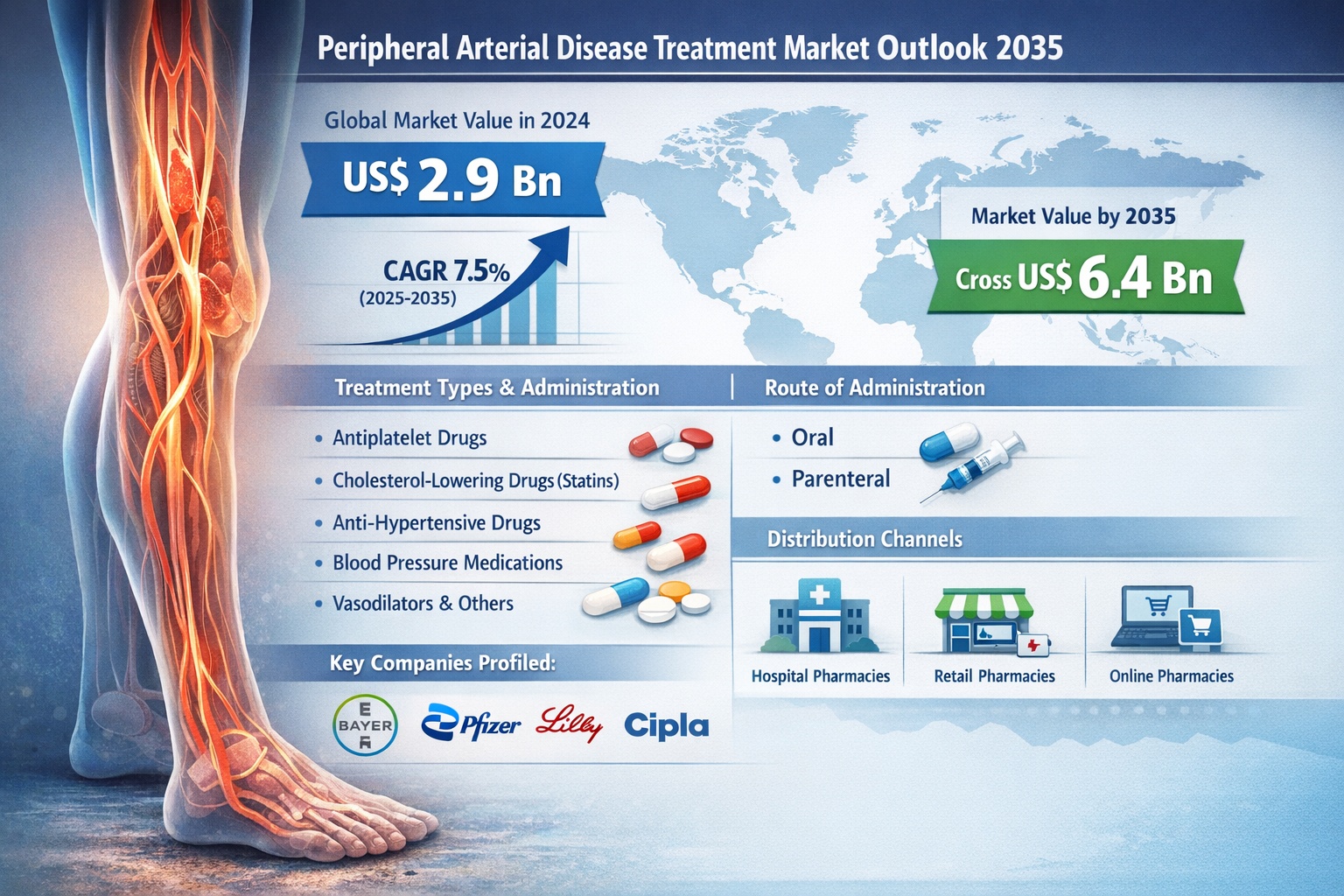
The global Peripheral Arterial Disease (PAD) treatment market is poised for significant and sustained growth over the next decade, supported by rising disease prevalence, advancements in drug development, and increasing awareness about early diagnosis. Valued at US$ 2.9 Bn in 2024, the market is projected to expand at a CAGR of 7.5% from 2025 to 2035, crossing US$ 6.4 Bn by the end of 2035.
Peripheral Arterial Disease is a chronic circulatory condition characterized by narrowed or blocked arteries that reduce blood flow to the limbs, most commonly the legs. With growing incidences of diabetes, obesity, hypertension, and smoking worldwide, PAD has become a major public health concern. Early detection and effective pharmaceutical intervention are becoming central strategies in reducing complications such as critical limb ischemia and amputation.
Access key findings and insights from our Report in this sample – https://www.transparencymarketresearch.com/sample/sample.php?flag=S&rep_id=86559
Market Overview
Peripheral Arterial Disease occurs primarily due to atherosclerosis—the buildup of fatty plaques in arterial walls. The condition often manifests as leg pain, cramping, or fatigue during physical activity (claudication). In severe cases, patients may experience chronic rest pain, non-healing ulcers, gangrene, and eventual limb amputation.
Beyond limb-related complications, PAD serves as an indicator of systemic atherosclerosis, significantly increasing the risk of heart attack and stroke. Therefore, early diagnosis and therapeutic intervention are essential not only for limb preservation but also for cardiovascular risk reduction.
The PAD treatment market encompasses various drug classes, including:
- Antiplatelet drugs
- Cholesterol-lowering drugs (statins)
- Anti-hypertensive drugs
- Blood pressure medications
- Vasodilators
- Other supportive therapies
With expanding healthcare infrastructure and improved patient access to medication, the global PAD treatment industry is steadily advancing.
Key Drivers of Market Growth
- Growing Awareness and Early Diagnosis
One of the most important drivers of the PAD treatment market is increased awareness among healthcare professionals and patients. Screening programs, cardiovascular risk assessments, and educational campaigns are helping identify PAD at earlier stages.
Early diagnosis enables timely intervention using medications such as antiplatelets, statins, and vasodilators. This reduces disease progression, lowers complication rates, and enhances patient quality of life. As a result, the number of diagnosed cases is rising, directly boosting demand for PAD treatment drugs.
- Rising Prevalence of Risk Factors
The global increase in lifestyle-related disorders—particularly diabetes, obesity, hypertension, and smoking—has significantly elevated the incidence of PAD. Aging populations, especially in developed regions, further contribute to disease burden.
Since PAD is more common in older adults, demographic shifts toward elderly populations are expected to sustain long-term market growth.
- Advancements in Drug Development
Continuous research and development in the pharmaceutical industry are leading to more effective, targeted, and safer drugs for PAD management.
New-generation antiplatelet agents and cholesterol-lowering medications are designed to provide stronger platelet inhibition and better plaque stabilization while minimizing side effects. Innovations in drug delivery systems, including extended-release formulations and targeted therapies, are improving patient adherence and therapeutic outcomes.
Successful clinical trials and regulatory approvals of novel therapies are enhancing confidence among healthcare providers and patients alike, strengthening market expansion.
Key Players and Industry Leaders
The global Peripheral Arterial Disease treatment market is highly competitive, with several multinational pharmaceutical companies playing a prominent role. Major companies include:
- Bayer AG
- Pfizer Inc.
- Eli Lilly and Company
- Cipla
- Lupin
- Viatris Inc
- Johnson & Johnson
- Sanofi
- Novartis AG
- Amgen Inc.
- Aurobindo Pharma
- Other Prominent Players
These companies are focusing on expanding product portfolios, strengthening distribution networks, and investing heavily in research and development. Strategic collaborations, licensing agreements, and regional expansions are shaping the competitive landscape.
Recent Developments
- In June 2023, Techdow USA Inc. announced the launch of its 30mg, 40mg, 60mg, 80mg, 100mg, 120mg, and 150mg strengths of generic Enoxaparin Sodium (Preservative Free) Prefilled Syringes, a therapeutic equivalent to the reference listed drug (RLD) Lovenox (Preservative Free) from Sanofi-Aventis US LLC. Enoxaparin, a low molecular weight heparin (LMWH), is an anticoagulant that helps to prevent thrombosis. Thrombosis is the formation of a blood clot within blood vessels that limits the flow of blood
- In July 2020, Apotex Inc., Canada’s leading pharmaceutical manufacturer of generic medicines, announced the launch of APO-Apixaban tablets, Canada’s first generic alternative to Eliquis. Apotex’s apixaban is an oral anticoagulant indicated for the prevention and treatment of harmful blood clots.
New Opportunities and Challenges
Opportunities
- Expansion in Emerging Markets
Growing healthcare infrastructure in Asia Pacific, Latin America, and parts of the Middle East & Africa is opening new revenue streams. - Combination Therapies
Ongoing clinical trials exploring dual antiplatelet therapy and combination regimens present significant growth opportunities. - Regulatory Approvals of Novel Drugs
Faster regulatory pathways for innovative cardiovascular therapies may accelerate market penetration. - Digital Health Integration
Remote monitoring and telemedicine solutions are improving chronic disease management, indirectly supporting medication adherence.
Challenges
- High cost of advanced treatment
- Long-term medication-related side effects
- Limited access to specialized treatment in developing countries
- Patient non-adherence to chronic therapy
Despite these challenges, the overall market trajectory remains positive.
Market Trends & Innovations
Dominance of Antiplatelet Drugs
Antiplatelet medications remain the leading drug type in the PAD treatment market. Aspirin continues to be widely prescribed due to its proven cardiovascular benefits and affordability.
However, advanced antiplatelet drugs such as clopidogrel and ticagrelor are gaining traction for enhanced platelet inhibition and improved patient outcomes.
Retail Pharmacies Leading Distribution
Retail pharmacies dominate the distribution channel segment due to ease of accessibility and convenience. Patients managing chronic conditions like PAD often prefer community pharmacies for medication refills and consultation.
Online pharmacies are also gradually gaining momentum, particularly in developed economies.
Shift Toward Personalized Medicine
Emerging therapies targeting specific atherosclerosis pathways represent a growing trend. Precision medicine approaches are expected to refine treatment strategies in the coming years.
Buy this Premium Research Report to gain valuable industry intelligence – https://www.transparencymarketresearch.com/checkout.php?rep_id=86559<ype=S
Market Segmentation
By Drug Type
- Antiplatelet Drugs
- Cholesterol-Lowering Drugs (Statins)
- Anti-hypertensive Drugs
- Blood Pressure Medications
- Vasodilators
- Others
By Route of Administration
- Oral
- Parenteral
By Distribution Channel
- Hospital Pharmacies
- Retail Pharmacies
- Online Pharmacies
By Region
- North America
- Europe
- Asia Pacific
- Latin America
- Middle East & Africa
Key Trends for the Future
- Increased focus on preventive cardiology
- Development of safer, long-acting drug formulations
- Rising adoption of dual antiplatelet therapy
- Growth in generic drug availability
- Integration of AI in cardiovascular diagnostics
- Strategic partnerships among pharmaceutical companies
As the global population ages and chronic diseases become more prevalent, PAD treatment will remain a critical therapeutic area.
Future Outlook
The Peripheral Arterial Disease treatment market is expected to witness stable and sustained growth over the next decade. With a projected value exceeding US$ 6.4 Bn by 2035, the industry reflects strong demand driven by early diagnosis, improved therapeutic options, and expanding healthcare infrastructure.
Pharmaceutical companies investing in innovation, cost-effective therapies, and global expansion are likely to benefit significantly from emerging opportunities. While cost and accessibility challenges persist, advancements in drug development and regulatory support are expected to create a favorable growth environment.
The PAD treatment market is not only expanding in value but also evolving in sophistication—moving toward safer, more targeted, and patient-centric solutions.
Important FAQs with Answers
Q1: How big was the Peripheral Arterial Disease treatment market in 2024?
The market was valued at US$ 2.9 Bn in 2024.
Q2: How large will the market be by 2035?
It is projected to cross US$ 6.4 Bn by the end of 2035.
Q3: What is the expected CAGR during 2025–2035?
The market is expected to grow at a CAGR of 7.5%.
Q4: What are the key drivers of growth?
Growing awareness and early diagnosis, advancements in drug development, and rising prevalence of diabetes, obesity, and hypertension.
Q5: Which region dominates the market?
North America is expected to account for the largest share during the forecast period.
Q6: Who are the leading players?
Bayer AG, Pfizer Inc., Eli Lilly and Company, Cipla, Lupin, Viatris Inc., Johnson & Johnson, Sanofi, Novartis AG, Amgen Inc., and Aurobindo Pharma, among others.
More Related Reports-
Skin Antiseptic Market: https://www.transparencymarketresearch.com/skin-antiseptic-market.html
Influenza Vaccine Market: https://www.transparencymarketresearch.com/influenza-vaccine-market.html
Lactated Ringers Injection Market: https://www.transparencymarketresearch.com/lactated-ringers-injection-market.html
Neonatal Toxicology Market: https://www.transparencymarketresearch.com/neonatal-toxicology-market.html
About Us Transparency Market Research
Transparency Market Research, a global market research company registered at Wilmington, Delaware, United States, provides custom research and consulting services. The firm scrutinizes factors shaping the dynamics of demand in various markets. The insights and perspectives on the markets evaluate opportunities in various segments. The opportunities in the segments based on source, application, demographics, sales channel, and end-use are analysed, which will determine growth in the markets over the next decade.
Our exclusive blend of quantitative forecasting and trends analysis provides forward-looking insights for thousands of decision-makers, made possible by experienced teams of Analysts, Researchers, and Consultants. The proprietary data sources and various tools & techniques we use always reflect the latest trends and information. With a broad research and analysis capability, Transparency Market Research employs rigorous primary and secondary research techniques in all of its business reports.
Contact Us
Transparency Market Research Inc.
CORPORATE HEADQUARTER DOWNTOWN,
1000 N. West Street,
Suite 1200, Wilmington, Delaware 19801 USA
Tel: +1-518-618-1030
USA – Canada Toll Free: 866-552-3453
Leave a Reply