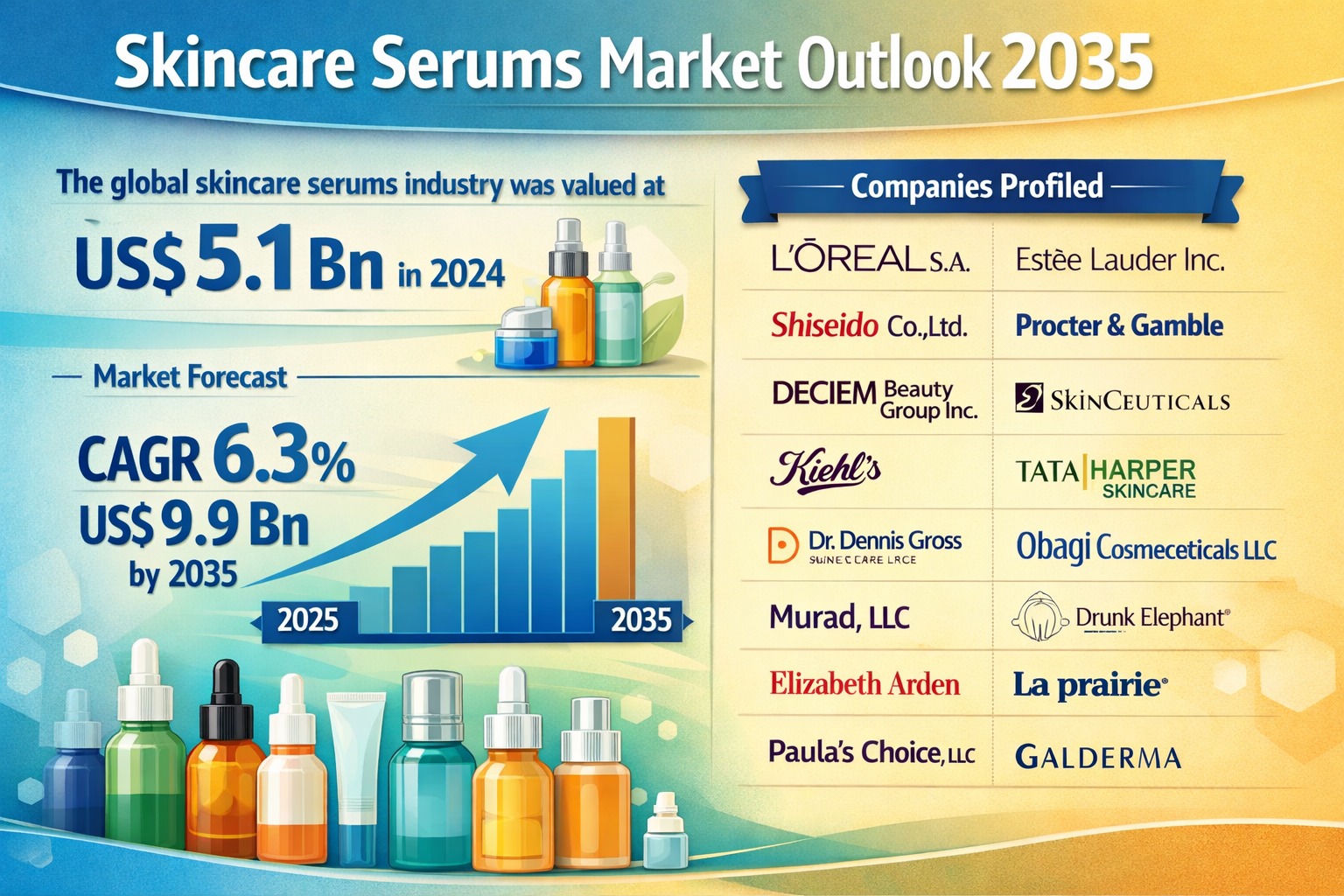
The global skincare serums market was valued at US$ 5.1 billion in 2024 and is projected to reach over US$ 9.9 billion by 2035, expanding at a compound annual growth rate (CAGR) of 6.3% from 2025 to 2035. This steady growth trajectory reflects the increasing consumer shift toward high-performance, targeted skincare solutions.
Between 2020 and 2023, the market demonstrated consistent resilience, supported by rising skincare awareness and the expansion of digital retail channels. By 2030, the market is expected to surpass approximately US$ 7.6 billion, indicating strong mid-term momentum.
→Discover Market Opportunities – Request Your Sample Copy Now: https://www.transparencymarketresearch.com/sample/sample.php?flag=S&rep_id=78457
Market Overview
Skincare serums are lightweight, highly concentrated formulations designed to deliver active ingredients deep into the skin. These products typically contain potent components such as hyaluronic acid, vitamin C, niacinamide, peptides, and retinol, targeting concerns like hydration, aging, acne, and hyperpigmentation.
Their rapid absorption and high efficacy make serums a core component of modern skincare routines. Applied after cleansing and before moisturizing, they provide visible improvements in skin texture, brightness, and elasticity.
Technological advancements in formulation—such as microencapsulation and stabilized actives—have enhanced serum performance, making them suitable for diverse skin types. Today’s serums are not only more effective but also more customizable, aligning with evolving consumer expectations for personalized skincare.
Key Market Growth Drivers
- Rising Consumer Awareness
Consumers are increasingly informed about skincare ingredients and their benefits. Social media platforms and dermatological education have popularized actives like vitamin C and peptides, driving demand for evidence-based products.
- Aging Global Population
Demographic shifts, particularly the growing aging population, are significantly boosting demand for anti-aging solutions. Serums are widely preferred due to their targeted action and clinical efficacy.
- Increasing Disposable Incomes
Higher income levels enable consumers to invest in premium skincare products. Serums, often perceived as high-value treatments, benefit from this trend, especially in emerging economies.
- Technological Advancements in Formulation
Innovations such as peptide delivery systems, biotechnology-derived actives, and exosome-inspired ingredients are enhancing product performance and safety.
- Expansion of E-commerce and DTC Channels
Direct-to-consumer models, subscription services, and rapid international distribution have significantly reduced time-to-market for new serum products.
Analysis of Key Players – Key Player Strategies
Leading companies such as L’OREAL S.A., Estée Lauder Inc., Shiseido Co., Ltd., Procter & Gamble, and GALDERMA are focusing on several strategic pillars:
- R&D Investment: Continuous innovation in active ingredients and formulation technologies
- Clinical Validation: Building consumer trust through scientifically proven results
- Sustainability: Adoption of refillable packaging and eco-friendly manufacturing
- Digital Engagement: Leveraging influencer marketing and social commerce
- Product Diversification: Offering both luxury and affordable product lines
These strategies enable companies to maintain competitive positioning while addressing diverse consumer segments globally.
Market Challenges & Opportunities
Challenges
- High Product Costs: Premium serums may limit adoption in price-sensitive markets
- Ingredient Sensitivity Issues: Potent actives can cause irritation, requiring careful formulation
- Regulatory Compliance: Increasing scrutiny on ingredient safety and claims
- Market Saturation: Growing number of brands intensifies competition
Opportunities
- Personalized Skincare Solutions: AI-driven diagnostics and customized serum blends
- Biotechnology Integration: Use of lab-grown actives and growth factors
- Sustainable Packaging: Refillable and recyclable packaging innovations
- Emerging Markets Expansion: Rapid growth potential in Asia Pacific and Latin America
→Explore Strategies & Trends – Request Full Report Access – https://www.transparencymarketresearch.com/sample/sample.php?flag=S&rep_id=78457
Key Player Strategies
Market leaders are increasingly adopting omnichannel retail strategies, combining online platforms with offline presence to maximize reach. Subscription-based models and curated skincare routines are gaining traction.
Partnerships with biotech firms are enabling companies to develop next-generation active ingredients, while investments in clinical trials help validate product claims and enhance brand credibility.
Additionally, brands are focusing on minimalist, high-performance formulations, catering to consumers seeking simplicity and effectiveness in skincare routines.
Recent Developments
In July 2025, Estée Lauder’s Advanced Night Repair line was further expanded with the launch of Advanced Night Repair Eye Lift + Sculpt. This revolutionary eye serum had been clinically shown to lift, sculpt, and redefine the eye zone. With the power of Estée Lauder’s revolutionary Night Peptide and nourishing hyaluronic acid, its dermatologist-tested formula sustained nightly renewal in four zones of concern for a smoother, more sculpted appearance.
In July 2024, Galderma was marking the single American introduction of two of its new innovations in its Cetaphil line, a Vitamin C Serum, and a Ceramide Serum. 95% of the subjects in a clinical trial concurred that the Cetaphil Vitamin C Serum continued to lighten the look of skin with regular use, 93% concurred that it unveiled a healthy glow day by day, and 86% concurred that it worked well to minimize the look of dark spots. In a second clinical trial, 100% of the subjects concurred that the Cetaphil Ceramide Serum calmed irritated skin and improved the look of skin texture after four weeks.
Investment Landscape and ROI Outlook
The skincare serums market presents a high-return investment opportunity, driven by consistent demand and product innovation. Venture capital and private equity investments are increasingly flowing into clean beauty brands, biotech skincare startups, and DTC platforms.
With a projected CAGR of 6.3%, investors can expect stable long-term returns, particularly in segments like anti-aging and personalized skincare. By 2035, companies investing early in AI-driven customization and sustainable production are likely to achieve above-average ROI.
Emerging markets such as India, China, and Southeast Asia are expected to deliver double-digit growth in certain sub-segments, further enhancing investment attractiveness.
Market Segmentations
By Product Type
- Anti-Aging Serum (leading segment)
- Skin Brightening Serum
- Anti-Acne Serum
- Hydrating Serum
- Others (Exfoliating Serum, etc.)
By Skin Type
- Dry Skin
- Sensitive Skin
- Oily Skin
- Combination Skin
By Formulation
- Oil-based Serum
- Water-based Serum
- Gel-based Serum
- Emulsion Serum
- Others
By Target Demographic
- Female
- Male
By Ingredients
- Hyaluronic Acid
- Vitamin C
- Retinol (Vitamin A)
- Alpha Hydroxy Acids (AHAs)
- Vitamin E
- Peptides
- Others
By Distribution Channel
- Online (company websites, third-party platforms)
- Offline (supermarkets, drug stores, convenience stores)
By Region
- North America (Leading Region): Strong consumer base, advanced retail infrastructure, and high adoption of clinical skincare
- Europe: Mature market with focus on sustainability and premium products
- Asia Pacific: Fastest-growing region driven by rising incomes and beauty trends
- Latin America: Emerging opportunities with expanding middle class
- Middle East & Africa: Gradual growth with increasing awareness
Analysts’ Viewpoint regarding Skincare Serums Market
Analysts highlight that demographic transformation and ingredient innovation are the primary forces shaping the market. The demand for targeted treatments continues to rise as consumers prioritize effective solutions for specific skin concerns.
Advancements in formulation science—such as microencapsulation and peptide delivery systems—are enabling higher efficacy with better tolerability. Additionally, the shift toward biotechnology-derived actives and clinical validation is redefining product development standards.
The integration of social commerce, subscription models, and rapid product launches is further accelerating market expansion. Analysts predict that brands combining science-backed innovation with sustainability and personalization will dominate the market by 2035.
Why Buy This Report?
- Comprehensive analysis of market size, trends, and forecasts from 2025 to 2035
- Detailed insights into key drivers, challenges, and growth opportunities
- In-depth profiling of leading market players and their strategies
- Coverage of technological advancements and innovation trends
- Regional and segment-wise analysis for strategic decision-making
- Investment insights and ROI outlook for stakeholders
FAQs: Skincare Serums Market Outlook 2035
- How big was the global skincare serums market in 2024?
The market was valued at US$ 5.1 billion in 2024.
- What will be the market size by 2035?
It is projected to exceed US$ 9.9 billion by 2035.
- What is the expected CAGR during 2025–2035?
The market is expected to grow at a CAGR of 6.3%.
- What factors are driving market growth?
Key drivers include rising consumer awareness, aging population, increasing disposable incomes, technological advancements, and e-commerce expansion.
- Who are the major players in the market?
Leading companies include L’OREAL S.A., Estée Lauder Inc., Shiseido Co., Ltd., Procter & Gamble, DECIEM Beauty Group Inc., SkinCeuticals, Kiehl’s, TATA HARPER SKINCARE, Dr. Dennis Gross Skincare LLC, Obagi Cosmeceuticals LLC, Murad, LLC, Drunk Elephant, Elizabeth Arden, LA PRAIRIE, Paula’s Choice, LLC, and GALDERMA.
Buy Full Report Now: https://www.transparencymarketresearch.com/checkout.php?rep_id=78457<ype=S
→Explore Latest Research Reports by Transparency Market Research:
Mechanical Ventilators Market: https://www.transparencymarketresearch.com/mechanical-ventilators-market.html
Skincare Devices Market: https://www.transparencymarketresearch.com/skincare-devices-market.html
Diagnostic Catheters Market: https://www.transparencymarketresearch.com/diagnostic-catheter-market.html
About Transparency Market Research
Transparency Market Research, a global market research company registered at Wilmington, Delaware, United States, provides custom research and consulting services. Our exclusive blend of quantitative forecasting and trends analysis provides forward-looking insights for thousands of decision makers. Our experienced team of Analysts, Researchers, and Consultants use proprietary data sources and various tools & techniques to gather and analyses information.
Our data repository is continuously updated and revised by a team of research experts, so that it always reflects the latest trends and information. With a broad research and analysis capability, Transparency Market Research employs rigorous primary and secondary research techniques in developing distinctive data sets and research material for business reports.

Leave a Reply