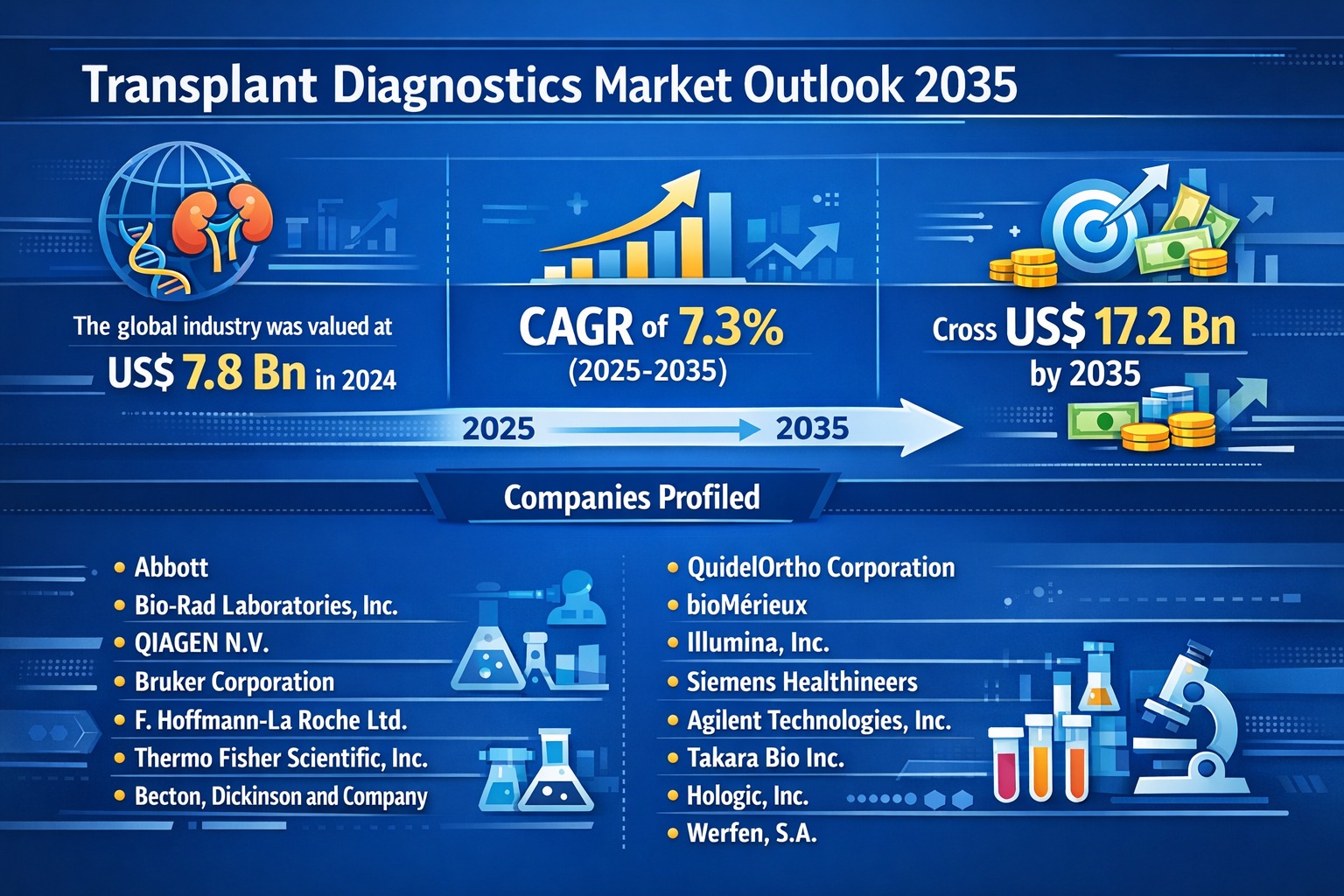
The global transplant diagnostics market was valued at US$ 7.8 Bn in 2024 and is projected to expand at a steady CAGR of 7.3% from 2025 to 2035, crossing US$ 17.2 Bn by the end of 2035. This growth trajectory reflects the rising global demand for organ transplantation, increasing technological advancements in molecular diagnostics, and expanding awareness regarding organ donation.
Historical data from 2020 to 2024 indicates a consistent rise in transplant procedures worldwide, setting a strong base for the upcoming decade. With healthcare systems increasingly adopting personalized medicine approaches, transplant diagnostics is becoming a critical component of pre- and post-transplant care protocols.
→Discover Market Opportunities – Request Your Sample Copy Now: https://www.transparencymarketresearch.com/sample/sample.php?flag=S&rep_id=20225
Analysts’ Viewpoint
Analysts observe that the transplant diagnostics industry is undergoing rapid transformation driven by technological sophistication and demographic changes. Surging organ transplant volumes, advancements in molecular diagnostics and genetic testing, biomarker identification, and increasing awareness about organ donation are key trends shaping the market.
The global aging population is a major structural driver, as age-related chronic diseases such as kidney failure, liver cirrhosis, heart disease, and diabetes significantly increase transplant demand. Supportive government policies and regulatory frameworks are further encouraging organ donation registrations and transplantation procedures.
Emerging technologies such as next-generation sequencing (NGS), molecular profiling, artificial intelligence (AI), and machine learning are improving donor-recipient matching accuracy, reducing rejection risks, and optimizing clinical workflows.
Market Introduction
Transplant diagnostics encompasses a broad range of medical testing techniques used to assess compatibility between organ donors and recipients to ensure successful transplantation. These diagnostics help identify immunological incompatibilities and reduce the likelihood of transplant rejection.
One of the most critical diagnostic tools is human leukocyte antigen (HLA) typing, which identifies specific immune-related proteins on cell surfaces. Accurate HLA matching significantly reduces graft rejection risks. Additionally, non-invasive diagnostic methods such as circulating cell-free DNA (cfDNA) testing are increasingly used to quantify donor-derived DNA in a recipient’s bloodstream, enabling real-time transplant monitoring.
Transplant diagnostics plays a vital role across organ transplantation (kidney, liver, heart, lung), tissue transplantation (corneal, skin, bone graft), and stem cell transplantation.
Key Market Growth Drivers
Rising Incidence of Organ Transplants
The increasing number of organ transplants globally is one of the strongest growth catalysts. According to data from the Organ Procurement and Transplantation Network (OPTN), 48,149 organ transplants were performed in the U.S. in 2024, marking a 3.3% increase compared to 2023 and a 23.3% increase over the past five years.
With aging populations and rising chronic disease prevalence, transplant demand continues to surge. Each transplant procedure requires comprehensive compatibility testing, organ viability assessment, and post-transplant monitoring—directly boosting demand for advanced diagnostic technologies.
Increasing Awareness and Acceptance of Organ Donation
Public awareness campaigns led by governments, healthcare organizations, and non-profits are transforming organ donation perceptions. As more individuals register as donors, the donor pool expands, creating greater demand for sophisticated diagnostic solutions.
Digital health platforms and social media campaigns are amplifying outreach efforts, further normalizing organ donation as a civic responsibility. This cultural shift is indirectly strengthening the transplant diagnostics market.
Technological Advancements in Molecular Diagnostics
The integration of NGS, PCR, molecular assays, and biomarker-based detection has significantly improved transplant success rates. Molecular assays, in particular, dominate the industry due to their sensitivity and specificity in identifying infectious agents and rejection risks.
Artificial intelligence and machine learning are being incorporated into diagnostic workflows to enhance data interpretation and risk prediction models.
Recent Developments (RD – As Provided)
In October 2024, QIAGEN announced key updates to its sample technologies solution, EZ2 Connect platform, for non-invasive liquid biopsy applications for use in research and clinical applications such as oncology, prenatal care, and organ transplantation. The EZ1&2 ccfDNA Kit has been upgraded to support fully automatic simultaneous processing of a maximum number of 24 samples of 10 ml serum or plasma and a new provided urine protocol. The company also introduced QIAsymphony DSP Circulating DNA Kit (96) and the QIAsymphony DSP Circulating DNA Maxi Kit (192), automated systems specifically designed for the isolation of ccfDNA from a maximum volume of 10ml.
In July 2024, Thermo Fisher Scientific released a new pre-transplant risk assessment assay from its CLIA laboratory in Fishers, Ind. The newly launched assay quantifies risk of early acute rejection in kidney transplant recipients and presents data that could be used to inform a more individualized post-transplant immunosuppression regimen.
Market Challenges & Opportunities
Challenges
- High cost of advanced molecular diagnostic tests
- Regulatory complexities across countries
- Limited transplant infrastructure in low-income regions
- Risk of false positives or negatives in complex immunological profiling
Opportunities
- Expansion in emerging markets
- Development of cost-effective rapid testing kits
- AI-powered predictive diagnostics
- Growing stem cell transplantation procedures
- Increasing adoption of non-invasive cfDNA monitoring
→Explore Strategies & Trends – Request Full Report Access – https://www.transparencymarketresearch.com/sample/sample.php?flag=S&rep_id=20225
Market Segmentations (With Regional Insights)
By Product & Service
- Instruments
- Kits and Reagents
- Software and Services
The kits and reagents segment dominates the market due to its essential role in donor-recipient compatibility testing. Continuous innovation in reagent chemistry and assay automation supports segment growth.
By Technique
- Molecular Assay
- Non-molecular Assay
The molecular assay segment holds the majority share, driven by increasing adoption of PCR, NGS, and molecular profiling technologies.
By Transplant Type
- Organ Transplant (Kidney, Liver, Heart, Lung, Others)
- Tissue Transplant (Corneal, Skin, Bone Graft, Cartilage, Others)
- Stem Cell Transplant
Kidney transplantation represents a significant share due to its high global procedure volume.
By Screening Type
- Pre-Transplant Diagnostics
- Post-Transplant Diagnostics
Pre-transplant diagnostics account for a major portion, while post-transplant monitoring is gaining traction with cfDNA-based tests.
By End-user
- Hospitals
- Transplant Centers
- Research Laboratories
- Others
Hospitals and transplant centers dominate due to increasing procedure volumes.
Regional Outlook
North America led the global transplant diagnostics market in 2024. The region benefits from:
- Advanced healthcare infrastructure
- High R&D investment
- Strong transplant networks
- Supportive regulatory frameworks
The U.S. remains the regional leader due to its established transplant ecosystem and high adoption of cutting-edge diagnostic solutions.
Europe follows closely, supported by strong public healthcare systems in Germany, the U.K., France, Italy, and Spain.
Asia Pacific is expected to witness the fastest growth during the forecast period, driven by expanding healthcare infrastructure in China, India, and Japan.
Latin America and Middle East & Africa are emerging markets with improving transplant program frameworks.
Analysis of Key Players – Strategies and Competitive Landscape
Leading companies are focusing on strategic collaborations, R&D expansion, and geographic penetration into emerging markets.
Prominent players include:
- Abbott
- Bio-Rad Laboratories, Inc.
- QIAGEN N.V.
- Bruker Corporation
- F. Hoffmann-La Roche Ltd.
- Thermo Fisher Scientific, Inc.
- Becton, Dickinson and Company
- QuidelOrtho Corporation
- bioMérieux
- Illumina, Inc.
- Siemens Healthineers
- Agilent Technologies, Inc.
- Takara Bio Inc.
- Hologic, Inc.
- Werfen, S.A.
- DiaSorin S.p.A.
Key Player Strategies
- Launch of advanced molecular assays
- Automation of diagnostic platforms
- Strategic mergers and acquisitions
- Geographic expansion into Asia Pacific and Latin America
- Partnerships with transplant centers and research institutions
- Integration of AI-powered analytics
Investment Landscape and ROI Outlook
The transplant diagnostics market presents a compelling investment opportunity due to:
- Stable CAGR of 7.3% over 10 years
- Strong recurring revenue model via reagents and kits
- High barriers to entry due to regulatory and technological complexity
- Increasing transplant volumes globally
Venture capital and private equity investments are flowing into molecular diagnostics startups focusing on biomarker discovery and AI-based transplant monitoring tools.
Long-term ROI prospects remain strong as transplant diagnostics becomes embedded in standard clinical protocols.
Why Buy This Report?
- Comprehensive analysis from 2020–2035
- Detailed segmentation by product, technique, transplant type, and region
- In-depth competitive landscape and company profiling
- Strategic insights into mergers, partnerships, and innovation trends
- Forecast modeling with quantitative data in US$ Bn
- Actionable insights for investors, manufacturers, and healthcare providers
The report is available in Electronic (PDF) + Excel format, with customization scope available upon request.
Frequently Asked Questions (FAQs)
Q.How big was the global transplant diagnostics market in 2024?
A.The market was valued at US$ 7.8 Bn in 2024.
Q.How large will the transplant diagnostics industry be by 2035?
A.It is projected to exceed US$ 17.2 Bn by the end of 2035.
Q.What is driving market growth?
A.Rising incidence of organ transplants, increasing awareness of organ donation, and technological innovations in molecular diagnostics are the primary growth drivers.
Q.What is the expected CAGR during 2025–2035?
A.The market is anticipated to grow at a CAGR of 7.3%.
Q.Who are the prominent players in the transplant diagnostics market?
A.Major companies include Abbott, Bio-Rad Laboratories, Inc., QIAGEN N.V., Bruker Corporation, F. Hoffmann-La Roche Ltd., Thermo Fisher Scientific, Inc., Becton, Dickinson and Company, QuidelOrtho Corporation, bioMérieux, Illumina, Inc., Siemens Healthineers, Agilent Technologies, Inc., Takara Bio Inc., Hologic, Inc., Werfen, S.A., and DiaSorin S.p.A.
Buy Full Report Now: https://www.transparencymarketresearch.com/checkout.php?rep_id=20225<ype=S
→Explore Latest Research Reports by Transparency Market Research:
Fetal Doppler Market: https://www.transparencymarketresearch.com/fetal-doppler-market.html
Digital Diagnostics Market: https://www.transparencymarketresearch.com/digital-diagnostics-market-report.html
Cancer Biomarkers Market: https://www.transparencymarketresearch.com/cancer-biomarkers-market.html
About Transparency Market Research
Transparency Market Research, a global market research company registered at Wilmington, Delaware, United States, provides custom research and consulting services. Our exclusive blend of quantitative forecasting and trends analysis provides forward-looking insights for thousands of decision makers. Our experienced team of Analysts, Researchers, and Consultants use proprietary data sources and various tools & techniques to gather and analyses information.
Our data repository is continuously updated and revised by a team of research experts, so that it always reflects the latest trends and information. With a broad research and analysis capability, Transparency Market Research employs rigorous primary and secondary research techniques in developing distinctive data sets and research material for business reports.
Leave a Reply