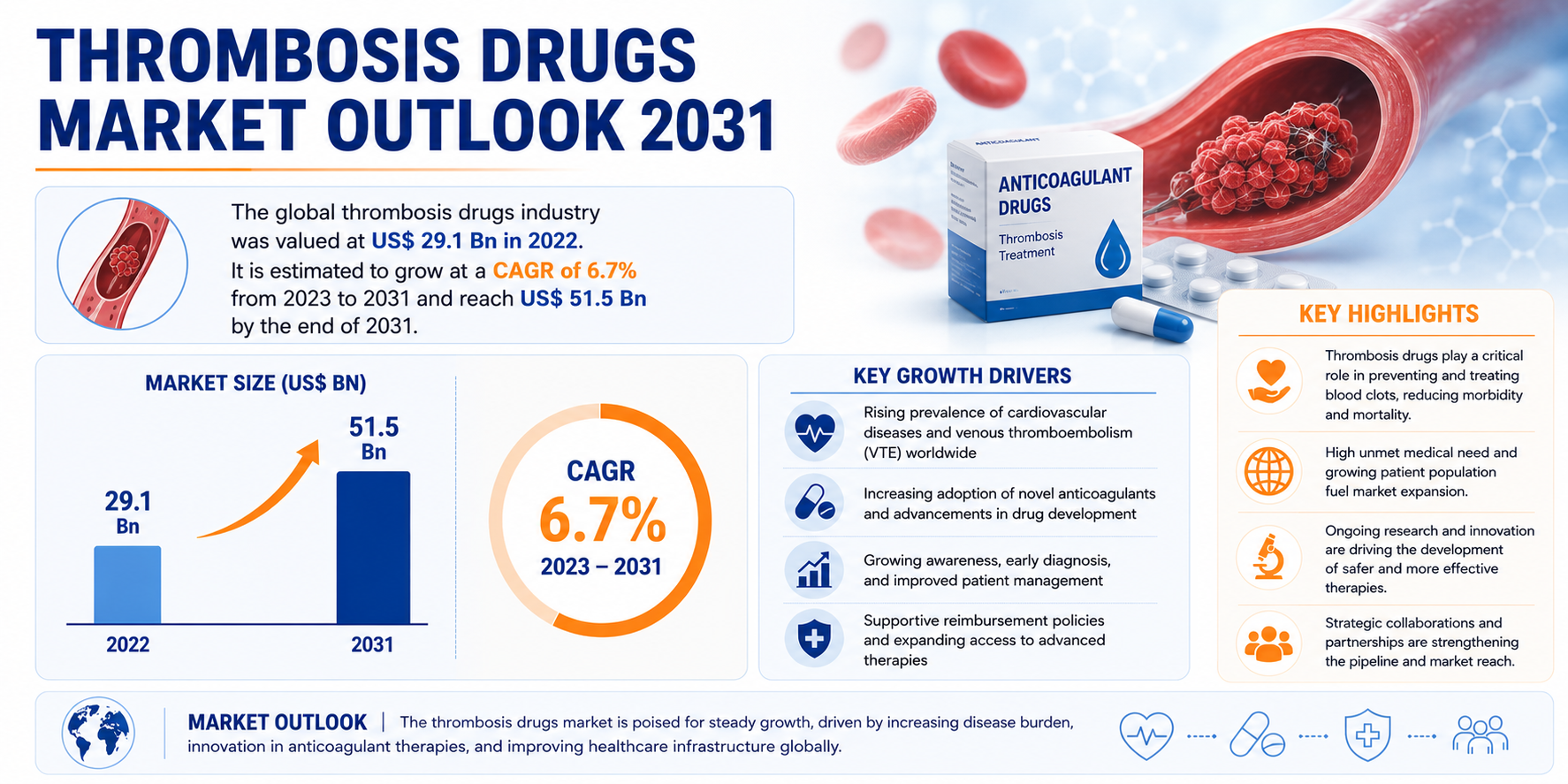
The global thrombosis drugs market is poised for substantial expansion as the prevalence of thrombotic disorders, cardiovascular diseases, and aging-related health complications continues to rise worldwide. According to recent industry analysis, the market, valued at US$ 29.1 billion in 2022, is projected to grow at a CAGR of 6.7% from 2023 to 2031, reaching approximately US$ 51.5 billion by the end of the forecast period.
The market growth is being fueled by increasing awareness regarding early diagnosis and treatment of thrombosis, advancements in anticoagulant therapies, and the development of next-generation anti-clotting agents with improved safety profiles. Pharmaceutical companies are increasingly investing in research and development activities to launch innovative oral anticoagulants and antiplatelet therapies designed to improve patient outcomes and reduce treatment-associated risks.
Review critical insights and findings from our Report in this sample –
https://www.transparencymarketresearch.com/sample/sample.php?flag=S&rep_id=46293
Market Size
The thrombosis drugs market has witnessed consistent growth over the last decade due to the increasing incidence of deep vein thrombosis (DVT), pulmonary embolism (PE), atrial fibrillation, and other blood clot-related disorders. In 2022, the market was valued at US$ 29.1 billion and is expected to attain US$ 51.5 billion by 2031.
The anticipated growth trajectory reflects increasing healthcare expenditure, improved diagnostic capabilities, and rising adoption of novel oral anticoagulants (NOACs). Demand for thrombosis drugs is especially high in developed healthcare markets where cardiovascular disease prevalence continues to rise among aging populations.
The growing burden of obesity, sedentary lifestyles, smoking, diabetes, hypertension, and chronic cardiovascular disorders is also contributing significantly to the expanding patient pool requiring thrombosis management therapies.
Market Overview
Thrombosis refers to the formation of blood clots within blood vessels, restricting normal blood flow. The condition can occur in arteries or veins, leading to serious complications such as stroke, pulmonary embolism, myocardial infarction, and deep vein thrombosis.
The market comprises several drug classes including factor Xa inhibitors, low molecular weight heparin (LMWH), P2Y12 platelet inhibitors, and other anticoagulants and antiplatelet agents. Among these, factor Xa inhibitors currently dominate the market due to their predictable pharmacological response, reduced monitoring requirements, and improved patient compliance.
Increasing awareness regarding thrombotic disorders and favorable reimbursement policies are driving greater treatment adoption globally. Healthcare providers are increasingly prescribing direct oral anticoagulants (DOACs) as alternatives to conventional therapies because of their superior convenience and efficacy.
Furthermore, advancements in biotechnology and precision medicine are enabling pharmaceutical manufacturers to develop safer therapeutic options with reduced bleeding risks and enhanced therapeutic effectiveness.
Key Market Growth Drivers
Rising Incidence of Thrombotic Disorders
One of the primary drivers of the thrombosis drugs market is the increasing prevalence of venous thromboembolism and cardiovascular diseases worldwide. According to healthcare estimates, hundreds of thousands of individuals are affected annually by DVT and pulmonary embolism in major economies such as the United States.
The growing incidence of thrombotic disorders among elderly individuals is creating sustained demand for anticoagulant therapies. Older adults are particularly vulnerable to blood clot formation due to reduced mobility, chronic illnesses, and age-related vascular changes.
Growth in Geriatric Population
The rapidly expanding global geriatric population is significantly contributing to market growth. By 2050, the population aged 60 years and older is expected to surpass 2.1 billion globally. Elderly individuals are at higher risk of atrial fibrillation, stroke, and venous thrombosis, thereby increasing the need for thrombosis prevention and treatment medications.
Asia Pacific and Europe are expected to witness substantial demographic shifts, leading to increased healthcare demand and thrombosis drug consumption.
Advancements in Drug Development
Technological innovations and ongoing R&D activities are revolutionizing thrombosis treatment approaches. Pharmaceutical companies are focusing on developing advanced anticoagulants with improved efficacy and lower bleeding complications.
The emergence of direct thrombin inhibitors and direct factor Xa inhibitors such as rivaroxaban, apixaban, and edoxaban has transformed thrombosis management. These drugs offer convenient oral administration and eliminate the need for continuous blood monitoring associated with traditional therapies.
Research institutions are also exploring innovative therapies such as anticoagulant aptamers and targeted biologics aimed at minimizing adverse effects while maintaining therapeutic effectiveness.
Increasing Healthcare Awareness
Improved awareness regarding early detection and treatment of thrombotic disorders is driving market demand. Public health campaigns, physician education programs, and advancements in diagnostic technologies are enabling earlier intervention and better disease management.
Patients are becoming increasingly aware of the symptoms and risks associated with blood clot formation, leading to higher treatment adoption rates.
Analysis of Key Players – Key Player Strategies
The global thrombosis drugs market is highly competitive and characterized by the presence of several multinational pharmaceutical companies focusing on product innovation, strategic collaborations, mergers, and geographic expansion.
Major companies operating in the market include:
- GSK plc
- Baxter International Inc.
- Johnson & Johnson
- Sanofi
- Bristol-Myers Squibb Company
- AstraZeneca plc
- Bayer AG
- Aspen Pharmacare Holdings Limited
- Boehringer Ingelheim GmbH
- Pfizer, Inc.
Product Innovation and R&D Investment
Leading pharmaceutical companies are heavily investing in research and development activities to introduce next-generation anticoagulants with improved efficacy and reduced side effects. Companies are prioritizing safer oral therapies that provide predictable dose responses and minimize bleeding complications.
Strategic Collaborations
Industry players are entering into collaborations with biotechnology firms, academic institutions, and healthcare organizations to accelerate drug discovery and clinical development activities. Strategic partnerships are helping companies strengthen product pipelines and expand therapeutic capabilities.
Geographic Expansion
Companies are increasingly targeting emerging healthcare markets in Asia Pacific, Latin America, and the Middle East to capitalize on rising healthcare expenditure and growing patient populations. Expansion of manufacturing and distribution networks is enabling broader market penetration.
Focus on Patient Compliance
Manufacturers are developing once-weekly and extended-release formulations to improve treatment adherence and reduce patient burden. Pediatric and elderly patient-friendly therapies are also gaining traction.
Market Challenges & Opportunities
Challenges
High Treatment Costs
Advanced anticoagulant therapies and novel biologics often involve high treatment costs, limiting accessibility in low-income and developing regions. The affordability gap remains a major challenge for market expansion.
Bleeding Risks and Side Effects
Despite therapeutic advancements, anticoagulants continue to pose bleeding risks and other adverse effects. Physicians remain cautious while prescribing these medications to high-risk patients, especially elderly individuals and those with multiple comorbidities.
Regulatory Complexity
Stringent regulatory approval processes and lengthy clinical trial requirements can delay product commercialization. Compliance with evolving healthcare regulations remains a challenge for manufacturers.
Opportunities
Emerging Markets
Developing economies present significant growth opportunities due to improving healthcare infrastructure, increasing awareness, and expanding access to advanced therapeutics.
Personalized Medicine
The emergence of precision medicine and biomarker-based therapies is expected to transform thrombosis treatment by enabling personalized anticoagulant selection and dosing strategies.
Novel Drug Platforms
Innovations in biologics, RNA therapeutics, and aptamer-based anticoagulants are expected to create new opportunities for safer and more targeted thrombosis treatments.
Key Player Strategies
Pharmaceutical companies are implementing multiple strategic initiatives to strengthen their market positions and gain competitive advantage.
Pipeline Expansion
Companies are expanding their anticoagulant and antiplatelet drug pipelines through continuous clinical research and acquisitions of innovative biotech startups.
Digital Healthcare Integration
Industry participants are leveraging digital health technologies, telemedicine, and AI-driven patient monitoring systems to improve disease management and patient engagement.
Market Penetration Through Partnerships
Strategic alliances with hospitals, healthcare providers, and government agencies are enabling companies to improve product accessibility and enhance market reach.
Investment in Clinical Trials
Major market participants continue to invest significantly in large-scale clinical trials to validate drug safety, efficacy, and expanded indications.
Recent Developments
In June 2023, pivotal data from the phase 3 XTEND-Kids study evaluating antihemophilic factor (recombinant), Fc-VWF-XTEN fusion protein (Altuviiio, Sanofi) as a once-week prophylaxis reduced bleeding episodes among younger children with severe hemophilia A, according to results from the 2023 annual meeting of the International Society on Thrombosis and Haemostasis in Montreal.
In August 2023, researchers from the University of Tokyo proposed a side effect-free anticoagulating treatment based on potent thrombin inhibitors using bivalent aptamers combined with antidotes. The therapy demonstrated promising results in preclinical studies and could advance toward human clinical trials in the coming years.
These developments highlight the industry’s growing emphasis on safer, longer-acting, and more effective anticoagulant therapies.
Investment Landscape and ROI Outlook
The thrombosis drugs market presents attractive investment opportunities due to the increasing global burden of cardiovascular diseases and thrombotic disorders. Pharmaceutical companies and investors are allocating substantial capital toward innovative anticoagulant therapies, clinical research programs, and manufacturing expansion.
The market’s stable growth trajectory and recurring demand for chronic thrombosis management therapies contribute to strong long-term revenue potential. Investors are particularly interested in companies developing oral anticoagulants, targeted biologics, and personalized treatment platforms.
North America remains a major investment hub due to advanced healthcare infrastructure and strong reimbursement frameworks. However, Asia Pacific is emerging as a high-growth investment destination because of its expanding patient population, rising healthcare spending, and increasing pharmaceutical manufacturing capabilities.
Companies focusing on innovative drug delivery systems, improved safety profiles, and strategic licensing agreements are expected to generate favorable returns on investment during the forecast period.
Market Segmentations
By Drug Class
- Factor Xa Inhibitor
- Low Molecular Weight Heparin
- P2Y12 Platelet Inhibitor
- Others
By Indication
- Pulmonary Embolism
- Atrial Fibrillation
- Deep Vein Thrombosis
- Others
By Distribution Channel
- Hospital Pharmacies
- Retail Pharmacies
- Online Pharmacies
By Region
- North America
- Latin America
- Asia Pacific
- Europe
- Middle East & Africa
Countries Covered
- United States
- Canada
- Germany
- United Kingdom
- France
- Italy
- Spain
- Russia
- China
- India
- Japan
- ASEAN
- Brazil
- Mexico
- South Africa
Why Buy This Report?
- Gain comprehensive insights into current and future thrombosis drugs market trends
- Understand key market drivers, restraints, and growth opportunities
- Analyze competitive landscape and company strategies
- Access detailed regional and country-level market forecasts
- Identify emerging investment opportunities and high-growth market segments
- Evaluate recent technological advancements and product innovations
- Obtain in-depth segmentation analysis across drug classes, indications, and distribution channels
- Support strategic business planning and investment decisions with reliable market intelligence
FAQs
1. What is the projected value of the global thrombosis drugs market by 2031?
The global thrombosis drugs market is projected to reach US$ 51.5 billion by 2031.
2. What is driving the growth of the thrombosis drugs market?
Key growth drivers include rising incidence of thrombotic disorders, aging population, sedentary lifestyles, and advancements in anticoagulant drug development.
3. Which drug class dominates the thrombosis drugs market?
Factor Xa inhibitors currently dominate the market due to their predictable dosing response and increasing physician preference for oral anticoagulants.
4. Which region holds the largest market share?
North America holds the largest market share due to high utilization of novel oral anticoagulants and favorable reimbursement policies.
5. Who are the major players in the thrombosis drugs market?
Major players include Sanofi, Pfizer, Inc., Bayer AG, Johnson & Johnson, and Bristol-Myers Squibb Company.



Leave a Reply