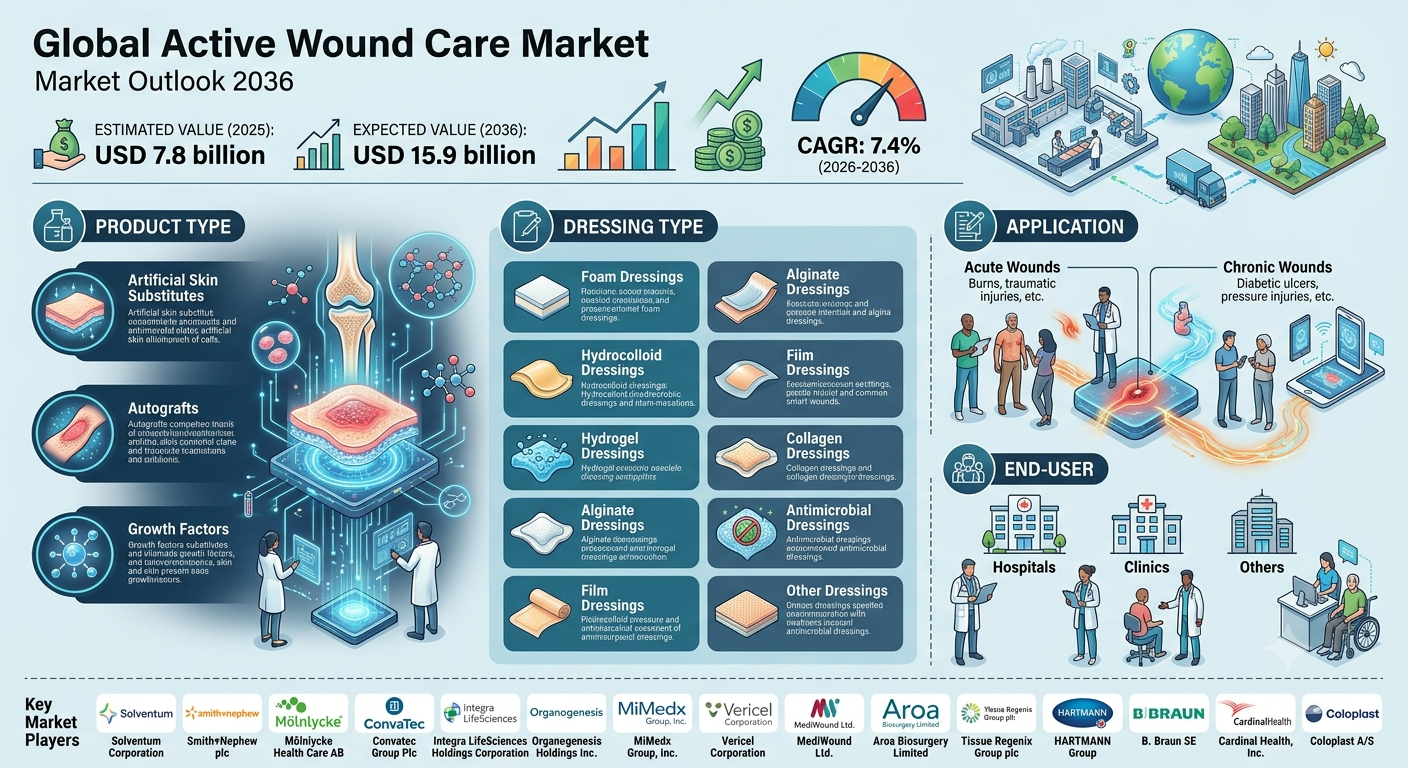
The global active wound care market is set to witness robust growth as healthcare providers increasingly adopt advanced therapies that accelerate wound healing and improve patient outcomes. The market was valued at USD 7.8 billion in 2025 and is projected to reach USD 15.9 billion by 2036, expanding at a compound annual growth rate (CAGR) of 7.4% from 2026 to 2036. Rising incidences of chronic wounds, diabetic foot ulcers, pressure ulcers, venous leg ulcers, and post-surgical wounds, coupled with the growing prevalence of diabetes and an aging global population, are driving sustained demand for advanced wound care solutions. Continued investments in regenerative medicine and biologically active wound therapies are expected to further strengthen market expansion during the forecast period.
Gain a preview of important insights from our Report in this sample –
https://www.transparencymarketresearch.com/sample/sample.php?flag=S&rep_id=85924
Market Overview
Active wound care encompasses advanced therapeutic products that actively promote tissue regeneration, cellular repair, and accelerated healing rather than simply protecting wounds. These products include artificial skin substitutes, autografts, growth factors, bioengineered tissues, regenerative matrices, and advanced wound dressings designed to stimulate the body’s natural healing processes. Active wound care solutions are extensively utilized for managing chronic wounds, acute injuries, burns, diabetic ulcers, pressure ulcers, venous leg ulcers, and surgical wounds.
The increasing adoption of regenerative medicine, tissue engineering, and personalized wound management has significantly transformed the treatment landscape. Healthcare providers are increasingly utilizing biologically active wound care products that reduce healing time, lower infection risks, and improve long-term clinical outcomes. Technological innovations in bioengineered skin substitutes, cellular therapies, collagen matrices, antimicrobial dressings, and growth factor therapies continue to enhance treatment effectiveness. Expanding healthcare infrastructure, favorable reimbursement policies in developed economies, and rising awareness regarding advanced wound management are further contributing to the widespread adoption of active wound care products across hospitals, specialty wound care centers, outpatient facilities, and home healthcare settings.
Key Market Growth Drivers
The growing burden of chronic wounds and diabetic foot ulcers remains one of the most significant factors driving the global active wound care market. Increasing prevalence of diabetes, obesity, vascular diseases, limited mobility, and age-related disorders has resulted in a substantial rise in chronic wounds that require specialized treatment. Unlike conventional wound dressings, active wound care products stimulate tissue regeneration, control inflammation, maintain optimal moisture balance, and support faster healing, making them essential components of advanced wound management.
The increasing number of surgical procedures performed worldwide is another major growth driver. Surgical wounds require effective infection prevention, moisture management, and tissue regeneration to minimize postoperative complications and improve recovery. Healthcare providers are increasingly utilizing antimicrobial dressings, collagen-based products, skin substitutes, and regenerative wound therapies to reduce surgical site infections and promote efficient wound healing. Growing emphasis on patient safety, improved clinical outcomes, and shorter hospital stays continues to accelerate the adoption of advanced wound care technologies.
Additionally, the expanding geriatric population contributes significantly to market growth, as older individuals experience delayed wound healing due to reduced immune function, impaired circulation, and chronic health conditions. Continuous advances in regenerative medicine, tissue engineering, and biologically active therapies are further expanding treatment options while improving patient outcomes across diverse wound care applications.
Analysis of Key Players – Key Player Strategies
The global active wound care market is highly competitive, with leading companies focusing on regenerative medicine, tissue engineering, product innovation, and strategic collaborations to strengthen their market positions. Major industry participants including Solventum Corporation, Smith+Nephew plc, Mölnlycke Health Care AB, Convatec Group Plc, Integra LifeSciences Holdings Corporation, Organogenesis Holdings Inc., MiMedx Group Inc., Vericel Corporation, MediWound Ltd., Aroa Biosurgery Limited, Tissue Regenix Group plc, HARTMANN Group, B. Braun SE, Cardinal Health Inc., and Coloplast A/S continue to invest heavily in research and development to introduce next-generation wound healing therapies.
Manufacturers are expanding their product portfolios through the development of bioengineered skin substitutes, cellular wound matrices, placental allografts, antimicrobial technologies, collagen-based therapies, and regenerative tissue products. Strategic acquisitions, licensing agreements, and partnerships with healthcare providers and research institutions are enabling companies to strengthen technological capabilities and accelerate commercialization. Continuous investment in clinical studies demonstrating product efficacy, regulatory approvals, and physician education programs further supports product adoption across hospitals and specialized wound care centers worldwide.
Market Challenges & Opportunities
Despite strong growth prospects, the active wound care market faces several challenges. Advanced regenerative wound care products often involve significantly higher treatment costs than conventional dressings, limiting accessibility in cost-sensitive healthcare systems. Stringent regulatory approval processes, reimbursement variability across different countries, and the need for robust clinical evidence can delay product commercialization and market expansion. In addition, limited awareness regarding advanced biologic wound therapies in certain developing regions continues to affect adoption rates.
However, the market presents substantial opportunities fueled by ongoing advancements in regenerative medicine and tissue engineering. Increasing demand for skin substitutes, acellular matrices, bioengineered tissues, placental allografts, and growth factor therapies offers significant growth potential for manufacturers. Expanding healthcare infrastructure across emerging economies, rising investments in advanced wound care research, and growing emphasis on personalized medicine are expected to create new business opportunities. Favorable reimbursement frameworks for skin substitutes and regenerative therapies in several developed markets are also likely to support broader market penetration during the forecast period.
Key Player Strategies
Industry leaders are implementing comprehensive strategies centered on innovation, product portfolio expansion, and evidence-based clinical development. Significant investments in regenerative technologies have enabled companies to develop advanced biologic wound care products capable of accelerating tissue repair while reducing complications associated with chronic wounds. Manufacturers are increasingly focusing on introducing antimicrobial dressings, collagen matrices, advanced foam dressings, engineered skin substitutes, and bioactive wound therapies that improve healing efficiency and patient outcomes.
Strategic mergers, acquisitions, collaborative research initiatives, and manufacturing capacity expansions remain central components of competitive growth strategies. Companies are also strengthening relationships with hospitals, wound care centers, and healthcare professionals through educational programs, clinical support services, and real-world evidence generation. Expansion into emerging markets and enhancement of global distribution networks continue to improve market accessibility while supporting long-term business growth.
Consult our report for a thorough exploration of essential insights –
https://www.transparencymarketresearch.com/active-wound-care-market.html
Investment Landscape and ROI Outlook
The global active wound care market offers highly attractive investment opportunities due to increasing demand for advanced regenerative therapies, rising healthcare expenditure, and favorable demographic trends. Investors are demonstrating strong interest in companies specializing in tissue engineering, biologics, skin substitutes, cellular therapies, and regenerative medicine technologies. The growing burden of chronic diseases and expanding patient populations requiring long-term wound management create stable and recurring demand for innovative wound care products.
Healthcare systems are increasingly prioritizing treatments that reduce hospitalization, accelerate healing, minimize complications, and improve overall cost efficiency, making advanced wound care an attractive area for long-term investment. Continuous innovation in biologically active therapies, supportive reimbursement policies in developed countries, and expanding healthcare infrastructure across emerging markets are expected to generate sustainable returns for investors throughout the forecast period.
Market Segmentations
The global active wound care market is segmented by product type into artificial skin substitutes, autografts, and growth factors. Based on dressing type, the market comprises foam dressings, hydrocolloid dressings, hydrogel dressings, alginate dressings, film dressings, collagen dressings, antimicrobial dressings, and other advanced wound dressings. Foam dressings accounted for the largest share of the market in 2025, representing approximately 29.0%, owing to their superior fluid absorption, cushioning properties, infection prevention capabilities, and effectiveness in managing both acute and chronic wounds.
By application, the market is divided into acute wounds and chronic wounds, while end users include hospitals, clinics, and other healthcare facilities. Geographically, the market spans North America, Europe, Asia Pacific, Latin America, and the Middle East & Africa. North America dominated the global market in 2025, accounting for approximately 43.0% of total revenue. The region’s leadership is attributed to advanced healthcare infrastructure, high prevalence of diabetes and chronic wounds, favorable reimbursement policies, strong investments in regenerative medicine, and the presence of leading wound care manufacturers. Asia Pacific is expected to experience significant growth during the forecast period, driven by expanding healthcare infrastructure, increasing healthcare expenditure, and rising awareness of advanced wound management solutions.
Why Buy This Report?
This comprehensive market report provides an in-depth analysis of the global active wound care industry, offering valuable insights into market size, growth forecasts, technological advancements, competitive dynamics, regulatory developments, and emerging investment opportunities through 2036. The report delivers detailed evaluation of market drivers, restraints, opportunities, value chain analysis, regional performance, product segmentation, and evolving clinical trends. It also includes comprehensive profiles of leading industry participants, covering financial performance, product portfolios, business strategies, recent developments, and competitive positioning. These insights enable manufacturers, healthcare providers, investors, distributors, and strategic decision-makers to identify emerging opportunities, formulate effective business strategies, assess investment potential, and make informed decisions within the rapidly evolving active wound care market.
FAQs
What is driving the growth of the global active wound care market?
The market is primarily driven by the increasing prevalence of chronic wounds, diabetic foot ulcers, pressure ulcers, growing numbers of surgical procedures, rising aging population, expanding incidence of diabetes, and continuous advancements in regenerative medicine and tissue engineering.
What is the projected market size by 2036?
The global active wound care market is projected to reach USD 15.9 billion by 2036, growing at a CAGR of 7.4% during the forecast period from 2026 to 2036.
Which dressing type dominates the market?
Foam dressings represent the leading dressing segment, accounting for approximately 29.0% of the global market in 2025 due to their superior fluid management, cushioning properties, moisture control, and effectiveness in treating both acute and chronic wounds.
Which region leads the global active wound care market?
North America holds the largest market share, accounting for approximately 43.0% of global revenue, supported by advanced healthcare infrastructure, favorable reimbursement policies, high prevalence of chronic wounds, and strong investments in regenerative wound care technologies.
What technologies are shaping the future of the active wound care market?
Emerging technologies including bioengineered skin substitutes, regenerative tissue engineering, cellular wound matrices, growth factor therapies, placental allografts, antimicrobial dressings, collagen-based wound care products, and personalized regenerative medicine are expected to significantly shape the future growth and innovation of the global active wound care market.
Buy this Premium Research Report and unlock critical data and findings –
https://www.transparencymarketresearch.com/checkout.php?rep_id=85924<ype=S
More Trending Reports by Transparency Market Research –
GCC Countries Vertical Lift Module Market
Computed Tomography (CT) Market
Atomic Force Microscopes (AFM) Market
About Transparency Market Research
Transparency Market Research, a global market research company registered at Wilmington, Delaware, United States, provides custom research and consulting services. Our exclusive blend of quantitative forecasting and trends analysis provides forward-looking insights for thousands of decision makers. Our experienced team of Analysts, Researchers, and Consultants use proprietary data sources and various tools & techniques to gather and analyses information.
Our data repository is continuously updated and revised by a team of research experts, so that it always reflects the latest trends and information. With a broad research and analysis capability, Transparency Market Research employs rigorous primary and secondary research techniques in developing distinctive data sets and research material for business reports.
Media Contact:
Abhishek Budholiya
Transparency Market Research Inc.
State Tower, 90 State Street, Suite 700,
Albany NY – 12207, United States
Tel: +1-518-618-1030
USA – Canada Toll Free: 866-552-3453
Website: https://www.transparencymarketresearch.com
Sales Inquiries: sales@transparencymarketresearch.com
Media Inquiries: media@transparencymarketresearch.com




Leave a Reply