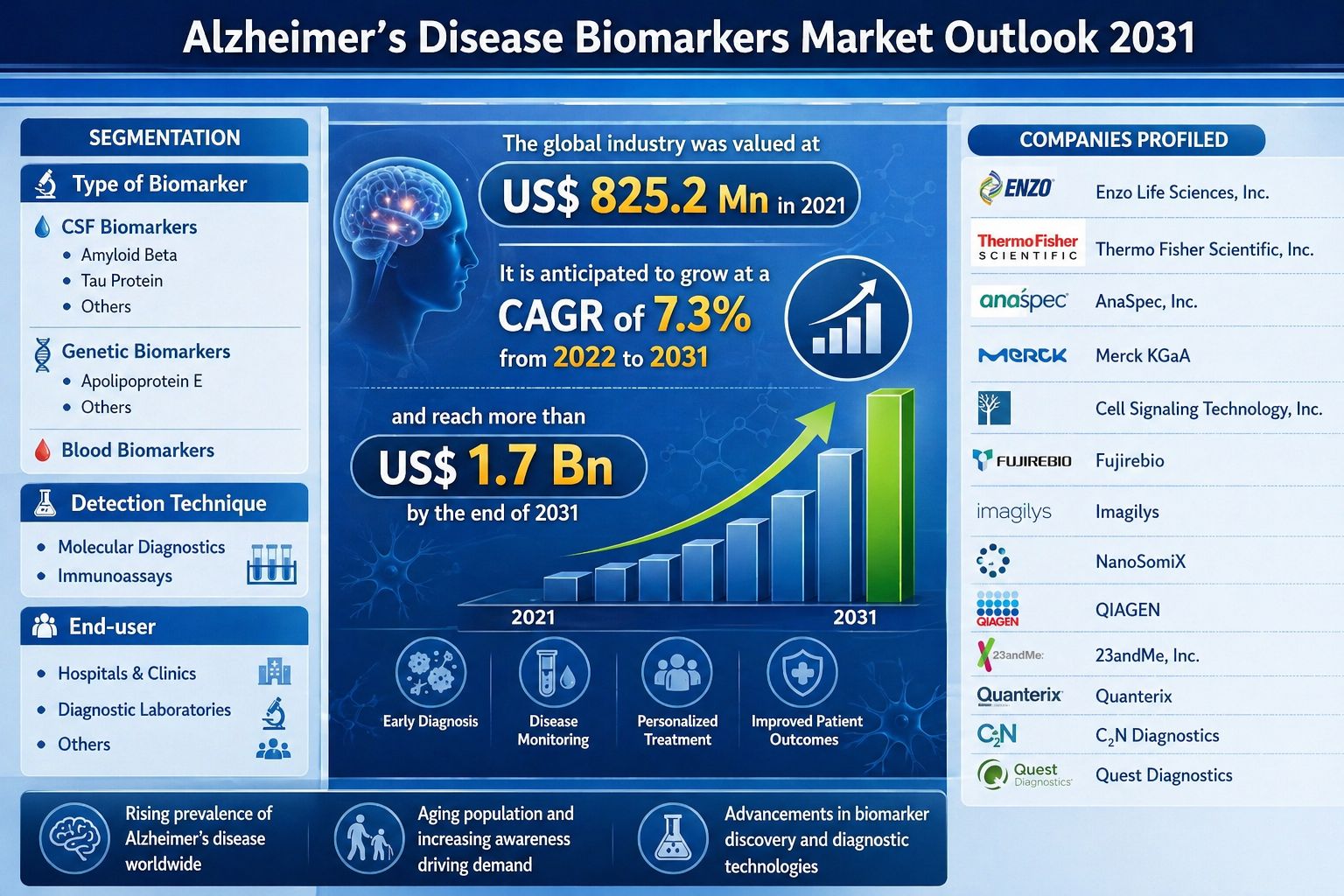
The global Alzheimer’s disease biomarkers market was valued at US$ 825.2 Mn in 2021 and is projected to exceed US$ 1.7 Bn by the end of 2031, expanding at a compound annual growth rate (CAGR) of 7.3% from 2022 to 2031. The steady expansion of this market is underpinned by increasing awareness of early diagnosis, technological advancements in biomarker detection, and the growing global burden of neurodegenerative diseases.
→Discover Market Opportunities – Request Your Sample Copy Now: https://www.transparencymarketresearch.com/sample/sample.php?flag=S&rep_id=44970
Market Overview
Alzheimer’s disease is a progressive neurodegenerative disorder characterized by cognitive decline, memory loss, behavioral changes, and reduced functional independence. It is the leading cause of senile dementia and represents a major public health concern globally.
Biomarkers play a critical role in diagnosing and monitoring Alzheimer’s disease. These measurable indicators—found in blood, cerebrospinal fluid (CSF), tissues, and even digital platforms—enable clinicians to detect disease progression, evaluate treatment responses, and identify at-risk individuals.
The increasing shift toward early-stage diagnosis and personalized treatment strategies is significantly boosting demand for advanced biomarker technologies. As pharmaceutical companies intensify efforts to develop disease-modifying therapies, the need for accurate and reliable biomarkers continues to rise.
Key Market Growth Drivers
One of the primary growth drivers of the Alzheimer’s disease biomarkers market is the rapid increase in the geriatric population. Aging remains the most significant risk factor for dementia. According to global estimates, 47 million people were living with dementia in 2020, and this number is expected to triple over the next three decades.
The prevalence of dementia increases sharply with age. For instance, nearly 2% of individuals aged 65–69 are affected, and the risk doubles every five years, reaching approximately 33% among those over 90 years old. This demographic trend is directly fueling demand for early diagnostic solutions, including biomarkers.
Another key driver is the rise in lifestyle-related risk factors. Sedentary lifestyles, poor diet, lack of physical activity, smoking, and excessive alcohol consumption contribute to cognitive decline and increase the risk of Alzheimer’s disease. Additionally, traumatic brain injuries (TBI) have been linked to a higher likelihood of developing dementia later in life. Data indicates that over 223,000 TBI-related hospitalizations and 64,000 deaths occur annually in the U.S. alone, highlighting the scale of this risk factor.
Furthermore, advancements in biomarker science—such as the development of peptides, genetic markers, and digital biomarkers—are accelerating market growth. These innovations enhance diagnostic accuracy and enable earlier intervention, which is crucial for improving patient outcomes.
Analysis of Key Players – Key Player Strategies
The Alzheimer’s disease biomarkers market is highly fragmented, with numerous global and regional players competing to gain market share. Prominent companies include Thermo Fisher Scientific, Inc., Merck KGaA, QIAGEN, Quanterix, and Fujirebio, among others.
These companies are actively investing in research and development (R&D) to introduce innovative biomarker solutions, particularly in areas such as blood-based and digital biomarkers. Strategic initiatives such as product launches, regulatory approvals, mergers & acquisitions, and partnerships are widely adopted to strengthen market positioning.
Collaboration remains a key strategy, enabling companies to expand their global footprint and accelerate innovation. Partnerships between biotechnology firms, diagnostic companies, and research institutions are driving the development of next-generation diagnostic tools.
Market Challenges & Opportunities
Despite strong growth prospects, the market faces several challenges. One of the primary barriers is the high cost associated with advanced diagnostic technologies, particularly imaging and molecular diagnostics. Limited accessibility in low- and middle-income countries further restricts market penetration.
Another challenge is the complexity of Alzheimer’s disease pathology, which makes it difficult to identify universally reliable biomarkers. Variability in biomarker expression across patients can affect diagnostic accuracy.
However, these challenges also present significant opportunities. The growing focus on non-invasive and cost-effective diagnostic solutions, such as blood-based biomarkers, is expected to transform the market landscape. Additionally, the integration of artificial intelligence and digital health technologies into biomarker analysis offers new avenues for innovation.
The increasing emphasis on personalized medicine and early intervention is also creating opportunities for companies to develop targeted diagnostic and therapeutic solutions.
→Explore Strategies & Trends – Request Full Report Access – https://www.transparencymarketresearch.com/sample/sample.php?flag=S&rep_id=44970
Key Player Strategies
Key players in the market are focusing on several strategic initiatives to maintain competitiveness:
- Product Portfolio Expansion: Companies are introducing advanced biomarker assays and diagnostic kits to cater to evolving clinical needs.
- Technological Innovation: Investment in digital biomarkers and AI-driven diagnostic tools is gaining momentum.
- Strategic Collaborations: Partnerships with research institutions and healthcare providers are enhancing product development and market reach.
- Geographic Expansion: कंपनियाँ emerging markets such as Asia Pacific to tap into high-growth opportunities.
- Regulatory Approvals: Securing approvals for new diagnostic tests is critical for commercialization and market adoption.
Recent Developments
On July 27, 2022, Quanterix Corporation announced the validation of a laboratory developed test (LDT) to quantitatively measure phospho-Tau 181 (pTau-181) in plasma as an aid in Alzheimer’s disease diagnostic evaluation (AD). Quanterix’ LDT, the first pTau-181 plasma test approved for clinical use in the U.S., is a quantitative immunoassay designed to measure pTau-181 concentrations in human plasma. The test results are intended to be used in adults with cognitive impairment who are being evaluated for Alzheimer’s disease and must be interpreted in conjunction with other diagnostic tools.
In March 2022, Fujirebio introduced Lumipulse G-Amyloid 1-42 Plasma and Lumipulse G-Amyloid 1-40 Plasma assays for the fully automated LUMIPULSE G immunoassay systems. These CLEIA (chemiluminescent enzyme immunoassay) assays allow for the quantitative measurement of amyloid1-42 and amyloid1-40 in human plasma in just 35 minutes. Furthermore, blood-based testing can become an even simpler, more accessible, and scalable approach to assist in the diagnosis of Alzheimer’s disease.
Investment Landscape and ROI Outlook
The Alzheimer’s disease biomarkers market presents a promising investment landscape, driven by strong demand fundamentals and continuous technological innovation. Venture capital investments and funding for neuroscience research are increasing, reflecting growing confidence in the market’s long-term potential.
The shift toward early diagnosis and preventive healthcare is expected to yield high returns on investment (ROI), particularly for companies developing scalable and cost-effective diagnostic solutions. Additionally, the growing pipeline of Alzheimer’s therapies is likely to drive demand for companion diagnostics, further boosting market growth.
Investors are particularly interested in companies focusing on blood-based biomarkers and digital diagnostics, as these segments offer significant scalability and commercial viability.
Market Segmentations
The Alzheimer’s disease biomarkers market can be segmented based on biomarker type, detection technique, end-user, and region.
By biomarker type, the market includes CSF biomarkers, genetic biomarkers, and blood biomarkers. Among these, CSF biomarkers dominated the market in 2021 due to their high reliability and direct interaction with brain pathology. These biomarkers are particularly useful in predicting disease progression and guiding clinical trial outcomes.
In terms of detection techniques, immunoassays hold a significant share due to their simplicity, cost-effectiveness, and widespread availability. Molecular diagnostics also play a crucial role in advanced research and clinical applications.
Based on end-users, the market is categorized into hospitals & clinics, diagnostic laboratories, and others, with diagnostic laboratories accounting for a major share due to the increasing demand for specialized testing services.
Regionally, North America held the largest market share of approximately 35.0% in 2021, driven by high disease prevalence, strong R&D infrastructure, and the presence of leading market players. The United States remains the dominant contributor in this region.
Asia Pacific is expected to be the fastest-growing region during the forecast period, fueled by rising healthcare awareness, increasing incidence of neurodegenerative diseases, and expanding healthcare infrastructure in countries such as China, India, and Japan.
Europe also represents a significant market, supported by government initiatives and growing investments in neuroscience research.
Why Buy This Report?
This report provides comprehensive insights into the Alzheimer’s disease biomarkers market, enabling stakeholders to make informed business decisions. It offers detailed analysis of market size, growth trends, competitive landscape, and regional dynamics.
The study includes in-depth evaluation of market drivers, challenges, opportunities, and key trends, along with strategic insights into leading players. It also covers segment-wise analysis and future growth projections, helping businesses identify high-growth areas.
Additionally, the report delivers actionable intelligence on investment opportunities, technological advancements, and emerging market trends, making it a valuable resource for investors, researchers, and industry participants.
FAQs
- How big was the global Alzheimer’s disease biomarkers market in 2021?
The market was valued at US$ 825.2 Mn in 2021. - How large is the market expected to be by 2031?
It is projected to exceed US$ 1.7 Bn by the end of 2031. - What is the expected CAGR during the forecast period?
The market is anticipated to grow at a CAGR of 7.3% from 2022 to 2031. - What are the key factors driving market growth?
Major drivers include the increasing geriatric population, rising prevalence of Alzheimer’s disease, advancements in biomarker technologies, and growing demand for early diagnosis. - Which region dominates the Alzheimer’s disease biomarkers market?
North America holds the largest market share, supported by strong research infrastructure and high disease prevalence.
Buy Full Report Now: https://www.transparencymarketresearch.com/checkout.php?rep_id=44970<ype=S
→Explore Latest Research Reports by Transparency Market Research:
Biologics Market: https://www.transparencymarketresearch.com/global-biologics-market.html
Diuretic Drugs Market: https://www.transparencymarketresearch.com/diuretic-drugs-market.html
Generic Drugs Market: https://www.transparencymarketresearch.com/generic-drugs-market-report.html
About Transparency Market Research
Transparency Market Research, a global market research company registered at Wilmington, Delaware, United States, provides custom research and consulting services. Our exclusive blend of quantitative forecasting and trends analysis provides forward-looking insights for thousands of decision makers. Our experienced team of Analysts, Researchers, and Consultants use proprietary data sources and various tools & techniques to gather and analyses information.
Our data repository is continuously updated and revised by a team of research experts, so that it always reflects the latest trends and information. With a broad research and analysis capability, Transparency Market Research employs rigorous primary and secondary research techniques in developing distinctive data sets and research material for business reports.



Leave a Reply