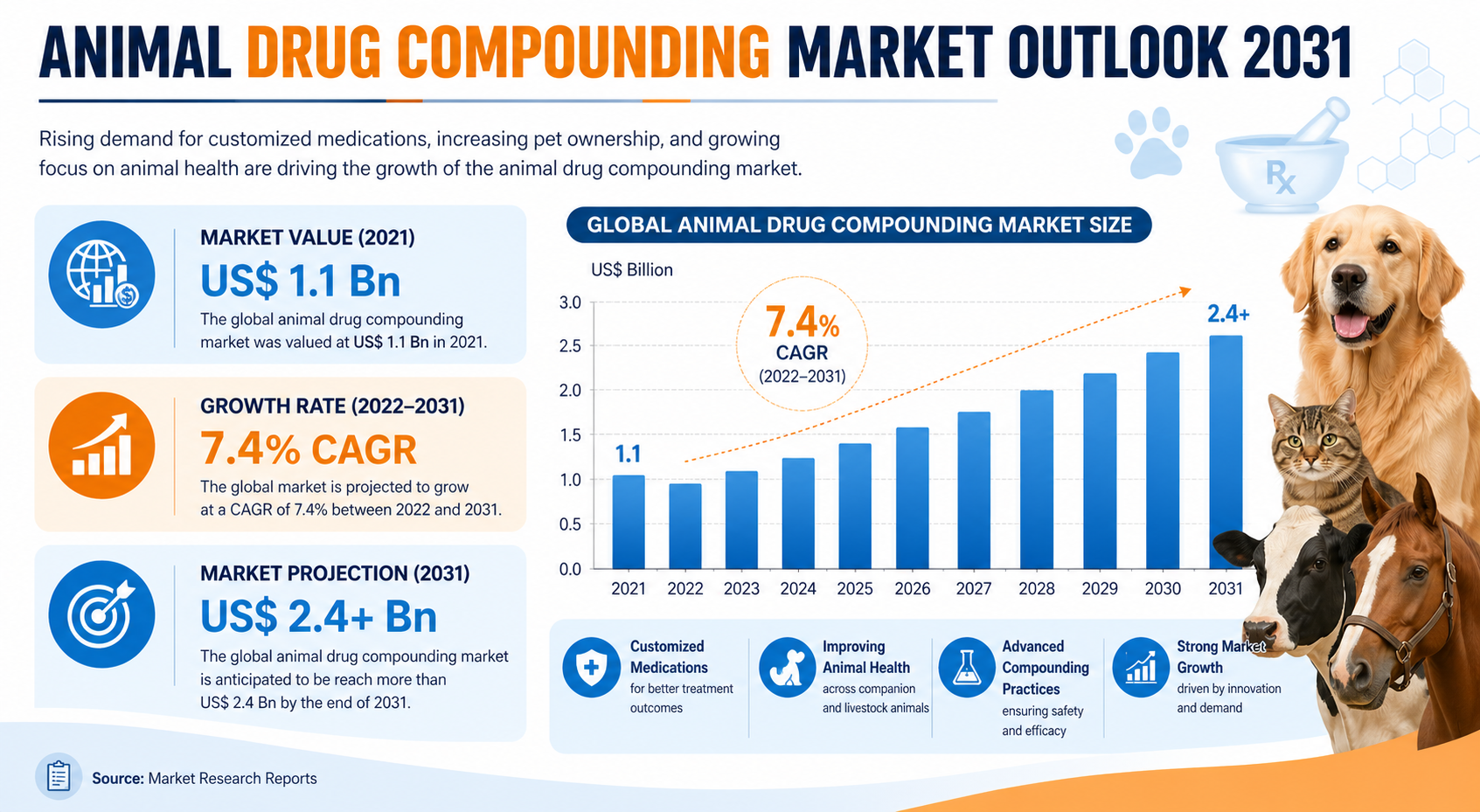
The global animal drug compounding market is experiencing strong growth, fueled by increasing awareness of animal health, rising pet ownership, and the growing need for personalized veterinary treatments. According to the latest industry analysis, the market was valued at US$ 1.1 billion in 2021 and is projected to exceed US$ 2.4 billion by 2031, expanding at a CAGR of 7.4% from 2022 to 2031.
Market Size
The animal drug compounding market has demonstrated robust expansion over recent years and is expected to maintain its upward trajectory throughout the forecast period. With a valuation of US$ 1.1 billion in 2021, the market is anticipated to more than double, crossing US$ 2.4 billion by 2031.
This strong growth is indicative of the increasing reliance on customized veterinary medications, especially in cases where commercially available drugs fail to meet specific animal requirements. The CAGR of 7.4% reflects a high-growth market supported by innovation and rising demand across both companion and livestock segments.
Access important conclusions and data points from our Report in this sample –
https://www.transparencymarketresearch.com/sample/sample.php?flag=S&rep_id=50493
Market Overview
Animal drug compounding refers to the process of customizing medications by combining, mixing, or altering ingredients to suit the specific needs of individual animals or small groups. These medications are typically prepared by trained pharmacists or veterinarians and are widely used in veterinary care.
Compounded drugs address critical gaps in the availability of approved medications, offering solutions such as:
- Tailored dosages
- Alternative dosage forms (liquids, powders, flavored formulations)
- Allergen-free medications
- Species-specific treatments
The market includes a wide range of products such as anti-infectives, anti-inflammatory drugs, central nervous system (CNS) agents, and gastrointestinal (GI) drugs. These are administered through various routes including oral, injectable, topical, rectal, and ocular.
The increasing complexity of animal healthcare and the need for precise treatment protocols are making compounding an essential component of modern veterinary medicine.
Key Market Growth Drivers
- Rise in Pet Ownership and Companion Animal Care
The growing global population of companion animals, particularly dogs and cats, is a major driver of market growth. A significant percentage of households worldwide own pets, leading to increased spending on veterinary care and medications.
Pet owners are increasingly seeking personalized treatments to improve the quality of life of their animals, boosting demand for compounded drugs.
- Increasing Number of Veterinarians and Compounding Pharmacists
The expansion of veterinary healthcare infrastructure, including the rising number of licensed veterinarians and pharmacists, is supporting the growth of compounding services. Governments and institutions are also funding training programs to enhance compounding expertise.
- Limitations of Commercially Available Drugs
Not all medications are available in suitable forms or dosages for animals. Compounded drugs provide an effective alternative, particularly for:
- Discontinued medications
- Species-specific requirements
- Allergies to certain ingredients
- Demand for Customized and Palatable Medications
Animals often resist taking standard medications. Compounding allows for the addition of flavors and adjustments in formulation, making drugs more palatable and easier to administer.
- Growth in Livestock Healthcare
In addition to companion animals, livestock owners rely on compounded medications to maintain animal health, ensure food safety, and prevent disease outbreaks.
Analysis of Key Players – Key Player Strategies
The global animal drug compounding market is relatively consolidated, with a limited number of key players dominating the landscape. Prominent companies include:
- Wedgewood Pharmacy
- Triangle Compounding Pharmacy
- Davis Islands Pharmacy
- Custom Med Compounding Pharmacy
- Central Compounding Center South
- Wellness Pharmacy of Cary
- Caringbah Compounding Pharmacy
- Millers Pharmacy
- Smith’s Pharmacy
- Specialist Compounding Pharmacy Pte Ltd.
- Tache Pharmacy
Key Strategies Adopted by Market Players
- Strategic Alliances and Partnerships
Companies are forming partnerships to expand their geographic presence and enhance service offerings. - Product Portfolio Expansion
Firms are investing in R&D to develop new formulations and broaden their range of compounded medications. - Mergers and Acquisitions
Acquisitions are being used to strengthen market position and increase operational scale. - Focus on Customization and Quality
Delivering high-quality, tailored medications is a key differentiator in the market.
Market Challenges & Opportunities
Challenges
- Regulatory Complexity
Animal drug compounding is subject to varying regulations across regions, which can complicate operations and limit market expansion. - Quality and Safety Concerns
Ensuring consistent quality and safety of compounded medications remains a challenge, particularly in less regulated markets. - Limited Awareness in Emerging Regions
In some regions, awareness about compounded veterinary drugs is still low, hindering market growth.
Opportunities
- Expansion in Emerging Markets
Rapid growth in pet ownership and livestock farming in countries such as India, China, and Brazil presents significant opportunities. - Technological Advancements in Compounding
Automation and advanced compounding equipment are improving efficiency, accuracy, and scalability. - Increasing Acceptance of Personalized Medicine
The broader trend toward personalized healthcare is driving adoption of compounded medications in veterinary practice.
Key Player Strategies
Key players are focusing on the following strategic initiatives to remain competitive:
- Enhancing compounding capabilities through advanced technologies
- Expanding distribution networks and global presence
- Investing in training and education programs for pharmacists
- Offering value-added services such as consultation and formulation support
- Strengthening relationships with veterinary clinics and hospitals
Recent Developments
- In March 2021, Osceola Capital and seasoned businessman Jacob Beckel announced the formation of Revelation Pharma Corp to investigate investments and strategic partnerships in the pharmacy compounding market
- In December 2020, Wedgewood Pharmacy and Partners Group agreed to replace New Harbor Capital as the majority shareholder
Investment Landscape and ROI Outlook
The animal drug compounding market presents a highly attractive investment landscape, characterized by strong growth potential and increasing demand for customized healthcare solutions.
Investment Trends
- Rising investments in veterinary healthcare infrastructure
- Increasing funding for compounding training and technology
- Growth in private equity participation in compounding pharmacies
ROI Outlook
With a CAGR of 7.4%, the market offers significant returns for investors. Companies that focus on innovation, compliance, and customer-centric solutions are expected to achieve higher profitability.
The growing acceptance of compounded medications and the expansion of veterinary services globally further enhance the long-term investment appeal of this market.
Market Segmentations
By Product
- Anti-infectives
- Anti-inflammatory
- CNS Agents
- GI Drugs
- Others
By Animal Type
- Companion Animals (Dogs, Cats, Others)
- Livestock
By Dosage Form
- Capsules
- Solutions
- Powders (dominant segment)
- Suspensions
- Others
By Route of Administration
- Oral (leading segment)
- Injectable
- Topical
- Rectal
- Ocular
By Region
- North America (largest share ~40% in 2021)
- Europe
- Asia Pacific (fastest growing region)
- Latin America
- Middle East & Africa
North America leads the market due to advanced healthcare infrastructure and high adoption of innovative veterinary practices, while Asia Pacific is expected to witness the fastest growth due to increasing pet ownership and rising awareness.
Why Buy This Report?
- Comprehensive analysis of market size, trends, and forecast
- In-depth insights into growth drivers, challenges, and opportunities
- Detailed competitive landscape and key player strategies
- Identification of high-growth segments and regions
- Access to reliable data for strategic decision-making
- Up-to-date information on industry developments
FAQs
- What is the projected size of the animal drug compounding market by 2031?
The market is expected to exceed US$ 2.4 billion by 2031. - What is driving the growth of this market?
Key drivers include rising pet ownership, increasing demand for customized medications, and growth in veterinary healthcare services. - Which region dominates the market?
North America holds the largest market share, accounting for around 40% in 2021. - What are compounded animal drugs?
They are customized medications prepared by pharmacists or veterinarians to meet specific needs of animals. - What opportunities exist in this market?
Opportunities include expansion in emerging markets, technological advancements, and increasing acceptance of personalized veterinary medicine.



Leave a Reply