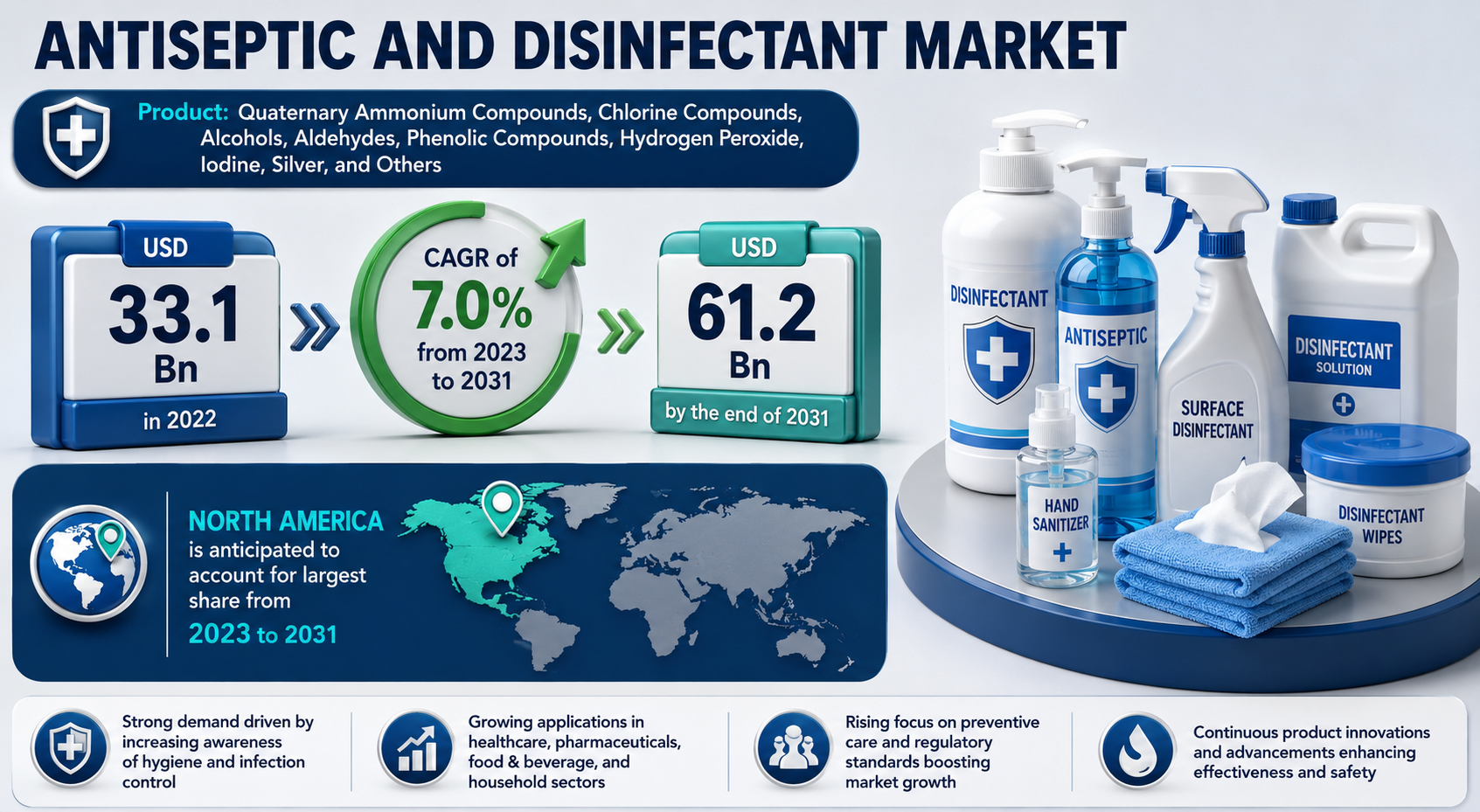
The global Antiseptic and Disinfectant Market was valued at USD 33.1 Bn in 2022 and is projected to reach USD 61.2 Bn by the end of 2031. Growing at a CAGR of 7.0% from 2023 to 2031, the market is expanding steadily due to rising awareness about hygiene, infection prevention, and increasing demand from healthcare facilities, households, and industrial sectors worldwide.
👉 Get sample market research report copy today@ https://www.transparencymarketresearch.com/sample/sample.php?flag=S&rep_id=1695
Market Overview
Antiseptics and disinfectants are used to control the spread of viruses and infections. They eliminate various microorganisms such as fungi, bacteria, and viruses. Disinfectants are employed to eliminate microorganisms on nonliving surfaces, whereas antiseptics eliminate microorganisms on skin. Antiseptics are antimicrobial compounds that can be applied to living tissues. These compounds help reduce the risk of sepsis, infection, or putrefaction. Disinfectants are chemical compounds utilized to inactivate or destroy microorganisms on inert surfaces.
Disinfectants include chlorine and chlorine compounds, phenolic, formaldehyde, alcohols, glutaraldehyde, hydrogen peroxide, quaternary ammonium compounds, iodophors, peracetic acid, and ortho-phthalaldehyde. Antiseptic agents include hydrogen peroxide, hexachlorophene, povidone-iodine, chloroxylenol, benzalkonium chloride, chlorhexidine, and isopropyl alcohol. Antiseptics and disinfectants are used extensively in hospitals and other healthcare facilities for several topical and hard-surface applications. Antiseptics and disinfectants maintain hygiene, avoid virus transmission, and limit infectious diseases.
Analysts’ Viewpoint
Increase in prevalence of infectious diseases and easy transmission of viruses are driving the antiseptic and disinfectant market size. Infectious diseases adversely affect people with weak immunity. Maintaining hygiene is important to restrict the spread of infectious diseases. Thus, a rise in demand for hygiene products in households, corporate places, schools, and healthcare settings is contributing to antiseptic and disinfectant industry growth.
Healthcare providers need to sanitize medical apparatus and surgical instruments to avoid disease transmission. An increase in the number of surgical treatments is driving the need for medical disinfectants. Manufacturers are increasing their production capacities and introducing a wide range of products to meet consumer demand.
Analysis of Key Players
The market is moderately concentrated, with the top players leveraging massive distribution networks and continuous R&D.
Leading companies operating in the global antiseptic and disinfectant market include:
- 3M Company (Leader in medical-grade skin preps and TB-quat surface cleaners)
- Reckitt Benckiser Group PLC (Owner of Lysol and Dettol; dominant in the FMCG/Retail space)
- Steris Plc (Specializing in high-level disinfection for surgical environments)
- Ecolab Inc. (Global leader in industrial hygiene and food safety solutions)
- Kimberly-Clark Corporation (Major provider of disinfectant wipes and non-woven hygiene products)
- Cardinal Health, Inc. (Key distributor and manufacturer for hospital-scale supply)
- Becton, Dickinson and Company (BD) (Innovator in sterile patient preoperative skin preparations)
- Johnson & Johnson (Kenvue) (Dominant in oral antiseptics with Listerine)
- Procter & Gamble (P&G) (Leveraging Microban for long-lasting surface protection)
- Clorox Company (A staple in chlorine-based bleach and household disinfection)
Strategic moves in 2026 focus on Partnerships for Public Safety, such as Reckitt’s “Deliver Safe” programs with major e-commerce platforms to standardize hygiene across supply chains.
Recent Developments (2025–2026)
- April 2026: Market data shows Enzymatic Cleaners growing at a rapid 10.6% CAGR, as they provide a safer, high-efficacy alternative for cleaning delicate medical instruments.
- March 2026: Ipsen and other European manufacturers expanded production of plant-based disinfectants to meet new EU eco-certification standards.
- May 2025: Solenis strengthened its portfolio by integrating Aqua ChemPacs, enabling customers to produce high-quality disinfectants on-site to reduce single-use plastic waste.
- Late 2025: The FMCG segment saw a surge in demand for skin-friendly formulations, leading to a 10.77% CAGR in retail disinfectant sales.
👉 Discuss Implications for Your Industry Request Sample Research Report PDF@ https://www.transparencymarketresearch.com/sample/sample.php?flag=B&rep_id=1695
Key Developments & Trends
- The “Stealth” Disinfection Trend: Rise of long-acting antimicrobial coatings (e.g., Microban) that protect surfaces for 24+ hours after application.
- B2B Dominance: Institutional contracts (Hospitals, Food Processing) account for over 52% to 65% of market revenue due to high-volume recurring demand.
- Aerosol and Air Sanitizers: Expansion of products like Lysol Air Sanitizer, designed to target airborne pathogens in shared indoor spaces.
- Microbiome-Friendly Antiseptics: New formulations in personal care that kill germs without stripping the skin’s natural protective barrier.
- Electrolyzed Water Systems: Growing adoption in Japan and South Korea as a low-residue, highly effective alternative to traditional chemicals.
Challenges
- Raw Material Volatility: Prices for isopropyl alcohol and hydrogen peroxide have seen 15-20% fluctuations since 2021 due to supply chain inconsistencies.
- Regulatory Compliance Costs: Meeting evolving EPA and EU Biocidal Products Regulation (BPR) standards can cost over US$ 2.5 million per product line.
- Microbial Resistance: Ongoing debate and research regarding whether extensive disinfectant use is fostering “superbugs,” though evidence in clinical settings remains limited.
- Counterfeit Products: The rise of unverified, low-efficacy brands in online marketplaces poses a threat to established brand equity and public health.
Opportunities
- Personalized Hygiene: Developing specialized disinfectants for high-risk demographics, such as the immunocompromised or the “geriatric surge” in Asia.
- On-Site Generation: Providing “dilution-at-scale” systems for large facilities to reduce shipping costs and carbon footprints.
- E-commerce Expansion: Significant growth potential in Emerging Markets (Africa/SEA) through digital-first distribution partnerships.
- Food Industry Integration: Demand for “no-rinse” disinfectants that are safe for food-contact surfaces in commercial kitchens.
Market Segmentation
➤ By Product Type
- Quaternary Ammonium Compounds (Market Leader ~31.6%)
- Oxidizing Agents (Hydrogen Peroxide, Chlorine – ~38.2%)
- Alcohols & Aldehydes
- Phenolics
- Enzymatic Cleaners (Fastest Growing ~10.6% CAGR)
➤ By Sales Channel
- B2B (Hospitals, Industrial – Majority Share ~65.5%)
- FMCG / Retail (Fastest Growing Segment)
➤ By End-Use Industry
- Healthcare (Hospitals/Clinics – ~45.8% share)
- Food & Beverage (Processing/Retail)
- Commercial/Institutional (Schools/Offices)
- Households
Conclusion
The antiseptic and disinfectant market in 2026 is evolving from emergency response to a foundational utility. Through 2035, the market will be defined by green chemistry and labor-saving automation. As the industry balances high-potency efficacy with environmental and skin-safety mandates, the companies that lead in sustainable formulations and IoT-integrated hygiene monitoring will dominate the global landscape.
👉 To buy this comprehensive market research report, click here to inquire@ https://www.transparencymarketresearch.com/checkout.php?rep_id=1695<ype=S
About Transparency Market Research
Transparency Market Research, a global market research company registered at Wilmington, Delaware, United States, provides custom research and consulting services. Our exclusive blend of quantitative forecasting and trends analysis provides forward-looking insights for thousands of decision makers. Our experienced team of Analysts, Researchers, and Consultants use proprietary data sources and various tools & techniques to gather and analyses information.
Our data repository is continuously updated and revised by a team of research experts, so that it always reflects the latest trends and information. With a broad research and analysis capability, Transparency Market Research employs rigorous primary and secondary research techniques in developing distinctive data sets and research material for business reports.
Contact:
Abhishek Budholiya
Transparency Market Research Inc.
State Tower, 90 State Street, Suite 700,
Albany NY – 12207, United States
Tel: +1-518-618-1030
USA – Canada Toll Free: 866-552-3453
Website: https://www.transparencymarketresearch.com
Sales Inquiries: sales@transparencymarketresearch.com
Media Inquiries: media@transparencymarketresearch.com


Leave a Reply