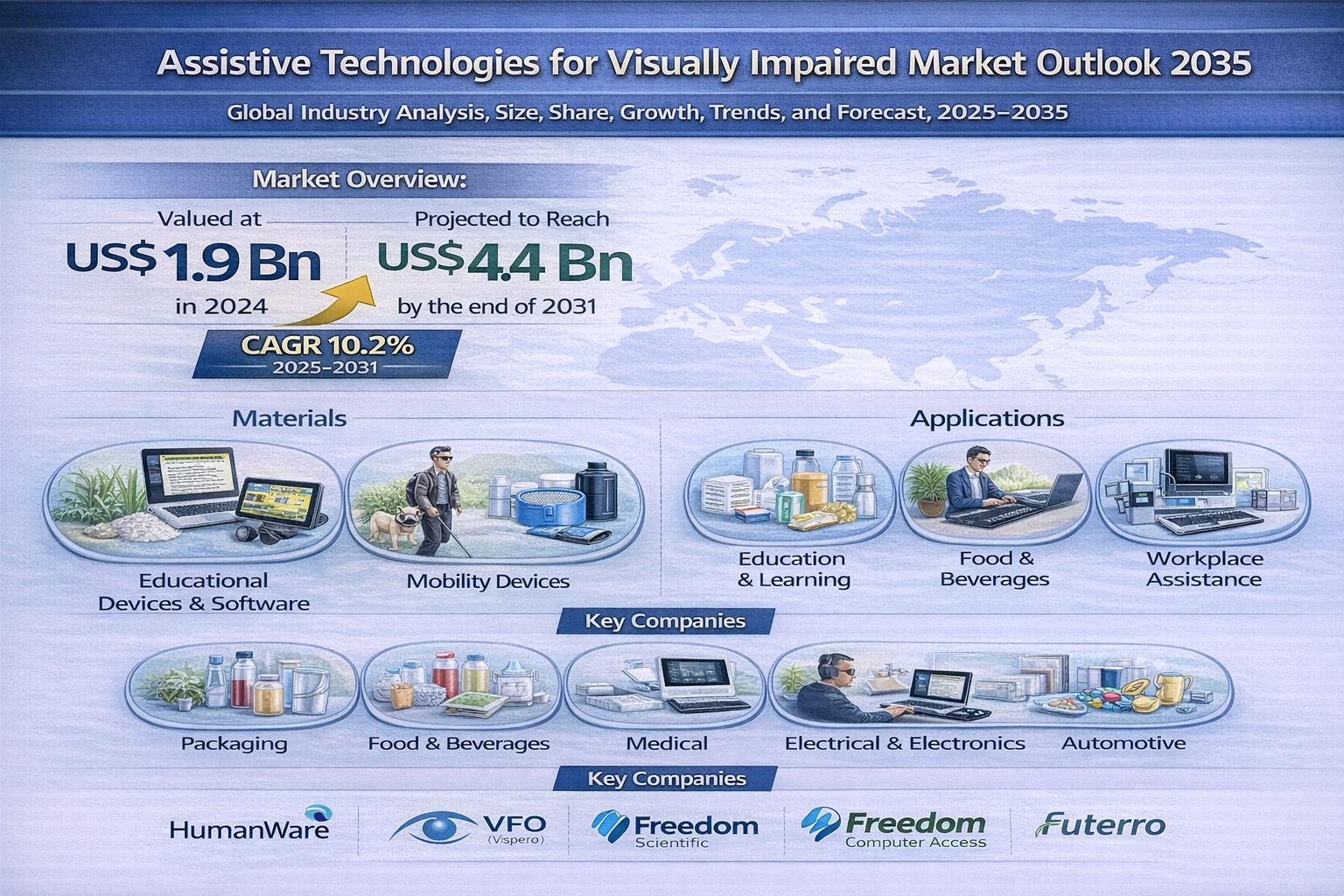
The global assistive technologies for visually impaired market is witnessing substantial growth as innovations in artificial intelligence (AI), wearable technology, and smart accessibility solutions transform the lives of visually impaired individuals. According to recent industry insights, the market was valued at US$ 5.6 Bn in 2024 and is projected to reach US$ 16.3 Bn by the end of 2035, expanding at a compound annual growth rate (CAGR) of 10.2% from 2025 to 2035.
Assistive technologies for the visually impaired encompass a wide range of products designed to improve accessibility, mobility, and independence for individuals with partial or complete vision loss. These technologies include screen readers, Braille displays, AI-powered navigation devices, smart glasses, electronic magnifiers, and mobility aids. The rapid integration of AI and IoT capabilities into accessibility solutions is transforming traditional assistive tools into intelligent systems capable of real-time environment recognition, object detection, and voice interaction.
In recent years, the adoption of assistive technologies has expanded significantly across education, healthcare, workplace environments, and personal use, reflecting growing awareness and digital accessibility initiatives worldwide. Increasing smartphone penetration and the availability of mobile applications designed specifically for visually impaired users have also accelerated market adoption.
Furthermore, the rise of digital inclusion programs, accessible infrastructure initiatives, and disability-friendly public policies across several countries is strengthening the foundation for sustained growth in the global assistive technologies market.
Access key findings and insights from our Report in this sample – https://www.transparencymarketresearch.com/sample/sample.php?flag=S&rep_id=39590
Key Drivers of Market Growth
Rising Technological Advancements
One of the most significant drivers of the assistive technologies for visually impaired market is the rapid pace of technological innovation. Advances in AI, machine learning, computer vision, and sensor technologies are enabling the development of highly sophisticated assistive devices.
Modern solutions now integrate capabilities such as:
- Real-time object recognition
- Voice-controlled navigation
- Image-to-audio conversion
- AI-based reading assistance
- Obstacle detection through sensors
For example, AI-powered wearables and smart glasses can now scan surroundings and convert visual information into audio descriptions, allowing visually impaired individuals to navigate independently. These innovations are significantly improving quality of life and increasing user confidence in everyday activities.
Additionally, technological miniaturization and declining component costs are making these devices more affordable and accessible. As hardware becomes smaller, lighter, and more efficient, adoption rates are increasing among both developed and emerging economies.
Government Support and Inclusive Education Policies
Government initiatives aimed at promoting digital accessibility and inclusive education are playing a critical role in accelerating market growth. Several countries have introduced policies that mandate accessibility features in educational institutions, public spaces, and digital platforms.
For instance, many education boards in North America and Europe have incorporated digital Braille readers, screen-reading software, and audio learning systems into school curriculums to support visually impaired students.
Public procurement programs, grants, and tax incentives are also encouraging the adoption of assistive technologies. These initiatives are helping educational institutions, libraries, and community centers provide equitable access to information and digital resources.
Moreover, awareness campaigns and disability-inclusive development strategies are encouraging organizations to design products that prioritize accessibility and user-centered design.
Key Players and Industry Leaders
The assistive technologies for visually impaired market features a dynamic ecosystem of global technology companies, specialized manufacturers, and innovative startups. These companies are focusing on product innovation, strategic collaborations, and technological integration to strengthen their market presence.
Prominent players operating in the market include:
- HumanWare
- VFO (Vispero)
- Freedom Scientific
- Dolphin Computer Access
- OrCam Technologies
- Envision AI
- Enhanced Vision
- BAUM Retec AG
- Amedia Corporation
- Jaws Screen Reader
- Eschenbach Optik
- Zoomax Technology
- Braille Works
These companies offer a broad portfolio of products such as Braille displays, screen reading software, magnification devices, wearable AI tools, and adaptive learning solutions.
Several technology companies from the consumer electronics industry are also entering the accessibility space, leveraging their expertise in AI, sensors, and wearable technology to develop solutions specifically designed for visually impaired users.
Recent Developments
Recent innovations and collaborations are further driving the evolution of assistive technologies for the visually impaired.
In June 2025, Waymap launched a GPS-style navigation application at Lord’s Cricket Ground in London. The system uses highly detailed spatial mapping to guide visually impaired individuals to their seats within the stadium. The app adapts to users’ walking patterns and offers precise indoor navigation capabilities. Future deployments are planned for large venues such as Wembley Stadium and major public transportation networks.
In April 2025, researchers from the Singapore Institute of Technology introduced a new integrated toolkit aimed at improving digital accessibility for visually impaired individuals. The toolkit combines multiple assistive features into a unified platform, allowing users to interact with digital environments more efficiently.
These developments highlight the increasing focus on integrated assistive ecosystems rather than standalone solutions.
New Opportunities and Challenges
Opportunities
The market presents several emerging opportunities for technology providers and healthcare organizations:
- AI-powered accessibility solutions are creating new product categories.
- Growing smartphone adoption is expanding the reach of assistive mobile applications.
- Expansion of inclusive education programs is driving demand for adaptive learning tools.
- Increased participation from non-profit organizations and training institutes is improving user awareness and skill development.
Furthermore, the development of multilingual and region-specific accessibility solutions is opening new growth avenues in emerging markets such as Asia-Pacific and Latin America.
Challenges
Despite strong growth potential, the industry faces several challenges:
- High cost of advanced assistive devices
- Limited awareness in developing regions
- Lack of trained professionals for assistive technology training
- Compatibility issues with legacy systems
Addressing these challenges will require collaboration between governments, technology providers, healthcare institutions, and non-profit organizations.
Market Trends & Innovations
The assistive technologies for visually impaired market is undergoing significant transformation due to emerging trends and technological advancements.
One of the key trends is the integration of AI and machine learning into assistive devices, enabling intelligent interaction with the surrounding environment. AI-based image recognition systems are allowing devices to identify objects, read text, and provide audio feedback in real time.
Another trend is the rise of wearable assistive technologies, including smart glasses, sensor-enabled shoes, and AI-powered navigation aids. These devices provide hands-free assistance and improve mobility for visually impaired users.
Mobile applications are also playing a critical role in accessibility innovation. Many smartphone apps now offer features such as text-to-speech conversion, voice commands, real-time navigation, and object identification, making everyday tasks easier.
Additionally, cloud-based assistive platforms are enabling seamless integration between multiple devices and services, improving the overall accessibility ecosystem.
Future Outlook
The future of the assistive technologies for visually impaired market looks highly promising as advancements in AI, robotics, and wearable electronics continue to redefine accessibility solutions.
Over the next decade, the market is expected to witness the development of fully integrated assistive ecosystems combining hardware devices, mobile applications, and cloud platforms.
Emerging technologies such as augmented reality (AR), advanced computer vision systems, and neural interfaces could further enhance the capabilities of assistive tools, enabling visually impaired individuals to interact with their surroundings more effectively.
Additionally, increasing investment in disability-inclusive technology development and the growing emphasis on universal design principles will further expand market opportunities.
Buy this Premium Research Report for exclusive, in-depth insights – https://www.transparencymarketresearch.com/checkout.php?rep_id=39590<ype=S
Market Segmentation
The assistive technologies for visually impaired market can be segmented based on product type, application, end-user, distribution channel, and region.
By Product Type
- Educational Devices & Software
- Braille Duplicators and Writers
- Braille Computers
- Mathematical & Science Devices
- Electronic Magnifiers
- Reading Machines
- Optical Character Recognition (OCR) Systems
- Screen Readers and Others
- Mobility Devices (Canes and others)
- Low Vision Devices
- Smart Glasses
- Magnifying Lenses
By Application
- Education and Learning
- Mobility Assistance
- Access to Information
- Personal Independence
- Workplace Assistance
By End-user
- Blind Schools
- Enterprises & Social Organizations
- Personal Use
- Federations & Hospitals
By Distribution Channel
- Online Retailers
- Specialty Stores
- Assistive Technology Centers
- Government Programs and Institutions
By Region
- North America
- Europe
- Asia Pacific
- Latin America
- Middle East & Africa
Among these regions, North America currently holds the largest market share, driven by advanced healthcare infrastructure, strong technology adoption, and supportive government policies.
Key Trends for the Future
Several transformative trends are expected to shape the future of the assistive technologies market:
- Expansion of AI-powered wearable devices for navigation and object detection.
- Increasing use of smartphone-based accessibility applications.
- Integration of cloud computing and IoT technologies in assistive platforms.
- Development of low-cost accessibility devices for emerging markets.
- Growing investment in inclusive education technologies.
These trends indicate that accessibility technologies will continue evolving into mainstream digital solutions rather than niche products.
Important FAQs with Answers
How big was the assistive technologies for visually impaired market in 2024?
The global assistive technologies for visually impaired market was valued at US$ 5.6 Bn in 2024.
What is the projected market value by 2035?
The market is expected to reach US$ 16.3 Bn by the end of 2035.
What is the expected CAGR of the market?
The market is projected to grow at a CAGR of 10.2% from 2025 to 2035.
What factors are driving market growth?
Key growth drivers include rapid technological advancements, increasing adoption of AI-powered assistive devices, government initiatives promoting inclusive education, and rising demand for accessibility solutions.
Which region dominates the market?
North America currently holds the largest share due to strong technological infrastructure, supportive policies, and significant research investments.
Who are the major players in the industry?
Major companies operating in the market include HumanWare, VFO (Vispero), Freedom Scientific, Dolphin Computer Access, OrCam Technologies, Envision AI, Enhanced Vision, BAUM Retec AG, Amedia Corporation, Eschenbach Optik, Zoomax Technology, and Braille Works.
More Related Reports-
Suture Anchors Market: https://www.transparencymarketresearch.com/suture-anchors-market.html
Tablet Hardness Testers Market: https://www.transparencymarketresearch.com/tablet-hardness-testers-market.html
Polymerase Chain Reaction (PCR) Market: https://www.transparencymarketresearch.com/pcr-technologies.html
Wearable Healthcare Devices Market: https://www.transparencymarketresearch.com/wearable-healthcare-devices-market.html
About Us Transparency Market Research
Transparency Market Research, a global market research company registered at Wilmington, Delaware, United States, provides custom research and consulting services. The firm scrutinizes factors shaping the dynamics of demand in various markets. The insights and perspectives on the markets evaluate opportunities in various segments. The opportunities in the segments based on source, application, demographics, sales channel, and end-use are analysed, which will determine growth in the markets over the next decade.
Our exclusive blend of quantitative forecasting and trends analysis provides forward-looking insights for thousands of decision-makers, made possible by experienced teams of Analysts, Researchers, and Consultants. The proprietary data sources and various tools & techniques we use always reflect the latest trends and information. With a broad research and analysis capability, Transparency Market Research employs rigorous primary and secondary research techniques in all of its business reports.
Contact Us
Transparency Market Research Inc.
CORPORATE HEADQUARTER DOWNTOWN,
1000 N. West Street,
Suite 1200, Wilmington, Delaware 19801 USA
Tel: +1-518-618-1030
USA – Canada Toll Free: 866-552-3453



Leave a Reply