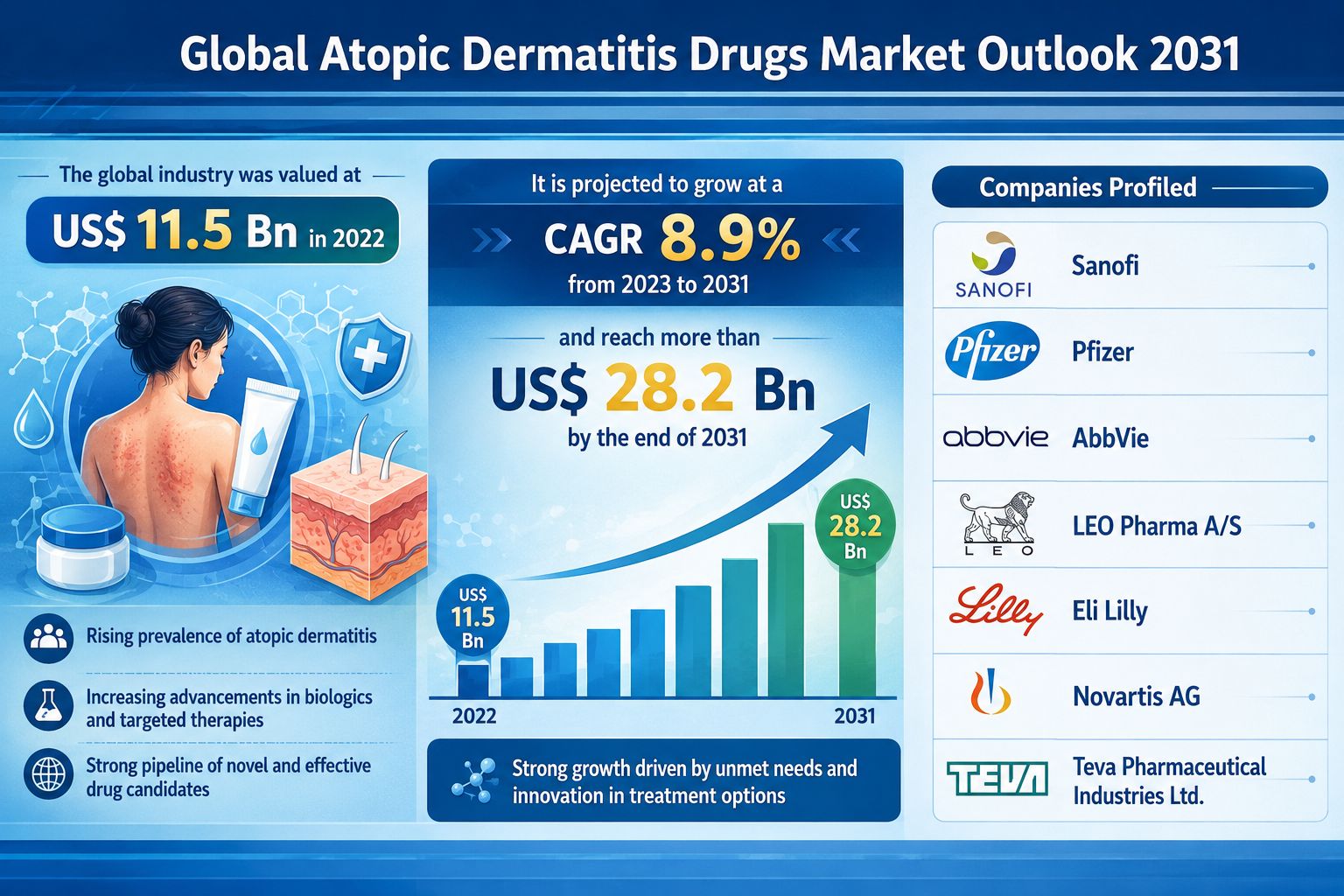
The global atopic dermatitis drugs market was valued at US$ 11.5 Bn in 2022 and is projected to reach more than US$ 28.2 Bn by the end of 2031. The industry is anticipated to expand at a robust CAGR of 8.9% during the forecast period from 2023 to 2031.
The strong growth trajectory of the market is attributed to the rising prevalence of atopic dermatitis worldwide, growing awareness regarding chronic inflammatory skin diseases, increasing healthcare expenditure, and rapid advancements in biologic therapies and targeted treatments.
→Discover Market Opportunities – Request Your Sample Copy Now: https://www.transparencymarketresearch.com/sample/sample.php?flag=S&rep_id=73639
Market Overview
Atopic dermatitis, commonly known as eczema, is a chronic inflammatory skin disease characterized by dry, itchy, swollen, and irritated skin. The disease is particularly common among children but can also affect adults. The condition often occurs in cycles of flare-ups and remission, significantly impacting the quality of life of patients.
According to global healthcare estimates, more than 223 million people were affected by atopic dermatitis in 2022, including around 43 million children below the age of five. The growing patient population is creating substantial demand for effective and long-term treatment options.
The market has witnessed major transformation in recent years with the introduction of biologics and Janus kinase (JAK) inhibitors. These therapies offer improved clinical outcomes, reduced side effects, and targeted mechanisms of action compared to traditional corticosteroids and immunosuppressive drugs.
Biologics have emerged as one of the most promising therapeutic categories due to their ability to specifically target inflammatory pathways associated with atopic dermatitis. Increasing product approvals and favorable reimbursement policies in developed economies are expected to further fuel market growth.
Key Market Growth Drivers
Rising Global Prevalence of Atopic Dermatitis
The increasing incidence of atopic dermatitis across children and adults remains the primary growth driver for the market. Environmental pollution, changing lifestyles, urbanization, genetic predisposition, and rising allergen exposure are contributing significantly to the growing disease burden globally.
According to the World Health Organization (WHO), skin diseases affected over 900 million individuals globally in 2017. Atopic dermatitis currently impacts approximately 15% to 20% of children and 1% to 3% of adults worldwide.
The increasing prevalence of moderate-to-severe eczema cases is creating strong demand for advanced treatment options, particularly biologics and targeted immunotherapies.
Growing Demand for Biologics
Biologics are revolutionizing atopic dermatitis treatment due to their precision-based therapeutic approach. Unlike conventional therapies, biologics target specific immune pathways responsible for inflammation, thereby minimizing systemic side effects.
The improved effectiveness and long-term symptom management associated with biologics are encouraging healthcare providers and patients to adopt these therapies rapidly.
Products such as Rinvoq, Cibinqo, and Opzelura have demonstrated strong commercial success in the U.S. and European markets, supporting the expansion of the biologics segment.
Increase in Healthcare Spending
Developing nations are witnessing rapid growth in healthcare investments and improved dermatology care infrastructure. Governments and private healthcare organizations are increasingly focusing on expanding access to specialty treatments and advanced therapies.
Improved insurance coverage and awareness campaigns are also enabling patients to seek early diagnosis and treatment.
Rise in Product Approvals and Clinical Trials
Pharmaceutical companies are investing heavily in research and development activities to introduce novel treatment options for moderate-to-severe atopic dermatitis. The growing pipeline of monoclonal antibodies, oral JAK inhibitors, and topical therapies is expected to accelerate market expansion over the next decade.
Analysis of Key Players – Key Player Strategies
The global atopic dermatitis drugs market is consolidated, with a small number of multinational pharmaceutical companies accounting for a significant market share.
Major companies operating in the industry include:
- Sanofi
- Pfizer
- AbbVie
- LEO Pharma A/S
- Eli Lilly
- Novartis AG
- Teva Pharmaceutical Industries Ltd.
Expansion of Product Portfolio
Leading pharmaceutical firms are focusing on broadening their dermatology product offerings through innovative biologics, oral therapies, and topical medications.
Strategic Collaborations and Partnerships
Companies are entering strategic partnerships with biotechnology firms and research institutions to accelerate drug development and strengthen their global presence.
Mergers and Acquisitions
Acquisitions remain a major strategy among market leaders to enhance pipeline capabilities and access next-generation technologies in immunology and dermatology.
Focus on Emerging Markets
Key players are increasingly targeting Asia Pacific, Latin America, and Middle East & Africa due to rising patient populations, improving healthcare infrastructure, and growing awareness regarding dermatological disorders.
→Explore Strategies & Trends – Request Full Report Access – https://www.transparencymarketresearch.com/sample/sample.php?flag=S&rep_id=73639
Market Challenges & Opportunities
Challenges
Despite strong market growth prospects, several challenges continue to affect the industry.
One of the major challenges is the high cost associated with biologic therapies and advanced targeted treatments. Many patients in low-income and middle-income countries face limited access to these therapies due to affordability constraints.
Stringent regulatory approval processes and lengthy clinical trial timelines also present barriers for pharmaceutical companies developing innovative therapies.
Additionally, side effects associated with long-term corticosteroid usage and concerns regarding immunosuppressive treatments continue to create treatment compliance issues among patients.
Opportunities
The market offers significant opportunities through the development of personalized medicine and precision-based biologic therapies.
Growing research into cytokine inhibitors, interleukin blockers, and JAK inhibitors is expected to create lucrative commercial opportunities for pharmaceutical companies.
The expansion of teledermatology services and online pharmacy channels also presents growth opportunities, especially in developing economies.
Increasing pediatric treatment approvals and the emergence of biosimilars are likely to improve treatment accessibility and affordability over the forecast period.
Key Player Strategies
Major market participants are implementing several growth-oriented strategies to strengthen their competitive position:
- Increasing investments in dermatology-focused R&D
- Expanding biologics manufacturing capabilities
- Launching targeted therapies with improved efficacy
- Enhancing patient support programs
- Strengthening hospital pharmacy distribution networks
- Expanding regional presence through partnerships and acquisitions
- Accelerating regulatory approvals for new formulations and indications
These initiatives are expected to intensify competition and drive innovation within the industry.
Recent Developments
In October 2022, LEO Pharma announced that the European Commission (EC) extended the marketing authorization for Adtralza (tralokinumab) to include adolescents aged 12 to 17 with moderate-to-severe atopic dermatitis (AD) who are candidates for systemic therapy.
In August 2021, the European Commission (EC) approved RINVOQ (upadacitinib) as the first JAK inhibitor in the European Union for the treatment of both adults and adolescents with moderate to severe atopic dermatitis. The approval was based on the results of two phase 3 clinical trials, which showed that RINVOQ was effective at reducing the signs and symptoms of atopic dermatitis, including itching, redness, swelling, and oozing.
Investment Landscape and ROI Outlook
The atopic dermatitis drugs market is attracting substantial investments from pharmaceutical manufacturers, venture capital firms, and biotechnology companies.
Biologics and advanced immunotherapies are expected to deliver high returns on investment due to premium pricing structures and strong patient demand. Increasing approval rates for targeted therapies and favorable reimbursement environments are further enhancing investor confidence.
North America and Europe remain key investment hubs owing to advanced healthcare systems and high biologics adoption. Meanwhile, Asia Pacific is emerging as a high-growth investment destination due to expanding healthcare infrastructure and rising disposable incomes.
Investments in clinical trials, biosimilar development, and next-generation dermatology therapeutics are likely to generate significant long-term returns through 2031.
Market Segmentations
By Product Type
The biologics segment accounted for the largest market share in 2022 due to superior clinical outcomes and growing product approvals. Biologics are increasingly preferred for moderate-to-severe atopic dermatitis cases because of their targeted mechanism and reduced side effects.
The “others” segment, including corticosteroids, calcineurin inhibitors, and emollients, continues to maintain substantial demand, particularly in mild-to-moderate disease management.
By Distribution Channel
Hospital pharmacies dominated the market in 2022 owing to the availability of advanced biologics and specialty dermatology treatments through hospital networks.
Retail pharmacies also contribute significantly to the market through widespread availability of topical therapies and prescription medications.
Online pharmacies are witnessing rapid growth due to increasing digital healthcare adoption and rising preference for home delivery services.
By Region
North America
North America held the largest share of the global market due to high disease prevalence, strong healthcare infrastructure, and extensive adoption of biologic therapies.
The U.S. dominates the regional market with approximately 9.6 million children and 16.5 million adults affected by atopic dermatitis.
Europe
Europe represents a major market supported by strong reimbursement systems, increasing biologic approvals, and rising awareness regarding chronic skin disorders.
Countries such as the U.K., Germany, France, Italy, and Spain contribute significantly to regional market growth.
Asia Pacific
Asia Pacific is projected to witness the fastest growth during the forecast period owing to expanding healthcare access, growing patient awareness, and increasing healthcare spending in countries such as China, India, and Japan.
Latin America and Middle East & Africa
These regions are gradually emerging as attractive markets due to improving healthcare infrastructure and rising diagnosis rates of dermatological disorders.
Why Buy This Report?
This report provides comprehensive insights into the global atopic dermatitis drugs market, including:
- Detailed market size analysis and forecast through 2031
- In-depth evaluation of market drivers, restraints, and opportunities
- Comprehensive analysis of biologics and emerging therapies
- Regional and country-level market assessment
- Competitive landscape and company profiling
- Analysis of recent product approvals and clinical developments
- Investment and ROI outlook for stakeholders
- Strategic recommendations for market participants
- Insights into distribution channels and treatment trends
The report serves as a valuable resource for pharmaceutical companies, investors, healthcare providers, distributors, and industry stakeholders seeking actionable market intelligence.
FAQs
How big was the global atopic dermatitis drugs market in 2022?
The global atopic dermatitis drugs market was valued at US$ 11.5 Bn in 2022.
What is the expected market value by 2031?
The market is projected to surpass US$ 28.2 Bn by the end of 2031.
What is the expected CAGR during the forecast period?
The market is anticipated to grow at a CAGR of 8.9% from 2023 to 2031.
Which segment dominates the global atopic dermatitis drugs market?
The biologics segment dominated the market in 2022 due to better clinical outcomes and rising approvals of targeted therapies.
Which region is expected to hold the largest market share?
North America is expected to maintain the largest share during the forecast period due to high prevalence of atopic dermatitis and strong adoption of biologic treatments.
Buy Full Report Now: https://www.transparencymarketresearch.com/checkout.php?rep_id=73639<ype=S
→Explore Latest Research Reports by Transparency Market Research:
Antihyperlipidemic Drugs Market: https://www.transparencymarketresearch.com/antihyperlipidemic-drugs-market.html
Neurological Disorder Drugs Market: https://www.transparencymarketresearch.com/neurological-disorder-drugs-market.html
Viral Clearance Service Market: https://www.transparencymarketresearch.com/viral-clearance-service-market.html
About Transparency Market Research
Transparency Market Research, a global market research company registered at Wilmington, Delaware, United States, provides custom research and consulting services. Our exclusive blend of quantitative forecasting and trends analysis provides forward-looking insights for thousands of decision makers. Our experienced team of Analysts, Researchers, and Consultants use proprietary data sources and various tools & techniques to gather and analyses information.
Our data repository is continuously updated and revised by a team of research experts, so that it always reflects the latest trends and information. With a broad research and analysis capability, Transparency Market Research employs rigorous primary and secondary research techniques in developing distinctive data sets and research material for business reports.


Leave a Reply