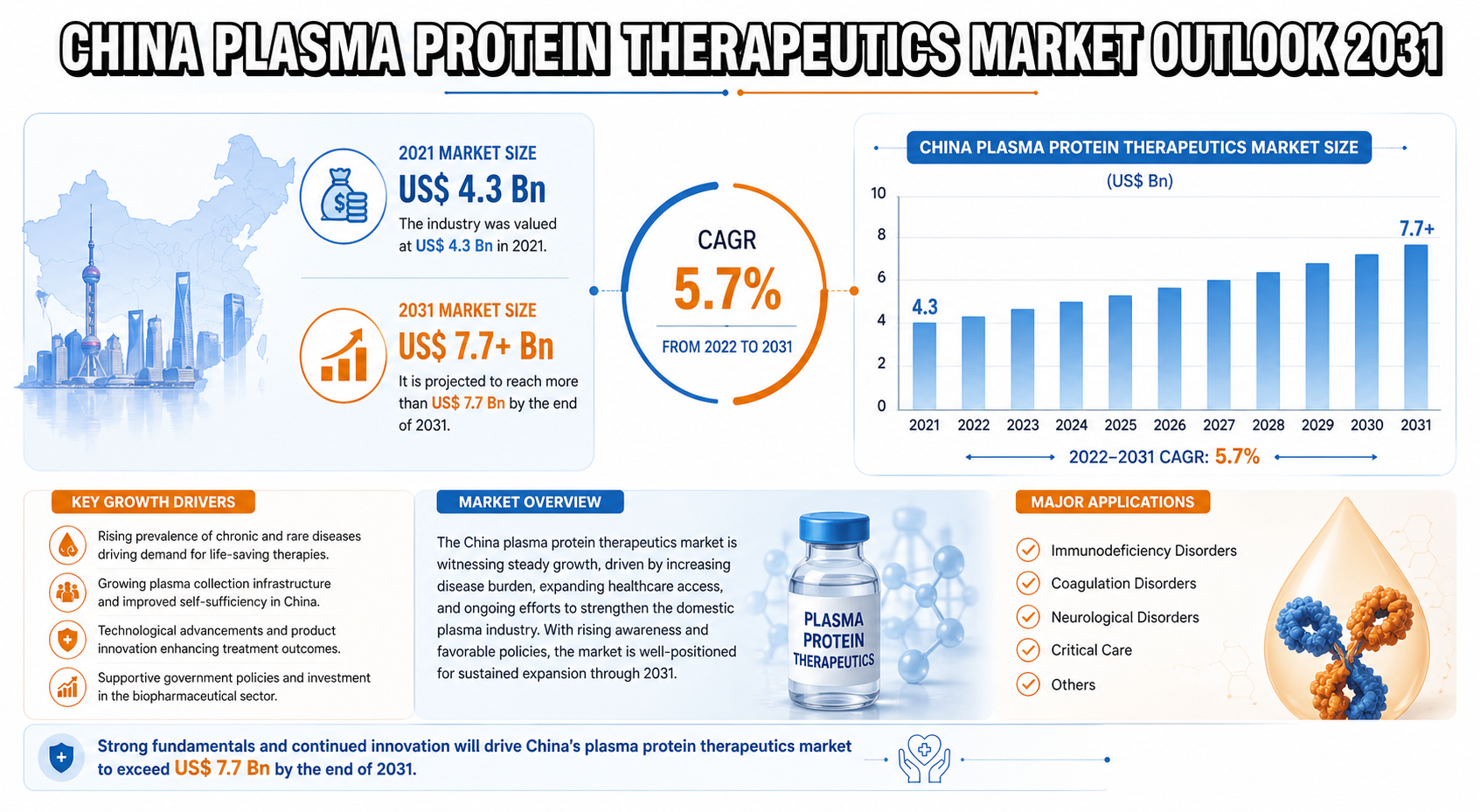
The China plasma protein therapeutics market was valued at US$ 4.3 billion in 2021 and is projected to exceed US$ 7.7 billion by 2031, growing at a compound annual growth rate (CAGR) of 5.7% from 2022 to 2031.
The market growth reflects rising demand for plasma-derived therapies used in treating chronic and rare diseases, alongside expanding healthcare infrastructure and increasing government support for advanced biologics in China.
Gain an understanding of key findings from our Report in this sample –
https://www.transparencymarketresearch.com/sample/sample.php?flag=S&rep_id=85322
Market Overview
Plasma protein therapeutics are life-saving biologic products derived from human plasma and are widely used in the treatment of:
- Immune deficiencies
- Blood clotting disorders
- Neurological conditions
- Autoimmune diseases
Key plasma-derived products include immunoglobulins, albumins, coagulation factors, and C1-esterase inhibitors.
China’s market is undergoing rapid transformation due to:
- Rising burden of chronic diseases
- Expansion of plasma collection and fractionation capacity
- Increased healthcare spending
- Government focus on rare disease diagnosis and treatment
- Growing adoption of biologic and gene therapy solutions
The increasing elderly population and environmental risk factors further contribute to demand for plasma-based therapies.
Key Market Growth Drivers
1. Rising Prevalence of Chronic and Autoimmune Diseases
China is experiencing a sharp rise in conditions such as:
- Rheumatoid arthritis
- Systemic lupus erythematosus
- Multiple sclerosis
- Inflammatory bowel disease
- Hemophilia and coagulation disorders
These conditions significantly increase demand for immunoglobulin and coagulation factor therapies, driving market expansion.
2. Increasing Geriatric Population
China’s aging population is a major structural driver. By 2035, nearly 20% of the population is expected to be aged 65 and above, increasing susceptibility to immune deficiencies, neurological disorders, and hematological diseases.
3. Rising Healthcare Expenditure
China’s healthcare spending has grown significantly, rising from ~4% of GDP in 2000 to nearly 9% in 2020, enabling wider access to expensive biologic therapies.
4. Growth in Immunoglobulin Demand
Immunoglobulins dominate the market due to:
- Expanding treatment of immune deficiencies
- Rising autoimmune disease prevalence
- Strong reimbursement support
- Advancements in plasma fractionation technologies
5. Government Support for Rare Disease Treatment
China is actively investing in:
- Rare disease diagnosis programs
- Plasma collection infrastructure
- Domestic biologics manufacturing
This is accelerating supply-side expansion and improving treatment accessibility.
Analysis of Key Players – Key Player Strategies
The China plasma protein therapeutics market is moderately consolidated with strong participation from global and domestic biopharmaceutical companies.
Key Players:
- CSL Behring
- Grifols, S.A.
- Takeda Pharmaceutical Company Limited
- Octapharma AG
- Kedrion S.p.A.
- Biotest AG
- Shanghai RAAS
- Taibang Biological Group
- Biognosys AG
Key Strategies Adopted by Market Leaders
1. Expansion of Plasma Collection Networks
Companies are investing in plasma donation centers to secure raw material supply and reduce dependency risks.
2. Strategic Partnerships and Government Collaboration
Firms are partnering with healthcare authorities to enhance immunoglobulin availability and national self-sufficiency.
3. Product Innovation and R&D Investment
Focus is on:
- Safer immunoglobulin formulations
- Advanced fractionation technologies
- Plasma proteomics research
4. Localization of Manufacturing
International players are establishing production facilities in China to benefit from regulatory support and lower production costs.
5. Mergers, Acquisitions, and Licensing Deals
Companies are expanding portfolios through strategic acquisitions and long-term supply agreements.
Market Challenges & Opportunities
Challenges
- High cost of plasma-derived therapies
- Limited plasma donation rates relative to demand
- Strict regulatory requirements
- Complex manufacturing and safety processes
- Supply chain dependency on human plasma availability
Opportunities
- Expansion of domestic plasma collection infrastructure
- Growth in immunoglobulin and rare disease therapies
- Increasing adoption of gene therapy integration
- Rising demand in neurology and hematology applications
- Strong government focus on healthcare modernization
The market is expected to benefit significantly from China’s push toward biologics self-sufficiency.
Key Player Strategies
Leading companies are focusing on long-term structural expansion through:
- Capacity expansion in plasma fractionation facilities
- Strengthening immunoglobulin supply chains
- Investment in clinical research for rare diseases
- Strategic alliances with hospitals and government programs
- Enhancing distribution networks across Tier 1 and Tier 2 cities
Recent Developments
- In September 2022, Grifols signed a long-term agreement with Canadian Blood Services, Canada’s national blood authority, to increase the country’s self-sufficiency in immunoglobulin (Ig) medicines. Under the agreement, Grifols is expected to provide around 2.4 million grams of Ig annually.
- In March 2021, Biognosys announced its R&D roadmap for plasma proteomics as an unbiased, true discovery offering for large-scale applications.
Investment Landscape and ROI Outlook
The China plasma protein therapeutics market presents a high-value, high-barrier investment environment driven by essential healthcare demand and strong policy backing.
Investment Highlights
- Stable long-term demand due to chronic disease prevalence
- Strong government support for biologics and rare disease treatment
- Growing domestic manufacturing capabilities
- Increasing demand for immunoglobulins and coagulation factors
ROI Outlook
Investments in plasma fractionation facilities, immunoglobulin production, and localized manufacturing are expected to deliver strong and stable ROI, supported by:
- High product dependency in clinical care
- Limited substitution risk
- Expanding reimbursement coverage
- Growing patient base
The market offers particularly strong returns in immunoglobulin production and neurology-focused plasma therapies.
Market Segmentations
By Product Type
- Albumins
- Immunoglobulins
- Coagulation Factors
- C1-esterase Inhibitors
- Others
By Therapeutic Area
- Immunology
- Neurology
- Hematology
- Pulmonology
- Others
By Country
- China
Immunoglobulins dominate the product segment due to strong demand in immune deficiency and autoimmune disease treatment.
Immunology leads the therapeutic area segment owing to rising autoimmune disorder prevalence.
Why Buy This Report?
- Detailed 2022–2031 market forecast with CAGR analysis
- Comprehensive segmentation by product type and therapeutic area
- In-depth competitive landscape of global and Chinese players
- Analysis of regulatory environment and government healthcare policies
- Investment-focused insights with ROI potential evaluation
- Strategic overview of supply chain and plasma collection infrastructure
- Identification of high-growth therapeutic segments
FAQs
1. What is the size of the China plasma protein therapeutics market?
The market was valued at US$ 4.3 billion in 2021 and is projected to exceed US$ 7.7 billion by 2031.
2. What is the growth rate of the market?
The market is expected to grow at a CAGR of 5.7% from 2022 to 2031.
3. Which product type dominates the market?
Immunoglobulins hold the largest share due to rising autoimmune and immune deficiency disorders.
4. Which therapeutic area leads the market?
Immunology is the leading therapeutic area segment in China.
5. What are the key drivers of market growth?
Key drivers include rising chronic disease prevalence, aging population, increasing healthcare spending, and government support for rare disease treatment.



Leave a Reply