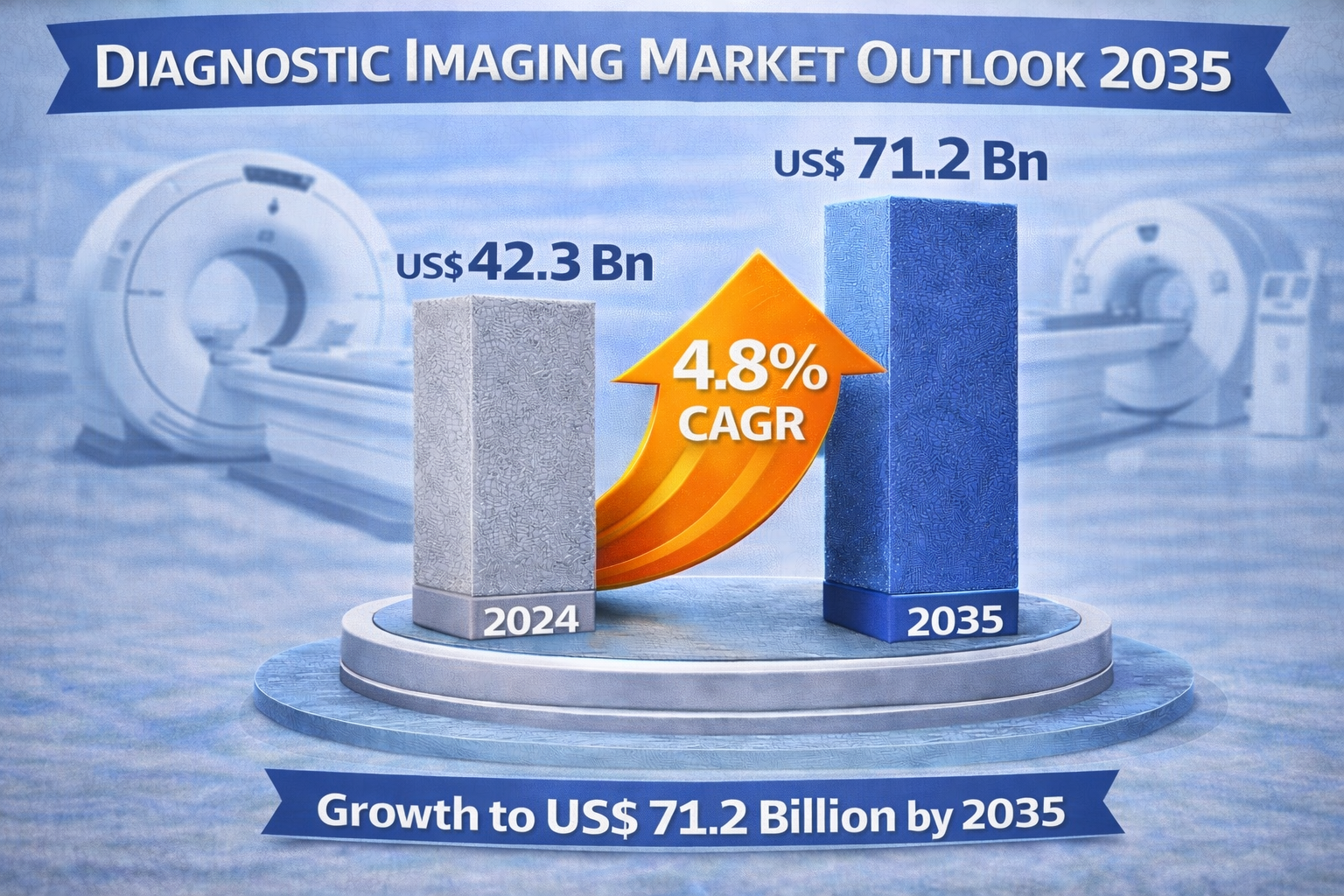
The global diagnostic imaging market was valued at US$ 42.3 Bn in 2024 and is projected to reach US$ 71.2 Bn by the end of 2035, expanding at a compound annual growth rate (CAGR) of 4.8% from 2025 to 2035. The steady growth trajectory reflects increasing demand for accurate diagnostic tools and the integration of innovative imaging technologies such as artificial intelligence (AI), 3D/4D imaging, and hybrid imaging systems.
Access key findings and insights from our Report in this sample – https://www.transparencymarketresearch.com/sample/sample.php?flag=S&rep_id=208
The growing focus on preventive healthcare, along with the expansion of healthcare infrastructure across emerging markets, is expected to further accelerate market growth over the forecast period.
Market Overview
Diagnostic imaging plays a critical role in modern healthcare by enabling physicians to visualize internal organs and structures without invasive procedures. Imaging modalities such as X-ray, magnetic resonance imaging (MRI), computed tomography (CT), ultrasound, and nuclear imaging help clinicians diagnose a wide range of conditions, including cardiovascular diseases, cancers, neurological disorders, and musculoskeletal injuries.
The rising aging population and increasing incidence of chronic diseases are significantly contributing to the expansion of the diagnostic imaging market. In addition, technological innovations such as low-dose CT scanners, hybrid PET/CT systems, and portable ultrasound devices are improving diagnostic accuracy and accessibility.
Key Market Growth Drivers
Rising Prevalence of Chronic Diseases
The increasing prevalence of chronic diseases such as cardiovascular disorders, cancer, and neurological conditions is a major factor driving the demand for diagnostic imaging solutions. Early and accurate diagnosis plays a crucial role in improving patient outcomes and enabling timely medical intervention.
Imaging technologies such as MRI, CT scans, and PET imaging are essential tools for identifying tumors, monitoring disease progression, and evaluating treatment effectiveness. According to the American Cancer Society, nearly 1.9 million new cancer cases were diagnosed in the United States in 2023, highlighting the growing need for advanced diagnostic imaging technologies.
Technological Advancements in Imaging Modalities
Technological innovation remains one of the most significant drivers of growth in the diagnostic imaging market. Modern imaging technologies now integrate artificial intelligence (AI), machine learning algorithms, 3D and 4D imaging capabilities, and dose-reduction technologies, which improve diagnostic precision while minimizing risks to patients.
Hybrid imaging systems such as PET/CT and PET/MRI combine anatomical and functional imaging, allowing clinicians to detect diseases earlier and monitor treatment responses more effectively.
Analysis of Key Players
The diagnostic imaging market is highly competitive and characterized by the presence of several global medical technology companies that focus on innovation and product development.
Major companies operating in the market include GE HealthCare, Siemens Healthineers, Koninklijke Philips N.V., Canon Medical Systems, Hitachi Healthcare, Hologic Inc., Bruker Corporation, Esaote SPA, Fujifilm Holdings Corporation, Shimadzu Corporation, Aurora Imaging Technologies, Shenzhen Mindray Bio-Medical Electronics Co., Ltd., Neusoft Medical Systems Co., Ltd., and Toshiba Medical Systems Corporation.
Market Challenges & Opportunities
Although the diagnostic imaging market is growing steadily, it faces several challenges. High capital costs associated with advanced imaging equipment, maintenance expenses, and regulatory compliance requirements can limit adoption, particularly in developing countries.
However, these challenges also create opportunities for innovation. The development of cost-effective imaging systems, AI-powered diagnostic tools, and portable imaging technologies is helping expand access to diagnostic services in emerging markets.
Additionally, the growing demand for preventive healthcare, early disease detection, and personalized medicine presents significant opportunities for imaging technology providers.
Explore our report to uncover in-depth insights – https://www.transparencymarketresearch.com/diagnostic-imaging-market.html
Recent Developments
- In March 2024, GE HealthCare developed its latest research model – SonoSAMTrack1, utilizing NVIDIA technology. This innovative model is built upon a promptable foundational model known as SonoSAM1, which is designed for object segmentation in ultrasound imagery. The primary function of SonoSAMTrack is to delineate anatomical structures, lesions, and the other critical regions within ultrasound images. Additionally, a more simplified iteration of this model, dubbed SonoSAMLite, has been introduced.
- In January 2024, Canon introduced Aplio me, a cutting-edge shared-service ultrasound system engineered to address the varied needs of everyday users in a broad range of medical environments. This exceptionally portable and light system is ideal for ultrasound experts who prioritize high efficiency in their workflow and seek sophisticated standard solutions, from smaller clinics to major hospitals.
Market Segmentation
Product Type
- X-Ray
- Fixed Digital X-Ray Systems
- Portable Digital X-Ray Systems
- Magnetic Resonance Imaging (MRI)
- Closed MRI
- Open MRI
- Computed Tomography (CT)
- Single slice
- Multi slice
- Spiral
- Other (Mobile, Slice counts etc.)
- Ultrasound
- Doppler ultrasound
- 2D ultrasound
- 3D ultrasound
- 4D ultrasound
- Others (Duplex ultrasound etc.)
- Nuclear Imaging
- SPECT
- PET
Application
- Cardiology
- Gynecology/ Obstetrics
- Orthopedics & Musculoskeletal
- Radiology
- Neurology & Spine
- General Imaging
- Others (Oncology etc.)
End-user
- Hospitals
- Diagnostic Centers
- Specialty Clinics
- Others (Research Institutes and Academics, etc.)
Regional Outlook
North America leads the global diagnostic imaging market, supported by its advanced healthcare infrastructure, high healthcare spending, and rapid adoption of innovative medical technologies.
The presence of leading medical technology companies, including GE HealthCare and Hologic, contributes to strong market growth in the region. Diagnostic imaging plays a significant role in the U.S. healthcare system, with imaging services accounting for a substantial portion of hospital outpatient spending.
According to the American Hospital Association, there are more than 6,000 hospitals in the United States, most of which provide access to advanced imaging facilities such as MRI and CT scanners. The high prevalence of chronic diseases, including cardiovascular conditions responsible for nearly 695,000 deaths annually in the U.S., further drives the demand for diagnostic imaging technologies.
With continued investments in research and development, supportive regulatory policies, and increasing imaging procedure volumes, North America is expected to maintain its leadership position in the global diagnostic imaging market.
Why Buy This Report?
- Gain comprehensive insights into the global diagnostic imaging market size and forecast through 2035
- Understand key growth drivers, technological trends, and emerging opportunities
- Analyze competitive strategies adopted by leading market players
- Explore regional market dynamics and growth potential
- Support strategic decision-making for investors, healthcare providers, and industry stakeholders
Buy this Premium Research Report for exclusive, in-depth insights – https://www.transparencymarketresearch.com/checkout.php?rep_id=208<ype=S
FAQs
- What is the current size of the global diagnostic imaging market?
The market was valued at US$ 42.3 Bn in 2024. - What is the projected market value by 2035?
The market is expected to reach US$ 71.2 Bn by the end of 2035. - What is the expected growth rate of the diagnostic imaging market?
The market is projected to grow at a CAGR of 4.8% from 2025 to 2035. - Which segment dominates the diagnostic imaging market?
The X-ray segment dominates due to its affordability, accessibility, and widespread use in medical diagnostics. - Which region leads the global diagnostic imaging market?
North America currently leads the market due to advanced healthcare infrastructure and high adoption of medical imaging technologies.
More Trending Reports by Transparency Market Research –
Healthcare Contract Research Outsourcing Market: https://www.transparencymarketresearch.com/hcro-market.html
Cervical Cancer Diagnostic Tests Market: https://www.transparencymarketresearch.com/cervical-cancer-diagnostic-tests-market.html
Sleep Apnea Devices Market: https://www.transparencymarketresearch.com/sleep-apnea-devices-market.html
Skin Antiseptic Market: https://www.transparencymarketresearch.com/skin-antiseptic-market.html
About Transparency Market Research
Transparency Market Research, a global market research company registered at Wilmington, Delaware, United States, provides custom research and consulting services. Our exclusive blend of quantitative forecasting and trends analysis provides forward-looking insights for thousands of decision makers. Our experienced team of Analysts, Researchers, and Consultants use proprietary data sources and various tools & techniques to gather and analyses information.
Our data repository is continuously updated and revised by a team of research experts, so that it always reflects the latest trends and information. With a broad research and analysis capability, Transparency Market Research employs rigorous primary and secondary research techniques in developing distinctive data sets and research material for business reports.
Contact:
Transparency Market Research Inc.
CORPORATE HEADQUARTER DOWNTOWN,
1000 N. West Street,
Suite 1200, Wilmington, Delaware 19801 USA
Tel: +1-518-618-1030
USA – Canada Toll Free: 866-552-3453





Leave a Reply