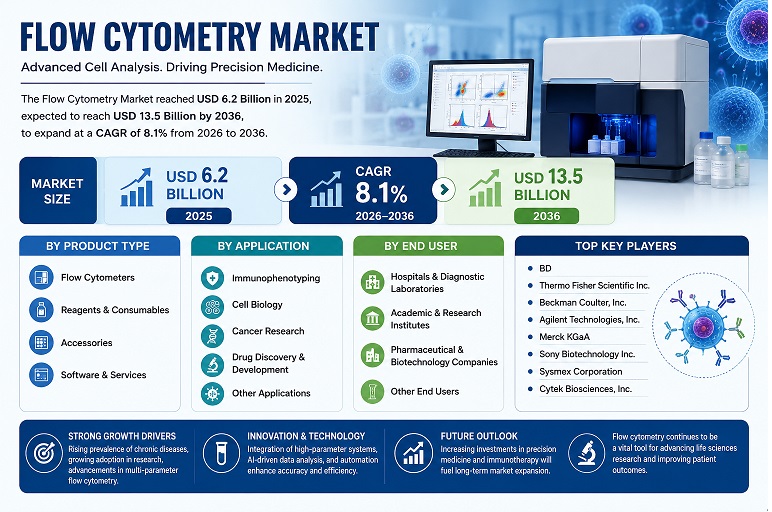
The Flow Cytometry Market is witnessing robust growth due to the increasing demand for advanced cell analysis technologies across clinical diagnostics, pharmaceutical research, biotechnology, and academic institutions. Flow cytometry is a laser-based technology that enables rapid, multiparametric analysis of physical and chemical characteristics of cells or particles suspended in a fluid stream. The technology has become indispensable in immunology, oncology, hematology, stem cell research, and infectious disease diagnostics.
The global Flow Cytometry Market was valued at USD 6.2 Billion in 2025 and is projected to reach USD 13.5 Billion by 2036, expanding at a CAGR of 8.1% from 2026 to 2036. Market growth is driven by the rising prevalence of cancer and infectious diseases, increasing demand for advanced cell analysis technologies, expanding applications in immunology and stem cell research, and growing investments in pharmaceutical and biotechnology R&D.
Request the Sample Report: https://www.transparencymarketresearch.com/sample/sample.php?flag=S&rep_id=40472
Market Overview
Flow cytometry has evolved from a specialized laboratory technique into a standard analytical tool used across hospitals, diagnostic laboratories, pharmaceutical companies, research institutes, and biotechnology firms. The technology offers rapid analysis of thousands of cells per second while simultaneously measuring multiple parameters, making it highly valuable for complex biological studies.
Modern flow cytometers are capable of detecting numerous fluorescent markers simultaneously, allowing researchers to obtain comprehensive cellular information in a single experiment. Continuous improvements in software, reagent development, and automation have significantly enhanced workflow efficiency and analytical accuracy.
Increasing healthcare expenditure, growing awareness regarding early disease diagnosis, and favorable government funding for biomedical research are further strengthening market expansion globally.
Key Market Drivers
Rising Cancer Incidence
Cancer remains one of the primary applications of flow cytometry. The technology plays a critical role in diagnosing leukemia, lymphoma, and other hematologic malignancies by identifying abnormal cell populations. As cancer incidence continues to rise worldwide, hospitals and diagnostic laboratories are investing in advanced flow cytometry systems to improve diagnostic precision.
Growth in Immunology Research
Flow cytometry is widely used for immune cell profiling, immune response monitoring, vaccine development, and autoimmune disease research. Increasing research activities in immunotherapy and immunology are creating substantial demand for sophisticated flow cytometry platforms.
Expansion of Pharmaceutical and Biotechnology Industries
Pharmaceutical companies utilize flow cytometry extensively during drug discovery, clinical trials, toxicity studies, and biologics development. Growing investments in biologic drugs, cell therapies, and gene therapies are accelerating the adoption of advanced cell analysis technologies.
Emerging Market Trends
Spectral Flow Cytometry
Spectral flow cytometry allows researchers to measure dozens of fluorescent markers simultaneously, overcoming limitations associated with conventional flow cytometers. This technology is rapidly gaining popularity in advanced immunology and cancer research.
Artificial Intelligence Integration
Artificial intelligence and machine learning algorithms are simplifying complex data interpretation, reducing human error, and enabling faster identification of rare cell populations.
Automation of Laboratory Workflows
Automated sample preparation, barcode tracking, robotic handling, and integrated laboratory information systems are improving laboratory productivity while minimizing manual intervention.
Growing Cell and Gene Therapy Research
The increasing number of clinical trials involving CAR-T therapy, stem cell therapy, and regenerative medicine has significantly expanded the use of flow cytometry for quality control and cell characterization.
Multiparameter Analysis
Modern instruments now support more than 30 simultaneous parameters, providing researchers with deeper insights into cellular behavior and disease mechanisms.
Market Challenges
Despite its promising growth outlook, the flow cytometry market faces several challenges.
High Equipment Costs
Advanced flow cytometers require significant capital investment, making adoption difficult for small hospitals and research laboratories, particularly in developing economies.
Shortage of Skilled Professionals
Operating sophisticated flow cytometry systems requires specialized technical expertise. The shortage of trained personnel can limit technology adoption.
Complex Data Analysis
Large datasets generated during multiparameter experiments require advanced analytical software and experienced researchers for accurate interpretation.
Standardization Issues
Variations in sample preparation, reagent quality, and instrument calibration may affect reproducibility across laboratories.
Buy this Premium Research Report: https://www.transparencymarketresearch.com/checkout.php?rep_id=40472<ype=S
Regional Analysis
North America
North America dominates the global flow cytometry market owing to advanced healthcare infrastructure, strong pharmaceutical and biotechnology sectors, substantial research funding, and widespread adoption of innovative diagnostic technologies. The United States remains the largest contributor due to continuous investments in cancer research and precision medicine.
Europe
Europe represents another significant market supported by increasing healthcare spending, strong academic research networks, and rising adoption of advanced laboratory technologies. Countries such as Germany, the United Kingdom, France, and Italy continue investing in biomedical innovation.
Asia-Pacific
Asia-Pacific is projected to register the fastest growth during the forecast period. Rapid expansion of healthcare infrastructure, increasing biotechnology investments, growing clinical research activities, and rising awareness regarding early disease diagnosis are fueling market demand across China, India, Japan, South Korea, and Southeast Asia.
Latin America
Improving healthcare accessibility, expanding diagnostic laboratories, and increasing government initiatives for disease management are supporting gradual market growth in Latin America.
Middle East & Africa
The Middle East & Africa market is experiencing steady growth due to increasing investments in healthcare modernization, research institutions, and advanced diagnostic capabilities.
Competitive Landscape
The global flow cytometry market is highly competitive, with major companies focusing on product innovation, strategic partnerships, acquisitions, and geographical expansion.
Leading companies operating in the market include:
- Becton, Dickinson and Company
- Beckman Coulter, Inc.
- Thermo Fisher Scientific Inc.
- Merck KGaA
- Miltenyi Biotec
- Agilent Technologies, Inc.
- Bio-Rad Laboratories, Inc.
- Sysmex Corporation
- Bio-Techne Corporation
- Cytek Biosciences, Inc.
- Sony Biotechnology Inc.
- Sartorius AG
- Standard BioTools Inc.
- Luminex Corporation
- Enzo Biochem, Inc.
- Union Biometrica, Inc.
- Apogee Flow Systems Ltd.
- Stratedigm, Inc.
- NanoCellect Biomedical, Inc.
- On-chip Biotechnologies Co., Ltd.
- Cytonome/ST, LLC
- Other Key Players
These companies continue investing heavily in automation, software development, spectral flow cytometry, and next-generation analytical platforms to strengthen their market positions.
Future Outlook
The future of the flow cytometry market appears highly promising as healthcare systems increasingly adopt precision diagnostics and personalized treatment approaches. Continued technological innovations, integration of artificial intelligence, and expansion of cell and gene therapy research will significantly broaden the scope of flow cytometry applications.
Growing investments in biotechnology, rising demand for high-throughput laboratory solutions, increasing prevalence of chronic diseases, and expanding pharmaceutical R&D activities are expected to create substantial opportunities for market participants. Furthermore, emerging economies are likely to witness accelerated adoption as healthcare infrastructure continues to improve and access to advanced diagnostic technologies expands.
Conclusion
The Flow Cytometry Market is poised for sustained growth, driven by technological advancements, increasing applications in clinical diagnostics and biomedical research, and the growing demand for personalized healthcare solutions. As innovations in spectral analysis, automation, and artificial intelligence continue to enhance the capabilities of flow cytometry, the technology will remain a cornerstone of modern life sciences and precision medicine. Companies that focus on innovation, affordability, and workflow optimization are expected to capitalize on the expanding opportunities in this dynamic global market.
More Trending Reports by Transparency Market Research –
Adhesive Bandages Market – https://www.transparencymarketresearch.com/adhesive-bandages-market.html
Lipid Disorder Treatment Market – https://www.transparencymarketresearch.com/lipid-disorder-treatment-market.html
North America Cosmetic Surgery Market – https://www.transparencymarketresearch.com/north-america-cosmetic-surgery-market.html
Media Contact:
Abhishek Budholiya
Transparency Market Research Inc.
State Tower, 90 State Street, Suite 700,
Albany NY – 12207, United States
Tel: +1-518-618-1030
USA – Canada Toll Free: 866-552-3453
Website: https://www.transparencymarketresearch.com
Sales Inquiries: sales@transparencymarketresearch.com
Media Inquiries: media@transparencymarketresearch.com




Leave a Reply