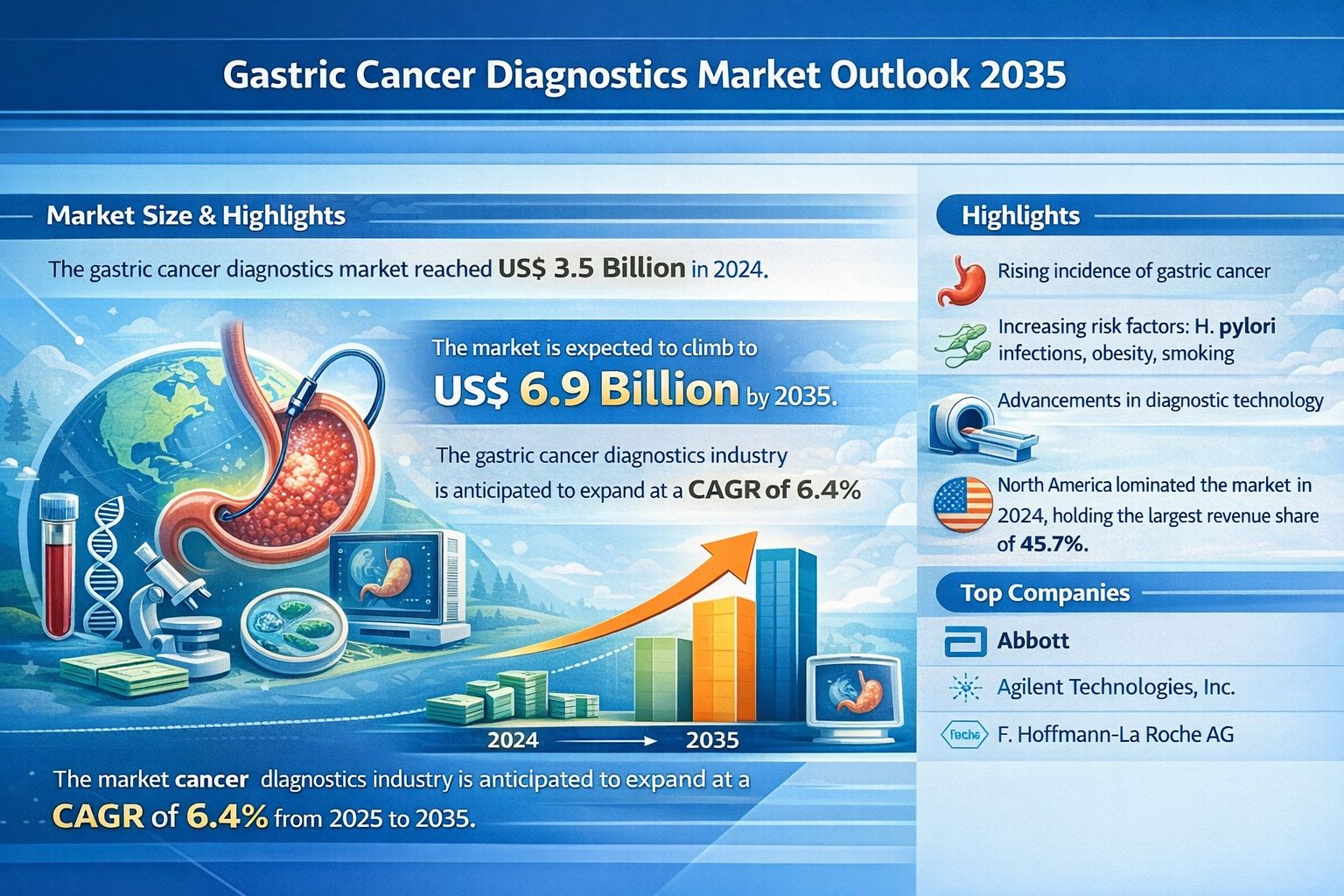
The global gastric cancer diagnostics market was valued at US$ 3.5 billion in 2024 and is projected to reach US$ 6.9 billion by 2035, expanding at a compound annual growth rate (CAGR) of 6.4% from 2025 to 2035. This steady growth trajectory reflects the increasing global burden of gastric cancer and the expanding role of advanced diagnostic technologies in early detection and disease management.
Key highlights include:
- Market value doubling from US$ 3.5 Bn (2024) to US$ 6.9 Bn (2035)
- Strong demand driven by screening programs and precision diagnostics
- Imaging tests dominating with 74.8% market share in 2024
- North America leading with 45.7% revenue share
→Discover Market Opportunities – Request Your Sample Copy Now: https://www.transparencymarketresearch.com/sample/sample.php?flag=S&rep_id=86864
Market Overview
Gastric cancer diagnostics encompasses a wide range of techniques used to detect and stage cancer originating in the stomach lining. These include endoscopy with biopsy, imaging modalities (CT, MRI, PET scans), blood-based tumor marker tests, and molecular diagnostics such as HER2 and PD-L1 biomarker testing.
The diagnostic workflow typically begins with non-invasive procedures like blood tests and imaging, followed by confirmatory methods such as biopsy and histopathology. Increasingly, genomic profiling and liquid biopsies are being integrated into clinical pathways, enabling personalized and targeted treatment strategies.
The market is witnessing a paradigm shift toward minimally invasive, patient-centric diagnostics, supported by advancements in artificial intelligence (AI), automation, and decentralized testing.
Key Market Growth Drivers
Rising Prevalence of Gastric Cancer
The growing global incidence of gastric cancer is a primary driver of market expansion. Lifestyle-related risk factors such as obesity, smoking, and diets high in processed foods, along with infections like H. pylori, are contributing to increasing patient volumes.
Healthcare systems are responding by:
- Expanding diagnostic infrastructure
- Increasing screening programs for high-risk populations
- Promoting early detection initiatives
This has resulted in sustained demand for imaging systems, endoscopic tools, and laboratory-based diagnostic tests.
Technological Advancements in Diagnostic Tools
Rapid innovation in diagnostic technologies is significantly enhancing detection accuracy and efficiency. Key advancements include:
- High-resolution endoscopy and narrow-band imaging
- Endoscopic ultrasound for precise tumor staging
- Next-generation sequencing (NGS) and PCR-based molecular tests
- AI-powered imaging analysis for early lesion detection
These innovations are improving clinical outcomes by enabling earlier diagnosis and personalized treatment planning.
Expanding Healthcare Investments and Screening Programs
Governments and private stakeholders are increasingly investing in preventive oncology and early screening initiatives. Favorable reimbursement policies and public health campaigns are:
- Increasing accessibility to diagnostic tests
- Reducing out-of-pocket expenses
- Driving adoption in urban and semi-urban regions
Imaging Tests Leading the Market
Imaging tests accounted for 74.8% of the global market share in 2024, making them the dominant diagnostic segment. Techniques such as CT scans, MRI, and PET scans are essential for:
- Tumor localization
- Disease staging
- Monitoring treatment response
Their non-invasive nature and high diagnostic precision make them indispensable in clinical workflows.
Regional Analysis
North America
North America dominated the market in 2024 with a 45.7% share, driven by:
- Advanced healthcare infrastructure
- High healthcare expenditure
- Strong reimbursement frameworks
- Early adoption of AI and molecular diagnostics
Europe
Europe follows closely, supported by:
- Government-funded screening programs
- Increasing awareness about early cancer detection
- Strong presence of diagnostic technology providers
Asia Pacific
Asia Pacific is expected to witness the fastest growth due to:
- High prevalence of gastric cancer in countries like China, Japan, and India
- Expanding healthcare infrastructure
- Rising investments in diagnostic technologies
Latin America and Middle East & Africa
These regions are gradually adopting advanced diagnostics, supported by:
- Public-private partnerships
- Improving healthcare access
- Increasing awareness campaigns
Analysis of Key Players – Key Player Strategies
Leading companies such as Abbott, Agilent Technologies, Inc., and F. Hoffmann-La Roche Ltd are focusing on strengthening their market presence through:
- Expansion of diagnostic portfolios
- Integration of molecular and genomic testing solutions
- Strategic collaborations with healthcare providers
- Investment in AI-driven diagnostic platforms
These players are also emphasizing real-world evidence generation and health-economic studies to support reimbursement and clinical adoption.
Market Challenges & Opportunities
Challenges
- High cost of advanced diagnostic technologies
- Limited access in rural and underdeveloped regions
- Variability in reimbursement policies across countries
- Need for skilled professionals to operate complex diagnostic tools
Opportunities
- Growth of liquid biopsy and non-invasive testing
- Expansion of AI-powered diagnostics
- Increasing demand for personalized medicine
- Untapped potential in emerging markets
The shift toward value-based healthcare models presents a significant opportunity for diagnostic providers to demonstrate cost-effectiveness and improved patient outcomes.
→Explore Strategies & Trends – Request Full Report Access – https://www.transparencymarketresearch.com/sample/sample.php?flag=S&rep_id=86864
Key Player Strategies
Key market participants are adopting a combination of strategies to enhance their competitive edge:
- Portfolio diversification with advanced imaging and molecular tests
- Geographic expansion into emerging markets
- Partnerships and collaborations with hospitals and research institutes
- Clinician education and awareness programs
- Development of cost-effective diagnostic solutions
These strategies are aimed at increasing accessibility, improving diagnostic accuracy, and expanding market reach.
Recent Developments
- In August 2025, Akeso, Inc. announced the enrolment of first patient in the phase III pivotal clinical trial, COMPASSION-33, for evaluation of a first-in-class PD-1/CTLA-4 bispecific antibody, cadonilimab, in combination with chemotherapy, for the perioperative treatment of resectable gastric/gastroesophageal junction (G/GEJ) adenocarcinoma.
- In March 2024, Astellas Pharma Inc. announced that the company received approval for VYLOYTM (zolbetuximab), an anti-claudin 18.2 (CLDN18.2) monoclonal antibody, from Japan’s Ministry of Health, Labour and Welfare (MHLW), for the treatment of CLDN18.2-positive, unresectable, advanced or recurrent gastric cancer.
Investment Landscape and ROI Outlook
The gastric cancer diagnostics market presents a promising investment landscape, driven by:
- Increasing demand for early detection tools
- Rapid adoption of AI and molecular diagnostics
- Growing healthcare expenditure globally
Investors are particularly interested in:
- Startups focusing on liquid biopsy technologies
- Companies developing AI-based diagnostic platforms
- Firms expanding into emerging markets
With a projected CAGR of 6.4%, the market offers stable and long-term returns, making it attractive for both venture capital and institutional investors.
Market Segmentations
The gastric cancer diagnostics market is segmented as follows:
By Diagnostic Test Type
- Imaging Tests (CT, MRI, PET, Endoscopic Ultrasound, GI series)
- Molecular Tests (HER2, MSI/MMR, PD-L1, CDH1 mutations)
- Biopsy
- Tumor Marker Tests and Others
By Disease Type
- Adenocarcinoma
- Gastrointestinal stromal tumors (GIST)
- Neuroendocrine tumors
- Others
By End-user
- Hospital Laboratories
- Diagnostic Centers
- Academic and Research Institutes
- Imaging Centers
By Region
- North America (U.S., Canada)
- Europe (Germany, U.K., France, Italy, Spain, Netherlands)
- Asia Pacific (China, Japan, India, South Korea, ASEAN, Australia)
- Latin America (Brazil, Mexico, Argentina)
- Middle East & Africa (GCC, South Africa)
Why Buy This Report?
- Comprehensive analysis of market size, trends, and forecasts up to 2035
- Detailed insights into key drivers, challenges, and opportunities
- In-depth profiling of leading market players
- Regional and segment-wise analysis for strategic decision-making
- Coverage of recent developments and investment trends
This report is essential for stakeholders seeking to capitalize on growth opportunities in the evolving gastric cancer diagnostics landscape.
FAQs
- How big was the gastric cancer diagnostics market in 2024?
The global gastric cancer diagnostics market was valued at US$ 3.5 billion in 2024.
- What is the projected market size by 2035?
The market is expected to reach US$ 6.9 billion by 2035.
- What is the expected CAGR during the forecast period?
The market is projected to grow at a CAGR of 6.4% from 2025 to 2035.
- What are the key drivers of market growth?
Key drivers include rising gastric cancer incidence, technological advancements, increased screening programs, and favorable reimbursement policies.
Buy Full Report Now: https://www.transparencymarketresearch.com/checkout.php?rep_id=86864<ype=S
→Explore Latest Research Reports by Transparency Market Research:
Hemostatic Agents Market: https://www.transparencymarketresearch.com/hemostatic-agents-market.html
Personal Mobility Devices Market: https://www.transparencymarketresearch.com/personal-mobility-devices-market.html
Nasopharyngeal Swabs Market: https://www.transparencymarketresearch.com/nasopharyngeal-swabs-market.html
About Transparency Market Research
Transparency Market Research, a global market research company registered at Wilmington, Delaware, United States, provides custom research and consulting services. Our exclusive blend of quantitative forecasting and trends analysis provides forward-looking insights for thousands of decision makers. Our experienced team of Analysts, Researchers, and Consultants use proprietary data sources and various tools & techniques to gather and analyses information.
Our data repository is continuously updated and revised by a team of research experts, so that it always reflects the latest trends and information. With a broad research and analysis capability, Transparency Market Research employs rigorous primary and secondary research techniques in developing distinctive data sets and research material for business reports.




Leave a Reply