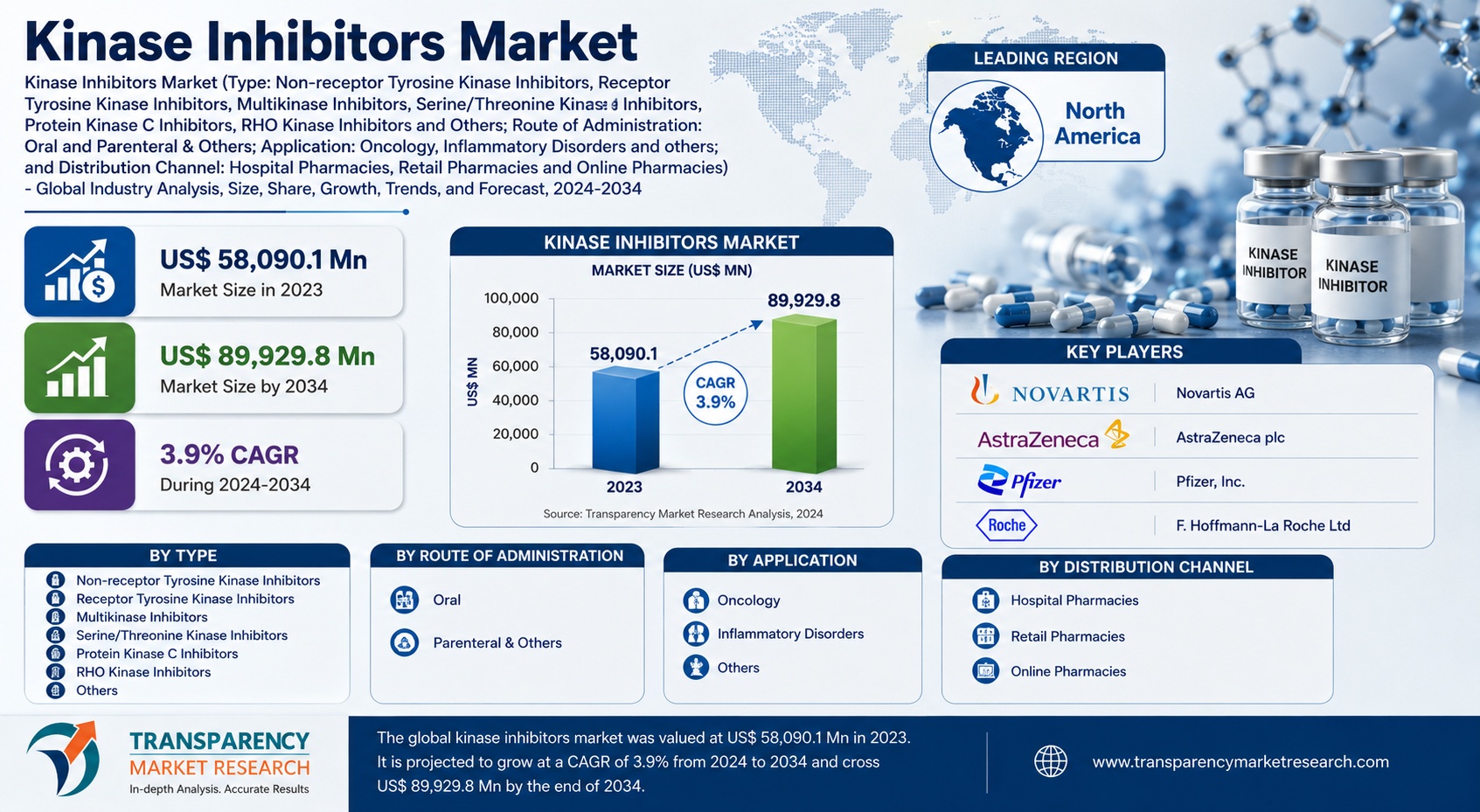
The global kinase inhibitors market is witnessing significant growth as advancements in precision medicine, targeted therapies, and molecular diagnostics continue to reshape the treatment landscape for cancer and chronic diseases. According to recent industry analysis, the global kinase inhibitors market was valued at US$ 58.1 billion in 2023 and is projected to reach US$ 89.9 billion by the end of 2034, expanding at a CAGR of 3.9% during the forecast period from 2024 to 2034.
Kinase inhibitors are specialized therapeutic agents designed to block the activity of protein kinases—enzymes that regulate critical cellular processes such as growth, differentiation, metabolism, and apoptosis. By targeting abnormal kinase signaling pathways associated with disease progression, these drugs have become a cornerstone of modern oncology and several emerging therapeutic applications.
The increasing prevalence of cancer, growing investments in research and development, and rapid technological advancements in targeted drug development are driving the widespread adoption of kinase inhibitors across healthcare systems worldwide.
Download now to explore primary insights from our Report in this sample – https://www.transparencymarketresearch.com/sample/sample.php?flag=S&rep_id=818
Market Overview: The kinase inhibitors market has evolved significantly over the last decade due to breakthroughs in personalized medicine and molecular-targeted therapies. Unlike traditional chemotherapy, which affects both healthy and cancerous cells, kinase inhibitors specifically target disease-causing molecular pathways, resulting in improved treatment outcomes and reduced side effects.
Several kinase inhibitors have demonstrated remarkable success in treating various cancers. Drugs such as imatinib, erlotinib, and other targeted therapies have revolutionized treatment protocols for chronic myeloid leukemia, lung cancer, breast cancer, and other malignancies.
The market is also expanding beyond oncology into autoimmune diseases, inflammatory disorders, and neurological conditions. Increasing regulatory approvals, expanding therapeutic indications, and the emergence of next-generation kinase inhibitors are expected to support long-term market growth.
Key Drivers of Market Growth
Rising Prevalence of Cancer and Chronic Diseases
One of the primary drivers of the kinase inhibitors market is the growing global burden of cancer. Increasing life expectancy, changing lifestyles, environmental factors, and genetic predispositions have contributed to a surge in cancer incidence worldwide.
According to global cancer statistics, millions of new cancer cases are diagnosed annually, creating an urgent demand for more effective and personalized treatment options. Kinase inhibitors have emerged as preferred therapeutic solutions due to their ability to selectively target cancer cells while minimizing damage to healthy tissues.
Beyond cancer, kinase inhibitors are increasingly being studied and utilized for inflammatory disorders, rheumatoid arthritis, and neurodegenerative diseases, further expanding their market potential.
Rapid Technological Advancements in Targeted Therapy
Advancements in molecular biology, genomics, and biomarker research have accelerated the development of highly selective kinase inhibitors. Pharmaceutical companies are investing heavily in next-generation therapies that offer enhanced efficacy, improved safety profiles, and better patient outcomes.
Companion diagnostics and biomarker-based treatment strategies have strengthened the adoption of precision medicine. By identifying specific genetic mutations and molecular abnormalities, healthcare providers can match patients with the most effective kinase inhibitor therapies.
These innovations are helping improve treatment success rates while reducing unnecessary exposure to ineffective therapies.
Increased Investment in Research and Development
Growing investments by pharmaceutical companies, biotechnology firms, and research institutions are fueling innovation in the kinase inhibitors market. Strategic collaborations, licensing agreements, and mergers are accelerating drug discovery programs and expanding clinical pipelines.
The robust pipeline of kinase inhibitors currently under development is expected to create substantial growth opportunities over the coming decade.
Key Players and Industry Leaders
The global kinase inhibitors market is highly competitive, with major pharmaceutical companies focusing on product innovation, clinical research, and strategic partnerships to strengthen their market positions.
Leading companies operating in the market include:
- Boehringer Ingelheim International GmbH
- Novartis AG
- AstraZeneca plc
- Pfizer Inc.
- F. Hoffmann-La Roche Ltd
- Bristol-Myers Squibb Company
- Bayer AG
- Johnson & Johnson
- Merck & Co., Inc.
- Takeda Pharmaceuticals
- Eisai Co., Ltd.
- GSK Plc.
- Eli Lilly
- Alcon
These organizations are actively investing in advanced drug development programs aimed at improving specificity, efficacy, and patient outcomes. Many companies are leveraging biomarker-driven approaches to advance personalized medicine and enhance therapeutic effectiveness.
The competitive landscape is characterized by extensive research collaborations, strategic acquisitions, and global commercialization efforts designed to expand treatment accessibility and address unmet medical needs.
Recent Developments
The kinase inhibitors industry has witnessed several notable developments that highlight the sector’s innovation momentum.
Novartis Launches Scemblix
In July 2024, Novartis launched Scemblix (asciminib), a next-generation kinase inhibitor developed for adults with newly diagnosed Philadelphia chromosome-positive chronic myeloid leukemia (Ph+ CML). Clinical studies demonstrated improved molecular response rates, positioning the therapy as a significant advancement in leukemia treatment.
Zion Pharma and Roche Collaboration
In May 2023, Zion Pharma announced a global collaboration agreement with Roche to develop and commercialize a blood-brain barrier penetrant oral HER2 tyrosine kinase inhibitor. The innovative therapy aims to treat or prevent brain metastases in patients with HER2-positive metastatic breast cancer.
These developments reflect the industry’s commitment to addressing complex medical challenges through innovative targeted therapies.
Key Trends for the Future
Expansion of Precision Medicine
Precision medicine continues to transform healthcare by enabling treatments tailored to individual patient profiles. Kinase inhibitors are expected to play a central role in this transformation due to their targeted mechanism of action and compatibility with biomarker-driven treatment strategies.
Growth of Combination Therapies
Researchers are increasingly exploring combination therapies involving kinase inhibitors and immunotherapies. These approaches seek to overcome treatment resistance and improve long-term patient outcomes.
Combination treatments are anticipated to become a major trend in oncology over the forecast period.
Development of Next-Generation Inhibitors
Next-generation kinase inhibitors with enhanced selectivity, reduced toxicity, and improved resistance management capabilities are entering clinical development and commercialization stages.
These innovations are expected to significantly improve treatment effectiveness while expanding the therapeutic scope of kinase inhibitor applications.
New Opportunities and Challenges
Emerging Opportunities
The increasing application of kinase inhibitors beyond oncology presents substantial growth opportunities.
Potential areas of expansion include:
- Autoimmune diseases
- Inflammatory disorders
- Neurological diseases
- Rare genetic disorders
- Cardiovascular conditions
Emerging economies also represent attractive opportunities due to improving healthcare infrastructure, increasing healthcare spending, and greater access to advanced therapies.
Key Challenges
Despite strong growth prospects, the market faces several challenges.
One major concern is the development of drug resistance. Cancer cells can acquire mutations that reduce the effectiveness of kinase inhibitors over time.
Additionally, high treatment costs may limit patient access in certain regions. Regulatory complexities, lengthy clinical trial timelines, and reimbursement challenges also pose obstacles for market participants.
Addressing these issues will be essential for ensuring sustainable market expansion.
Market Trends & Innovations
Biomarker-Guided Therapies
Biomarker-driven treatment selection is becoming increasingly important in clinical practice. Healthcare providers are using genetic testing and molecular profiling to identify patients most likely to benefit from specific kinase inhibitors.
This trend is improving treatment precision and enhancing patient outcomes.
Artificial Intelligence in Drug Discovery
Artificial intelligence and machine learning technologies are accelerating kinase inhibitor development by identifying promising molecular targets and optimizing drug design processes.
These technologies are helping pharmaceutical companies reduce development timelines and improve research efficiency.
Oral Drug Formulations
The growing preference for oral therapies is driving innovation in kinase inhibitor formulations. Oral medications offer greater convenience, improved patient compliance, and reduced healthcare costs compared to hospital-administered treatments.
This trend is contributing to the dominance of retail pharmacies as a major distribution channel within the market.
Buy this Premium Research Report to gain valuable industry intelligence – https://www.transparencymarketresearch.com/checkout.php?rep_id=818<ype=S
Future Outlook
The future of the kinase inhibitors market appears highly promising as healthcare systems increasingly embrace targeted therapies and precision medicine approaches.
Rising cancer incidence, ongoing technological advancements, and expanding clinical applications will continue to drive demand for kinase inhibitors globally.
North America is expected to maintain its leadership position due to strong research infrastructure, favorable regulatory frameworks, and significant investments in oncology innovation. However, Asia Pacific is anticipated to emerge as a rapidly growing market owing to increasing healthcare expenditure, growing patient populations, and expanding pharmaceutical manufacturing capabilities.
As next-generation inhibitors gain regulatory approvals and new therapeutic applications emerge, the market is expected to experience sustained growth throughout the forecast period.
Market Segmentation
By Type
- Non-receptor Tyrosine Kinase Inhibitors
- Receptor Tyrosine Kinase Inhibitors
- Multikinase Inhibitors
- Serine/Threonine Kinase Inhibitors
- Protein Kinase C Inhibitors
- RHO Kinase Inhibitors
- Others
By Route of Administration
- Oral
- Parenteral & Others
By Application
- Oncology
- Breast Cancer
- Leukemia
- Renal Cancers
- Lung Cancer
- Melanoma
- Colorectal Cancer
- Others
- Inflammatory Disorders
- Others
By Distribution Channel
- Hospital Pharmacies
- Retail Pharmacies
- Online Pharmacies
By Region
- North America
- Europe
- Asia Pacific
- Latin America
- Middle East & Africa
Important FAQs with Answers
How large was the global kinase inhibitors market in 2023?
The global kinase inhibitors market was valued at US$ 58,090.1 million in 2023.
What is the projected market value by 2034?
The market is expected to surpass US$ 89,929.8 million by the end of 2034.
What is the expected CAGR during the forecast period?
The market is projected to grow at a CAGR of 3.9% from 2024 to 2034.
What factors are driving market growth?
Major growth drivers include increasing cancer prevalence, technological advancements in targeted therapies, precision medicine adoption, and rising investments in research and development.
Which segment leads the market by type?
Non-receptor tyrosine kinase inhibitors currently hold the largest market share due to their effectiveness in treating various hematological cancers and other malignancies.
Which region dominates the global market?
North America accounted for the largest market share in 2023 and is expected to remain a leading region throughout the forecast period.
Who are the major players in the kinase inhibitors market?
Key players include Novartis, Pfizer, Roche, AstraZeneca, Bayer, Bristol-Myers Squibb, Merck, Takeda, Eli Lilly, Boehringer Ingelheim, and Johnson & Johnson.
More Related Reports –
Acute Myeloid Leukemia (AML) Therapeutic Market: https://www.transparencymarketresearch.com/acute-myeloid-leukemia-therapeutics-market.html
CAR T-cell Therapy Market: https://www.transparencymarketresearch.com/car-t-cell-therapy-market.html
T-Cell Lymphoma Therapeutics Market: https://www.transparencymarketresearch.com/t-cell-lymphoma-therapeutics-market.html
Anticancer Drugs Market: https://www.transparencymarketresearch.com/anticancer-drugs-market.html
About Us Transparency Market Research
Transparency Market Research, a global market research company registered at Wilmington, Delaware, United States, provides custom research and consulting services. The firm scrutinizes factors shaping the dynamics of demand in various markets. The insights and perspectives on the markets evaluate opportunities in various segments. The opportunities in the segments based on source, application, demographics, sales channel, and end-use are analysed, which will determine growth in the markets over the next decade.
Our exclusive blend of quantitative forecasting and trends analysis provides forward-looking insights for thousands of decision-makers, made possible by experienced teams of Analysts, Researchers, and Consultants. The proprietary data sources and various tools & techniques we use always reflect the latest trends and information. With a broad research and analysis capability, Transparency Market Research employs rigorous primary and secondary research techniques in all of its business reports.
Contact:
Abhishek Budholiya
Transparency Market Research Inc.
State Tower, 90 State Street, Suite 700,
Albany NY – 12207, United States
Tel: +1-518-618-1030
USA – Canada Toll Free: 866-552-3453
Website: https://www.transparencymarketresearch.com
Media Inquiries: media@transparencymarketresearch.com
Sales Inquiries: sales@transparencymarketresearch.com



Leave a Reply